Silky Shark — The Smooth-Skinned Shark of the Open Ocean
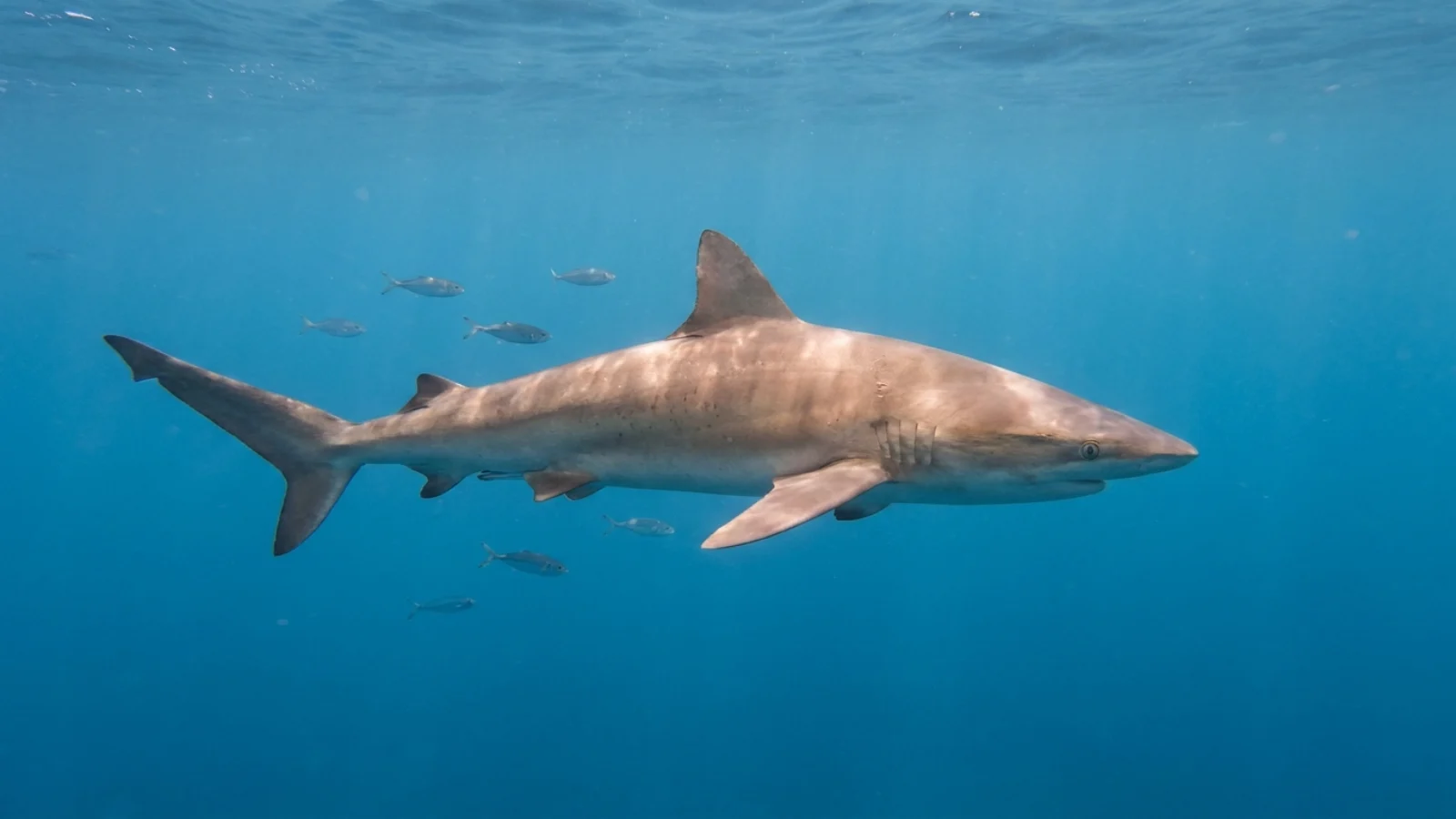
The silky shark (Carcharhinus falciformis) is a slender, bronze-grey requiem shark of the tropical open ocean, named for its smooth, satiny skin. Adults typically measure about 2.5 m, with the largest at 3.5 m and 346 kg. It is one of the most abundant oceanic sharks, often schooling in groups of hundreds around tuna and floating objects, and one of the most heavily fished: it is listed as Vulnerable by the IUCN and on CITES Appendix II.
Silky Shark
Why is it called a silky shark?
Because it feels like silk. The silky shark’s skin is covered with extremely small, tightly packed dermal denticles, the tooth-like scales all sharks have, giving it a smooth, satiny feel and a metallic sheen in the water.
Most sharks feel like sandpaper if stroked from tail to head. The silky’s denticles are so small and dense that the skin feels almost smooth, and in sunlight near the surface its bronze-grey back shines. Other identification marks: a small first dorsal fin with a rounded tip, set behind the pectoral fins; a tiny second dorsal fin with a long free rear tip; very long, narrow, sickle-shaped pectoral fins (falciformis means “sickle-shaped”); a low ridge of skin along the back between the two dorsal fins; and no strong fin markings, though the fin tips can be dusky. Adults typically measure about 2.5 m; the largest documented female was 3.5 m and 346 kg.
Where do silky sharks live?
Silky sharks live in warm tropical and subtropical seas around the world, roughly between 40°N and 40°S. Juveniles stay near continental and island shelves; adults roam the open ocean.
Silky sharks are usually found in the upper 200 m, along the edges of continental and island shelves, around seamounts and deep reefs, and far out at sea. Young sharks stay closer to the coast and move offshore as they grow. They are strongly attracted to anything floating, including logs, debris, buoys and fish aggregating devices (FADs) deployed by tuna fleets, and they gather around tuna schools. For divers, silky sharks are the signature shark of Jardines de la Reina in Cuba, Socorro in Mexico, Rangiroa in French Polynesia and the Red Sea, where groups patrol just below the boat.
What do silky sharks eat?
Silky sharks eat mostly bony fish, especially tuna, mackerel and other schooling fish, plus squid, octopus and pelagic crabs. In the eastern Pacific fishermen call them “net-eaters” because they tear into tuna purse-seine nets.
Stomach contents include yellowfin tuna, albacore, little tunny, mackerel, mullet, porcupinefish, squid and paper nautiluses. Groups of silky sharks follow tuna schools and herd baitfish, sometimes working with other predators, and they quickly investigate any commotion at the surface. This attraction to tuna and to floating objects is exactly what puts them in harm’s way.
Why are silky sharks caught so often?
Silky sharks are one of the most common sharks caught as bycatch in tropical tuna fisheries, especially around drifting fish aggregating devices (FADs). They are also one of the most frequent species in the international shark-fin trade.
Because silky sharks gather under floating objects with tuna, they are scooped up in purse seines set on FADs and hooked on longlines. A 2013 study by John Filmalter and colleagues found another hidden cost: silky sharks become entangled in the netting that hangs beneath many FADs, and the authors estimated that hundreds of thousands die this way each year in the Indian Ocean alone. Changing FAD designs to non-entangling materials has since become a goal of several tuna fishery commissions. In the Maldives and Sri Lanka, silky sharks have made up 70–80% of the pelagic longline shark catch, and fin-trade studies have consistently ranked silky fins among the most traded.
The IUCN listed the silky shark as Vulnerable globally in 2017, and it was added to CITES Appendix II the same year, requiring international trade to be legal and sustainable. The Western and Central Pacific Fisheries Commission prohibits retaining, transshipping, storing or landing silky sharks in its convention area.
How do silky sharks reproduce?
Silky sharks are placental viviparous. After a 9–12 month pregnancy, females give birth to litters of 2 to 18 pups, usually every two years.
Pups are born at about 73–87 cm, often in late spring, in nursery areas along the outer edge of continental and island shelves. Age at maturity varies widely by region, from about 5 to 15 years, and the maximum lifespan is about 22–23 years. Slow growth, late maturity and a two-year breeding cycle mean silky shark populations recover slowly from heavy fishing.
Are silky sharks dangerous?
Silky sharks are bold and curious, and large individuals should be treated with respect, but bites on people are rare. The ISAF lists 3 unprovoked bites and no deaths.
Because they live offshore, silky sharks rarely meet swimmers, but they can be persistent around divers and boats, especially when there is food in the water. Like the grey reef shark, a silky shark that feels threatened may perform a threat display: it raises its head, arches its back and lowers its tail and pectoral fins. If you see that posture, back away calmly and give the shark space. The oceanic whitetip is the more dangerous offshore shark.
How does the silky shark compare with other open-ocean sharks?
The silky shark is one of three abundant open-ocean sharks of the tropics, along with the oceanic whitetip and the blue shark.
It is closely related to the coastal spinner and blacktip sharks but lives far from shore. Compared with the blue shark, it prefers warmer water; compared with the oceanic whitetip, it is slimmer, more social and more numerous.
| Species | Max length | Max weight | Unprov. bites (ISAF) | Lifespan | IUCN |
|---|---|---|---|---|---|
| Silky shark | 3.5 m | 346 kg | 3 | 22–23 yrs | VU |
| Oceanic whitetip | 4.0 m | 170 kg | 15 | 22 yrs | CR |
| Blue shark | 3.8 m | 206 kg | 13 | 20 yrs | NT |
| Spinner shark | 3.0 m | 90 kg | 16 | 15–20+ yrs | VU |
| Blacktip shark | 2.8 m | 123 kg | 35 | 12–15 yrs | VU |
| Shortfin mako | 4.0 m | 570 kg | 10 | 30 yrs | EN |
Bite counts: Florida Museum International Shark Attack File, species-implicated table (1580–2022). * Genus-level total. IUCN: LC Least Concern, NT Near Threatened, VU Vulnerable, EN Endangered, CR Critically Endangered, DD Data Deficient.
Why is it called a silky shark?
Its skin is covered in tiny, densely packed dermal denticles, so it feels smooth and silky compared with most sharks.
Are silky sharks dangerous?
They are curious and can be bold around boats and divers, but the ISAF records only 3 unprovoked bites and no deaths.
How big do silky sharks get?
Adults typically measure about 2.5 m, with a maximum of 3.5 m (11.5 ft) and 346 kg (763 lb).
Where can you dive with silky sharks?
Jardines de la Reina (Cuba), Socorro (Mexico), Rangiroa (French Polynesia), the Red Sea, Andros (Bahamas) and Protea Banks (South Africa) are well-known sites.
Are silky sharks endangered?
They are listed as Vulnerable by the IUCN (2017) and are on CITES Appendix II, mainly because of bycatch in tuna fisheries and the fin trade.
What do silky sharks eat?
Mostly bony fish, especially tuna and mackerel, plus squid, octopus and pelagic crabs.
How long do silky sharks live?
About 22–23 years at most. They mature at roughly 5–15 years depending on the region.
Why do silky sharks gather under boats and debris?
Floating objects attract baitfish and tuna, and silky sharks follow them. That habit is why so many are caught around fish aggregating devices.
Blane Perun has been exploring Earth’s oceans and marine life for over 25 years. Founder of TheSea.Org in 1999, underwater photographer, coral aquaculture pioneer, and explorer of 80+ countries.
About Blane Perun → All Shark Species A–Z →