Epaulette Shark — The Shark That Walks on Land
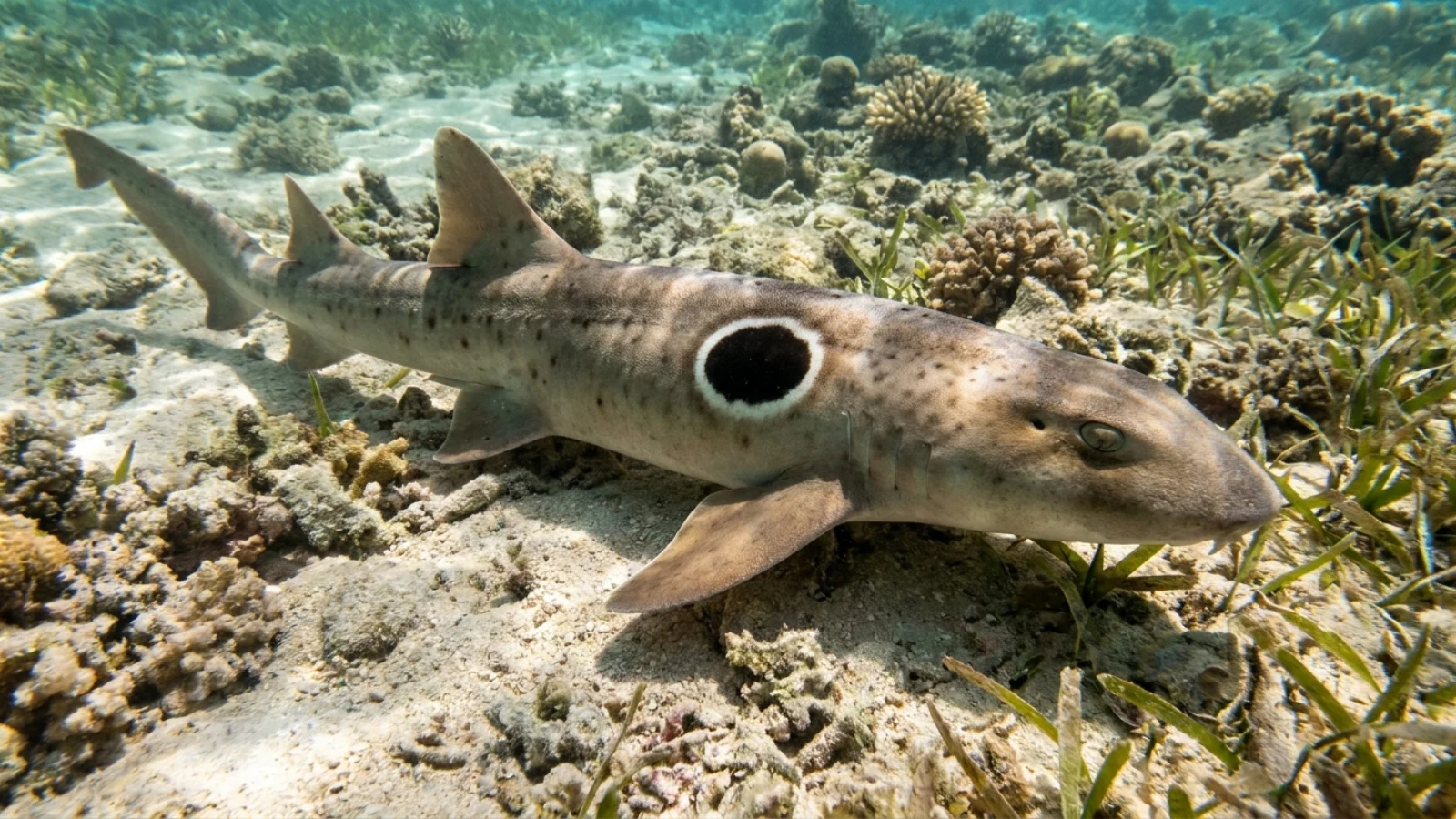
The epaulette shark (Hemiscyllium ocellatum) is a small, slender carpet shark of the reef flats of northern Australia and southern New Guinea, usually 70–90 cm long, named for the large black, white-ringed spot above each pectoral fin. It “walks” on its paired fins across reef flats and even out of water between tide pools, and it can survive hours of near-zero oxygen by shutting down parts of its brain. It is harmless and listed as Least Concern.
Epaulette Shark
How does an epaulette shark walk?
An epaulette shark walks by bending its body from side to side and pushing off with its paddle-like pectoral and pelvic fins, moving them in a pattern similar to a salamander. It can walk across reef flats, through narrow gaps in coral, and across exposed reef between tide pools.
On the reef flats of the southern Great Barrier Reef, especially around Heron Island, falling tides leave a maze of isolated pools. Epaulette sharks exploit them. Rather than swimming away as the water drains, they stay behind and hunt worms and crabs among the coral rubble, and when a pool becomes too warm or too small they clamber across the exposed reef to the next one. The fins are thickened and muscular, and the walking gait uses the same alternating fin pattern seen in early four-legged animals, which is why epaulette sharks are often discussed in studies of how vertebrates first moved onto land. Even newly hatched pups walk.
Epaulette sharks belong to a genus of nine “walking sharks” (Hemiscyllium) found in northern Australia, New Guinea and eastern Indonesia, several of them described only in the last two decades. Genetic research has shown this is the youngest shark genus known, with species splitting off as recently as a few million years ago as reefs and islands shifted.
How can an epaulette shark survive without oxygen?
On a hot, still night, the oxygen in a reef-flat pool can drop by 80% or more. Epaulette sharks cope by lowering their metabolism and switching off non-essential brain activity, surviving hours that would kill most fish.
In laboratory tests, epaulette sharks have survived two hours of complete anoxia (no oxygen at all) without ill effects, and more than three hours at 5% of normal oxygen while staying responsive. They survived an hour with no oxygen even at 30°C. During these episodes their blood pressure falls by half, and the brain selectively shuts down motor centres while keeping sensory areas working, so the shark stays alert but uses as little energy as possible. Its brain needs only about a third as much ATP as the brains of typical bony fishes. Researchers studying stroke and brain injury in humans have taken an interest in how the epaulette shark protects its brain.
How do you identify an epaulette shark?
Look for a slim, long-tailed little shark with a pale brown body covered in dark spots and a large black spot ringed in white above each pectoral fin, like a military epaulette.
The body is slender and the tail very long, making up more than half of the total length. The head is short and rounded, with small barbels near the nostrils and spiracles behind the eyes. The “epaulette” spot is an eyespot that may confuse predators about which end is the head. Juveniles have bolder banding that fades into spots. Typical adults measure 70–90 cm, with a maximum reported length of about 1.07 m.
Where do epaulette sharks live?
Epaulette sharks live on shallow coral reef flats, in tide pools and in seagrass from southern New Guinea along northern Australia, and as far south as Sydney.
Around Heron Island they are common, with densities of roughly 0.3–1.2 sharks per 100 m² of reef flat. Most hunting is done at dusk and night, and on low tides in daylight. Snorkellers and reef walkers on the Great Barrier Reef regularly see them tucked under coral heads or moving through very shallow water. For more about where they live, see our guide to the Australian coral reef ecosystem.
What do epaulette sharks eat?
More than 90% of the diet off Heron Island is polychaete worms and crabs. Juveniles eat mostly worms and adults mostly crabs, with shrimp and small fish as extras.
Epaulette sharks hunt by smell and electroreception, nosing through sand and rubble and sucking prey out of crevices. Unusually for a shark, they chew: an epaulette may spend 5–10 minutes processing a meal, crunching shells before swallowing. Their small, flattened teeth are designed for crushing, not cutting.
How do epaulette sharks reproduce?
Epaulette sharks lay eggs. Between August and December a female lays two egg capsules about every 14 days, producing 20 to 50 eggs a year.
Each capsule is about 10 × 4 cm. The embryos develop for 120–130 days and hatch at 14–16 cm, already able to walk and feed. Growth is about 5 cm a year, and sexual maturity comes at 54–64 cm and at least seven years old. Climate research is watching this stage closely: a 2021 study found that embryos raised at 31°C hatched after about 100 days instead of 125, smaller and weaker, with fitness falling sharply above 29°C, suggesting that even this tough species may struggle on a warming Great Barrier Reef.
Are epaulette sharks dangerous?
No. Epaulette sharks are small, timid and have crushing teeth. They may nip if picked up, but pose no danger to swimmers or reef walkers.
Their main interaction with people is through aquariums. Epaulette sharks are hardy, small and breed in captivity, which makes them one of the few sharks kept by advanced home aquarists. Adults need large tanks, about 680 L (180 gallons) or more, with plenty of floor space.
Are epaulette sharks endangered?
No. The IUCN lists the epaulette shark as Least Concern. It is not targeted by Australian fisheries, though it is Near Threatened off New Guinea.
Most of its Australian range lies inside the Great Barrier Reef Marine Park, and the species is not caught by commercial or recreational fisheries there. The longer-term concern is warming: reef flats are among the hottest marine habitats, and the epaulette shark’s eggs and young may be sensitive to temperatures expected later this century. See Great Barrier Reef coral bleaching for more on reef warming.
How does the epaulette shark compare with other carpet sharks?
The epaulette is one of the smallest carpet sharks, related to the bamboo sharks, the zebra shark and, distantly, the whale shark.
Its closest relatives are the bamboo sharks, which share its slender body, long tail and egg-laying habit. The zebra shark and nurse shark are larger carpet sharks with similar suction feeding.
| Species | Max length | Max weight | Unprov. bites (ISAF) | Lifespan | IUCN |
|---|---|---|---|---|---|
| Epaulette shark | 1.07 m | n/a (small) | 0 | n/a | LC |
| Brownbanded bamboo shark | 1.04 m | n/a (small) | 0 | 25 yrs (aquaria) | NT |
| Zebra shark | 2.5 m | n/a | 1 (2008) | 25–30 yrs | EN |
| Nurse shark | 3.08 m | ~110 kg+ | 9 | 24–40+ yrs | VU |
| Tasselled wobbegong | 1.8 m | n/a | 31* | n/a | LC |
| Whale shark | 18.8 m | 19,000 kg | 0 | 80–130 yrs | EN |
Bite counts: Florida Museum International Shark Attack File, species-implicated table (1580–2022). * Genus-level total. IUCN: LC Least Concern, NT Near Threatened, VU Vulnerable, EN Endangered, CR Critically Endangered, DD Data Deficient.
Can epaulette sharks really walk on land?
Yes, for short distances. They use their paired fins to walk across exposed reef between tide pools and can survive out of water for short periods.
How long can an epaulette shark survive without oxygen?
In laboratory tests, epaulette sharks survived two hours of complete anoxia without harm, and more than three hours at 5% of normal oxygen levels.
Are epaulette sharks dangerous?
No. They are small and timid with crushing teeth. They may nip if handled but pose no threat to people.
How big do epaulette sharks get?
Usually 70–90 cm, with a maximum of about 1.07 m (42 in).
Where do epaulette sharks live?
On shallow reef flats and in tide pools of northern Australia, including the Great Barrier Reef, and southern New Guinea.
Can you keep an epaulette shark as a pet?
Experienced aquarists do keep them. Adults need tanks of about 680 L (180 gal) or larger, with sand and caves. They breed readily in captivity.
What do epaulette sharks eat?
Mostly worms and crabs, plus shrimp and small fish. They chew their food for several minutes before swallowing.
Why is it called an epaulette shark?
For the large black, white-ringed spot above each pectoral fin, which resembles the shoulder decoration on a military uniform.
Blane Perun has been exploring Earth’s oceans and marine life for over 25 years. Founder of TheSea.Org in 1999, underwater photographer, coral aquaculture pioneer, and explorer of 80+ countries.
About Blane Perun → All Shark Species A–Z →