Blacktip Shark — Carcharhinus limbatus, the Spinning, Black-Tipped Coastal Predator
The blacktip shark (Carcharhinus limbatus) is one of the most common sharks in warm coastal waters worldwide. Medium-sized at 1.5–2 m typical adult length, the species is named for the conspicuous black tips on its fins (visible on first dorsal, pectorals, pelvics, and lower caudal lobe). Blacktips are best known for the spinning leaps they perform when feeding on schooling fish at the surface — spectacular acrobatic behaviour rare among sharks. They are responsible for many minor unprovoked bites in Florida and elsewhere, but rarely cause serious injury.
Blacktip Shark
Identification — the spinning, black-tipped coastal shark
Blacktip sharks have a streamlined torpedo body, a long pointed snout, and the conspicuous black fin-tip markings that give them their name. The species is often confused with the spinner shark, which performs the same spinning attack and looks superficially similar.
A typical adult blacktip is 1.5–2 m long with a maximum recorded length of about 2.8 m. The body is grey to brown above and white below, with a distinctive white band along the flank and the black tips on first dorsal, pectorals, pelvics, and lower caudal lobe. (The anal fin lacks the black tip in blacktips, distinguishing them from the closely-related spinner shark, Carcharhinus brevipinna.) The teeth are narrow, slightly recurved, and finely serrated, suited to gripping the slippery schooling fish that make up most of the diet.
Florida's annual blacktip migration is the largest documented shark aggregation in U.S. waters: aerial surveys by Stephen Kajiura and colleagues at Florida Atlantic University documented over 12,000 individuals in a single census off Palm Beach in February 2014. The migration follows the Gulf Stream's edge between summer waters off the Carolinas and winter waters off South Florida.
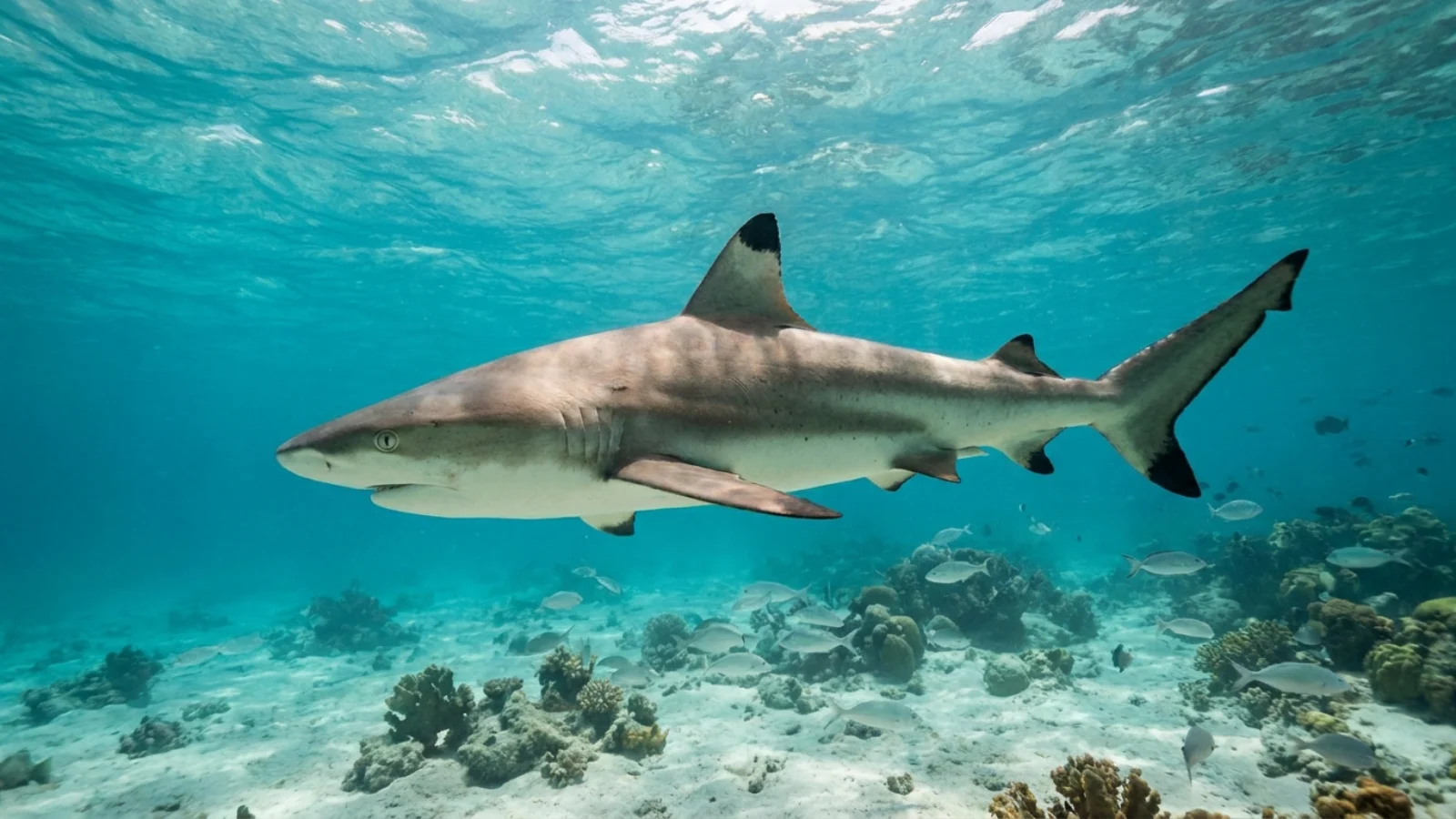
Range — circumglobal in warm coastal water
Blacktips occur in every tropical and warm-temperate coastal sea, with strong site fidelity to specific reefs, estuaries, and sandbanks.
The species is one of the most numerous sharks of warm coastal waters worldwide, with major populations off the southeastern United States, Gulf of Mexico, Caribbean, Brazil, west and east African coasts, the Red Sea, the Maldives, eastern Australia, and Indonesia. Blacktips are highly migratory: the Florida population's seasonal movement is the most dramatic, but tagging data shows similar annual cycles in South Africa, Australia, and the Mediterranean. The species rarely descends below 30 m and is functionally a surface and inshore animal.
Diet — schooling fish and the spinning attack
Blacktip sharks are pelagic ambush predators that target dense schools of small fish. The famous spinning leap is a feeding tactic, not a display: the shark accelerates vertically through a fish school with mouth open, rotating axially, and breaks the surface having taken multiple fish in a single pass.
The spinning attack works because schooling baitfish (sardines, herring, mullet) packed densely near the surface present a wall of food the shark cannot easily target individually. By accelerating from below at high speed and rotating, the shark passes through the school taking multiple bites before momentum carries it clear of the water. Footage from the southeastern US sardine run and from South Africa's annual sardine run shows the same behaviour. Stomach contents are dominated by sardines, mullet, mackerel, anchovies, and small jacks, with smaller numbers of squid, smaller sharks, and crustaceans.
Reproduction — viviparous with strong nursery-area fidelity
Blacktips give live birth to small litters in shallow coastal nurseries that the species uses for years at a time. Females typically reproduce every other year.
Females reach maturity at ~7 years, males at 5. Gestation is 10–12 months, producing litters of 1–10 pups, each 55–72 cm long. Major Atlantic nursery grounds include Bull Bay (South Carolina), Pine Island Sound (Florida), and the Indian River Lagoon (Florida). Pups remain in shallow estuarine waters for 2–3 years before joining the migrating offshore population.
Attack record — many bites, few serious injuries
Blacktips are responsible for a large share of unprovoked shark bites in Florida and other warm coastal regions, but most are minor exploratory bites that do not progress to predation.
Blacktips are not large enough to pose the consistent threat of a great white or tiger, but their abundance in surf zones and at popular beaches puts them in frequent contact with humans. ISAF attributes ~28 unprovoked attacks specifically to Carcharhinus limbatus, with zero documented fatalities. The species is widely considered responsible for many of the unprovoked bites attributed to "unidentified species" in the Florida statistics — particularly during the annual migration along Palm Beach and Volusia County beaches.
Where the blacktip sits among the major shark species
Comparing blacktips against the major species at a glance.
The blacktip is far smaller than the apex predators in the comparison and bites less hard, but its abundance and concentration in surf zones make it numerically the most-encountered shark for swimmers in the southeastern United States.
| Species | Max length | Max weight | Bite force | Attacks (unprov.) | Lifespan |
|---|---|---|---|---|---|
| Great white shark | 6.0 m | 2,300 kg | ~4,000 PSI | 354 | 70 yrs |
| Tiger shark | 5.5 m | 900 kg | ~6,000 PSI | 142 | 27–50 yrs |
| Bull shark | 3.5 m | 320 kg | 1,250 PSI | 121 | 16 yrs |
| Oceanic whitetip | 4.0 m | 170 kg | n/a | 15 | 22 yrs |
| Shortfin mako | 4.0 m | 570 kg | n/a | 10 | 30 yrs |
| Great hammerhead | 6.1 m | 580 kg | n/a | 17 | 44 yrs |
| Whale shark | 12.0 m | 19,000 kg | n/a (filter) | 0 | 80–130 yrs |
Related on TheSea
How big does a blacktip shark get?
Adult blacktips typically reach 1.5–2 m (5–7 ft), with the largest recorded individuals at 2.8 m. They are mid-sized as carcharhinid sharks go — smaller than tiger and bull sharks, larger than reef sharks.
Why do blacktip sharks spin?
The spinning leap is a feeding tactic. The shark accelerates vertically through a dense school of baitfish with its mouth open, rotating axially as it goes. The rotation lets it take multiple fish in a single pass that wouldn't be possible with a straight horizontal attack.
Are blacktips dangerous to humans?
They're responsible for a high number of minor bites, particularly during Florida's February–March annual migration, but only one fatality is on record. Most bites are quick exploratory contacts in turbid surf, not committed predation.
What's the difference between a blacktip and a spinner shark?
Both species perform the same spinning leap and look very similar. The simplest field distinction is the anal fin: spinner sharks (Carcharhinus brevipinna) have a black-tipped anal fin, while blacktips do not. Spinners are also slightly slimmer with a longer snout.
Where can I see the blacktip migration?
The Florida blacktip migration peaks off Palm Beach in February and March on the northbound leg, and again in October and November on the southbound. Aerial surveys regularly document thousands of animals at a time. Surf-zone density is high enough that the migration produces visible "shark slicks" of darker water near the beach.
Blane Perun has been exploring Earth’s oceans and marine life for over 25 years. Founder of TheSea.Org in 1999, underwater photographer, coral aquaculture pioneer, and explorer of 80+ countries.
About Blane Perun → More on Sharks →