Spinner Shark — The Leaping, Spinning Coastal Shark
The spinner shark (Carcharhinus brevipinna) is a slim, long-snouted requiem shark of warm coastal seas, famous for charging vertically through schools of small fish while spinning on its axis and often launching clear of the water. Adults average about 2 m and 56 kg, reaching about 3 m and 90 kg. It looks very like the blacktip shark; the surest difference is the black-tipped anal fin of adult spinners. It is listed as Vulnerable by the IUCN.
Spinner Shark
Why does the spinner shark spin?
To eat. A spinner shark charges up through a school of baitfish from below with its mouth open, rotating on its long axis as it snaps, and its momentum often carries it out of the water, where it may spin several times before crashing back.
The spinning attack is a way of hunting dense, fast schools of small fish such as sardines, menhaden, mullet and anchovies. Approaching from below hides the shark against the dark water, and the rotation lets it snap at fish all around as it passes through the ball. The shark’s teeth are narrow and smooth-edged, built for grabbing and swallowing small fish whole rather than cutting. The aerial spin is a side effect of the speed, not a display. The blacktip shark does the same thing, but the spinner is the species most associated with it, and it is the one that gave the behaviour its name.
For anyone fishing or paddling off Florida, the Carolinas or the Gulf coast in spring and summer, a spinner shark leaping out of a bait school is a common sight. Spinners and blacktips move along the US Atlantic coast together in seasonal migrations, heading north in spring and south to deeper, warmer water in winter.
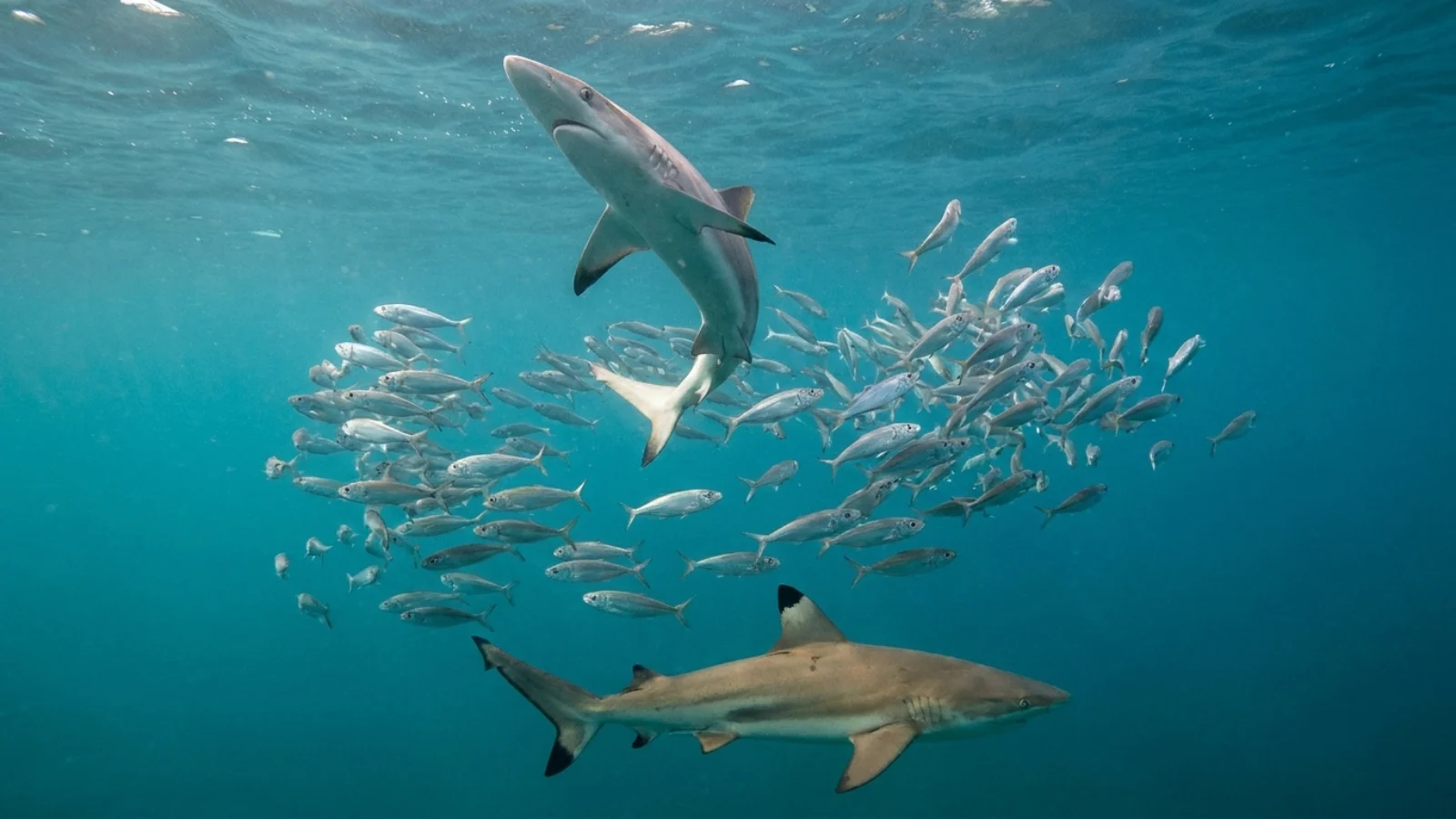
What is the difference between a spinner shark and a blacktip?
Check the anal fin, the small fin on the underside just in front of the tail. In adult spinner sharks it has a black tip; in blacktips it does not.
| Feature | Spinner shark | Blacktip shark |
|---|---|---|
| Anal fin | Black tip in adults | No black tip (pale) |
| Snout | Long, pointed | Shorter, more rounded |
| First dorsal fin | Slightly more triangular, set farther back | Taller, set farther forward |
| Body | Slimmer | Stockier |
| Teeth | Narrow, smooth or nearly smooth edges | Narrow, finely serrated |
| Max size | ~3 m, 90 kg | ~2.8 m, 123 kg |
| IUCN status | Vulnerable | Vulnerable |
Juvenile spinners lack the black fin tips altogether, which makes young sharks harder still. In the US, spinner shark meat is commonly sold as “blacktip shark,” and the two species are often mixed up in catch records and in bite reports. The Florida Museum’s International Shark Attack File notes that requiem sharks of the genus Carcharhinus are difficult to identify, so some bites attributed to one may involve the other.
Where do spinner sharks live?
Spinner sharks live in tropical and warm-temperate coastal waters around the world, except the eastern Pacific, mostly in water less than 30 m deep.
In the western Atlantic they range from North Carolina to Brazil, including the Gulf of Mexico and Caribbean, and in the eastern Atlantic from the Mediterranean to South Africa. In the Indo-Pacific they occur from the Red Sea and South Africa to Japan and Australia. Spinners are found from the surf zone out to about 100 m, and juveniles use shallow bays as nurseries, though they avoid low-salinity water. Indo-Pacific spinners tend to grow larger than those in the northwest Atlantic.
How do spinner sharks reproduce?
Spinner sharks are placental viviparous: embryos are nourished through a placenta and born live after 11–15 months. Females breed every other year and have litters of 3 to 20 pups, usually 7 to 11.
In the northwest Atlantic, pups are born in March and April in shallow coastal nurseries, at 66–77 cm. They grow quickly at first, about 30 cm in the first year, then slow to about 5 cm a year as adults. Northwest Atlantic males mature at about 1.3 m and 4–5 years, and females at 1.5–1.6 m and 7–8 years; in South Africa spinners mature at larger sizes. Maximum lifespan is estimated at 15–20 years or more.
Are spinner sharks dangerous?
Spinner sharks are occasionally involved in minor bites on surfers and swimmers, usually in murky surf where bait fish are present. The ISAF lists 16 unprovoked bites and no deaths.
Most spinner shark bites happen in the surf zone of Florida and the Carolinas, where the sharks are chasing bait in cloudy water and mistake a hand or foot for a fish. These bites are typically single, quick and non-fatal. Spinner sharks are not interested in people as prey, and divers rarely see them underwater because they are wary. For Florida’s bite statistics in context, see our guide to shark attacks in Florida.
Are spinner sharks endangered?
The IUCN lists the spinner shark as Vulnerable globally (2020). It is fished heavily for meat, fins, liver oil and skin throughout its coastal range.
Because it lives in shallow coastal waters, the spinner is exposed to almost every kind of fishing gear, from gillnets and longlines to recreational rods. In the US it is managed as a large coastal shark under federal fishery management plans and is popular with anglers as a hard-fighting fish. Outside well-managed waters, declines have been significant, and coastal nursery habitat is under pressure from development.
How does the spinner compare with other requiem sharks?
The spinner shark is a mid-sized requiem shark, close in size to the blacktip and smaller than the bull, tiger and lemon sharks.
It shares Florida’s surf with the blacktip, bull and lemon sharks, and offshore it gives way to the silky shark, another slim, smooth-skinned requiem shark of open water.
| Species | Max length | Max weight | Unprov. bites (ISAF) | Lifespan | IUCN |
|---|---|---|---|---|---|
| Spinner shark | 3.0 m | 90 kg | 16 | 15–20+ yrs | VU |
| Blacktip shark | 2.8 m | 123 kg | 35 | 12–15 yrs | VU |
| Bull shark | 3.5 m | 320 kg | 119 | 16+ yrs | VU |
| Lemon shark | 3.4 m | 184 kg | 10 | 25–30 yrs | VU |
| Tiger shark | 5.5 m | 900 kg | 142 | 27–50 yrs | NT |
| Silky shark | 3.5 m | 346 kg | 3 | 22–23 yrs | VU |
Bite counts: Florida Museum International Shark Attack File, species-implicated table (1580–2022). * Genus-level total. IUCN: LC Least Concern, NT Near Threatened, VU Vulnerable, EN Endangered, CR Critically Endangered, DD Data Deficient.
Why do spinner sharks spin?
They spin while charging up through schools of small fish from below, snapping in all directions. The speed often carries them out of the water, where they keep spinning.
How can you tell a spinner shark from a blacktip?
Adult spinner sharks have a black tip on the anal fin; blacktips do not. Spinners also have a longer, more pointed snout and a slimmer body.
Are spinner sharks dangerous?
They are responsible for some minor bites in murky surf, usually when chasing bait. The ISAF lists 16 unprovoked bites and no deaths.
How big do spinner sharks get?
Adults average about 2 m and 56 kg, with a maximum of about 3 m (9.8 ft) and 90 kg (200 lb).
Where do spinner sharks live?
In warm coastal waters of the Atlantic, Indian and western Pacific oceans, including Florida, the Gulf of Mexico, the Mediterranean, South Africa and Australia. They are absent from the eastern Pacific.
Are spinner sharks endangered?
They are listed as Vulnerable by the IUCN (2020) because of heavy coastal fishing.
Can you eat spinner shark?
Yes; in the US its meat is often sold as “blacktip shark.” It is a managed species with federal and state rules on size and bag limits.
How many pups do spinner sharks have?
Litters of 3 to 20, usually 7 to 11, born every other year after an 11–15 month pregnancy.
Blane Perun has been exploring Earth’s oceans and marine life for over 25 years. Founder of TheSea.Org in 1999, underwater photographer, coral aquaculture pioneer, and explorer of 80+ countries.
About Blane Perun → All Shark Species A–Z →