Zebra Shark — Spots, Stripes and Virgin Births
The zebra shark (Stegostoma tigrinum) is a docile Indo-Pacific carpet shark that grows to about 2.5 m (8 ft), with a tail nearly as long as its body, five ridges along its back and a pale coat of dark spots. It is called “zebra” because the young are striped, and divers in Australia and Southeast Asia often call adults “leopard sharks.” Females can reproduce without a male, and the species is listed as Endangered by the IUCN.
Zebra Shark
Why is a spotted shark called a zebra shark?
Because it starts life striped. Juvenile zebra sharks are dark brown with pale vertical bands; as they grow past about 50–90 cm the stripes break up and the pattern reverses into dark spots on a pale tan body.
That change confuses almost everyone. The striped juvenile gave the species its English name, but almost every zebra shark a diver meets is a spotted adult, so in Australia, Thailand and much of Southeast Asia dive operators call it the “leopard shark.” That is a different animal from the Californian leopard shark (Triakis semifasciata), a houndshark of the eastern Pacific. One theory for the juvenile stripes is that they help small sharks in a group blend together, making it harder for a predator to target one; another is that they mimic venomous banded sea snakes.
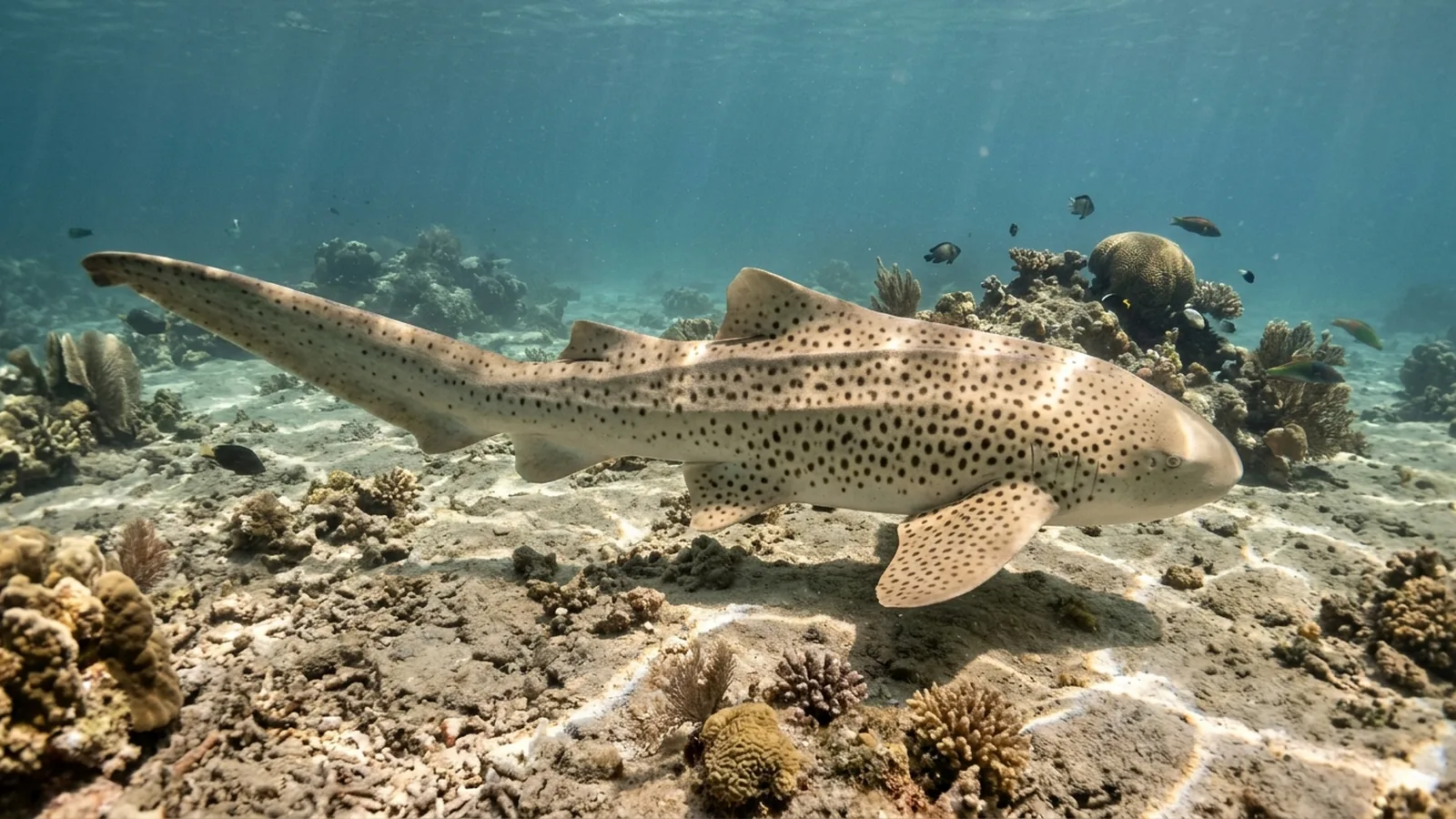
Adults are easy to recognise. The body is long and cylindrical with five prominent ridges running along the back and sides (juveniles lack them), a short, blunt head with small barbels, small eyes and spiracles behind them, and a broad, flat tail that makes up nearly half the total length. Maximum length is about 2.5 m; a 3.5 m record is unverified.
Where do zebra sharks live?
Zebra sharks live on tropical reefs and sand flats across the Indo-West Pacific, from South Africa and the Red Sea to New Caledonia and Tonga, and from northern Australia north to Japan and Taiwan.
They are found from the intertidal zone down to about 62 m, most often on sand or rubble patches beside coral reefs. By day a zebra shark usually lies motionless on the sand, propped on its pectoral fins and facing into the current so water flows over its gills. Divers in Thailand’s Andaman Sea, the Maldives, Mozambique and Australia’s Great Barrier Reef see them this way, and they often let divers approach closely. At night they become active, sliding into holes and crevices in the reef to hunt. Off southeast Queensland, Australia, zebra sharks form large seasonal aggregations in summer that appear to be linked to mating.
What do zebra sharks eat?
Zebra sharks eat mostly shelled molluscs, especially snails and clams, plus crabs, shrimp and small bony fish, which they extract from crevices by suction.
The mouth is small and set well forward, with many rows of small, three-cusped teeth. Like the nurse shark, a zebra shark can create strong suction by expanding its throat, drawing prey out of holes it cannot fit into. Its slender, flexible body lets it wriggle deep into reef cracks after prey. Sea snakes have been reported in stomach contents, though this is uncommon.
How do zebra sharks reproduce?
Zebra sharks lay eggs. A female can produce up to 46 large, dark egg cases in a season, laid in batches of about four and anchored to the reef by fibrous tendrils.
The egg cases are tough, dark brown to purple, about 17 × 8 × 5 cm, with hair-like fibres that tangle around coral and rock. In aquariums, a female laid up to 46 eggs over a 112-day period. Embryos develop for four to six months depending on temperature, and hatchlings are 20–36 cm long, already striped. Males mature at 1.5–1.8 m and females at about 1.7 m, and wild zebra sharks are estimated to live 25–30 years.
Can zebra sharks have babies without a male?
Yes. Zebra sharks are one of the best-documented cases of parthenogenesis, or “virgin birth,” in any vertebrate. Females isolated from males have laid eggs that hatched into healthy pups.
The most famous case is Leonie, a female at Reef HQ Aquarium in Townsville, Australia. She had produced pups with a male for years, but after being separated from him she went on to lay eggs that hatched in 2016, and genetic tests showed the pups carried only her DNA. It was the first recorded case of a shark switching from sexual to asexual reproduction. Since then, studies of captive zebra sharks have found parthenogenesis in females regardless of whether they had ever mated. Parthenogenetic offspring are not clones; they carry a reshuffled half of the mother’s genes, which reduces genetic diversity. Scientists think it may be a fallback strategy for when males are scarce, which could matter in depleted wild populations.
Are zebra sharks dangerous?
No. Zebra sharks are among the most docile sharks a diver can meet. The ISAF listed one unprovoked incident as of 2008, with no injury.
The handful of bites on record were provoked by divers who grabbed a zebra shark’s tail or tried to ride it. Left alone, a resting zebra shark will usually let you hover beside it, and some individuals at popular sites are habituated to divers.
Why are zebra sharks endangered, and can they be rewilded?
The IUCN lists the zebra shark as Endangered worldwide. Heavy fishing in Southeast Asia and South Asia has wiped out or nearly wiped out populations in many areas, though Australian populations are considered stable.
Zebra sharks are caught in trawls, gillnets and on longlines for meat, fins and liver oil, and their habit of resting in shallow, predictable places makes them vulnerable. Market surveys suggest they are much rarer than they once were. In parts of Indonesia the species is considered functionally extinct. Off Australia it is assessed as Least Concern, with only minor bycatch in prawn trawls.
The species is now the subject of one of the most ambitious shark rewilding projects anywhere. The StAR project (Stegostoma tigrinum Augmentation and Recovery), led by partners including Georgia Aquarium, Conservation International and Raja Ampat’s marine protected area authority, ships fertilised eggs from aquariums to Raja Ampat in Indonesia, raises the pups in sea pens and releases them into protected reefs. The IUCN reports 22 zebra sharks reared, tagged and released so far. Because zebra sharks breed readily in aquariums, they are an ideal test case for restoring a lost shark population.
How does the zebra shark compare with other carpet sharks?
The zebra shark is the only member of its family, but it belongs to the carpet shark order with the whale shark, nurse sharks, wobbegongs, epaulette and bamboo sharks.
Its closest relatives in lifestyle are the nurse shark, another suction-feeding reef shark, and the smaller bamboo and epaulette sharks, which also lay eggs. Genetically it is close to the whale shark, which shares its ridged back and spotted pattern.
| Species | Max length | Max weight | Unprov. bites (ISAF) | Lifespan | IUCN |
|---|---|---|---|---|---|
| Zebra shark | 2.5 m | n/a | 1 (2008) | 25–30 yrs | EN |
| Nurse shark | 3.08 m | ~110 kg+ | 9 | 24–40+ yrs | VU |
| Whale shark | 18.8 m | 19,000 kg | 0 | 80–130 yrs | EN |
| Tasselled wobbegong | 1.8 m | n/a | 31* | n/a | LC |
| Leopard shark | 1.9 m | ~18 kg avg | 1 | 20–30 yrs | LC |
| Blacktip shark | 2.8 m | 123 kg | 35 | 12–15 yrs | VU |
Bite counts: Florida Museum International Shark Attack File, species-implicated table (1580–2022). * Genus-level total. IUCN: LC Least Concern, NT Near Threatened, VU Vulnerable, EN Endangered, CR Critically Endangered, DD Data Deficient.
Why is it called a zebra shark if it has spots?
Juvenile zebra sharks are striped, dark brown with pale vertical bands. The stripes break into spots as they grow, so adults look spotted.
Is a zebra shark the same as a leopard shark?
In Australia and Southeast Asia, yes: “leopard shark” is a common local name for adult zebra sharks. The Californian leopard shark (Triakis semifasciata) is a different species.
Are zebra sharks dangerous?
No. They are slow, docile bottom-dwellers. The few bites recorded were provoked by divers pulling their tails or trying to ride them.
How big do zebra sharks get?
About 2.5 m (8.2 ft) maximum, with the tail making up nearly half of that length.
Can zebra sharks reproduce without a male?
Yes. Zebra sharks can reproduce by parthenogenesis. A female named Leonie at Reef HQ in Townsville produced pups without a male after years of sexual reproduction, hatched in 2016.
Do zebra sharks lay eggs?
Yes. Females lay large, dark egg cases about 17 cm long that anchor to the reef with hair-like fibres. One female laid 46 eggs in 112 days.
Are zebra sharks endangered?
Yes. The IUCN lists the zebra shark as Endangered worldwide, mainly because of fishing in Southeast and South Asia. Australian populations are considered stable.
Where can I dive with zebra sharks?
They are regularly seen in Thailand’s Andaman Sea, the Maldives, Mozambique, New Caledonia and Australia’s Great Barrier Reef and east coast, usually resting on sand beside reefs.
Blane Perun has been exploring Earth’s oceans and marine life for over 25 years. Founder of TheSea.Org in 1999, underwater photographer, coral aquaculture pioneer, and explorer of 80+ countries.
About Blane Perun → All Shark Species A–Z →