Sixgill Shark — The Ancient Deep-Water Giant With an Extra Gill
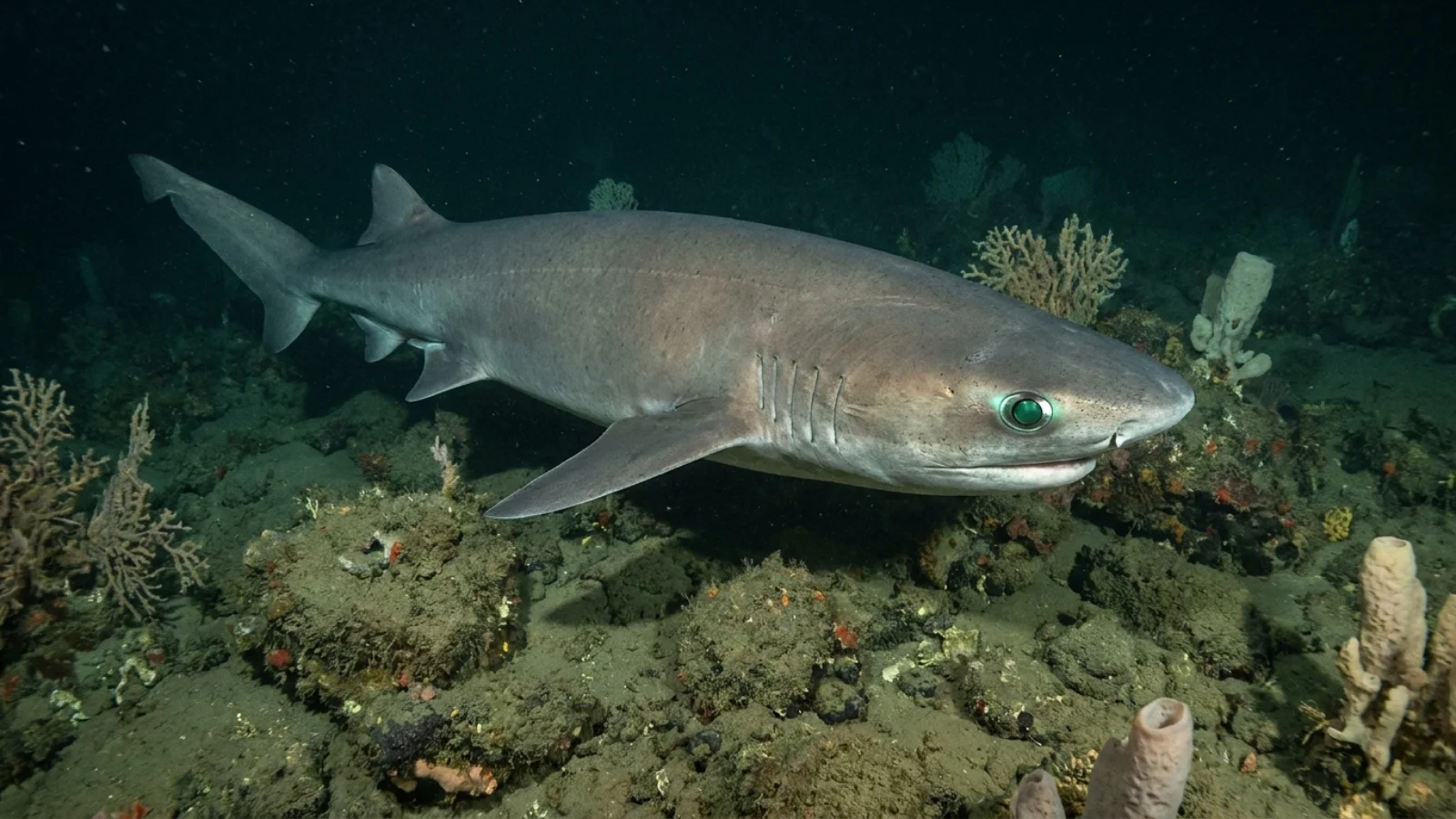
The bluntnose sixgill shark (Hexanchus griseus) is a large, primitive deep-water shark with six gill slits on each side instead of the usual five, a single dorsal fin set far back, and glowing green eyes. Females reach at least 5.5 m and 590 kg, making it one of the largest predatory sharks. It lives in every ocean from about 100 m to 2,500 m, rises toward the surface at night to feed, can have litters of more than 100 pups, and is listed as Near Threatened.
Bluntnose Sixgill Shark
Why does the sixgill shark have six gills?
The sixgill belongs to the cow sharks (Hexanchiformes), the most primitive living sharks. Six or seven gill slits and a single dorsal fin are ancestral features that most other sharks lost long ago, when the five-gilled body plan became standard.
Hexanchiform sharks have fossil relatives dating back to the Early Jurassic, roughly 190 million years ago, and the living species have changed relatively little. Their skeletons are less calcified than those of other sharks, their single dorsal fin sits far back near the tail, and they keep features such as six or seven pairs of gill slits. The order includes the bluntnose sixgill, the bigeyed sixgill, the broadnose sevengill and sharpnose sevengill sharks, and the eel-like frilled shark. For divers and biologists the sixgill is a rare chance to see an animal very close to what sharks looked like in the age of the dinosaurs.
How big do sixgill sharks get?
The bluntnose sixgill is one of the biggest sharks in the world. Females reach at least 5.5 m and 590 kg; males are smaller, typically 3.1–3.3 m.
Typical females measure 3.5–4.2 m, and the largest reach at least 5.5 m (18 ft). The body is heavy and powerful, dark brown to grey above and paler below, with a broad, rounded snout and small eyes that glow fluorescent green in torchlight. The teeth are unusual: the lower jaw carries six rows on each side of broad, comb-shaped teeth with several cusps, like a saw, while the upper teeth are narrower and pointed. That arrangement lets a sixgill grip and saw through large prey and carcasses. In length it is in the same league as the great white and the Greenland shark; see our ranking of the biggest sharks.
Where do sixgill sharks live?
Bluntnose sixgills are found in all the world’s temperate and tropical oceans, mostly on continental and island slopes and seamounts below 100 m, down to about 2,500 m.
Sixgills are vertical migrants: they spend the day in deep water and rise toward the surface at night to feed, sometimes into water only a few metres deep. In a few places they come shallow enough to be seen by divers. The most famous is Puget Sound in Washington State, where juvenile sixgills live year-round and pregnant females move into shallow water to give birth, and divers occasionally meet them along the Seattle waterfront. Hornby Island in British Columbia was once famous for summer sixgill encounters in shallow water. In Washington, recreational fishing for sixgills is closed and the species is listed as a Species of Greatest Conservation Need.
What do sixgill sharks eat?
Sixgills are generalist predators and scavengers. They eat fish, rays, other sharks, squid, crabs and shrimp, seals, and carcasses that sink to the seabed.
Their excellent sense of smell and saw-like teeth make them efficient scavengers at whale falls, and deep-sea cameras baited with fish regularly attract them. Live prey includes hake, herring, ratfish, dogfish, chimaeras and skates, as well as seals and other marine mammals. Their slow, sluggish appearance hides a capacity for short bursts of speed when attacking.
How do sixgill sharks reproduce?
Sixgills are ovoviviparous: eggs hatch inside the mother, who gives birth to large litters of 22 to 108 pups, each about 65–70 cm long.
Very little is known about sixgill reproduction because mating and birth take place in deep water. Gestation is thought to last more than two years. Males are estimated to mature at 11–14 years and females much later, perhaps 18–35 years. Ageing is difficult because their weakly calcified vertebrae do not lay down clear growth rings, but lifespans of up to about 80 years have been estimated. The large litters are offset by the very late maturity of females.
Are sixgill sharks dangerous?
Not to people. Sixgills are generally slow and unaggressive toward divers, and there are no confirmed unprovoked bites. Their close relative, the broadnose sevengill shark, has been involved in a few incidents.
Divers who meet sixgills at night in Puget Sound or British Columbia generally describe slow, calm animals that tolerate a torch for a while before drifting back into the dark. Like any large predator, they deserve respect, and bait in the water changes the picture.
Are sixgill sharks endangered?
The IUCN lists the bluntnose sixgill shark as Near Threatened. It is caught as bycatch in deep-water trawl and longline fisheries and was once targeted for its liver oil and meat.
Late maturity of females makes the species vulnerable even though litters are large. Increasing ocean temperatures and falling oxygen levels in places like Puget Sound are emerging concerns.
How does the sixgill compare with other deep-sea sharks?
The sixgill is one of the giants of the deep, alongside the Greenland and sleeper sharks.
Its closest living relatives are the sevengill sharks and the frilled shark. In lifestyle it overlaps with the Pacific sleeper shark, another big, slow scavenger of cold deep water, and the goblin shark, another living fossil of the deep slopes.
| Species | Max length | Max weight | Unprov. bites (ISAF) | Lifespan | IUCN |
|---|---|---|---|---|---|
| Bluntnose sixgill shark | 5.5 m | 590 kg | 0 | ~80 yrs (est.) | NT |
| Greenland shark | 6.4–7.3 m | ~1,000+ kg | 0 | 272–512 yrs (est.) | VU |
| Pacific sleeper shark | 4.65 m confirmed (~7 m filmed) | 888 kg | 0 | Long; 35 yrs at 4.3 m | NT |
| Great white shark | 6.0 m | 2,300 kg | 351 | 70 yrs | VU |
| Tiger shark | 5.5 m | 900 kg | 142 | 27–50 yrs | NT |
Bite counts: Florida Museum International Shark Attack File, species-implicated table (1580–2022). * Genus-level total. IUCN: LC Least Concern, NT Near Threatened, VU Vulnerable, EN Endangered, CR Critically Endangered, DD Data Deficient.
Why does the sixgill shark have six gills?
It belongs to the cow sharks, the most primitive living sharks, which retain six or seven gill slits, an ancestral trait. Most other sharks have five.
How big do sixgill sharks get?
Females reach at least 5.5 m (18 ft) and 590 kg (1,300 lb). Males are smaller, typically 3.1–3.3 m.
Are sixgill sharks dangerous?
There are no confirmed unprovoked bites. They are generally slow and calm with divers.
Where can you see sixgill sharks?
Puget Sound in Washington State is one of the few places where divers meet them in shallow water, mainly at night. Otherwise they live deep, from about 100 m to 2,500 m.
How many pups do sixgill sharks have?
Litters of 22 to 108 pups have been recorded, each about 65–70 cm long at birth.
How long do sixgill sharks live?
Estimates suggest up to about 80 years, though their soft vertebrae make ageing difficult.
Are sixgill sharks endangered?
They are listed as Near Threatened by the IUCN because of bycatch and past targeted fisheries.
What is the difference between sixgill and sevengill sharks?
Sixgills have six pairs of gill slits and sevengills have seven; both belong to the cow shark family Hexanchidae and have a single dorsal fin.
Blane Perun has been exploring Earth’s oceans and marine life for over 25 years. Founder of TheSea.Org in 1999, underwater photographer, coral aquaculture pioneer, and explorer of 80+ countries.
About Blane Perun → All Shark Species A–Z →