Leopard Shark — California’s Spotted Shark of the Shallows
The leopard shark (Triakis semifasciata) is a slim, harmless houndshark of the Pacific coast of North America, from Oregon to Mexico, patterned with bold black saddles and spots on a silver-grey body. Adults average about 1.5 m (5 ft) and reach 1.9 m. Each summer hundreds of mostly pregnant females gather in waist-deep water off La Jolla Shores, San Diego, making it one of the easiest sharks in the world to snorkel with.
Leopard Shark
How do you identify a leopard shark?
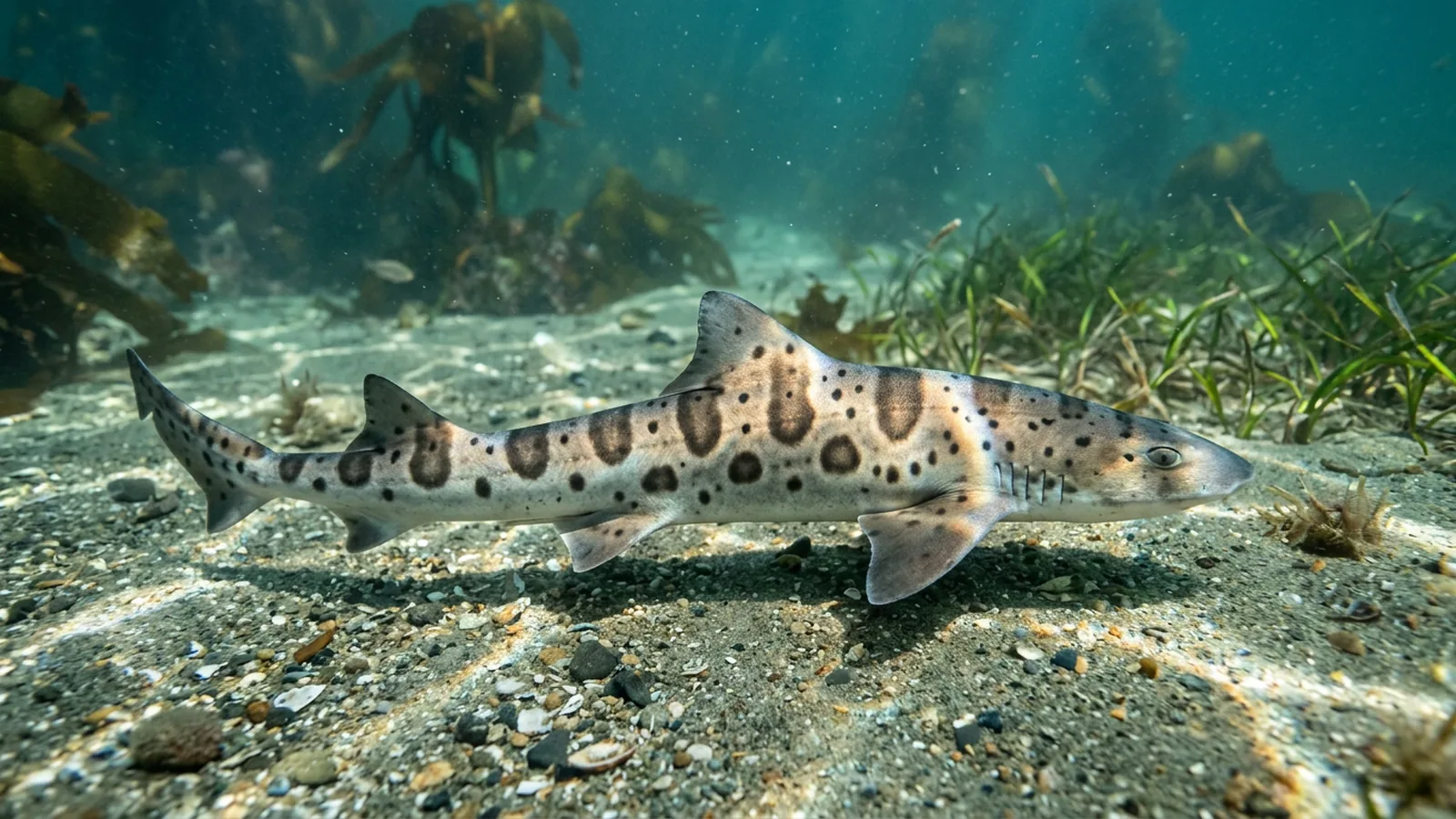
A leopard shark has a slender, silver-grey to bronze body marked with dark saddles across the back and large black spots along the sides. No other shark on the California coast looks like it.
The pattern is the giveaway: broad, dark crossbars over the back that break into spots and blotches along the flanks, sharper in juveniles and sometimes fading into rings in old adults. The body is long and narrow, with a short, rounded snout, two large dorsal fins of similar size, and a tail with a long upper lobe. The eyes are oval with a nictitating membrane. Teeth are small, smooth and pavement-like, made for crushing and gripping small invertebrates, which is why this shark poses no threat to people. Adults average about 1.5 m and 18 kg, with females reaching about 1.9 m.
There is a naming trap here. In Australia and much of the Indo-Pacific, “leopard shark” usually means a completely different animal, the zebra shark (Stegostoma tigrinum), a spotted carpet shark. If you see “leopard shark” on a Thai or Australian dive brochure, that is the species they mean. This page covers the Californian houndshark.
Where do leopard sharks live?
Leopard sharks live along the eastern Pacific coast from Oregon to Mazatlán, Mexico, including the Gulf of California, mostly in water less than 20 m deep.
The species is a shallow-water specialist of bays, estuaries, sandy flats, kelp beds and rocky reefs, typically at 4–20 m and rarely deeper than 91 m. San Francisco Bay, Tomales Bay, Elkhorn Slough in Monterey Bay, Santa Monica Bay and the La Jolla coast all hold large populations. Leopard sharks prefer water of about 13–16°C and tend to move away when the coast cools below about 10–12°C. Most individuals stay within a small home range of a few kilometres, which makes local populations sensitive to habitat change.
Why do leopard sharks gather at La Jolla?
Every summer and autumn, hundreds of leopard sharks, almost all of them pregnant females, gather in the warm shallows off La Jolla Shores. Researchers believe they use the warm water to speed up the development of their pups.
A three-year acoustic tagging study led by Andrew Nosal, published in Marine Ecology Progress Series in 2014, tracked 33 leopard sharks along 120 km of southern California coast. Female abundance at La Jolla peaked from late June through early December and rose and fell with sea-surface temperature; numbers were highest in the late afternoon, when the shallows were warmest. Half of the tagged females came back to the same site every year. The sharks rest in the shallows of the Matlahuayl State Marine Reserve by day and move into the deeper water of the La Jolla Submarine Canyon at night to feed.
For snorkellers it is one of the most accessible shark encounters anywhere: the sharks cruise in water from waist to chest deep, often within 50 m of the beach off the Marine Room restaurant at the south end of La Jolla Shores. Calm mornings at low tide with good visibility are best. Swim slowly, don’t chase or touch them, and you can float over dozens. Our guide to scuba diving in San Diego covers the wider area.
What do leopard sharks eat?
Leopard sharks feed on the bottom, mostly on burrowing worms, clams, crabs, shrimp, fish eggs and small fish. They hunt by suction and by digging in mud and sand.
The fat innkeeper worm (Urechis caupo), which lives in U-shaped burrows on mudflats, is a staple; sharks are caught with innkeeper worms packed in their stomachs and bite marks on their bodies. Clams, ghost shrimp, crabs, herring eggs laid on eelgrass, anchovies, smelt and small rockfish are also eaten. Leopard sharks often hunt in schools, sometimes alongside smoothhounds and spiny dogfish, moving into flats on the rising tide to feed and retreating as it falls. Schools are usually sorted by size and sex.
How do leopard sharks reproduce?
Leopard sharks are ovoviviparous (aplacental viviparous). Females carry litters of 4 to 37 pups, about 20 on average, for 10–12 months and give birth in spring in shallow bays and estuaries.
Mating happens once a year, between about April and July. Pups are born at roughly 20–24 cm and grow slowly, about 2 cm a year. Males mature at 7–13 years (0.7–1.2 m) and females at 10–15 years (0.7–1.3 m). Wild leopard sharks have been aged at 18–26 years, and captive animals have lived 22–30 years. Slow growth means a leopard shark you see at La Jolla may well be older than 20.
Are leopard sharks dangerous?
No. Leopard sharks are timid, have small crushing teeth and eat invertebrates. The International Shark Attack File lists a single unprovoked bite, with no significant injury.
Are leopard sharks endangered?
No. The IUCN lists the leopard shark as Least Concern. California manages the fishery, and the main concerns are local: habitat loss in bays, illegal collection of pups for the aquarium trade, and disease die-offs.
Leopard sharks are a popular recreational catch in California, with a minimum size and bag limit. Gillnets are prohibited in water shallower than 110 m in much of their range, which reduced bycatch. Collecting pups for sale was made illegal in 1994, but federal investigations have since uncovered large-scale poaching of juveniles from San Francisco Bay for the aquarium trade. Mass die-offs of leopard sharks in San Francisco Bay, notably in 2011 and 2017, were linked to a parasitic ciliate, Miamiensis avidus, that infects the brain. Because they eat shellfish in urban bays, leopard sharks can also carry high mercury levels, and California issues consumption advisories for them.
How does the leopard shark compare with other sharks?
The leopard shark is a small ground shark, a cousin of the requiem sharks and hammerheads, but with the lifestyle of a bottom-feeding bay fish.
It is often compared with the Pacific horn shark, which shares the same California kelp beds, and with the spiny dogfish, which sometimes schools alongside it. Among the sharks covered on TheSea.Org it is one of the smallest and safest.
| Species | Max length | Max weight | Unprov. bites (ISAF) | Lifespan | IUCN |
|---|---|---|---|---|---|
| Leopard shark | 1.9 m | ~18 kg avg | 1 | 20–30 yrs | LC |
| Spiny dogfish | 1.6 m | 9 kg | 0 | 70–100 yrs | VU |
| Blacktip shark | 2.8 m | 123 kg | 35 | 12–15 yrs | VU |
| Lemon shark | 3.4 m | 184 kg | 10 | 25–30 yrs | VU |
| Nurse shark | 3.08 m | ~110 kg+ | 9 | 24–40+ yrs | VU |
| Great white shark | 6.0 m | 2,300 kg | 351 | 70 yrs | VU |
Bite counts: Florida Museum International Shark Attack File, species-implicated table (1580–2022). * Genus-level total. IUCN: LC Least Concern, NT Near Threatened, VU Vulnerable, EN Endangered, CR Critically Endangered, DD Data Deficient.
Are leopard sharks dangerous?
No. Leopard sharks are shy bottom feeders with small teeth. The ISAF lists only one unprovoked bite, with no significant injury.
When can you see leopard sharks in La Jolla?
From about June through December, with the peak in August and September. Calm mornings at low tide off La Jolla Shores, near the Marine Room, give the best viewing.
Why are there so many leopard sharks at La Jolla?
Most are pregnant females using the warm shallow water to speed up the development of their pups. Research shows their numbers track sea temperature.
How big do leopard sharks get?
Adults average about 1.5 m (5 ft) and 18 kg (40 lb). The largest females reach about 1.9 m (6.2 ft).
Is a leopard shark the same as a zebra shark?
No. In Australia and Southeast Asia “leopard shark” often refers to the zebra shark, a spotted carpet shark. The Californian leopard shark (Triakis semifasciata) is a different species in a different order.
What do leopard sharks eat?
Mostly bottom invertebrates such as innkeeper worms, clams, crabs and shrimp, plus fish eggs and small fish like anchovies.
Can you keep a leopard shark in an aquarium?
Leopard sharks grow too large for home aquariums and need very large systems. Collecting them for sale has been illegal in California since 1994.
How long do leopard sharks live?
Wild leopard sharks have been aged at 18–26 years, and captive animals have lived up to about 30.
Blane Perun has been exploring Earth’s oceans and marine life for over 25 years. Founder of TheSea.Org in 1999, underwater photographer, coral aquaculture pioneer, and explorer of 80+ countries.
About Blane Perun → All Shark Species A–Z →