Seashells — How They Form, What Lives Inside, and Where to Find Them
Seashells are the hard, external skeletons built by marine mollusks — snails, clams, scallops, conchs and their relatives — out of calcium carbonate they pull from seawater. Every shell on the beach was grown, layer by layer, by a living animal’s mantle; the empty ones you pick up are what remains after that animal died or, in many cases, after a hermit crab moved out. A few beach finds called “shells” come from other animals entirely: sand dollars and sea urchin tests are echinoderm skeletons, and barnacles are crustaceans.
How are seashells formed?
A seashell is grown, not found: the mollusk’s mantle secretes calcium carbonate and protein along the shell’s edge, so the shell gets bigger by adding new material at the lip rather than by stretching.
The mantle is a fold of tissue that lines the inside of the shell. Cells at its margin pump calcium and carbonate ions — drawn from seawater and the animal’s food — into a thin space between the tissue and the existing shell, where they crystallize onto an organic scaffold. The outermost layer, the periostracum, is pure protein and gives live shells their dull, often fuzzy or brownish skin. Under it sit one or more mineral layers: prismatic calcite or aragonite for strength and, in pearl oysters, abalone and many snails, a lustrous inner layer of nacre (mother-of-pearl).
Because growth happens only at the edge, a shell is a timeline. Ridges, color bands and “varices” (thickened ribs left by pauses in growth) record seasons, food supply and water temperature. Scientists read those layers the way foresters read tree rings, and a shell that has stopped growing at the lip — like the flared lip of an adult Queen Conch — usually belongs to a mature animal.
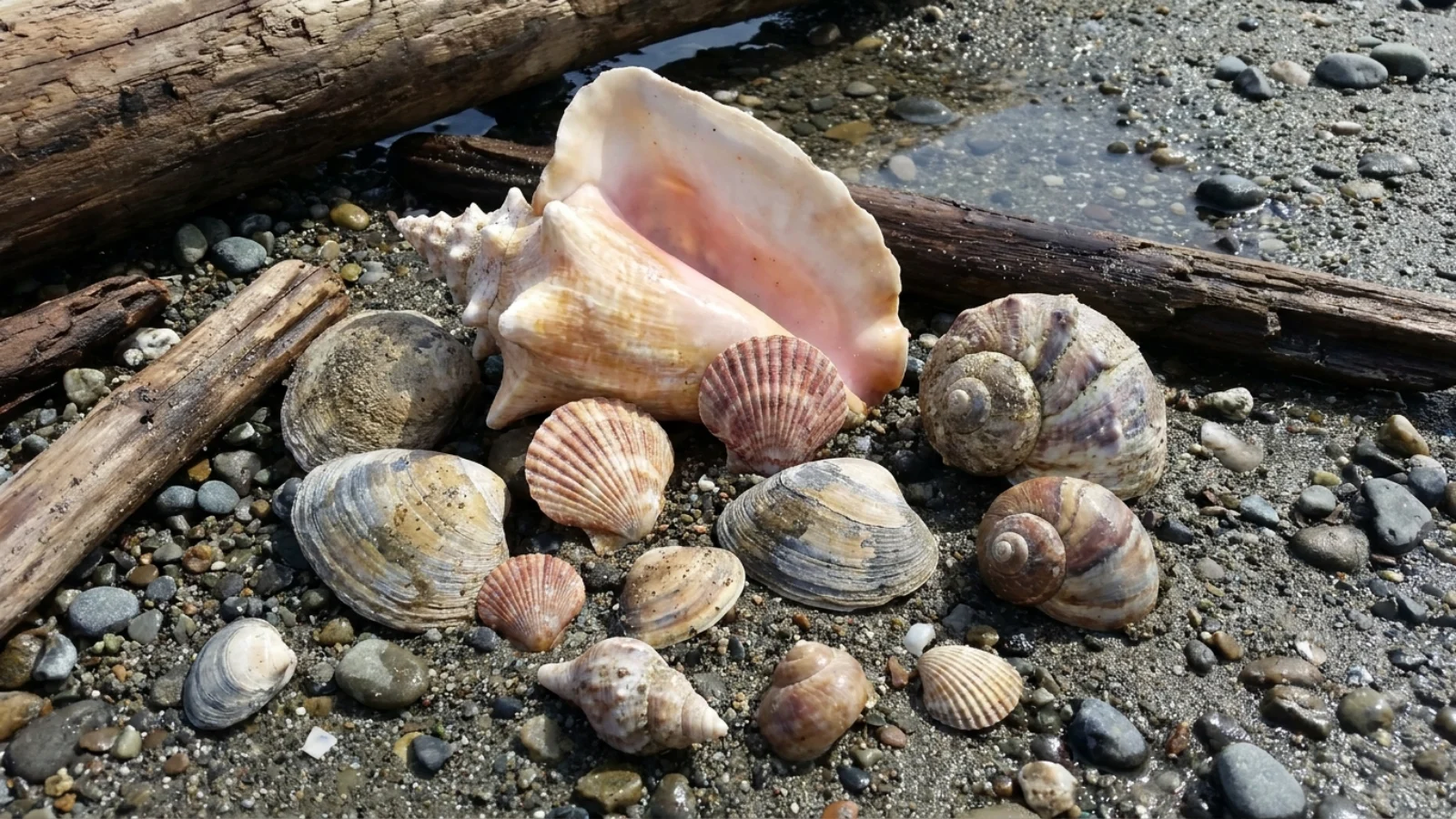
Why are seashells spiral-shaped?
Snail shells spiral because the animal adds new shell faster on one side of the opening than the other; that uneven growth around a central axis produces a logarithmic coil that keeps the same shape as it grows.
A coiled tube is a compact way to carry an ever-larger home: the animal never has to move out, and the shell stays balanced over its foot. The vast majority of snail species coil to the right (hold the shell point-up with the opening facing you, and the opening is on the right). The famous exception on Florida beaches is the Lightning Whelk, which opens on the left. Bivalves such as scallops and Coquina Clams don’t spiral at all; they grow two hinged valves outward from a point near the hinge called the umbo.
What lives inside a seashell?
A seashell’s builder is a soft-bodied mollusk — a snail, clam, scallop or similar — that stays attached to it for life; an empty shell may later be occupied by a hermit crab, an octopus or a tiny fish.
Inside a snail shell lives a muscular foot, a head with tentacles and eyes, and a visceral mass coiled up into the spire. Many marine snails seal the door behind them with an operculum, a horny or chalky trapdoor attached to the foot. A bivalve’s two valves are pulled shut by one or two adductor muscles — the “scallop” on your plate is that muscle. When the builder dies, the shell becomes real estate: hermit crabs trade up shell by shell as they grow, which is one of the best reasons to check every shell before you pocket it.
What are the main types of seashells?
Nearly every shell on a beach belongs to one of two mollusk classes: gastropods, which make a single, usually coiled shell, and bivalves, which make two hinged halves.
| Group | Shell | Florida beach examples |
|---|---|---|
| Gastropods (snails) | One shell, usually coiled | Whelks, conchs, olives, tulips, moon snails, murex, augers, cones |
| Bivalves | Two hinged valves | Scallops, coquinas, cockles, arks, pen shells, venus clams |
| Scaphopods | Open-ended tusk | Tusk shells (Dentalium) |
| Polyplacophora | Eight overlapping plates | Chitons on jetty rocks |
| Cephalopods | Chambered (nautilus) or internal | Paper nautilus egg cases, cuttlebones; see nautilus shells |
| Not mollusks | Echinoderm test | Sand dollars, sea urchins, sea biscuits |
For a picture-by-picture walk-through of the shells you’re most likely to find on the Gulf Coast, start with our Florida shell identification guide. For the animals themselves, see our overviews of mollusks, gastropods and bivalves.
Why do you hear the ocean in a seashell?
The “ocean” in a shell is ambient noise from the room around you, amplified by the shell’s curved cavity, which resonates at certain frequencies like a tiny echo chamber.
Hold a cup or your cupped hand to your ear and you’ll hear the same soft roar, and the pitch changes with the size of the cavity. Big, deep shells like the Conch Shell resonate at lower frequencies, which is why they sound most like surf. In a truly silent room the effect largely disappears. It is not your blood, and it is not the sea.
Where are the best places to find seashells?
In the United States, Southwest Florida’s Gulf beaches are the benchmark: Sanibel and Captiva, Cayo Costa, Marco Island and the barrier islands south of Naples collect huge volumes of shells because of their shallow, gently sloping shelf and orientation to Gulf currents.
Living in Southwest Florida, I get to watch how the shelling changes with the weather. The biggest “shell lines” come after a cold front or a strong west wind, on the lowest tides of the month, and in the winter months when fronts are frequent. Sanibel’s east–west orientation means its long south-facing beach catches whatever the Gulf pushes ashore, while Marco Island and the sandbars off Tigertail Beach are known for sand dollars and big gastropods. Farther north, Venice is famous for something else entirely: fossil Shark Teeth.
See Best Shelling Beaches in Florida for a beach-by-beach guide and Shelling for timing, tide and technique. Outside Florida, Costa Rica’s Playa Conchal is made largely of crushed shell, and the Sea Glass Beaches of California, Hawaii and northern England reward a different kind of beachcombing.
Are seashells disappearing?
Shells are not running out, but studies show heavy collecting does reduce shell numbers on popular beaches, and empty shells play real roles in the ecosystem.
A long-term study at Llarga Beach in Spain found that a tripling of tourism over three decades coincided with a roughly 70% drop in shell abundance. Empty shells stabilize sand, anchor seagrass and algae, provide homes for hermit crabs and fish, and dissolve slowly to return calcium carbonate to the water. Ocean acidification is a longer-term worry: lower seawater pH makes it harder for mollusks, especially larvae, to build shells. Taking a handful of empty shells is legal almost everywhere in Florida outside parks and refuges; taking bags full of them, or any live animal, isn’t a good look.
What are seashells made of?
Seashells are about 95–99% calcium carbonate, in the mineral forms aragonite and calcite, bound together by a small amount of protein. The mollusk’s mantle secretes the shell layer by layer, adding new material at the opening as the animal grows.
Is it illegal to take seashells from the beach in Florida?
Taking empty shells is generally legal on Florida beaches, though state and national parks and wildlife refuges may restrict it. Taking a shell with a live animal requires a Florida saltwater fishing license, and Lee County (including Sanibel) bans live shell collecting entirely, with a few edible-clam exceptions. Live queen conch can’t be taken anywhere in Florida.
How do you know if a seashell is alive?
Look into the opening. If you see an animal, a foot, or an operculum (a trapdoor) sealing the entrance, it’s alive. For bivalves, two valves clamped tightly shut usually mean a living clam. Live sand dollars are fuzzy and brown or purple, not white. Put living shells back in the water.
Why do some seashells have holes in them?
A neat, countersunk round hole is usually the work of a predatory snail such as a moon snail or murex, which drills through the shell with its radula and acid to eat the animal inside. Ragged holes come from wave damage, boring sponges or worms.
Can a seashell grow back?
A living mollusk can repair cracks and chips in its own shell by secreting new material, and repairs often show up as scars. Once the animal dies, the shell can’t grow or heal.
What is the rarest seashell in Florida?
Among shells that occasionally wash onto beaches, the junonia is the most famous rarity on Sanibel. It lives offshore at 29–126 m and usually reaches the beach only after strong storms. Florida also produces rare color forms and deep-water species brought in by shrimp trawlers.
When is the best time to look for seashells?
Go at low tide, especially the very low tides around a new or full moon, and right after a storm, cold front or strong onshore wind. In Southwest Florida, winter and early spring usually bring the best shelling.
Are sand dollars seashells?
Not technically. A sand dollar is the skeleton (test) of a flattened sea urchin, an echinoderm, not a mollusk. Shellers collect them alongside shells, but in Lee County taking a live sand dollar is illegal.
Living Animal, Legend and Beach Find.
The Holy Grail of Sanibel Shelling.
The Drilling Predator Behind Holed Shells.
The Lettered Olive and Its Glossy Kin.
Spines, Drills and the Snail Behind Tyrian Purple.
What the Urchin Test Is and How to Identify One.
The Needle-Spired Cousin of the Cone Snail.
Banded and True Tulips of Florida.
Blane Perun has been exploring Earth’s oceans and marine life for over 25 years. Founder of TheSea.Org in 1999, underwater photographer, coral aquaculture pioneer, and explorer of 80+ countries. Based in Southwest Florida, home to some of the best shelling beaches in North America.
About Blane Perun → More on Seashells & Shelling →