Conch Shell — Types, Sound, Pearls and Whether You Can Take One Home
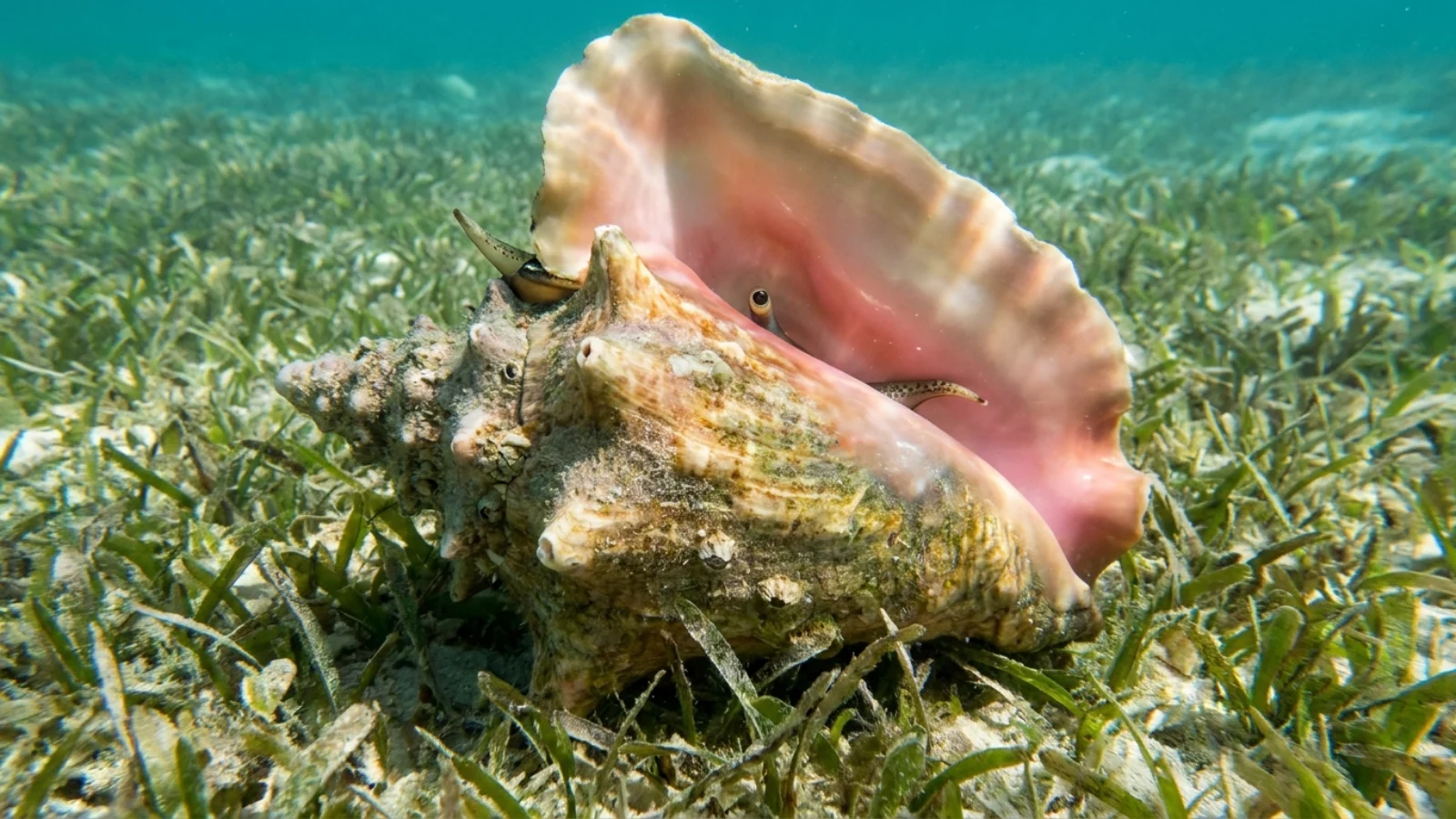
A conch shell is the heavy, spiral shell of a large marine snail, most correctly one of the “true conchs” in the family Strombidae, a group of roughly a hundred species led by the pink-lipped queen conch. In everyday use the word also covers other big snails such as the Florida horse conch, crown conch and whelks. True conchs graze algae on sandy seagrass flats in warm seas, and their flared, often pink-lipped shells are some of the most recognizable objects in the ocean.
What are the different types of conch shells?
The conchs you’re most likely to see are the queen conch of the Caribbean and the Bahamas, the smaller Florida fighting conch on Gulf beaches, and two Florida shells called conchs that aren’t true conchs at all: the horse conch and the crown conch.
| Shell | Scientific name | Size | Where / notes |
|---|---|---|---|
| Queen conch | Aliger gigas | Up to ~30 cm | Caribbean, Bahamas, Florida Keys; pink lip; federally threatened |
| Florida fighting conch | Strombus alatus | ~7–10 cm | Very common on Southwest Florida beaches; orange-brown |
| Milk conch | Macrostrombus costatus | ~15–18 cm | Caribbean; heavy, creamy-white lip |
| Hawk-wing conch | Lobatus raninus | ~10 cm | Caribbean, South Florida; wing-like lip |
| Goliath conch | Lobatus goliath | Up to ~38 cm | Brazil only; largest true conch |
| Horse conch (not a true conch) | Triplofusus giganteus | Up to ~60 cm | Florida state shell; family Fasciolariidae |
| Crown conch (not a true conch) | Melongena corona | ~5–12 cm | Florida mangroves and oyster bars; spiny crown |
On Southwest Florida beaches the fighting conch is the conch you’ll actually find, often alive in the shallows, where it moves by planting its sickle-shaped operculum and vaulting forward. True conchs have a telltale stromboid notch near the front of the lip, a little gap that lets one of their stalked eyes peek out while the shell is held down. For the bigger Florida gastropods often lumped in as conchs, see whelks and tulip shells.
Why does a conch shell sound like the ocean?
A conch shell sounds like the ocean because its large, curved interior traps and amplifies the background noise around you, resonating at low frequencies that resemble distant surf.
The effect is acoustic resonance, the same reason a cupped hand or an empty glass produces a hum. Big shells with deep, smooth chambers resonate at lower pitches, which is why conchs produce the most convincing “ocean.” Hold a conch to your ear in a soundproof room and the roar fades away.
How do you blow a conch shell horn?
To make a conch horn, the tip of the spire is cut or ground off to make a mouthpiece, and the player buzzes their lips into it like a trumpet; the spiral interior acts as the horn’s tube.
Conch trumpets have been used for thousands of years. They were blown in Pacific island navigation and ceremony, in Mesoamerica, in Japanese Buddhist ritual (the horagai), and in Hindu worship, where the sacred shankha is actually the shell of a different snail, Turbinella pyrum. In the Florida Keys, blowing a conch at sunset is a tradition, and Key West residents have called themselves “Conchs” for generations.
What is a conch pearl?
A conch pearl is a rare, non-nacreous pearl formed inside a queen conch; it is usually pink, has a flame-like surface pattern, and cannot be reliably cultured, which makes fine examples very valuable.
Unlike oyster pearls, conch pearls aren’t made of nacre, so they lack the classic mirror luster and instead show a silky, shimmering “flame” structure. They are a byproduct of the meat fishery; nearly all come from conchs harvested in the Caribbean, and only a small fraction of animals contain one of gem quality.
Is it illegal to take conch shells?
In Florida you may keep an empty conch shell if it held no live animal when you found it, but possessing a live queen conch is prohibited, as is a queen conch shell with a harvest hole in the spire.
Most conch shells sold in tourist shops are byproducts of the meat fishery in the Caribbean. That trade, and illegal harvest, is why the queen conch was listed as threatened under the US Endangered Species Act in 2024. Read the full story in Queen Conch.
How do you clean a conch shell?
Soak an empty conch shell in fresh water, scrub off growth with a stiff brush, then soak briefly in diluted bleach to remove the outer skin; finish with a light coat of mineral oil to restore the shine.
- Never boil or freeze a shell to remove a live animal; that is how many illegal shells are produced.
- Use a 1:1 bleach-water soak only until the periostracum (brown skin) lifts; long soaks dull the pink lip.
- Muriatic acid strips color and should be avoided on conchs.
- Sunlight fades the pink lip over time, so display conchs out of direct sun.
For more on the snails behind these shells see gastropods and snails, and for the big Florida finds see the Lightning Whelk and Best Shelling Beaches in Florida.
What animal lives in a conch shell?
A large sea snail. True conchs (family Strombidae) are herbivorous snails with long, stalked eyes, a muscular foot, and a sickle-shaped operculum they use to vault across the sand.
Can you take conch shells from the beach in Florida?
You can keep an empty conch shell that held no living animal when found. You may not possess a live queen conch anywhere in Florida, and Lee County bans taking any live shell.
Can you bring conch shells back from the Bahamas or Caribbean?
US rules allow up to three queen conch shells per person as personal effects without a CITES permit. More requires CITES documents, and the country you’re leaving may require an export permit.
Why is the inside of a conch shell pink?
The pink comes from pigments laid down in the shell’s inner layers as the snail matures. The color is strongest in the flared lip of adult queen conchs and fades in sunlight.
How long do conchs live?
Queen conchs reach maturity at about 3 to 5 years, when the lip flares, and can live roughly 20 to 30 years or more in the wild.
Is a conch a snail?
Yes. A conch is a marine gastropod, a sea snail, in the family Strombidae.
What is the biggest conch shell?
Among true conchs, the goliath conch of Brazil, up to about 38 cm. The Florida horse conch, often called a conch, is larger at up to about 60 cm but belongs to a different family.
Are conch shells rare?
Queen conch shells aren’t rare in shops, but queen conch populations have declined from overfishing. Wild, beach-found adult queen conchs are uncommon in Florida, where harvest has been closed since the 1980s.
Blane Perun has been exploring Earth’s oceans and marine life for over 25 years. Founder of TheSea.Org in 1999, underwater photographer, coral aquaculture pioneer, and explorer of 80+ countries. Based in Southwest Florida, home to some of the best shelling beaches in North America.
About Blane Perun → More on Seashells & Shelling →