Moon Snail — The Drilling Predator Behind Every Holed Shell
A moon snail is a predatory sea snail in the family Naticidae that plows through sand hunting clams and other snails, which it kills by drilling a neat, beveled hole through their shells. Moon snails have smooth, globe-shaped shells and an enormous foot that can cover most of the shell when the animal is active. On Florida’s Gulf beaches the best-known species is the shark eye, named for the dark, eye-like spiral on top of its shell, and the perfectly round holes in many beach shells are its handiwork.
How does a moon snail drill a hole?
A moon snail wraps its foot around a clam, then alternates between rasping the shell with its radula and softening it with an acid secretion from a special boring gland, until it breaks through and eats the animal inside.
The finished hole is a tidy, countersunk circle, wider on the outside than the inside, usually near the clam’s hinge where the meat is thickest. Drilling can take hours or longer depending on shell thickness. Murex snails also drill, but their holes tend to be straighter-sided, and murexes usually hunt on harder bottoms. Next time you see a clam valve with a perfect hole on a Florida beach, you’re looking at a moon snail kill, and that hole is exactly what shell jewelry makers use to thread a necklace.
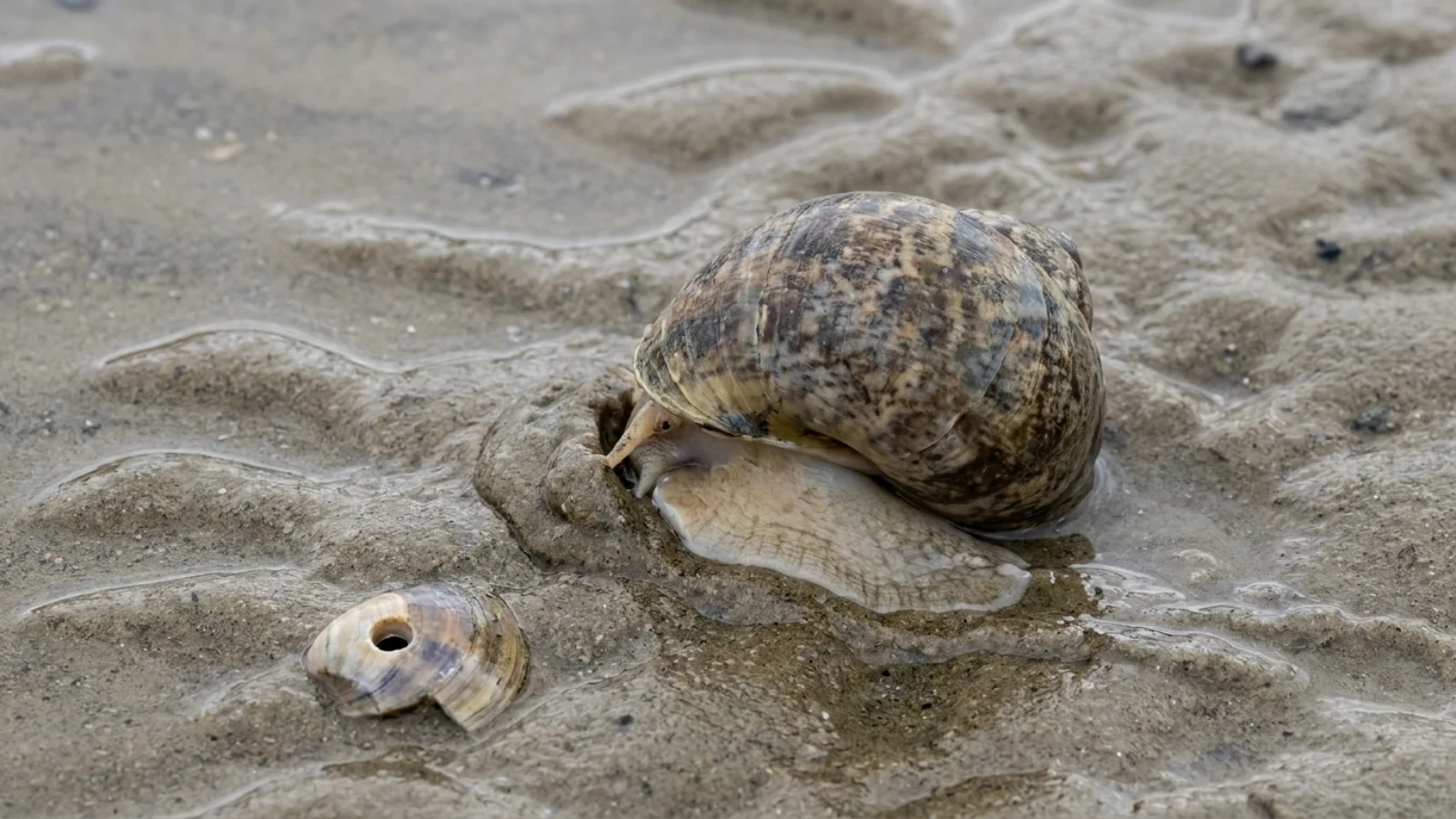
Why does a moon snail have such a big foot?
The moon snail’s foot is inflated with seawater to become huge and soft, letting it plow through sand and envelop prey; to pull back into its shell the snail squirts that water out.
In Lewis’s moon snail from the Pacific Northwest, the extended foot can be several times the size of the shell. The front of the foot forms a shield that pushes sand aside, so the snail moves just under the surface, leaving a low ridge on tidal flats. On Southwest Florida flats at low tide you can sometimes follow those trails to a shark eye at the end.
What is a moon snail sand collar?
A sand collar is a moon snail egg mass: a curved, rubbery band shaped like an old-fashioned shirt collar, made of sand grains cemented together with mucus and thousands of eggs.
The female forms it around her shell and foot, then crawls out, leaving a collar that can last several weeks before the larvae hatch and the collar crumbles. People often mistake sand collars for trash or a piece of rubber. They are living egg masses, so leave them where they are.
| Species | Scientific name | Size | Where |
|---|---|---|---|
| Shark eye | Neverita duplicata | ~5–9 cm | Atlantic and Gulf coasts, common in Florida |
| Colorful Atlantic natica | Naticarius canrena | ~2–5 cm | Florida, Caribbean; bold patterned shell |
| Baby’s ear | Sinum perspectivum | ~3–5 cm | Florida; flat, ear-shaped, mostly internal shell |
| Northern moon snail | Euspira heros | To ~11 cm | North Atlantic |
| Lewis’s moon snail | Neverita lewisii | To ~14 cm | Pacific coast of North America |
How do you identify a moon snail shell?
Look for a smooth, glossy, rounded shell with a low spire, a very large oval opening and, in many species, a small pit or callus beside the opening called the umbilicus.
Moon snail shells are among the easiest beach shells to recognise. The body whorl makes up most of the shell, so it looks like a polished ball or a slightly flattened dome. The surface is usually smooth rather than ribbed or spiny. In the shark eye, a thick brown pad of shell (the callus) partly covers the umbilicus, and the top of the shell shows the dark spiral that gives it its name. Moon snails also have an operculum, the “trapdoor” that seals the opening: in shark eyes and northern moon snails it is thin and horny, while in Natica and Naticarius species it is hard and shelly. Baby’s ear shells are the odd ones out, flattened and ear-shaped, with the soft body largely covering the shell in life.
How do moon snails find their prey?
By smell. Moon snails hunt under the sand, where eyes are of little use, so they track buried clams by chemical cues in the water and sediment.
A moon snail plows slowly through the sand until it detects a likely target, then wraps the clam in its foot so it cannot escape or close tightly enough to matter. Studies of naticid feeding suggest they tend to choose prey of a size that gives the best return for drilling time, and they often drill in a consistent position on each type of shell. Moon snails will also eat other moon snails, and cannibalism is well documented in the family.
What eats moon snails?
Fish, crabs, sea stars, octopus and shorebirds take moon snails, and other moon snails drill them too.
A moon snail’s best defence is staying buried and pulling into its shell. Once it dies, the shell often has a second life: empty shark eye and moon snail shells are among the most popular homes for hermit crabs, and on Southwest Florida flats it is common to pick up a “moon snail” that turns out to have a hermit crab inside.
What is the moon snail life cycle?
Moon snails have separate sexes; females lay sand collars, and the eggs hatch into tiny swimming larvae that drift before settling as miniature snails.
After mating, the female builds her sand collar on the bottom. The larvae, called veligers, swim using a pair of ciliated lobes and feed in the plankton for a period before they settle on sand and begin life as tiny predators. Moon snails grow steadily, and the larger species can take several years to reach full size.
Why do scientists study moon snail holes?
Because drill holes fossilise. A drilled shell preserves a record of who ate whom, sometimes millions of years later.
Paleontologists count and measure the bevelled holes in fossil clam and snail shells to track how predation by naticids and other drilling snails changed over geological time. The countersunk shape of a moon snail hole can usually be distinguished from the straighter hole made by a murex, so a pile of old shells can reveal which predators were active and how successful they were. Ecologists use the same trick on modern beaches to measure predation rates on clam populations.
How do you collect and clean a moon snail shell?
Take only empty shells, check for hermit crabs, then rinse and soak them in fresh water before drying.
- Make sure the shell is empty: no foot, no operculum and no hermit crab legs in the opening.
- Rinse off sand, then soak in fresh water for a day or so to remove salt.
- A soft toothbrush removes grime; avoid harsh scrubbing that can dull the glossy surface.
- A short soak in diluted bleach can lift stains and growth, but rinse well afterwards.
- A light coat of mineral oil can bring back the shine on dry, faded shells.
Shark eyes are among the most common gastropods on our Gulf beaches, from Sanibel to Marco Island. A live one plowing the flats at low tide looks like a pale, oversized blob, and it is gone back into the sand in seconds if disturbed.
Related: Coquina Clams (a favorite prey), Types of Seashells, snails, gastropods.
Are moon snails dangerous?
No. Moon snails are harmless to people. They are predators only of clams and other mollusks.
What does a moon snail eat?
Mainly clams, including coquinas, plus other snails, even other moon snails. It drills through the shell to reach the soft animal.
What is the shark eye shell?
The shark eye, Neverita duplicata, is the common moon snail of the US Atlantic and Gulf coasts. The dark spiral on its shell looks like an eye.
Why do shells on the beach have holes in them?
A neat, round, beveled hole usually means a moon snail or murex drilled it to eat the animal inside.
What is a sand collar?
A moon snail egg mass made of sand and mucus, shaped like a curved collar. It contains thousands of eggs and should be left alone.
How big do moon snails get?
Florida shark eyes reach about 9 cm. Lewis’s moon snail on the Pacific coast has a shell up to about 14 cm and a much larger foot.
Can a moon snail fit back in its shell?
Yes. It expels the water that inflates its foot, shrinking it enough to retreat inside and close the operculum.
Where can you find moon snails in Florida?
On sandy beaches and tidal flats throughout Florida, especially the Gulf Coast from Sanibel to Marco Island.
Do hermit crabs use moon snail shells?
Yes. Empty shark eye and other moon snail shells are favourite homes for hermit crabs, so check the opening before taking a shell home.
Blane Perun has been exploring Earth’s oceans and marine life for over 25 years. Founder of TheSea.Org in 1999, underwater photographer, coral aquaculture pioneer, and explorer of 80+ countries. Based in Southwest Florida, home to some of the best shelling beaches in North America.
About Blane Perun → More on Seashells & Shelling →