Types of Seashells — A Florida Shell Identification Guide
Almost every seashell belongs to one of two groups of mollusks: gastropods (sea snails), which build a single, usually spiral shell, and bivalves (clams, scallops, oysters, cockles), which build two hinged halves. Smaller groups add tusk shells, chitons and the chambered shells of cephalopods like the nautilus. To identify a shell, start with that split, then look at shape, opening, ribs, color pattern and size; on Florida’s Gulf beaches, about two dozen species make up most of what you will find.
How do you identify a seashell?
Identify a seashell in four steps: decide whether it is a snail (one shell) or a clam (two halves), check the shape and opening, look at the surface sculpture and color, and compare its size against a regional guide.
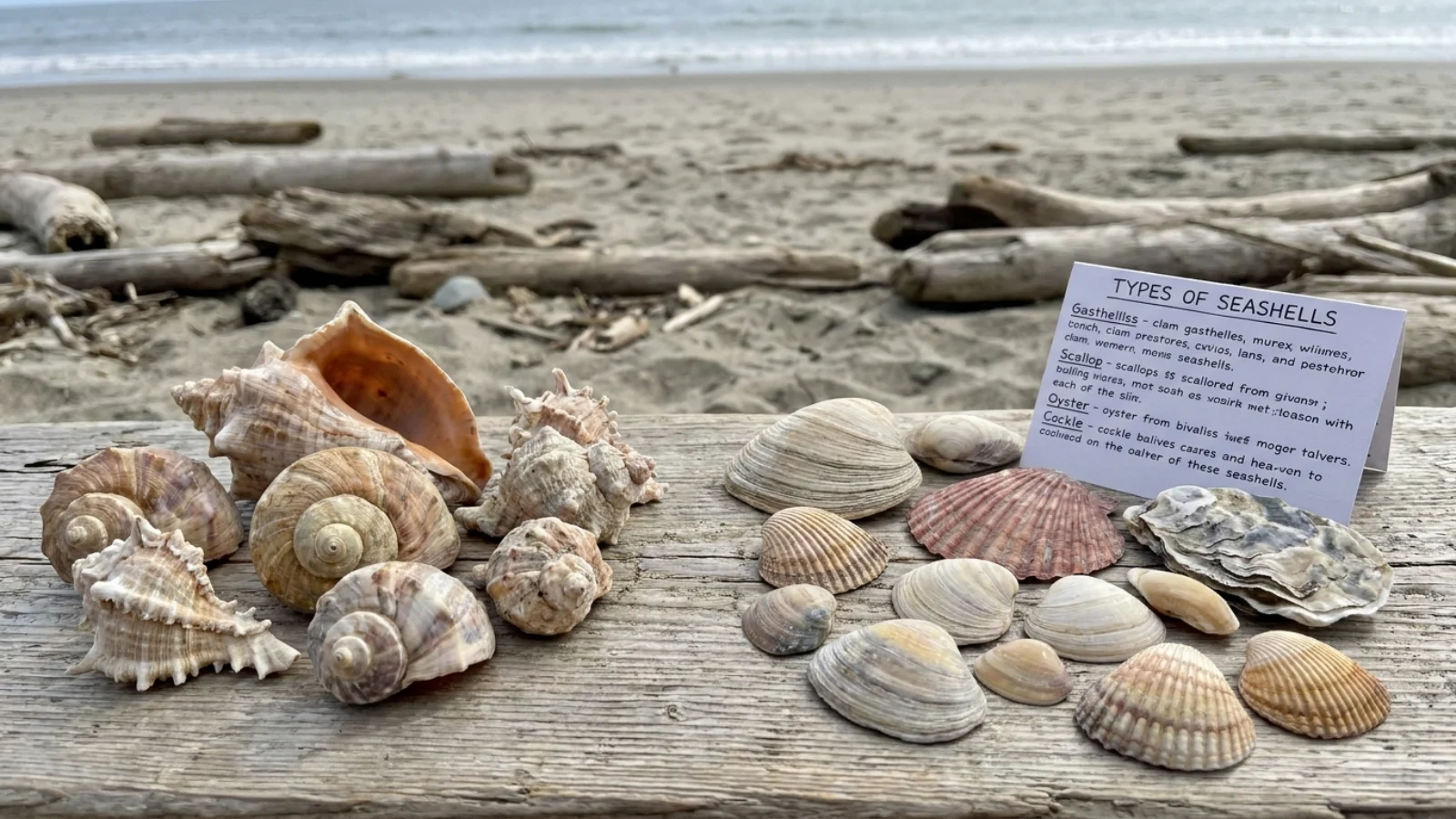
What are the most common types of seashells on Florida beaches?
On Southwest Florida beaches, the shells you will find most often are calico scallops, cockles, ark clams, lettered olives, Florida fighting conchs, lightning whelks, moon snails, coquinas, kitten’s paws, jingle shells and pen shells.
| Shell | Type | Size | Key ID features |
|---|---|---|---|
| Lightning whelk | Gastropod | To ~40 cm | Opening on the left; zigzag stripes when young |
| Florida fighting conch | Gastropod | 7–10 cm | Heavy, orange-brown, short spines on shoulder, flared lip |
| Horse conch | Gastropod | To ~60 cm | Florida state shell; huge spindle shape; orange when young |
| Banded tulip | Gastropod | 5–10 cm | Smooth, spindle-shaped, thin dark spiral lines |
| Lettered olive | Gastropod | 4–6 cm | Glossy cylinder, zigzag “letter” markings |
| Shark eye (moon snail) | Gastropod | 5–8 cm | Round, smooth, with an eye-like spiral on top |
| Crown conch | Gastropod | 5–12 cm | Crown of spines on the shoulder; mangrove areas |
| Apple murex | Gastropod | 5–10 cm | Heavy, rows of knobby varices |
| Florida cone | Gastropod | 3–5 cm | Smooth cone shape, narrow slit opening |
| Atlantic auger | Gastropod | 3–5 cm | Long, needle-like spire |
| Junonia | Gastropod | To ~15 cm | Cream with squarish brown spots; rare |
| Calico scallop | Bivalve | 3–6 cm | Fan with ribs and ears; mottled colors |
| Lion’s paw | Bivalve | To ~15 cm | Heavy knobby ribs, orange-red; rare |
| Giant Atlantic cockle | Bivalve | To ~13 cm | Rounded, heart-shaped from side, fine ribs, pink inside |
| Prickly cockle | Bivalve | 5–7 cm | Rows of tiny spines on ribs, often orange-yellow |
| Ponderous ark | Bivalve | 5–6 cm | Boxy, strong ribs, black fuzzy skin when fresh |
| Turkey wing | Bivalve | 5–8 cm | Long, zebra-striped like a feather |
| Sunray venus | Bivalve | To ~15 cm | Glossy, oval, rays of pink and lavender |
| Kitten’s paw | Bivalve | 2–3 cm | Small, thick, few strong rounded ribs |
| Jingle shell | Bivalve | 2–5 cm | Thin, translucent gold, silver or black; jingles |
| Pen shell | Bivalve | To ~25 cm | Large, thin, fan-shaped, brittle |
| Coquina | Bivalve | 1–2.5 cm | Tiny wedge, rainbow colors |
| Angel wing | Bivalve | 10–20 cm | Thin white wings with ribbed “feathers” |
| Sand dollar | Echinoderm | 5–10 cm | Flat disc, five-petal pattern, slots |
| Coffee bean trivia | Gastropod | ~1 cm | Tiny ribbed oval with dark spots |
For the stories behind the headline shells, see Lightning Whelk, Conch Shell, tulip shells, olive shells, moon snails, murex shells, augers, the junonia, scallops, coquinas and sand dollars.
How do you tell a snail shell from a clam shell?
A snail shell is one piece, usually coiled, with an opening where the animal came out; a clam shell is one of two matching halves, with a hinge area at the top and a muscle scar inside.
Which seashells are rare in Florida?
The most celebrated rare finds on Florida’s Gulf beaches are the junonia, the lion’s paw scallop, the golden olive and other color forms, the Scotch bonnet and the Florida horse conch in large sizes.
Most rarities live offshore and only wash in after strong storms or come up in shrimp trawls. That is why serious shellers on Sanibel and Marco Island watch the weather and head out on the first low tide after a front. For timing and technique, read Shelling.
Most beginners on our beaches mix up three shells: fighting conch vs. young horse conch, banded tulip vs. pear whelk, and lettered olive vs. cowrie. The table above sorts each pair by one feature you can check in seconds.
Background reading: mollusks, gastropods, bivalves and the Seashells hub.
What are the 5 main types of seashells?
Gastropods (snails), bivalves (clams and scallops), scaphopods (tusk shells), chitons (eight-plated shells) and cephalopods (nautilus). Gastropods and bivalves make up nearly all beach shells.
How can I identify a seashell I found?
Note whether it is one piece or half of a pair, its shape and opening, ribs or spines, color pattern and size, and where you found it, then compare with a regional guide like the table above.
What is the most common shell on Florida beaches?
On Southwest Florida beaches, scallops (especially calico scallops), cockles, ark clams and coquinas are among the most abundant, along with fighting conchs and lettered olives.
What is the rarest shell to find on a Florida beach?
The junonia is the most famous rare beach find on Sanibel. Lion’s paws and unusual color forms are also prized.
Is a sand dollar a seashell?
No, it is the skeleton of a flattened sea urchin, an echinoderm. It is collected alongside shells, but live sand dollars can’t be taken in Lee County.
What shell has a hole in the top?
A small, round, beveled hole is usually where a moon snail or murex drilled in. A large hole in the spire of a conch is often from harvest.
Which shells open on the left?
In Florida, the lightning whelk. Left-handed (sinistral) shells are uncommon among snails.
Is there an app for identifying seashells?
Several apps and online keys can help, but photos of both sides plus the size and location give the best results with any guide.
Blane Perun has been exploring Earth’s oceans and marine life for over 25 years. Founder of TheSea.Org in 1999, underwater photographer, coral aquaculture pioneer, and explorer of 80+ countries. Based in Southwest Florida, home to some of the best shelling beaches in North America.
About Blane Perun → More on Seashells & Shelling →