Where Does Sea Glass Come From? — How Broken Bottles Become Frosted Beach Treasure Over Decades
Sea glass comes from human trash: bottles, jars, tableware, windows and insulators that were dumped into the sea or rivers, often decades ago. Waves and sand break and tumble the pieces, rounding the edges, while seawater slowly leaches soda and lime from the surface, leaving the frosted texture collectors love. Good-quality pieces typically take about 20–50 years to form. The commonest colours are white, brown and green; red, orange, yellow and turquoise are among the rarest.
Sea glass is weathered in salt water; beach glass is weathered in fresh water such as the Great Lakes. Freshwater beach glass is often less frosted than true sea glass. Imitation “craft glass” is machine-tumbled and acid-etched in weeks.
How does sea glass form?
Physics shapes it; chemistry frosts it.
The time depends heavily on the beach: high-energy pebble beaches round glass fast, while sheltered sandy coves may take far longer. Thicker glass from old bottles often makes the best pieces.
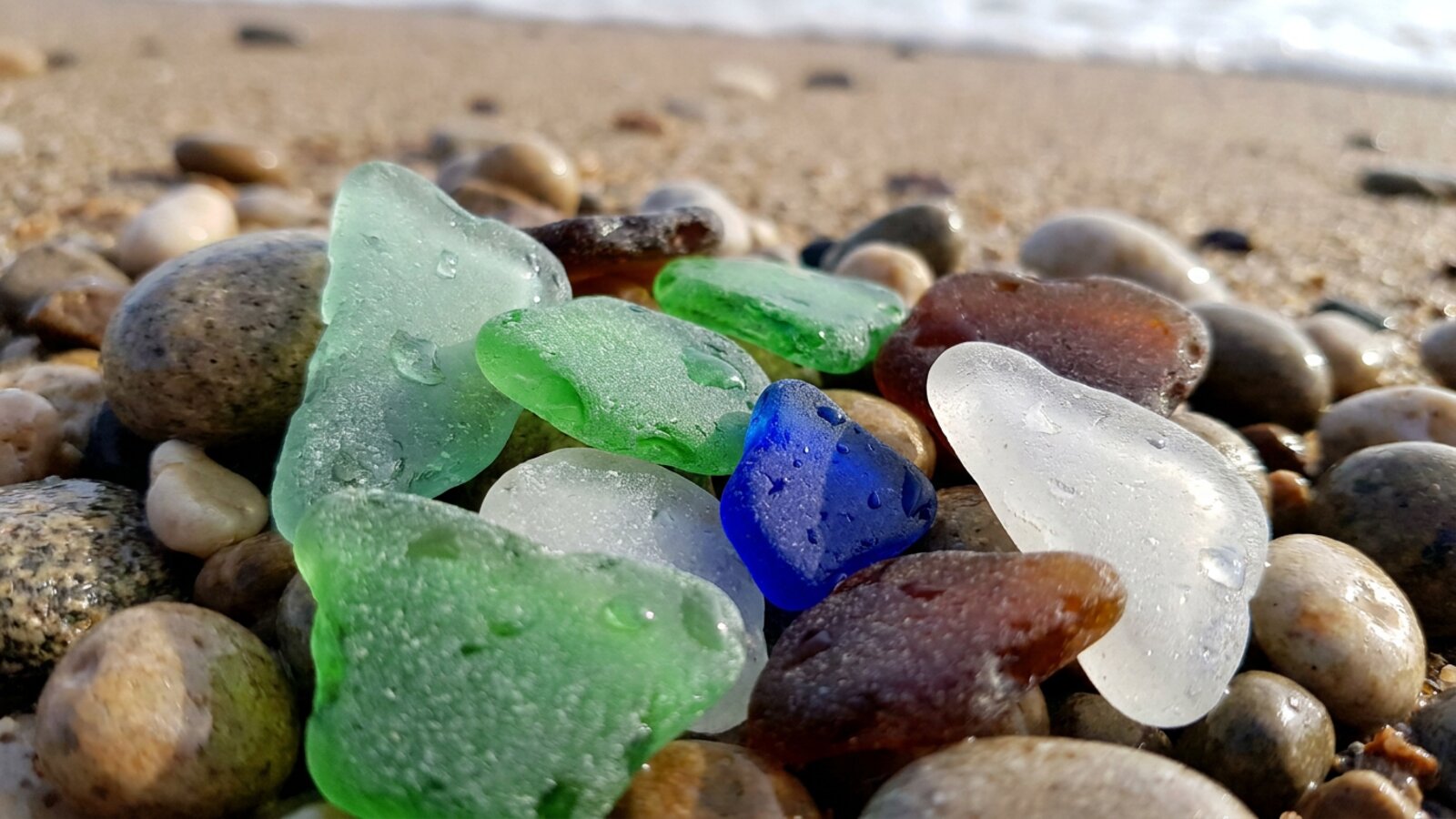
What are the rarest sea glass colours?
Colour tells you where, and when, the glass came from.
| Rarity | Colours | Typical source |
|---|---|---|
| Very common | White/clear, brown, kelly green | Beer, soda and food bottles |
| Uncommon | Seafoam, soft green, forest green, amber | Older bottles, Coke bottles, wine |
| Rare | Cobalt blue, cornflower blue, lavender, amethyst | Medicine bottles (e.g. Milk of Magnesia, Vicks), early manganese glass that turned purple in sunlight |
| Very rare | Citron, aqua, gray, pink, opaque white (milk glass) | Depression glass, cosmetics jars |
| Extremely rare | Red, orange, yellow, turquoise, black | Car tail lights, signal lanterns, art glass; red and orange glass used gold or selenium |
Collectors estimate red turns up about once in 5,000 pieces and orange about once in 10,000. Black sea glass is often very dark olive or amber from 1700s–1800s bottles, which glows green or brown when held to a light.
Where are the best sea glass beaches?
Look for old dumps, glassworks and busy harbours.
- Glass Beach, Fort Bragg, California: three successive town dump sites used from 1906 to 1967; the land beside Glass Beach joined MacKerricher State Park in 2002, collecting there is illegal, and the glass is steadily disappearing.
- Seaham, County Durham, England: waste from the Londonderry Bottleworks (1853–1921) produces multi-coloured “end of day” glass.
- Bermuda (Dockyard area), Puerto Rico (Vieques), and Kauai’s Glass Beach near Port Allen.
- Davenport, California; the Outer Banks of North Carolina; Nova Scotia and Prince Edward Island.
Best times are low tide after winter storms, which churn up new pieces. Check local rules: some parks ban collecting.
What is sea glass made of?
Almost all sea glass starts as soda-lime glass, also called soda-lime-silica glass. This is the ordinary glass of windows, bottles and jars, and it makes up about 90 per cent of all glass manufactured. It is made by melting sand (silica) with soda (sodium carbonate) and lime in a furnace at temperatures that locally reach about 1,675 °C. Sand and other cheap minerals such as trona and feldspar stand in for pure chemicals. The soda lowers the melting point enough to make glass cheaply, and the lime makes the result stable enough to hold a drink.
There are two industrial families of soda-lime glass, and both turn up on beaches. Flat glass for windows is made by floating molten glass on tin. Container glass for bottles and jars is blown or pressed. Window glass carries more magnesium oxide and sodium oxide, and container glass carries more silica, calcium oxide and aluminium oxide. Because container glass holds less of the most water-soluble ions, it is slightly more resistant to attack by water. That is a deliberate design choice for storing food and drink, and it is one reason thick old bottle glass makes such durable sea glass.
Why sea glass is frosted
The frosting is the chemistry half of the story. Glass looks solid and permanent, but over decades in water its surface slowly reacts. Sodium and calcium ions near the surface are leached out and replaced by hydrogen from the water. What remains is a thin skin rich in silica, with a different structure and refractive index from the glass beneath. Studies of glass durability, many of them carried out to judge how well glass will lock up nuclear waste, describe this “leached layer” and how its thickness changes with time, temperature and the chemistry of the surrounding water.
Mechanical wear adds the rest. Sand and pebbles round the edges, and impacts chip the surface into a scatter of tiny crescent-shaped fractures, the C-shaped marks that collectors use as one of the most reliable signs of genuine sea glass. Machine tumbling can mimic the rounding but rarely produces the same pattern of crescents, and acid etching gives an even, sugary frost instead of a patchy one. Sources disagree on timing, but a typical estimate is 20 to 40 years for a piece to acquire the classic look, and up to 100 to 200 years for the deepest frosting. The rate depends on the beach: a pebble beach battered by surf works much faster than a sheltered sandy cove.
Sea glass is often confused with beach glass, and in practice the two names are used interchangeably. Strictly, beach glass comes from fresh water, such as lakes, and is often less frosted. Another informal name, drift glass, comes from the longshore drift that carries pieces along the coast while they are being rounded.
Reading colour like a glass chemist
The colour of a piece of sea glass is a record of what the glassmaker put in the furnace. Ordinary soda-lime glass looks colourless when thin, but the iron impurities present in most sand give it a green tint that you can see by looking through the edge of a thick piece. Glassmakers add iron(II) oxide deliberately to get the bluish-green of many beer bottles. Iron combined with chromium gives the richer green of wine bottles, and chromium alone, a very powerful colourant, can push glass to dark green or almost black. Amber and brown come from sulfur combined with carbon and iron, forming iron polysulfides, and the shade can range from yellowish to nearly black.
Blue is the work of cobalt, which is potent even in tiny doses. Just 0.025 to 0.1 per cent cobalt gives a strong blue, which is why cobalt glass from old medicine, poison and cosmetic bottles is so recognisable. Red and pink usually mean selenium or gold. In low doses selenium acts as a decolouriser, but in higher concentrations its nanoparticles turn glass pink and red, and together with cadmium sulfide it gives bright reds and oranges. The classic “gold ruby” is coloured by colloidal gold. These costly or toxic recipes are one reason red, orange and yellow glass were always produced in smaller quantities, and are correspondingly rare on beaches.
Purple sea glass has the most interesting origin. Glassmakers added manganese dioxide to cancel the green tint from iron and make “clear” glass. Over long exposure to sunlight, the manganese slowly changes to a purple compound. Some New England houses more than 300 years old still have window panes tinted faintly violet by this process, and the same chemistry turns old clear bottle glass a soft lavender. Selenium can do the same decolourising job without turning purple, so not every old clear piece goes lavender.
Glowing glass and other collector clues
Some yellow and yellow-green sea glass contains uranium. Uranium was first identified in 1789, and glassmakers soon began adding it for its fluorescent effect. The glassmaker Riedel produced uranium glass in Bohemia between 1830 and 1848, and by the 1840s many European glassworks made it. Most pieces contain anything from trace amounts to about 2 per cent uranium by weight, and they are considered only negligibly radioactive. The pale yellow-green version earned the nickname “Vaseline glass” in the 1930s, after the look of the petroleum jelly of the day. Under an ultraviolet torch, uranium glass glows a vivid green, which makes a small UV torch a handy tool for beachcombers.
Other colours point to particular products and periods. Opaque white milk glass was first made in Venice in the 16th century. Depression glass, cheap machine-made tableware made in the United States and Canada between 1929 and 1939 and often given away in food boxes, came in pink, yellow, green, blue and amber, and some of it was uranium glass. Collectors link pink sea glass to Depression-era plates and aqua to Ball mason jars and some 19th-century bottles. Soft blue comes from soda, medicine and ink bottles and fruit jars of the late 19th and early 20th centuries, and lime green from 1960s soda bottles. Teal often traces back to Mateus wine bottles, and some red to old Schlitz beer bottles, car tail lights and ship lanterns.
Rarity can be put in rough numbers. According to collectors’ tallies, amber, golden amber, lime green, forest green and soft blue turn up about once in every 25 to 100 pieces. Purple, citron, opaque white, cobalt, cornflower blue and aqua are found once in every 200 to 1,000. Gray, pink, teal, black, yellow, turquoise, red and orange are found once in 1,000 to 10,000. Old “black” glass is usually very dark olive green. Some 18th-century bottles had iron slag added during manufacture to make them stronger and more opaque, and when held up to a strong light such pieces show their original green or brown.
Dating a piece by its shape
Fragments that keep part of a bottle neck, base or embossed lettering can sometimes be dated. Before the 20th century, bottles were blown by hand or in moulds by skilled workers. The automatic bottle-blowing machine, introduced in 1903, industrialised production and gave bottles uniform shapes and seams.
Some fragments are even more distinctive. In 1872 Hiram Codd of Camberwell, London, patented a bottle for fizzy drinks that was sealed by a glass marble pressed against a rubber washer by the gas pressure inside. The thick glass needed to withstand the pressure, and the pinched neck that held the marble, are easy to recognise. Codd bottles were produced for decades and were especially popular in Europe, India and Australasia. Fragments of embossed lettering, maker’s marks or base codes can sometimes narrow a piece to a factory and decade, which turns beachcombing into a kind of coastal archaeology.
The story of Fort Bragg’s Glass Beach
California’s most famous glass beach was a rubbish dump. In 1906 residents of Fort Bragg set up an official dump on the shore behind the Union Lumber Company, now called Site One. Locals simply called it “The Dumps,” and they burned the piles to reduce them. When Site One filled in 1943, dumping moved to Site Two until 1949, and then north to the site now known as Glass Beach, which took the town’s rubbish until 1967. That year the California State Water Resources Control Board and city leaders closed it. Over the following decades waves ground the glass and pottery into smooth pebbles, while metal was removed and sold for scrap.
In 1998 the private owner began a five-year process to clean up the land and sell it to the state. In October 2002 the 38-acre property next to Glass Beach became part of MacKerricher State Park. The glass itself lies below the mean high-water mark, 5.2 feet (1.6 m) at Fort Bragg, the line where property ownership ends under California’s constitution. Collecting is illegal in the park and discouraged by rangers. It still happens: in summer about 1,000 to 1,200 people a day visit the town’s glass beaches, and most take some glass. Combined with the steady grinding of the waves, that means the famous coloured shingle is slowly thinning. A local sea glass museum has even campaigned to restock the beach with discarded glass.
Other famous glass beaches
At Seaham in County Durham, England, John Candlish built the Londonderry Bottleworks in 1853. It became the largest glass bottle works in Britain and ran until 1921. Its waste glass was dumped at sea, and today it washes up on local beaches as multicoloured pebbles. Many collectors prize the pieces with several colours swirled together, said to come from mixing up leftover glass at the end of a working day.
On Kauai, Hawaii, Glass Beach sits in Hanapepe Bay at Eleele, an industrial area near Port Allen harbour. There the sea glass lies among dark basalt pebbles. Benicia, on San Francisco Bay, has another glass beach. In Russia, beaches on Ussuri Bay near Vladivostok have become a tourist attraction because waves have pounded bottles and waste from nearby glass and porcelain factories into rounded pebbles. Broken pottery, called sea pottery, often turns up alongside the glass and can be read in much the same way, from the glaze and the transfer-printed patterns.
All of these beaches share a history of large-scale dumping that would now be illegal. They will not be replaced. Once the existing glass is collected or ground to sand, it is gone. A responsible collector takes a few pieces, leaves sharp shards to finish weathering, and follows local rules. In many protected areas the rule is to take nothing at all.
Is sea glass becoming rare?
Yes, for good reasons and bad.
Since the mid-20th century, plastic has replaced much glass packaging, recycling has reduced dumping, and environmental laws ended ocean disposal. Meanwhile popular beaches have been picked over. The irony is that today’s plastic litter will not turn into anything beautiful: instead of frosting, it fragments into microplastics that end up in fish and even sea salt.
How can you tell real sea glass from fake?
Look at the frost and the edges.
Genuine sea glass has an uneven, slightly pitted frost with tiny C-shaped marks, and its edges are rounded but rarely perfectly uniform. Fake glass is evenly matte, often has a smooth, waxy or sugary feel, and comes in suspiciously bright, uniform colours. Real pieces look glassy when wet and frosty when dry, and often carry fragments of embossing, seams or bottle lips that date them.
Where does sea glass come from?
From discarded glass bottles, jars and tableware that waves have broken and tumbled for decades.
How long does it take for sea glass to form?
Typically about 20–50 years for a well-frosted piece, sometimes longer.
What is the rarest colour of sea glass?
Orange and red are usually considered rarest, along with yellow and turquoise.
Is sea glass worth money?
Most is worth little, but rare colours and large or marked pieces can sell for tens to hundreds of dollars.
Can you take sea glass from Glass Beach in Fort Bragg?
No. Collecting is prohibited within MacKerricher State Park.
What is the difference between sea glass and beach glass?
Sea glass forms in salt water; beach glass forms in fresh water.
Why is sea glass frosted?
Seawater chemically leaches the glass surface, leaving a pitted, hydrated layer.
Is sea glass natural?
No. It is man-made glass weathered by natural processes.
- LaMotte, R. (2004). Pure Sea Glass: Discovering Nature’s Vanishing Gems. Sea Glass Publishing.
- California State Parks. MacKerricher State Park: Glass Beach. parks.ca.gov.
- North American Sea Glass Association. Sea glass rarity and identification resources.
- Touray, J. C. & Baillif, P. (1994). In vitro assessment of the biopersistence of vitreous fibers: state of the art from the physical-chemical point of view (leached-layer glass dissolution). Environmental Health Perspectives 102 (Suppl. 5).
Blane Perun has been exploring Earth’s oceans and marine life for over 25 years. Founder of TheSea.Org in 1999, underwater photographer, coral aquaculture pioneer, and explorer of 80+ countries.
