The Smallest Fish in the World — Paedocypris, the Infantfish and a 6 mm Anglerfish
The smallest fish in the world, by the usual measure, is Paedocypris progenetica, a translucent carp relative from the acidic peat swamps of Sumatra and Bintan whose smallest mature female measured just 7.9 mm. The smallest marine fish is the stout infantfish, Schindleria brevipinguis, of the Great Barrier Reef and Coral Sea, with males averaging 7.7 mm and a maximum of 10 mm. The smallest mature individuals of any fish are the parasitic males of the deep-sea anglerfish Photocorynus spiniceps, at 6.2 to 7.3 mm, but they live fused to females up to 50.5 mm long.
The record depends on whether you count the smallest species, the smallest marine species or the smallest mature individual of any sex, and on how length is measured.
How the smallest fish is measured
Records for tiny fish are measured in millimetres, and the method matters. Ichthyologists normally use standard length, the distance from the tip of the snout to the base of the tail fin, leaving out the tail fin itself, because fins are easily damaged in small specimens. Records are also usually based on mature individuals: a newly hatched larva of almost any fish is tiny, so the meaningful question is how small a fish can be when it is fully grown and able to breed. Finally, it matters whether we compare the smallest species, judged by its typical adult size, or the smallest single individual ever found. Those three choices explain why several different fish are called “the smallest in the world”, and why the title has changed hands several times since the 1980s.
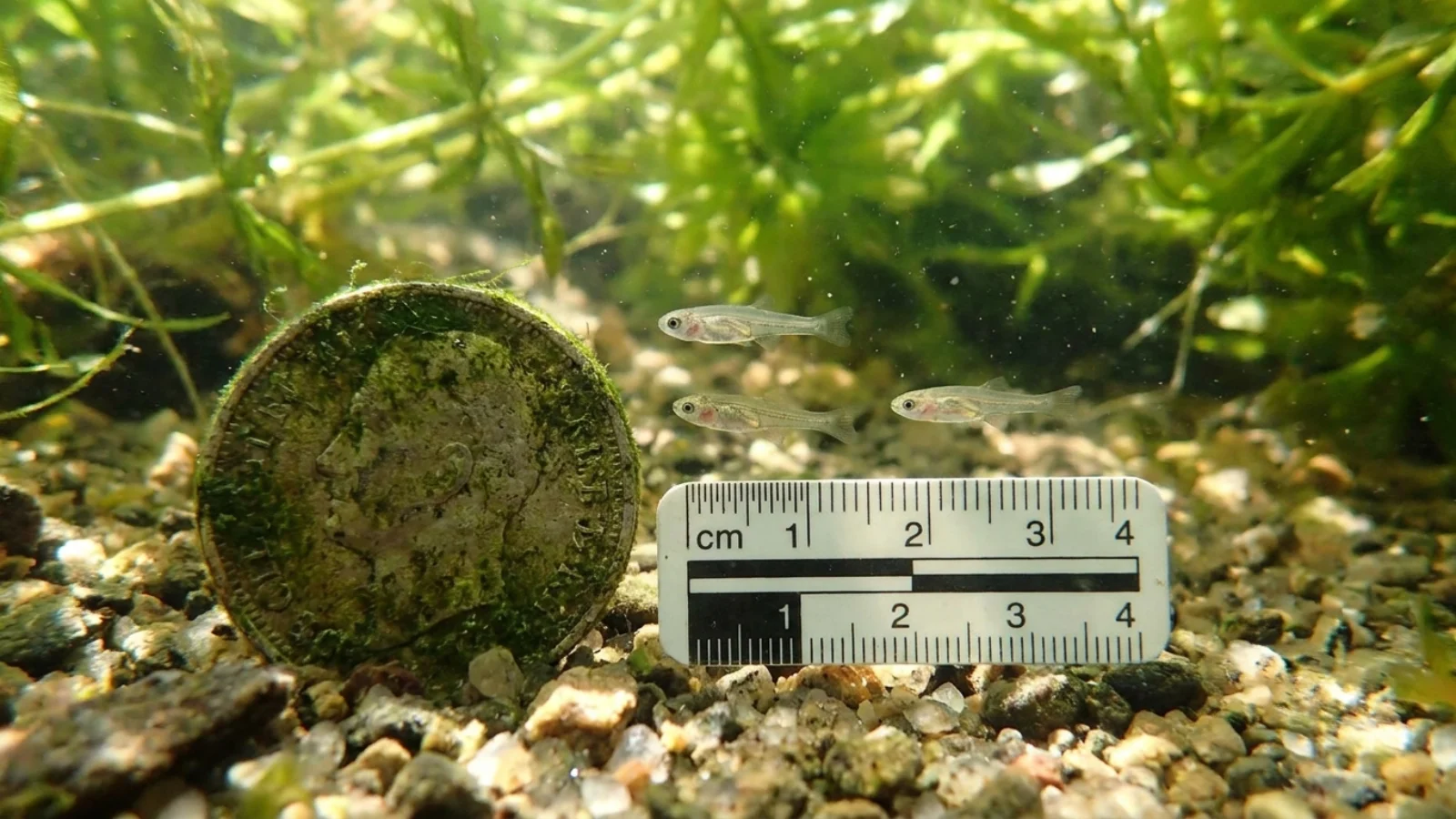
1. Paedocypris progenetica: the smallest fish species
Paedocypris is a genus of tiny fish in the carp family, Cyprinidae, described in 2006 by Maurice Kottelat, Ralf Britz, Heok Hui Tan and Kai-Erik Witte. It lives in swamps and streams on the South-East Asian islands of Sumatra, Bintan and Borneo, and the type species, Paedocypris progenetica, is the best-known claimant to the title of world’s smallest fish. The smallest mature female measured 7.9 mm in standard length, smaller than the female of any other vertebrate, and the largest individual known is 10.3 mm. When it was described it was also hailed as the smallest vertebrate of all, a title it held until the description of the New Guinea frog Paedophryne amauensis in 2012.
The name Paedocypris means “child carp”, and it fits. These fish are progenetic: they become sexually mature while keeping a body that looks like a larva’s. Their translucent bodies lack features typical of adult fish, such as a bony skull roof covering the brain, and they retain the larval fin-fold along the underside of the tail. In effect, evolution has stopped their development early and allowed them to breed in a juvenile form. The sexes are also unusual: males have strongly modified pelvic fins, with the first ray ending in a hook, which probably help them clasp females during spawning.
Three species are currently recognised: P. progenetica from Sumatra and Bintan, P. micromegethes from Sarawak in Malaysian Borneo, and P. carbunculus from peat swamps in Central Kalimantan, Indonesian Borneo. All are habitat specialists that live only in acidic water. Within the peat swamp forests they tend to stay in the deeper, cooler water near the bottom.
Life in the blackwater swamps
Peat swamp forests are among the most extreme freshwater habitats on Earth. Their tea-coloured blackwaters are stained by tannins from decaying leaves and are very acidic, poor in nutrients and often low in oxygen. A 2026 genome study by Sudasinghe, Britz and colleagues described these swamps as harbouring a remarkable diversity of fish, including several lineages that have independently adapted to the conditions and in some cases become extremely miniaturised, among them Paedocypris and the related Sundadanio atomus. Their tiny size may itself be an advantage: during droughts, Paedocypris can survive in the small puddles that remain.
The same specialisation makes them fragile. Their small ranges and narrow habitat needs leave them extremely vulnerable to habitat loss, especially the drainage and burning of peat swamps for agriculture and plantations, and some populations have already disappeared. Scientists have suggested that other miniature fish from these swamps may have gone extinct before anyone described them.
2. The stout infantfish: the smallest marine fish
The smallest fish in the sea is the stout infantfish, Schindleria brevipinguis, described in 2004 by Watson and Walker. It is native to Australia’s Great Barrier Reef and to Osprey Reef in the Coral Sea. Males have an average standard length of 7.7 mm, a gravid female measured 8.4 mm, and the maximum length known for the species is 10 mm. When it was described it took the title of smallest known vertebrate, which it held until Paedocypris was described two years later.
Infantfish are relatives of the gobies and, like Paedocypris, they keep larval features into adulthood. Fish this small and slender are almost impossible to spot underwater, so they are known mainly from collected specimens rather than from observations of living fish. The IUCN lists the stout infantfish as Least Concern.
3. The anglerfish with 6 mm males
If the question is the smallest mature fish of any kind, the answer is a deep-sea anglerfish. In Photocorynus spiniceps, known mature males measure only 6.2 to 7.3 mm, smaller than any other mature fish or vertebrate. The females, however, are giants by comparison, reaching up to 50.5 mm. The male spends its life fused to a female after biting into her body, so that the pair effectively function as a single hermaphrodite. This is the extreme form of the sexual parasitism seen in several families of deep-sea anglerfish, described in our list of the ugliest fish in the world.
Because only the males are tiny, most specialists do not count Photocorynus as the smallest fish species. Many fish species mature below 20 mm in both sexes, while the anglerfish’s tiny males depend entirely on a much larger female.
4. The midget dwarfgoby and other tiny gobies
Gobies dominate the list of tiny reef fish. The midget dwarfgoby, Trimmatom nanus, lives on oceanic drop-offs in the Indian Ocean and western Pacific and was, until 2004, the smallest known fish and vertebrate. The discovery of the stout infantfish pushed it into second place, and the description of Paedocypris pushed it further down. Many dwarf gobies are only about a centimetre long as adults.
Tiny gobies also hold a remarkable lifespan record. A 2005 study in Current Biology by Martial Depczynski and David Bellwood reported the shortest lifespan recorded for any vertebrate in the pygmy goby Eviota sigillata of the Great Barrier Reef, which lives for a maximum of about 59 days. In that time it must grow from a larva drifting in the plankton, settle on the reef, mature and breed. Our guide to gobies and blennies covers the reef’s smallest fish more broadly.
In fresh water, the dwarf pygmy goby, Pandaka pygmaea, of brackish water and mangroves in South-East Asia is another of the world’s smallest fish. The sinarapan, Mistichthys luzonensis, a goby found only in a few lakes and rivers of the Philippines, is listed by Guinness World Records as the smallest commercially harvested food fish, caught with fine nets and palm leaves; its story is told in more detail below.
The smallest shark, seahorse and other tiny relatives
Every group of fish has its miniature. The smallest shark in the world is the dwarf lanternshark, Etmopterus perryi, which reaches a maximum known length of about 20 cm. It is known only from the upper continental slopes off Colombia and Venezuela, at depths of 283 to 439 m, and it can be identified by its small size at maturity, its long, flattened head and a pattern of black markings on its underside with a dark line along the middle of its back.
Among seahorses, Bargibant’s pygmy seahorse, Hippocampus bargibanti, is usually under 2 cm long and at most about 2.7 cm. It spends its adult life on a single sea fan of the genus Muricella, with bulbous tubercles that copy the fan’s polyps so precisely that the species was noticed only in 1969, when a pair turned up on a gorgonian on a laboratory bench in New Caledonia. Read more in our profile of the pygmy seahorse.
A short history of the record
The title of world’s smallest fish has passed through several hands in a few decades, and the sequence shows how recently these animals were found. The midget dwarfgoby, Trimmatom nanus, was described by Winterbottom and Emery in 1981 and held the record for more than twenty years. In 2004 Watson and Walker described the stout infantfish from the Great Barrier Reef, and it became the smallest known fish and vertebrate. Just two years later, in January 2006, Kottelat and colleagues published Paedocypris in the Proceedings of the Royal Society B under a title calling it the world’s smallest vertebrate. In 2012 the frog Paedophryne amauensis from Papua New Guinea took the vertebrate title, measured by snout-to-vent length, although the smallest mature female Paedocypris remains smaller than the female of any other vertebrate.
The genus name itself records the scientists’ surprise. It combines the Greek paideios, meaning children, with cypris, a name for Venus that is commonly used as a suffix for carp genera; the species name progenetica refers to progenesis, the evolutionary process by which an animal becomes sexually mature while keeping juvenile features.
The sinarapan of Lake Buhi
The sinarapan deserves a closer look, because it is a tiny fish that people depend on. It is the only member of its genus, Mistichthys, and lives only in the Philippines: along the Bicol River, in Lakes Buhi and Bato, in the small lakelets of Katugday and Manapao near Buhi in Camarines Sur, and in Danao Lake in Polangui, Albay. It lives from the shoreline down to about 12 m and tends to school, which makes it easy to catch in large numbers. Known locally as tabyos, it is considered a delicacy and has been harvested heavily since the 1940s. That combination of a tiny range and intense fishing is why the IUCN lists it as Vulnerable.
Why some fish became so small
Miniaturisation has evolved many times in fish, and the same few explanations recur. In unusual habitats with little food, such as acidic swamp waters, being small reduces energy needs. Tiny size lets fish use microhabitats that larger animals cannot, such as the gaps between coral branches, the surface of a sea fan or the puddles left in a drying swamp. Maturing early, as Paedocypris and the infantfishes do, allows a fish to reproduce quickly, which suits environments where life is short or unpredictable; the 59-day lifespan of Eviota sigillata is an extreme example.
There are limits. Below about 8 mm a vertebrate has to fit a brain, eyes, gills, gut, muscles and reproductive organs into a body the size of a grain of rice, and miniature fish often show reduced skeletons and simplified organs as a result. The fact that the smallest fish, the smallest frog and the smallest marine fish all mature at about 7 to 8 mm suggests that this may be close to the lower size limit for a free-living vertebrate.
How small fish are discovered
Almost all of the record holders in this list were described in the last few decades, and that is no coincidence. Tiny transparent fish are easily missed by ordinary nets, collectors and divers. Paedocypris came from careful sampling of blackwater swamps that few ichthyologists had visited; and the pygmy seahorse was discovered by accident on a sea fan collected for another purpose. Specialists expect that more miniature fish remain undescribed, particularly in tropical peat swamps and on deep reef walls. The irony is that some of those habitats, especially the peat swamps of Sumatra and Borneo, are disappearing faster than they can be surveyed.
From the smallest to the largest
The difference between the extremes of fish size is staggering. A mature Paedocypris of 8 mm and a whale shark of more than 18 m differ in length by a factor of more than 2,000. Both are fish, and both are highly specialised for their way of life. For the other end of the scale, see our ranking of the largest fish in the world, and for the smallest cephalopod see our profile of Octopus wolfi, an octopus that barely reaches 2.5 cm.
What is the smallest fish in the world?
Paedocypris progenetica, from peat swamps in Sumatra and Bintan; the smallest mature female measured 7.9 mm.
What is the smallest fish in the ocean?
The stout infantfish, Schindleria brevipinguis, of the Great Barrier Reef and Coral Sea; males average 7.7 mm and the maximum is 10 mm.
What is the smallest mature fish of all?
Males of the deep-sea anglerfish Photocorynus spiniceps, at 6.2 to 7.3 mm, which live fused to much larger females.
What is the smallest shark?
The dwarf lanternshark, which reaches about 20 cm and lives off Colombia and Venezuela.
Is Paedocypris the smallest vertebrate?
It was once; since 2012 the New Guinea frog Paedophryne amauensis has been considered smaller by some measures.
Which fish has the shortest life?
The pygmy goby Eviota sigillata, which lives at most about 59 days.
What is the smallest fish people eat?
The sinarapan of the Philippines, listed by Guinness World Records as the smallest commercially harvested food fish.
Why are some fish so small?
Small size saves energy in poor habitats, opens tiny microhabitats and allows early breeding.
- Kottelat, M., Britz, R., Tan, H. H. and Witte, K.-E. (2006), “Paedocypris, a new genus of Southeast Asian cyprinid fish with a remarkable sexual dimorphism, comprises the world’s smallest vertebrate”, Proceedings of the Royal Society B, doi:10.1098/rspb.2005.3419.
- Depczynski, M. and Bellwood, D. R. (2005), “Shortest recorded vertebrate lifespan found in a coral reef fish”, Current Biology, doi:10.1016/j.cub.2005.04.016.
- Sudasinghe, H. et al. (2026), “Reference genomes of four miniature and non-miniature cypriniform fishes inhabiting acidic peat-swamp forest blackwaters of Southeast Asia”, preprint.
- Wikipedia contributors, “Paedocypris”, “Schindleria brevipinguis”, “Photocorynus spiniceps”, “Trimmatom nanus”, “Dwarf pygmy goby”, “Sinarapan”, “Dwarf lanternshark” (accessed November 2026).
Blane Perun has been exploring Earth’s oceans and marine life for over 25 years. Founder of TheSea.Org in 1999, underwater photographer, coral aquaculture pioneer, and explorer of 80+ countries.
About Blane Perun →