The Deepest Animals in the Ocean — Records From the Hadal Trenches
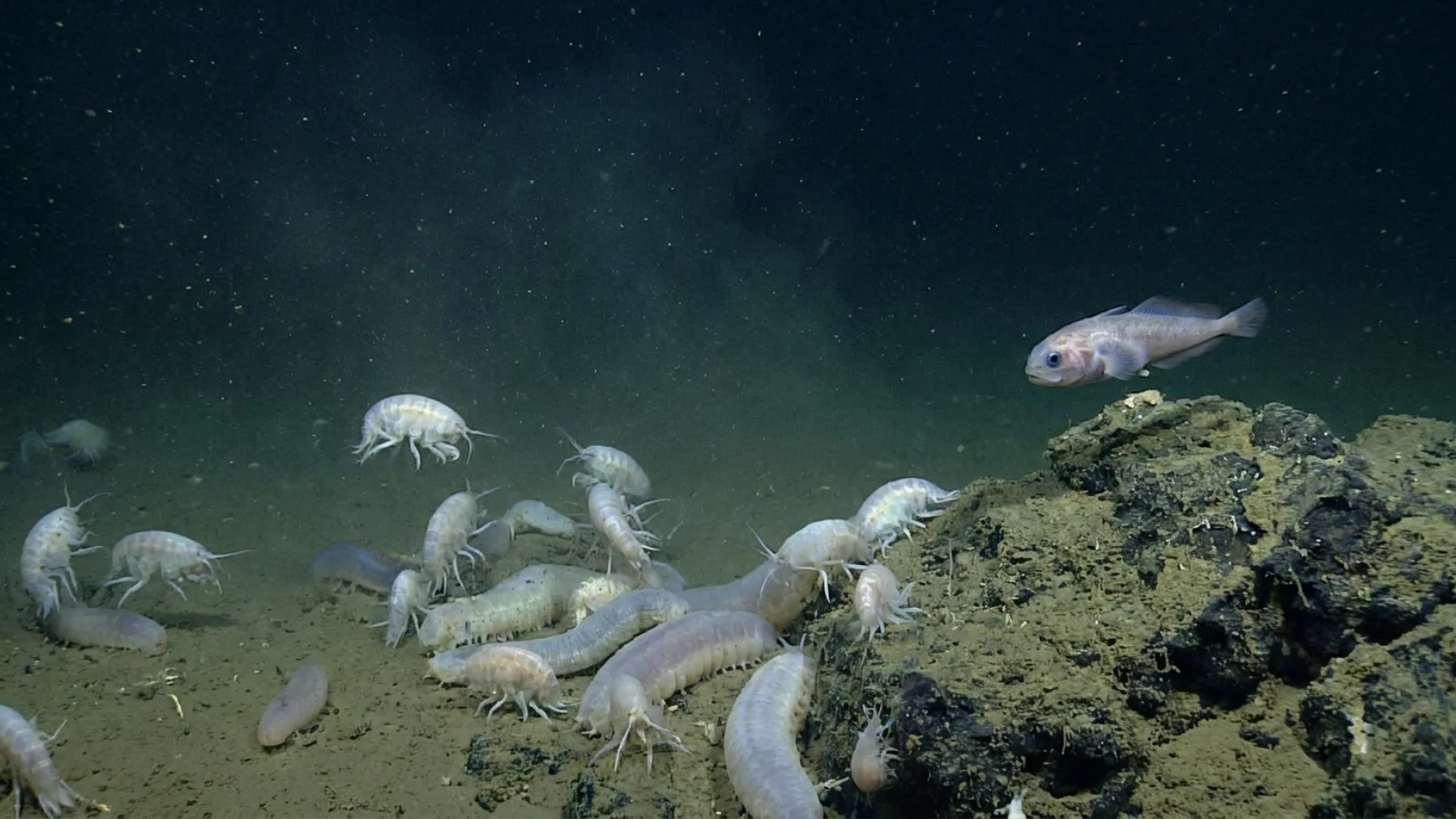
The deepest animals in the ocean live on the floor of Challenger Deep, about 10,900 m down, where amphipods, sea cucumbers, worms and single-celled foraminifera have all been recorded. The deepest fish is a juvenile snailfish (Pseudoliparis) filmed at 8,336 m in the Izu-Ogasawara Trench off Japan in 2022, announced in April 2023. The deepest cephalopods are a dumbo octopus seen at 6,957 m and a bigfin squid at about 6,200 m. Among air-breathers, the record belongs to a Cuvier’s beaked whale tagged at 2,992 m.
Invertebrates reach the very bottom of the ocean; fish appear to stop at about 8,200 to 8,400 m because of the chemistry of their cells, so the deepest fish record is close to a physical limit rather than a gap in exploration.
Where the deepest animals live
The ocean is divided by depth into zones, and the deepest of them, the hadal zone, is found almost entirely inside ocean trenches. These are long, narrow gashes in the seafloor where one tectonic plate dives beneath another, and they plunge far below the abyssal plains that cover most of the deep ocean floor. The hadal zone is usually defined as everything deeper than about 6,000 m. Its very bottom is Challenger Deep, at the southern end of the Mariana Trench in the western Pacific, where published estimates of the maximum depth cluster around 10,900 m, with figures from about 10,911 to 10,935 m depending on the survey and method.
Biologists did not always treat the trenches as a separate world. In the early 1950s the Danish Galathea expedition and the Soviet research ship Vityaz independently found a distinct change in the animals living below roughly 6,000 to 7,000 m, a change that the broad term “abyssal” did not capture. That observation is the origin of the hadal zone as a concept. Because the shift happens gradually across that 1,000 m band, some researchers have proposed placing the boundary in the middle, at about 6,500 m, while many still use the original 6,000 m line.
Every animal in this list lives, or was recorded, in water that is permanently dark and close to freezing, under pressure of several hundred times that at the surface. At the bottom of Challenger Deep the pressure is roughly a thousand times greater than at sea level. The animals that manage there are not monsters; most are small scavengers and deposit feeders that depend on food sinking from far above.
How depth records are made
A depth record is only as good as the method behind it, and that matters more than most lists admit. Older records came from trawl nets dragged along the seafloor from ships. A net that is open all the way down and all the way up can catch an animal at any depth along the way, so a fish recovered from a trawl that reached 8,000 m was not necessarily living at 8,000 m. Modern records come instead from baited landers: free-falling frames carrying cameras and traps that sit on the seafloor at a known depth and film whatever comes to the bait. A fish filmed at the bait on a lander is unambiguous. For that reason, this list separates animals that were filmed or caught at a known depth from those recorded by older, open-net methods, and we give the source and date for each record. Records in the deep sea are broken regularly, and several in this list were set in the last decade.
The deepest fish: hadal snailfish
Snailfish, family Liparidae, are a large family of mostly small, soft-bodied fish. Most species live in cold coastal water or on continental slopes shallower than about 4,000 m, but the family also holds every reliable record for the deepest fish. Snailfish have been found in at least seven ocean trenches, and in the trenches of the western Pacific they are the dominant fish at the bottom.
The current record was set during an expedition to the trenches around Japan in August 2022, led by Alan Jamieson of the University of Western Australia’s Minderoo-UWA Deep Sea Research Centre with the Tokyo University of Marine Science and Technology. A baited lander in the Izu-Ogasawara Trench filmed a small juvenile snailfish of the genus Pseudoliparis at 8,336 m. On the same expedition, traps in the neighbouring Japan Trench caught two snailfish at 8,022 m, which the team described as the only fish ever caught below 8 km. The results were made public in early April 2023, when Guinness World Records also recognised the filmed fish as the deepest ever recorded. Jamieson described the depth these fish can survive as “truly astonishing” and the Japanese trenches as rich in life “all the way at the bottom.”
The previous record came from the Mariana Trench. The Mariana snailfish, Pseudoliparis swirei, was formally described in 2017; its holotype was caught on 21 November 2014 at 7,949 m, and the species is known from about 6,198 m to 8,076 m. Snailfish were filmed deeper still in the same trench, at 8,145 m in December 2014 and 8,178 m in May 2017. Sources differ on who those fish were: Guinness lists the 2017 record under P. swirei, while other accounts attribute the deepest Mariana footage to a different, undescribed species nicknamed the “ethereal snailfish”. Either way, the Izu-Ogasawara fish beat both by more than 150 m.
How do these fish live so deep? Hadal snailfish have no swim bladder, a gelatinous body rather than heavy muscle, and a skeleton that is only partly hardened. Their bodies are loaded with trimethylamine N-oxide (TMAO), a small molecule that stabilises proteins against the distorting effect of pressure. The deeper a fish lives, the more TMAO its tissues contain. Researchers who measured this trend calculated that at somewhere between about 8,000 and 8,500 m a fish would need so much TMAO that its body fluids would become saltier than seawater, drawing water in by osmosis. The 8,336 m snailfish sits just inside that predicted ceiling, which is why scientists think fish will never be found at the bottom of Challenger Deep. A 2025 genetic study by Maroni, Weston, Kitazato and Jamieson found that some hadal snailfish species range across several separate trenches, so the deepest fish may be more widespread than the scattered records suggest.
Our profile of the Mariana snailfish covers that species’ biology in more detail.
Contenders from older records: cusk eels and pearlfish
For decades the textbook answer to “what is the deepest fish” was a cusk eel, Abyssobrotula galatheae. One specimen was trawled from 8,370 m in the Puerto Rico Trench in 1970, deeper than any snailfish since. The difficulty is the method: the record may have come from a net that was open during its descent and ascent, so the fish could have been caught somewhere shallower. Most specialists now treat it as unconfirmed. A pearlfish, Echiodon neotes, was likewise reported from a trawl reaching 8,200 to 8,300 m, but it too was probably caught in open water on the way up rather than on the seafloor. Neither has been filmed at such depths, and the lander records from snailfish remain the reliable benchmark.
The deepest octopus and squid
Cephalopods were long thought to be absent from the trenches. Occasional open-net trawls hinted that they might reach about 8,000 m, but before 2020 the deepest confirmed photograph of any cephalopod had been taken at 5,145 m. In a 2020 paper in Marine Biology, Alan Jamieson and Michael Vecchione reported video from a lander in the Java Trench, in the Indian Ocean, showing a dumbo octopus (Grimpoteuthis sp.) at 5,760 m and again at 6,957 m. That extended the known depth range of cephalopods by 1,812 m and, the authors calculated, raised the share of the global seafloor potentially open to cephalopods from about 75 to 99 percent. Our page on dumbo octopus depth follows these cirrate octopods down through the abyss.
Squid joined the list in 2021. In March of that year the crewed submersible DSV Limiting Factor, searching the Philippine Trench for the wreck of the destroyer USS Johnston, filmed a bigfin squid (family Magnapinnidae) swimming just above the seafloor at about 6,200 m. Jamieson and Vecchione described the sighting in Marine Biology in December 2021; it was the first squid ever seen at hadal depth, beating a previous bigfin record of about 4,700 m. The animal had short arms and was probably a juvenile. On the same dives the team recorded four dumbo octopuses at similar depths, only the second time cirrate octopods had been seen that deep.
Animals on the floor of Challenger Deep
Below the fish limit, life continues to the very bottom. The most famous inhabitant of Challenger Deep is Hirondellea gigas, a scavenging amphipod, a relative of beach hoppers, a few centimetres long. Baited traps sent to the bottom of the trench regularly come back full of them, and expeditions have recovered dozens to hundreds at a time from depths of about 10,900 m. The biologist A. Aristides Yayanos recovered a live amphipod from about 10,900 m using a pressurised trap.
Amphipods have their own unusual chemistry. For some years it was claimed that H. gigas coats itself in an aluminium gel to stop its shell from dissolving below the depth at which calcium carbonate is no longer stable. A 2022 study in PLOS ONE by Okada and colleagues, using electron microscopy designed to avoid aluminium contamination, found no aluminium shield; instead, the grinding parts of its stomach and its bristles are enriched in bromine, which may harden them. It is a reminder that even well-publicised deep-sea “facts” get revised.
Other animals share the trench floor. Cameras sent into Challenger Deep have recorded sea cucumbers, white polychaete bristle worms, scale worms, tube worms and small shrimp-like crustaceans. Holothurians, or sea cucumbers, are especially important in the deepest trenches; they plough through the soft sediment, digesting the organic matter that settles from above. Reviews of hadal fauna list polynoid scale worms, myriotrochid sea cucumbers, turrid snails and pardaliscid amphipods among the animals recorded deeper than 10,000 m. Our guides to deep-sea crustaceans and the depth of the Mariana Trench cover this ecosystem further.
Single-celled giants: foraminifera and xenophyophores
Some of the deepest organisms are not animals at all but single-celled protists. Sediment cores taken from Challenger Deep have yielded hundreds of kinds of foraminifera, mostly soft-walled forms, along with a few multi-chambered species. Xenophyophores, a group of giant foraminifera whose single cells can reach several centimetres across and build fragile structures from sediment grains, have been found from about 500 m to about 10,600 m. They are among the most abundant large organisms on parts of the deep seafloor and provide shelter for small animals living in and around them. Strictly they do not belong on a list of animals, but they are often the first living things a camera sees on the floor of a trench.
The deepest air-breathers
A different set of records belongs to animals that must return to the surface to breathe. The deepest-diving mammal is Cuvier’s beaked whale. In 2014 researchers working off southern California reported a tagged individual that dived to 2,992 m, and the same species holds the record for the longest dive by a mammal, at 222 minutes. How these whales tolerate such pressure is still debated; one suggestion is that their rib cage and lungs collapse on deep dives, forcing air out of the gas-exchange surfaces and limiting nitrogen uptake.
The sperm whale is close behind, diving to at least 2,250 m for up to two hours as it hunts squid. Among seals, the southern elephant seal has been recorded at a maximum of 2,388 m, making it the deepest-diving air-breather outside the whales. Elephant seals dive almost continuously at sea, each dive lasting more than 20 minutes, typically to 400 to 1,000 m. Our elephant seal profile describes these diving records.
Among reptiles, the leatherback turtle follows its jellyfish prey deeper than 1,000 m, beyond the limits of any other diving reptile or bird. Birds stop much shallower. The emperor penguin is the deepest-diving bird: the American physiologist Gerry Kooyman’s first dive recorders in 1971 showed dives to 265 m, later work found a small female reaching 535 m near McMurdo Sound, and a bird from the Auster colony reached 564 m in 1994.
Why the deep trenches are hard to study
Most of the records above are recent because reaching hadal depths is expensive and risky. Only a handful of vehicles have ever reached the bottom of Challenger Deep. Jacques Piccard and Don Walsh made the first descent in the bathyscaphe Trieste in 1960. James Cameron dived solo to about 10,908 m in 2012 in the Deepsea Challenger; our account of Cameron’s Mariana Trench dive covers that expedition. The Chinese crewed submersible Jiaolong reached 7,020 m in the Mariana Trench in 2012, and several deep robotic vehicles have been lost, including Japan’s Kaiko in 2003 and the US vehicle Nereus in 2014.
Landers changed the field. They are cheap enough to deploy repeatedly in different trenches, and their cameras record animals at the bait for hours. Most of the fish records in this list came from landers rather than crewed dives. Even so, only a small fraction of the hadal seafloor has been seen, and the trenches are separated from each other like islands. It is likely that more deep species, and deeper records within known groups, remain to be found.
Hadal life depends on falling food
No sunlight reaches the trenches, so almost all food arrives from above as marine snow, dead plankton, carcasses and plant debris. Researchers studying trenches have proposed that their steep, V-shaped walls funnel this material toward the axis, and that earthquake-triggered slides add more, so a trench floor may hold more organic matter than the surrounding abyssal plain; that would help explain why snailfish and amphipods are abundant there rather than rare. Snailfish in turn feed largely on amphipods and other small crustaceans, so the deepest fish food webs are short: sinking food, scavenging amphipods, and the fish that eat them.
Why fish stop but invertebrates do not
The contrast between fish and invertebrates at the bottom of the ocean is the most interesting pattern in these records. Invertebrates such as amphipods and sea cucumbers have body fluids that are naturally close to the saltiness of seawater, so they can accumulate pressure-protecting molecules without upsetting their water balance. Bony fish keep their blood much less salty than the sea, and every extra molecule of TMAO they need to protect their proteins pushes them towards that osmotic limit. The 8,000 to 8,500 m ceiling predicted from TMAO measurements matched the depth at which snailfish disappear from trench footage, and the 2022 record at 8,336 m fits within it.
That makes the deepest animals in the ocean a story of chemistry as much as exploration. The trenches are not empty below 8,400 m, but the animals living there are crustaceans, worms, sea cucumbers, snails and single-celled giants rather than fish. For the wider list of extremes, see our hub of deep-sea predators and the guide to the deepest point in each ocean.
What is the deepest animal in the ocean?
Amphipods such as Hirondellea gigas, along with sea cucumbers and worms, live on the floor of Challenger Deep at about 10,900 m, the deepest point in the ocean.
What is the deepest fish ever recorded?
A juvenile snailfish of the genus Pseudoliparis filmed at 8,336 m in the Izu-Ogasawara Trench off Japan in August 2022, announced in April 2023.
What is the deepest fish ever caught?
Two snailfish trapped at 8,022 m in the Japan Trench in 2022. A cusk eel reported from 8,370 m in 1970 may have been caught shallower by an open net.
Can fish live at the bottom of the Mariana Trench?
Probably not. Pressure chemistry appears to limit fish to about 8,000 to 8,500 m, well short of the 10,900 m bottom.
What is the deepest octopus?
A dumbo octopus (Grimpoteuthis) filmed at 6,957 m in the Java Trench, reported in 2020.
What is the deepest squid?
A bigfin squid filmed at about 6,200 m in the Philippine Trench in March 2021.
Which mammal dives the deepest?
Cuvier’s beaked whale, recorded at 2,992 m in a 2014 study; it also holds the 222-minute record for the longest dive.
What lives at the bottom of Challenger Deep?
Scavenging amphipods, sea cucumbers, bristle worms, scale worms and many single-celled foraminifera.
- Jamieson, A. J. and Vecchione, M. (2020), “First in situ observation of Cephalopoda at hadal depths”, Marine Biology 167, doi:10.1007/s00227-020-03701-1.
- Jamieson, A. J. and Vecchione, M. (2021), “Hadal cephalopods: first squid observation (Magnapinna sp.)”, Marine Biology, doi:10.1007/s00227-021-03993-x; Live Science report on the Philippine Trench squid.
- OPB/NPR (5 April 2023), “Check out the deepest-swimming fish ever caught on camera” (UWA, Minderoo-UWA Deep Sea Research Centre, Tokyo University of Marine Science and Technology).
- Okada, S. et al. (2022), “Unusual bromine enrichment in the gastric mill and setae of the hadal amphipod Hirondellea gigas”, PLOS ONE, doi:10.1371/journal.pone.0272032.
- Maroni, P. J. et al. (2025), “Hadal snailfishes extend across multiple trenches”, Ecology and Evolution, doi:10.1002/ece3.71779.
- Wikipedia contributors, “Hadal zone”, “Snailfish”, “Pseudoliparis swirei”, “Abyssobrotula galatheae”, “Challenger Deep”, “Xenophyophorea”, “Cuvier’s beaked whale”, “Southern elephant seal”, “Emperor penguin” (accessed November 2026).
Blane Perun has been exploring Earth’s oceans and marine life for over 25 years. Founder of TheSea.Org in 1999, underwater photographer, coral aquaculture pioneer, and explorer of 80+ countries.
About Blane Perun →