The Rarest Sea Animals in the World — Vaquita, Rice’s Whale, Maui Dolphin and Red Handfish
The rarest sea animal in the world is the vaquita, a small porpoise of Mexico’s upper Gulf of California, of which a 2025 survey saw just 7 to 10 individuals. Close behind are Rice’s whale of the Gulf of Mexico, with a most recent estimate of about 50 animals, the Maui dolphin of New Zealand, at about 54 dolphins older than one year, and the red handfish of Tasmania, with fewer than 250 left on two small reefs. Larger but still critically threatened populations include the North Atlantic right whale, estimated at 384 in 2024, and the Hawaiian monk seal, at about 1,600.
This list ranks animals by how few individuals are thought to survive in the wild, using the most recent published counts. Rarity is not the same as risk: a species can be rare but stable, or common but declining fast.
How rarity is measured
Counting animals in the sea is hard. Whales and dolphins are counted with a mix of aerial and ship surveys, photo-identification of individuals from natural markings, acoustic detectors that listen for their calls, and genetic mark-recapture studies that identify individuals from small skin samples. Fish and invertebrates are usually counted by divers on fixed transects. Each method produces an estimate with a range of uncertainty, and estimates are often published a year or more after the survey. The numbers in this list are the most recent figures published by the agencies or scientific teams responsible, with the year they refer to, and where sources differ both figures are given.
Rarity is also different from threat. The IUCN Red List assesses extinction risk using several criteria, including how fast a population is declining, how small and fragmented its range is, and how many mature individuals remain. A species can be listed as Critically Endangered because it has crashed from millions to thousands, even though thousands is far from rare. The animals below are the ones that are genuinely scarce in absolute numbers, from a handful of individuals to a few hundred.
1. Vaquita: the rarest marine mammal
The vaquita, Phocoena sinus, is a porpoise found only at the northern end of the Gulf of California in Mexico, the smallest range of any marine mammal. It is the smallest living cetacean, recognisable by the prominent black patches around its lips and eyes, and it was described by Norris and McFarland only in 1958, from skulls found on a beach. Its steep decline has been driven primarily by drowning in gillnets set for the totoaba, a large fish whose swim bladder is prized as a delicacy and luxury product in Chinese markets and is smuggled, often through Hong Kong, at very high prices. For the animal’s size, range and biology, see vaquita facts.
The latest numbers come from the joint acoustic and visual survey carried out in 2025 by Sea Shepherd, Mexican government agencies and international scientists. Acoustic monitoring ran from 24 May to 29 September, using 1,228 detector deployments at 497 sites and recording 254 acoustic encounters with vaquitas. Visual observers aboard the vessels Seahorse and Bob Barker searched from 2 to 30 September. The survey team concluded, with a 67% probability, that between 7 and 10 distinct vaquitas were seen, including at least one or two calves. One calf belonged to a female known as Frida, recognisable by her bent dorsal fin, who was also seen with calves in 2023 and 2024. Comparable surveys estimated 8 to 12 animals in 2023 and 6 to 8 in 2024.
The fact that vaquitas are still breeding is the main reason for hope. The population no longer appears to be collapsing at the rate seen in earlier years, when it fell by 45% in a single year. But the margin for error is close to zero, and protection in the upper Gulf has been inconsistent: in 2021 the Mexican government removed a no-tolerance zone and reopened the area to fishing. Any vaquita caught in a gillnet now represents a significant fraction of the species. Our page on which dolphins are endangered compares the vaquita with other threatened cetaceans.
2. Rice’s whale: the rarest great whale
Rice’s whale, Balaenoptera ricei, is a baleen whale that lives year-round in the Gulf of Mexico, called the Gulf of America in current US federal usage. It was long treated as a population of Bryde’s whale, but scientists demonstrated in 2021 that it is genetically and physically distinct, and it was named after Dale W. Rice, who first wrote about these whales in 1965. According to NOAA Fisheries, the population is likely fewer than 100, and the most recent estimate, from surveys in 2017 and 2018 in the north-eastern Gulf, is about 50 individuals.
Most sightings are in waters 100 to 400 m deep in the north-eastern Gulf, off west Florida and south of Alabama, an area also crossed by shipping and energy activity. The threats NOAA lists include vessel strikes, noise from ships and energy exploration, oil spills and other pollutants, including the lingering effects of the 2010 Deepwater Horizon spill, marine debris, entanglement in fishing gear and climate change affecting its prey. It was listed as endangered under the US Endangered Species Act in 2019. With so few animals and such a narrow range, a single major spill or a few ship strikes could decide its fate.
3. Maui dolphin: the rarest dolphin
The Maui dolphin, a subspecies of Hector’s dolphin, is one of the world’s rarest and smallest dolphins. It is found only off the west coast of New Zealand’s North Island. The most recent abundance estimate, completed in 2021, found about 54 individuals aged over one year, roughly 14% fewer than the previous estimate five years earlier. The Department of Conservation repeats the estimate every five years with a genetic mark-recapture study, collecting small skin samples from living dolphins with a biopsy dart to measure population size, genetic diversity and movements. The latest round began in February 2025 and continued into a second season in February 2026, covering the coast from the entrance of Kaipara Harbour to the Mokau River in Taranaki.
Hector’s dolphin is the only cetacean endemic to New Zealand, with two subspecies: the more numerous South Island Hector’s dolphin and the critically endangered Maui dolphin. In its 2026 announcement the Department of Conservation highlighted toxoplasmosis, a disease caused by a parasite that can reach waterways and the sea through cat faeces and improperly disposed cat litter, as a threat to these dolphins.
4. Red handfish: one of the rarest fish
The red handfish, Thymichthys politus, is a small, bright red fish that uses its modified, hand-like pectoral fins to move over the sea floor instead of swimming far. It was historically found in several places in south-eastern Tasmania, including Port Arthur, Fortescue Bay, the Actaeon Islands, the D’Entrecasteaux Channel and the Forestier Peninsula. Today it is known from only two small patches of rocky reef in Frederick Henry Bay, south-east of Hobart, and the University of Tasmania estimates that fewer than 250 remain in the wild.
Two features of its biology make it especially vulnerable. Handfish cannot “walk” to new areas, and they lack a drifting larval stage, so their young cannot spread on ocean currents to recolonise lost reefs. Their main threat is the loss of seaweed habitat to overgrazing by native sea urchins, along with pollution, siltation, coastal development, disturbance from boating and diving, and climate change. Researchers at the Institute for Marine and Antarctic Studies have run a conservation breeding programme and have released 65 captive-raised red handfish back into the wild. The species is one of 110 priority species under Australia’s national Threatened Species Action Plan.
5. North Atlantic right whale
The North Atlantic right whale is far more numerous than the animals above, but for a great whale it is extraordinarily rare, and it is one of the most closely watched species in the ocean. The North Atlantic Right Whale Consortium estimated the population at 384 whales for 2024, released in October 2025, up from a recalculated 376 for 2023. Eleven calves were born in the 2024 to 2025 calving season, and no right whale deaths were detected in 2025.
The two main threats are entanglement in fishing gear and collisions with ships. In 2024 the population lost four reproductive females, and five of the 20 calves born that year died; scientists recorded 16 entanglements that year. Because so few breeding females remain, every death of an adult female has a large effect on the species’ future, and conservationists stress that protections must continue if the slow increase is to last.
6. Hawaiian monk seal
The Hawaiian monk seal is the only seal native to Hawaii. NOAA Fisheries puts the population at about 1,600 seals, roughly 1,200 in the Papahanaumokuakea Marine National Monument of the Northwestern Hawaiian Islands and 400 in the main Hawaiian Islands; the population passed 1,500 in 2021. Older summaries gave a figure closer to 1,400. After declining for about six decades, the population began to increase gradually in 2013, but it is still only about a third of its historic size. Threats include food limitation for juveniles, shark predation on pups, entanglement in debris, male aggression, habitat loss to erosion and sea-level rise, and disease, notably toxoplasmosis, a leading cause of death in the main islands. See our profile of the monk seal.
7. Mediterranean monk seal
The Mediterranean monk seal survives in a handful of isolated groups. As of 2015, fewer than 700 were estimated to remain in three or four subpopulations, mainly in the Aegean Sea, the Madeira archipelago and the Cabo Blanco area of the north-eastern Atlantic. Pregnant females typically give birth in inaccessible sea caves, although historical descriptions show that the species used open beaches until the eighteenth century. It has been listed by the IUCN as Endangered.
8. Kemp’s ridley sea turtle
Kemp’s ridley is the smallest of all sea turtles, maturing at a carapace length of 58 to 70 cm and a weight of only 36 to 45 kg, and it is the rarest. It is the only sea turtle that nests mainly during the day, with females arriving together in mass nesting aggregations called arribadas, Spanish for “arrivals”. About 95% of nesting takes place on a stretch of beach in the Mexican state of Tamaulipas, centred on Rancho Nuevo, and on Padre Island in Texas. Its collapse was dramatic: an estimated 121,517 nests in 1947 fell to just 702 in 1985, a decline of more than 99%, and the estimated number of nesting females dropped from 89,000 to about 7,700 over the same period. A Kemp’s Ridley Working Group first met in 1977 and a binational US-Mexico recovery plan followed in 1984, revised in 1992. Nest numbers then recovered rapidly until a renewed decline in about 2011 to 2016, and the species remains Critically Endangered. Read our profile of the Kemp’s ridley sea turtle.
9. Smalltooth sawfish
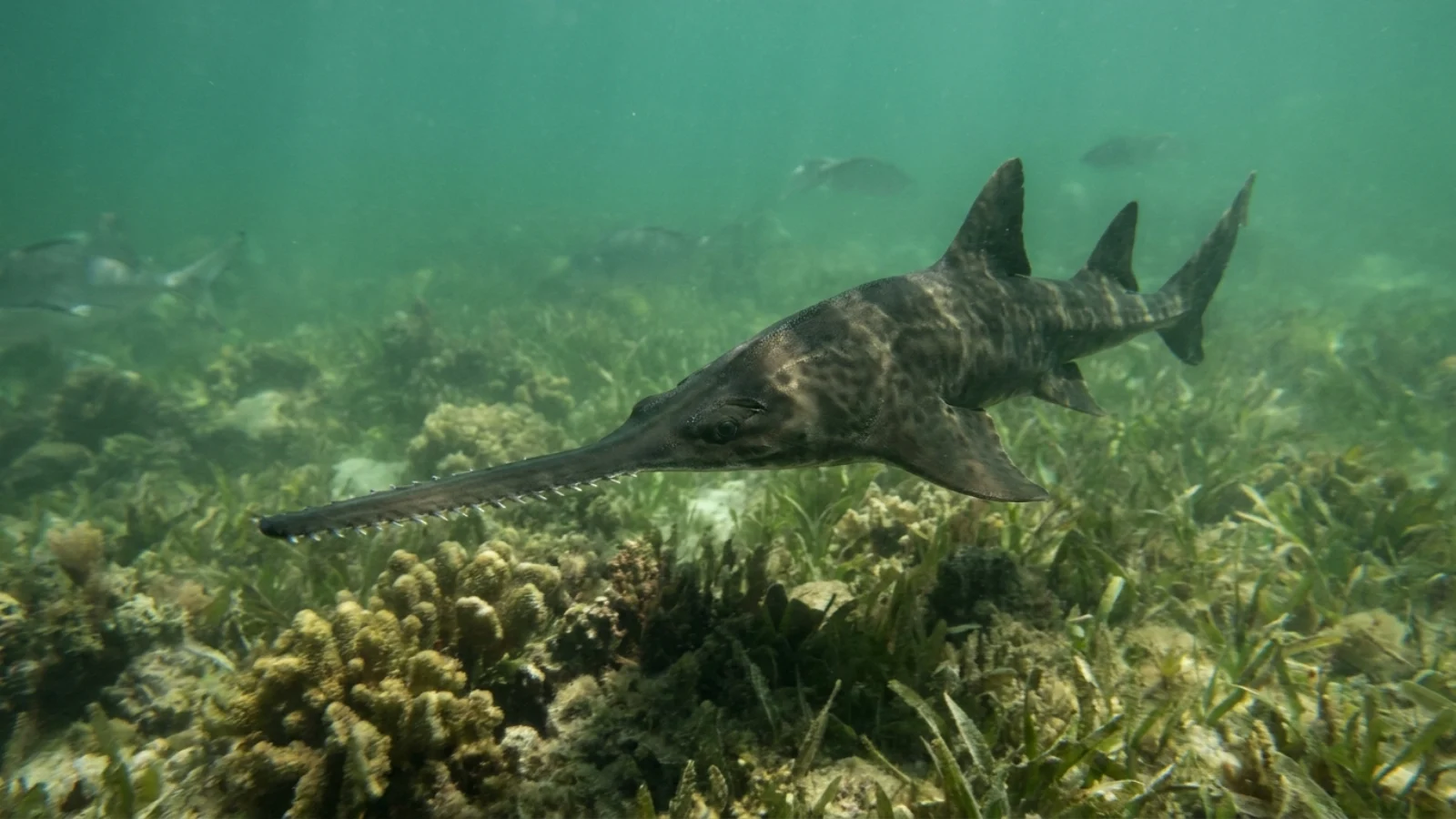
The smalltooth sawfish is a critically endangered ray that has disappeared from much of its historical range. In the United States it once occurred from Texas to New York, with northern records as summer visitors, but today it is essentially limited to Florida. Its narrow rostrum, or saw, carries 20 to 32 teeth on each side. Claims that it reaches 7.6 m are probably exaggerated; the largest confirmed specimen measured 5.54 m. One remarkable discovery from Florida is that about 3% of the sawfish in one estuary were the product of parthenogenesis, or virgin birth, perhaps a sign of how hard it has become for mates to find each other. See our profile of the smalltooth sawfish.
10. Angelshark
The angelshark, Squatina squatina, is a flattened shark that lies buried in sand, commonly at depths of up to about 150 m. It was once common over large areas of the north-east Atlantic, from Norway and Sweden to Morocco and the Canary Islands, and in the Mediterranean and Black Seas. Fishing pressure caused a major decline, and it was classified as Critically Endangered in 2010, a status the IUCN reaffirmed in 2019. See our profile of the angel shark.
11. Coelacanth
The coelacanth is rare in a different sense: it was thought to have died out with the dinosaurs. Coelacanths are well represented in fossils from the Devonian onwards and were believed to have become extinct in the Late Cretaceous, about 66 million years ago, until 23 December 1938, when the museum curator Marjorie Courtenay-Latimer found a living specimen among a fisherman’s catch off the Chalumna River in South Africa. The genus was named Latimeria in her honour. The West Indian Ocean coelacanth, Latimeria chalumnae, lives mainly around the Comoro Islands and is assessed as Critically Endangered. A second species, the Indonesian coelacanth, was found off Manado in North Sulawesi in 1998 and described in 1999. Some coelacanths have been seen performing headstands, which may help them slurp prey from crevices in lava caves. See our profile of the coelacanth.
Possibly extinct: the baiji
Not every rare species is still with us. The baiji, or Yangtze river dolphin, is a freshwater species rather than a marine one, but its fate is a warning for the vaquita. The last known captive baiji, Qiqi, died in 2002; the species was last sighted in the wild in August 2004; and a major expedition in late 2006 failed to find any. There was a possible sighting in 2007. The IUCN lists it as Critically Endangered (Possibly Extinct), and it is thought to be the first dolphin species driven to extinction by human activity.
Sea animals already lost
The modern record contains several marine mammals that went from rare to extinct. Steller’s sea cow, a giant relative of the manatee described by Georg Wilhelm Steller in 1741, survived only around the Commander Islands in the Bering Sea when Europeans found it, after its range had contracted from across the North Pacific. Within 27 years of its discovery the slow-moving, easily caught animal was hunted to extinction for its meat, fat and hide, and it was gone by 1768. The Caribbean monk seal, hunted for oil and deprived of food by overfishing, was last confirmed at Serranilla Bank, between Jamaica and Nicaragua, in 1952, and the United States declared it extinct in 2008 after a five-year search.
Why rare sea animals are so hard to save
The rarest sea animals share some features. Most have tiny ranges, like the vaquita in the upper Gulf of California, the red handfish on two reefs or Rice’s whale in one part of the Gulf of Mexico. Many breed slowly, so a population cannot bounce back quickly once numbers fall. And many of their threats are side effects of activities aimed at other targets, such as gillnets for totoaba, fishing gear for right whales, or shipping lanes for Rice’s whale. That makes protection a matter of changing fisheries, shipping and coastal development rather than simply banning hunting. The successes, including the recovery of Kemp’s ridley from its 1985 low, the slow growth of the Hawaiian monk seal and the release of captive-bred handfish, show that targeted protection can work when it is sustained. For the gentler side of the ocean, see the cutest sea animals; for a rare coral, see Millepora laboreli, Brazil’s rarest fire coral. The vaquita is one of seven porpoises; see porpoise species for its relatives, and dugong facts for another marine mammal in trouble across much of its range.
Why not simply breed the rarest species in captivity? For the vaquita, scientists tried in 2017, with tragic results. See why vaquitas aren’t kept in captivity.
What is the rarest sea animal in the world?
The vaquita, a porpoise of Mexico’s upper Gulf of California; a 2025 survey saw 7 to 10 individuals.
How many vaquitas are left in 2026?
The most recent survey, in 2025, estimated that 7 to 10 were seen, including calves; earlier surveys estimated 6 to 8 in 2024 and 8 to 12 in 2023.
What is the rarest whale?
Rice’s whale of the Gulf of Mexico, with a most recent estimate of about 50 animals from 2017 to 2018 surveys.
What is the rarest dolphin?
The Maui dolphin of New Zealand, with about 54 individuals over one year old in the 2021 estimate.
What is the rarest fish in the sea?
The red handfish of Tasmania is a leading candidate, with fewer than 250 left on two small reefs.
How many North Atlantic right whales are left?
About 384, according to the estimate for 2024 published in October 2025.
What is the rarest sea turtle?
Kemp’s ridley, whose nests fell from about 121,500 in 1947 to 702 in 1985 before a recovery plan helped numbers rise again.
Which sea animals have gone extinct recently?
Steller’s sea cow by 1768 and the Caribbean monk seal, last seen in 1952; the baiji river dolphin is possibly extinct.
- Sea Shepherd Conservation Society (28 October 2025), “Results of the 2025 vaquita monitoring effort”; IUCN SSC Cetacean Specialist Group, vaquita survey report 2025.
- NOAA Fisheries, “Frequently asked questions: Rice’s whales” and “Hawaiian monk seal” species page (accessed 8 November 2026).
- New Zealand Department of Conservation (2026), “New survey continues effort to safeguard critically endangered Maui dolphins”.
- University of Tasmania (2025), “Scientists release captive-raised red handfish into the wild”.
- New England Aquarium / North Atlantic Right Whale Consortium (October 2025), right whale population estimate for 2024.
- Wikipedia contributors, “Vaquita”, “Totoaba”, “Red handfish”, “Mediterranean monk seal”, “Kemp’s ridley sea turtle”, “Smalltooth sawfish”, “Angelshark”, “Coelacanth”, “Baiji”, “Steller’s sea cow”, “Caribbean monk seal” (2023 snapshot, accessed November 2026).
Blane Perun has been exploring Earth’s oceans and marine life for over 25 years. Founder of TheSea.Org in 1999, underwater photographer, coral aquaculture pioneer, and explorer of 80+ countries.
About Blane Perun →