The Largest Fish in the World — Ranked by Length, Weight and Kind
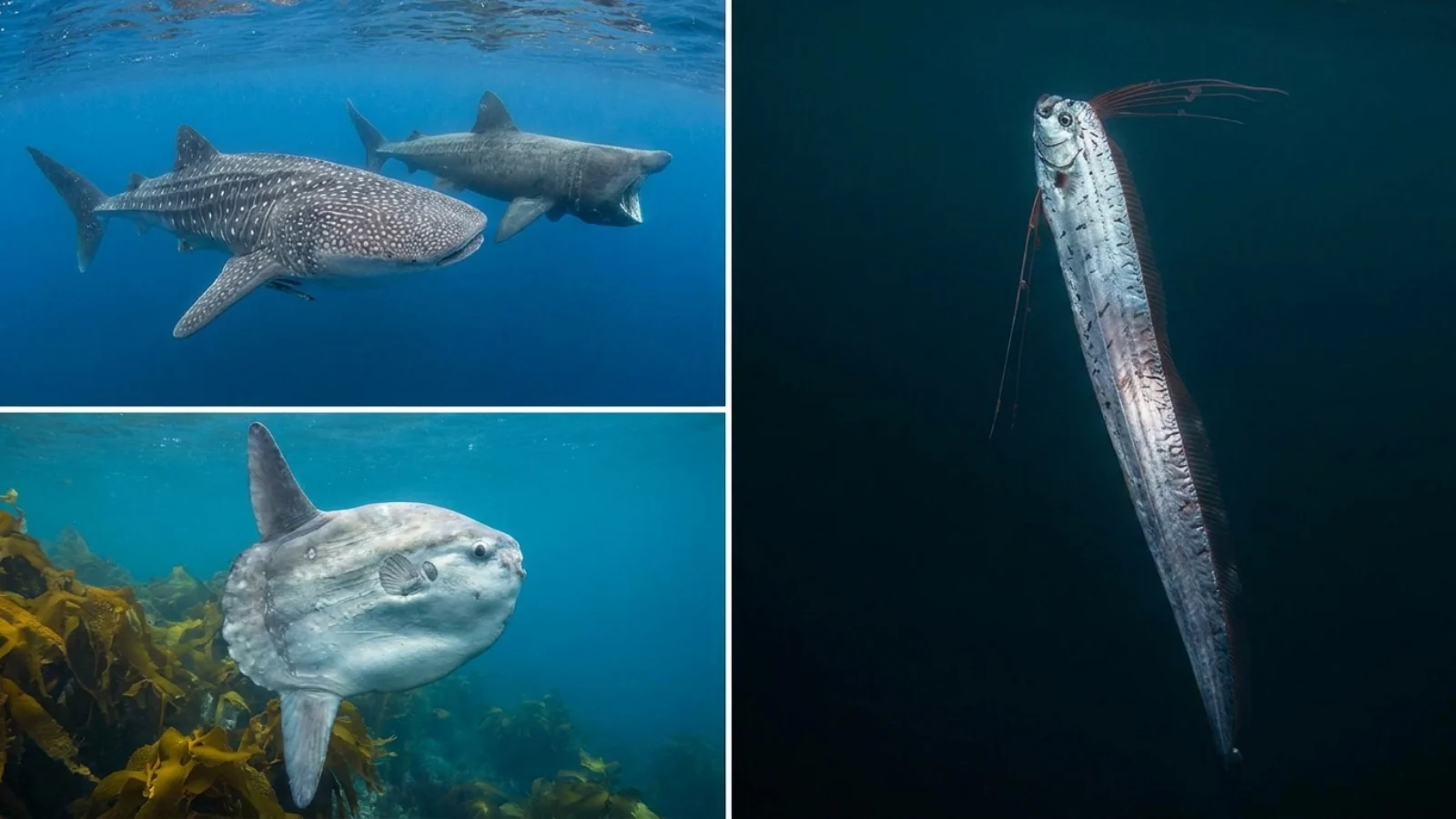
The largest fish in the world is the whale shark, a plankton-eating shark whose largest confirmed individual measured 18.8 m (61.7 ft). Second is the basking shark, usually about 8 m long as an adult. The heaviest bony fish ever recorded is a southern sunfish, Mola alexandrini, found dead off the Azores in 2021 at 2,744 kg; the longest bony fish is the giant oarfish, confirmed to 8 m. Whales are larger still, but they are mammals, not fish.
The two biggest fish alive are both gentle filter-feeding sharks; the biggest bony fish are an ocean sunfish (by weight) and the giant oarfish (by length).
How to measure “largest”
Ranking fish by size sounds simple, but the answer depends on what you measure and how strict you are about evidence. Length and weight give different winners: a long, ribbon-like oarfish and a short, massive sunfish are both giants, in different ways. Fish are also rarely weighed at their maximum size. The biggest individuals of most species are measured from photographs, from stranded or decomposed carcasses, or from fishermen’s estimates, and older reports of enormous animals often grow with retelling. In this list we separate confirmed measurements from estimates and reports, and give the source of each record.
A second issue is what counts as a fish. Whales, including the blue whale, are mammals and do not belong here. “Fish” in the everyday sense covers two very different groups: the cartilaginous fish, sharks and rays, whose skeletons are made of cartilage, and the bony fish, which include almost everything else from tuna to sunfish. The very largest fish are all cartilaginous; the biggest bony fish are much smaller in length but can be astonishingly heavy. We rank the two groups separately below.
1. Whale shark
The whale shark, Rhincodon typus, is the largest fish alive and the largest living animal that is not a mammal. It is a slow-moving carpet shark that feeds by filtering plankton, small fish and fish eggs from the water, often swimming at the surface with its huge mouth open. It lives in all tropical and warm-temperate seas.
Its maximum size is still debated because the largest reported individuals were poorly documented. The largest generally accepted measurement is 18.8 m (61.7 ft), from an animal reported in the Arabian Sea in 2001. Several other whale sharks of around 18 m have been reported, and older claims of 20 m or more lack reliable evidence. Most whale sharks seen by divers are much smaller; studies of growth suggest that females, which grow larger than males, reach an average of around 14.5 m. Weight is even harder to pin down: one 11 to 12 m individual was estimated at about 15,000 kg, and the largest whale sharks would be considerably heavier. Whale sharks also dive deep: one tagged animal was recorded at 1,928 m. Their mouths contain more than 300 rows of tiny teeth that play no real part in feeding; the work is done by about 20 filter pads that sieve food from the water, a method shared only with the megamouth and basking sharks and not unlike that of baleen whales. Studies of growth bands in the vertebrae and of growth rates in free-swimming sharks suggest that whale sharks may live for 80 to 130 years, and the IUCN lists the species as Endangered. Our profile of the whale shark covers its biology, and the record itself is examined in the largest whale shark ever recorded.
2. Basking shark
The basking shark, Cetorhinus maximus, is the second-largest living fish. It is one of only three plankton-eating sharks, along with the whale shark and the megamouth shark, and it feeds by swimming slowly with its cavernous mouth, up to about a metre wide, held open, so that water passes over the long gill rakers. Its gill slits nearly encircle the head. Adults typically reach about 7.9 m and a weight of around 4.65 tonnes, and some individuals reach 9 to 11 m. Reports from the late nineteenth and early twentieth centuries described basking sharks of 12 to 14 m, but these were visual estimates without good evidence. Satellite tagging since 2003 has shown that basking sharks travel thousands of kilometres between seasons, following rich patches of zooplankton, and some overwinter in deep water off the continental shelf.
3. Giant oceanic manta ray
Measured by width, the giant oceanic manta ray, Mobula birostris, is the largest ray. It can reach a disc width of about 7 m and a weight of about 3,000 kg, though the average size commonly observed is closer to 4.5 m across. Like the two largest sharks, it is a filter feeder, using the cephalic fins on either side of its mouth to funnel plankton inside. Our page on the biggest manta ray ever caught examines the historical giants.
4. Great white shark
The largest predatory fish is the great white shark, Carcharodon carcharias. The largest preserved specimen, a female, measures 5.83 m, and mature females may weigh around 2,000 kg, though most great whites are considerably smaller, and males are smaller than females. Claims of 7 to 10 m great whites appear regularly in old books and newspapers; on examination nearly all of them turn out to be estimates, misidentifications or mismeasurements. Our pages on the biggest great white sharks and the biggest sharks, ranked go through the records in detail.
5. Greenland shark and Pacific sleeper shark
In the cold north, the largest fish are sleeper sharks. The Greenland shark, Somniosus microcephalus, usually grows to between 2.4 and 7 m, and it rivals its relative the Pacific sleeper shark, which may reach about 7 m, as the largest species in the family Somniosidae. The Greenland shark is better known for another record. A 2016 study used radiocarbon dating of the proteins in the lenses of the eyes of 28 sharks, ranging from 81 to 502 cm long, to estimate their ages. The largest and oldest was about 392 years old, give or take 120 years, making the species the longest-lived vertebrate known. Greenland sharks are thought to mature at about 150 years old, which makes them highly vulnerable to bycatch. They have been seen as deep as 2,200 m.
6. Tiger shark and largetooth sawfish
The tiger shark, Galeocerdo cuvier, is the next-largest predatory shark, with females able to exceed 5 m. The largetooth sawfish, Pristis pristis, a ray despite its shark-like shape, has been reported at up to about 7.5 m, though the largest confirmed individual, from West Africa, was 7 m long. Sawfish once lived in rivers and coastal waters across the tropics, and young largetooth sawfish travel far up the Amazon basin; today all sawfish are threatened by fishing and habitat loss.
The largest bony fish
Bony fish cannot match the great sharks for length, but some are enormously heavy. The heaviest are the ocean sunfishes, genus Mola, flattened, round-bodied fish that look like a giant swimming head. In late 2021 a southern sunfish, Mola alexandrini, was found dead off Faial Island in the Azores. It measured 325 cm long and weighed 2,744 kg, about 444 kg more than the previous heaviest known specimen, a 2,300 kg sunfish caught off Kamogawa, Japan, in 1996. That makes it the heaviest bony fish ever recorded. Many references still give the familiar ocean sunfish, Mola mola, a maximum of about 2,300 kg, the figure from that Japanese fish. Southern sunfish are sometimes seen lying on their side at the surface, which is thought to help them warm up again after dives into cold water. Our sunfish profile describes them in more detail.
The longest bony fish is the giant oarfish, Regalecus glesne, a silvery, ribbon-shaped fish with a red dorsal fin running the length of its body. Its confirmed record length is 8 m, and unconfirmed reports describe animals up to 11 m. Oarfish are thought to live in the open ocean from the sunlit surface layer down into the dimly lit mesopelagic zone, as deep as about 1,000 m, and are seen alive only rarely, usually when sick or dying individuals come to the surface or wash ashore. Their great length, their red crest and their undulating way of swimming have led to speculation that they lie behind many sea-serpent sightings. Their eggs and larvae drift near the surface, and the larvae are sometimes seen there in the spawning season.
Beluga sturgeon: the heaviest fish of rivers and seas
The beluga sturgeon, Huso huso, rivals the sunfish as the most massive bony fish and is the second-longest after the giant oarfish. It lives in the Caspian and Black Sea basins and migrates up rivers to spawn. The largest accepted record is a female taken in 1827 in the Volga estuary that weighed 1,571 kg and measured 7.2 m, and several other historical records exceed 5 m. Today, giants of that size are gone. Belugas take many years to mature, and decades of fishing for caviar and the damming of spawning rivers have made the species critically endangered. Among sturgeons only the closely related kaluga, which reaches about 1,000 kg, comes close in size.
Tuna, marlin and swordfish
Among the fast, streamlined open-ocean fish, the heaviest are the Atlantic bluefin tuna and the great billfish. Atlantic bluefin have been recorded at up to about 680 kg; the largest caught under International Game Fish Association rules came from Nova Scotia and weighed 679 kg. The black marlin, Istiompax indica, reaches well over 4 m including the bill and is one of the largest bony fish of all, and the Atlantic blue marlin is a close rival. These are fast, warm-bodied predators rather than slow giants, and they are the targets of the most famous sport-fishing records; see our profiles of the black marlin and blue marlin.
The largest fish that ever lived
The whale shark is the largest fish alive, but not the largest that has ever lived. Megalodon, Otodus megalodon, the giant shark that died out a few million years ago, is known mainly from teeth and vertebrae, and estimates of its maximum length vary widely between studies; most place it well beyond the whale shark’s length. Our page on how big megalodon was explains how those estimates are made and why they differ.
The largest bony fish known from fossils is Leedsichthys problematicus, a filter-feeding pachycormid fish that lived in Middle to Late Jurassic seas. Like today’s largest sharks, it fed on plankton. Its fossils are fragmentary, so size estimates have ranged widely. Studies of growth rings in its bones suggest it took about 21 to 25 years to reach adult size, and isolated bones from some specimens make a maximum length of just over 16 m plausible. Even the 2021 Azores sunfish, at under three tonnes, would have been an order of magnitude lighter.
Why the biggest fish eat the smallest food
The most striking pattern in this list is that the largest fish of all, past and present, eat plankton. The whale shark, the basking shark, the giant manta, the megamouth and the extinct Leedsichthys are or were filter feeders. The same is true of the baleen whales, the largest animals of all. Feeding at the bottom of the food chain gives access to a vast energy supply: a large filter feeder can process huge volumes of water rich in zooplankton and small fish, while a predator at the top of the food chain has to find, chase and kill prey that is far less abundant. Large size also helps filter feeders travel between patchy food sources and survive lean periods on stored energy.
Large size has a cost, too. Big fish tend to grow slowly and mature late, and many produce few young. The Greenland shark matures at about 150 years, the frilled shark and other deep-water sharks carry their young for years, and the beluga sturgeon needs many years before it spawns. Those traits make the largest fish especially vulnerable to fishing, and several of the giants on this list, including the whale shark, the basking shark, the great sawfish species and the beluga sturgeon, are listed as threatened by the IUCN.
Seeing the giants
The easiest of the largest fish to see in the wild is the whale shark, which gathers seasonally at predictable feeding sites. Basking sharks appear off western Britain and Ireland in summer, and giant mantas visit cleaning stations on reefs in several tropical regions. Sunfish are encountered by divers at a few seamounts and islands where they come up to be cleaned of parasites. Wherever you see them, give large fish space: touching or chasing them stresses the animals, and local codes of conduct usually specify a minimum distance. For more size records, see our list of the deepest animals in the ocean.
What is the largest fish in the world?
The whale shark. The largest confirmed individual measured 18.8 m (61.7 ft).
What is the second largest fish?
The basking shark, which typically reaches about 7.9 m as an adult and occasionally 9 to 11 m.
What is the largest bony fish?
By weight, the southern sunfish (Mola alexandrini): a 2,744 kg specimen was found off the Azores in 2021. By length, the giant oarfish, confirmed to 8 m.
Is a whale a fish?
No. Whales are mammals: they breathe air, are warm-blooded and nurse their young with milk.
What is the largest predatory fish?
The great white shark; the largest preserved specimen is a 5.83 m female.
What is the largest fish ever?
Extinct giants such as the shark megalodon and the Jurassic bony fish Leedsichthys were larger than any living fish except, possibly, the biggest whale sharks.
How heavy is a whale shark?
Estimates vary; one 11 to 12 m whale shark was estimated at about 15,000 kg, and the largest are heavier.
What is the largest freshwater fish?
Sturgeons such as the beluga are the heaviest fish found in rivers, though belugas also live in the sea; the largest record is 1,571 kg from 1827.
- Wikipedia contributors, “Whale shark”, “Basking shark”, “Giant oceanic manta ray”, “Great white shark”, “Greenland shark”, “Tiger shark”, “Largetooth sawfish” (accessed November 2026).
- Wikipedia contributors, “Mola alexandrini”, “Ocean sunfish”, “Giant oarfish”, “Beluga (sturgeon)”, “Atlantic bluefin tuna”, “Black marlin”, “Leedsichthys” (accessed November 2026).
- Nielsen, J. et al. (2016), “Eye lens radiocarbon reveals centuries of longevity in the Greenland shark”, Science 353: 702–704.
Blane Perun has been exploring Earth’s oceans and marine life for over 25 years. Founder of TheSea.Org in 1999, underwater photographer, coral aquaculture pioneer, and explorer of 80+ countries.
About Blane Perun →