The Cutest Sea Animals — Otters, Seal Pups, Sea Bunnies and the Science of Cute
The cutest sea animals are the ones that trigger what the ethologist Konrad Lorenz called the baby schema: big eyes, round heads, soft-looking bodies and clumsy movements. Sea otters, whitecoat harp seal pups, belugas, puffins and Commerson’s “panda” dolphins top most lists, along with small oddities such as the sea bunny, a sea slug under about 2.5 cm long, and the dumbo octopus, which flaps ear-like fins thousands of metres down. Behind every cute face is a real adaptation, from the sea otter’s 150,000 hairs per square centimetre to the harp seal pup’s white lanugo coat.
Humans respond to infant-like features, called the baby schema or Kindchenschema: a large head, round face, high forehead and big eyes. Animals with these traits are rated as cuter and attract more attention and donations.
What makes a sea animal cute?
Cuteness is not a property of an animal; it is a reaction in the person looking at it. The idea was formalised by the Austrian ethologist Konrad Lorenz, who proposed that a set of infantile features, which he called the Kindchenschema or baby schema, releases a caring response in adults. The features are familiar from any baby or puppy: a large head relative to the body, a round face, a high and bulging forehead, big eyes set low in the face, a small nose and chin, and soft, rounded body shapes. Lorenz argued that the response evolved because it helped parents look after their young, and that it spills over onto any animal or object that happens to share those proportions.
Later experiments put the idea on a firmer footing. In a 2009 study in the journal Ethology, Melanie Glocker and colleagues digitally manipulated photographs of real infant faces to give them more or fewer baby-schema features, such as a rounder face and higher forehead, and found that faces with stronger baby schema were rated as cuter and increased people’s motivation to take care of them. A 2014 study in Frontiers in Psychology by Marta Borgi and colleagues showed that the effect extends to animal faces and is already present in children, who rated puppies, kittens and human babies with exaggerated baby features as cuter and spent more time looking at them.
That is why the list below is dominated by mammals with big dark eyes and round heads, by animals that look fluffy even when they are not, and by small creatures with ear-like flaps. Each one, though, owes its appearance to something more practical than charm: insulation, camouflage, swimming, or a way to find food in the dark.
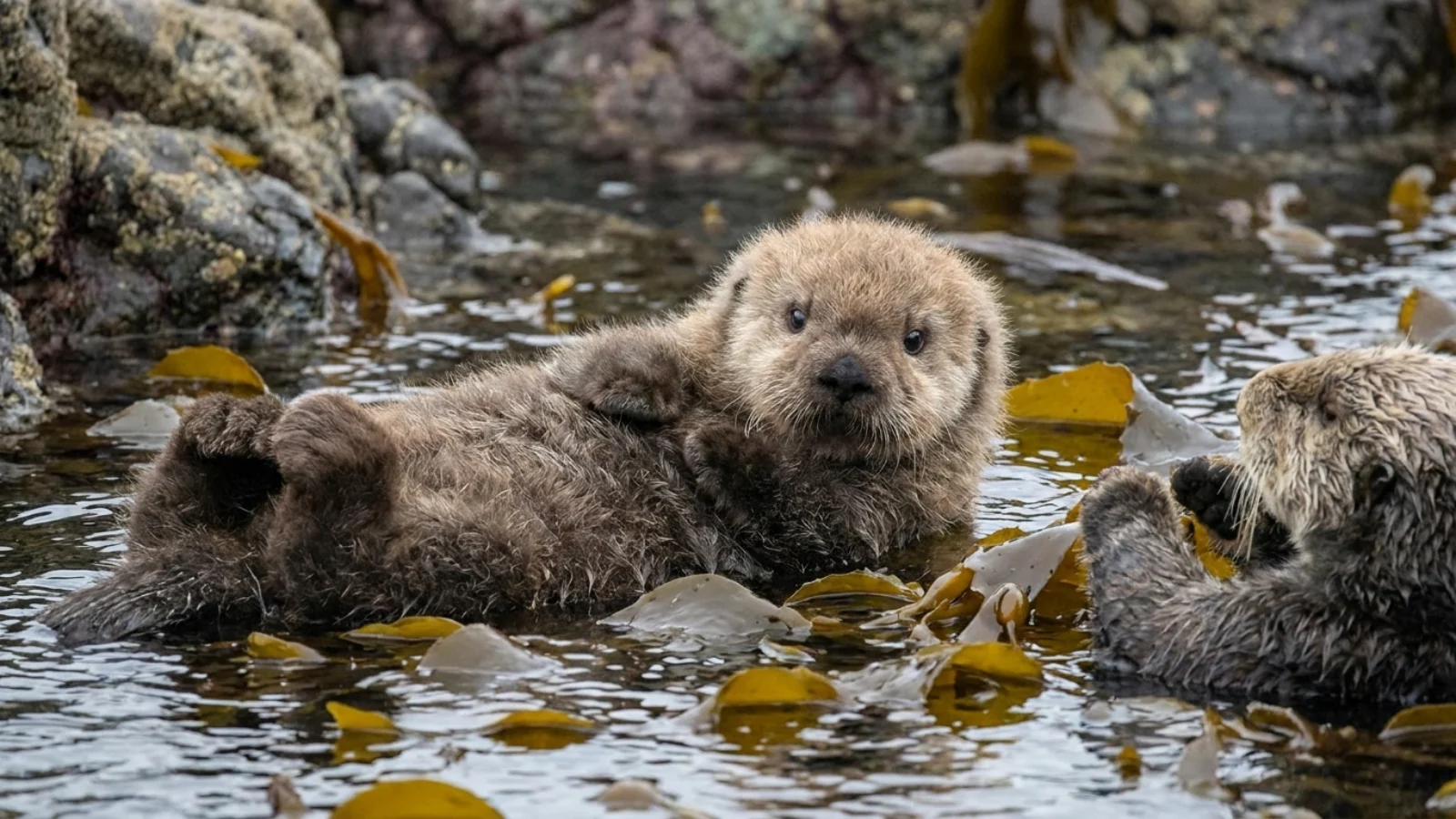
1. Sea otter
For most people, the sea otter is the cutest animal in the sea. It floats on its back, grooms its face with its paws and cracks open shellfish on its chest, and all of those habits have practical explanations. Unlike whales and seals, which rely on blubber, the sea otter keeps warm almost entirely with fur, and that fur is the densest of any animal, with up to 150,000 strands of hair per square centimetre. Constant grooming keeps air trapped in the coat, which is why a sea otter spends so much time rubbing, rolling and fluffing itself.
Adults weigh between about 14 and 45 kg, making the sea otter the heaviest member of the weasel family but one of the smallest marine mammals. It is also one of the few mammals that uses tools: it uses rocks to knock prey loose and to break open shells, and it is the only marine animal able to lift and turn over rocks with its front paws when searching for food. That foraging has an outsized effect on its habitat. Sea otters are a keystone species in kelp forests, because by eating sea urchins they stop the urchins from grazing the kelp away.
The sea otter’s appeal very nearly came too late. Its numbers were once estimated at 150,000 to 300,000, but hunting for its fur between 1741 and 1911 reduced the world population to roughly 1,000 to 2,000 animals in a fraction of the original range. Protection has allowed a partial recovery, but the species is still listed as Endangered by the IUCN. Read more in our profile of the sea otter.
2. Harp seal pup
The white, wide-eyed harp seal pup lying on the ice is one of the most famous images in conservation. The pup’s coat is often yellowish at birth because of staining from amniotic fluid, but within one to three days it turns pure white and stays that way for two to three weeks, until the first moult. These “whitecoats” depend on that dense, woolly lanugo coat while they nurse on the ice. Lanugo insulates well in air but poorly in water, so the pups stay out of the sea until they have built up a layer of blubber.
The adults are less fluffy but still striking: silver-grey seals 1.7 to 2.0 m long and weighing 115 to 140 kg, with a black harp or wishbone-shaped marking across the back that gives the species its name. Harp seals live in the northernmost Atlantic and the Arctic Ocean and spend relatively little time on land. Even the nursing mothers spend about 80% of their time in the water and only about 20% on the ice with their pups. See our profile of the harp seal for its migrations and diet.
3. Sea bunny
The sea bunny went viral in July 2015, when a video taken the previous year spread around the world. It is not a rabbit at all but a sea slug, a nudibranch usually identified as Jorunna parva, first described by the Japanese zoologist Kikutaro Baba in 1938 under the name Thordisa parva. According to the sea slug specialist Angel Valdes, interviewed by National Geographic, most are under 2.5 cm long, and they live in the Indo-Pacific from South Africa to the central Pacific. Specimens reported to the Sea Slug Forum ranged from about 10 mm in Saipan to 30 mm on Japan’s Miura Peninsula.
Every part of the bunny look has a function. The two “ears” are rhinophores, sensory organs that detect chemicals in the water and help the slug find food and mates. The “fur” is a covering of tiny rods called caryophyllidia, arranged around knobs that are sometimes black, which produces the speckled pattern; their function is not known for sure, but they probably have a sensory role. The fluffy “tail” is a ring of gills. The colour also varies more than the viral photographs suggest. The famous white animals with black spots are not typical; many are yellow or orange. Behind the cute face is a well-armed animal. Valdes describes these slugs as very toxic, using chemicals obtained from their food, and dorid nudibranchs like this one feed on sponges. See our full guide to the sea bunny.
4. Dumbo octopus
The dumbo octopuses, genus Grimpoteuthis, take their name from the title character of Disney’s 1941 film Dumbo, because of the two ear-like fins that stick out from the mantle above the eyes. Instead of jetting like shallow-water octopuses, they flap these fins and pulse their webbed arms to swim slowly above the sea floor. They are the deepest-living octopuses known, and in 2020 a Grimpoteuthis was filmed 6,957 m deep in the Java Trench, confirming that the genus reaches the hadal zone. Their eggs are unusual, with a tough outer casing, and dumbo octopuses attach them to deep-sea corals. Our profile of the dumbo octopus covers its biology in depth.
5. Flapjack octopus
A close relative of the dumbos, the flapjack octopus, Opisthoteuthis californiana, looks like a pink pancake with eyes when it rests on the bottom. Its appearance is so endearing that one of its common names is simply adorabilis. Flapjack octopuses are usually pinkish and reach a maximum of about 20 cm in mantle length. They swim by moving their fins, pulsing their webbed arms and pushing water through the funnel. The species was described by Berry in 1949 and is listed by the IUCN as Data Deficient: it lives so deep that too little is known to assess it.
6. Beluga whale
The beluga is the only whale that is regularly all white, which earned it the name white whale. It is also called the sea canary because of its high-pitched calls. Its most expressive feature is the melon, the rounded bulge on its forehead that houses the organ used in echolocation. In the beluga the melon is large and deformable, and it changes shape as the whale calls, giving the animal an unusually mobile face. Belugas also lack a dorsal fin, an adaptation that lets them swim easily under sea ice. More in our profile of the beluga whale.
7. Atlantic puffin
Puffins are seabirds rather than sea animals in the strict sense, but they spend most of their lives at sea and are a fixture of every cute-animal list. The Atlantic puffin has a broad, boldly marked red-and-black beak and orange legs that contrast with its black-and-white plumage. It swims on the surface and catches small fish and crabs by diving underwater, using its wings for propulsion. It spends the autumn and winter in the open ocean of the cold northern seas and returns to coastal colonies in late spring, nesting in clifftop burrows where each pair lays a single white egg. The species breeds from Russia, Iceland, Norway and Greenland to Newfoundland, Nova Scotia, Maine, Ireland and France, and is most common in Iceland’s Westman Islands.
8. Commerson’s dolphin
With its crisp black-and-white pattern, Commerson’s dolphin is sometimes called the panda dolphin, or less flatteringly the skunk dolphin. It is a small oceanic dolphin of the genus Cephalorhynchus, named after the French naturalist Philibert Commerson, who first described it in 1767. The species has an unusual split distribution: two subspecies live in areas separated by about 8,500 km, one around the southern tip of South America and the other, which is larger and has less sharply defined grey patterning, around the Kerguelen Islands in the southern Indian Ocean. Nobody knows why the populations are divided so widely.
9. Ocellaris clownfish
The ocellaris clownfish, Amphiprion ocellaris, described by Cuvier in 1830, became one of the most recognisable fish on Earth thanks to animated films. Its charm comes from bright orange stripes and its habit of nestling into a sea anemone. Juveniles drift in the plankton, then settle to the bottom to find shelter in a host anemone, with which they form a symbiotic relationship. Our Q&A on why clownfish can live in anemones explains how they avoid being stung.
10. Sea angel
Sea angels are swimming sea slugs that look like tiny translucent figures with wings. The best known, Clione limacina, also called the naked sea butterfly, is found from the surface to more than 500 m deep in cold waters. It swims by flapping a pair of wing-like lobes. The angelic look hides a specialised predator: adults feed almost exclusively on sea butterflies of the genus Limacina, swimming snails that they grab with tentacles and chitinous hooks, and the species can survive for a year without food.
11. Pineconefish
The pineconefish, Monocentris japonica, looks like a small yellow pine cone with fins. It grows to 17 cm but is more commonly up to 12 cm long. Its party trick is light: on each side of the lower jaw it has light organs filled with luminescent bacteria. Their purpose is not known for certain, but they may help the fish see at night or attract prey.
12. Longhorn cowfish
The longhorn cowfish, Lactoria cornuta, is a boxfish with two long horns protruding from the front of its head, rather like those of a cow. It lives in the Indo-Pacific and can grow to 50 cm long. Its boxy body and slow, hovering swimming give it a toy-like appearance. Like other boxfish, it relies on a rigid body casing for protection.
13. Hawaiian monk seal
The Hawaiian monk seal is the only seal native to Hawaii and, with the Hawaiian hoary bat, one of only two mammals endemic to the islands. Its large dark eyes and habit of hauling out to sleep on beaches make it a favourite with visitors, but it is also one of the rarest seals in the world. NOAA Fisheries puts the population at about 1,600 seals, having passed 1,500 in 2021, while older summaries gave about 1,400. It is threatened by human disturbance, very low genetic variation, entanglement in fishing nets and disease, and the species is listed as Endangered. Visitors are asked to keep their distance from resting seals.
14. Manatee
The manatee completes the list. Its wrinkled face, small eyes and slow, gentle movements give it the nickname sea cow, and it is one of Florida’s best-loved animals. Unlike most animals here, its appeal does not rest on baby-like proportions so much as on its calm behaviour and the fact that it is a large herbivore.
Does cuteness help conservation?
Cute animals attract attention, and attention can turn into money and protection. Conservation groups have long used appealing flagship species, such as seals, otters and dolphins, to raise funds that also protect less glamorous animals living in the same habitats. The harp seal pup is the clearest example: images of whitecoats on the ice became the face of campaigns against commercial sealing.
The effect has a downside. A 2017 study in Biological Conservation by Agathe Colleony and colleagues analysed the choices of 10,066 participants in a zoo programme in which people donated money to “adopt” an animal. Participants did not choose animals because they were endangered and did not give more to endangered species; instead they were more likely to choose charismatic species. Surprisingly, the people who did pick less charismatic species gave more money on average, suggesting a stronger commitment. The authors concluded that zoos should communicate more clearly about threatened species, because charisma alone does not steer support towards the animals that need it most.
In the ocean, that bias matters, because many of the most threatened animals are not cute at all. Sawfish, deep-sea corals and many sharks face serious declines but rarely appear on lists like this one. Several of them appear in our list of the rarest sea animals.
Cute is not the same as harmless
Several animals on this list are reminders that appearance says little about behaviour. The sea bunny is toxic. Sea otters are powerful predators with strong jaws that can crack shells. Seals and sea lions bite, and a mother seal will defend her pup. Even the gentle-looking manatee is a large animal that should not be crowded or fed. The other side of the coin, animals whose looks put people off even though they are harmless, is covered in our lists of the ugliest fish and the scariest sea creatures.
How to see cute sea animals responsibly
Many of these animals can be seen in the wild. Sea otters are visible from the shore in parts of California and Alaska; puffins can be watched from cliff paths at their summer colonies; belugas gather in some Arctic estuaries in summer; and manatees use warm springs and power-plant outflows in Florida in winter. The rules are similar everywhere: keep your distance, never feed or touch wild animals, follow local viewing guidelines, and choose operators who follow them too. Pups and chicks that appear to be alone are usually waiting for a parent that is feeding nearby. Small animals such as the sea bunny and pygmy seahorses are seen by divers, who should avoid touching them or the sponges and sea fans they live on.
What is the cutest sea animal?
There is no official answer, but the sea otter tops most polls, followed by harp seal pups, belugas, puffins and the sea bunny.
Why do we find some sea animals cute?
They show baby-schema features such as big eyes, a round head and soft-looking bodies, which trigger a caring response in people.
Is the sea bunny a real animal?
Yes. It is a sea slug, usually identified as Jorunna parva, from the Indo-Pacific; most are under 2.5 cm long.
Is the sea bunny poisonous?
Specialists describe it as very toxic. It takes its chemical defences from its food rather than making them itself.
Why do sea otters have such thick fur?
They have no blubber and rely on fur for warmth; it is the densest of any animal, with up to 150,000 hairs per square centimetre.
Why are baby harp seals white?
Their lanugo coat turns white one to three days after birth and stays white for two to three weeks, until the first moult.
What is the cutest deep-sea animal?
The dumbo octopus and the flapjack octopus are the usual answers; both swim with ear-like fins.
Are cute animals more likely to be protected?
They attract more attention and donations, but a 2017 study found people did not favour endangered species when choosing which animal to support.
- Glocker, M. L., Langleben, D. D., Ruparel, K. et al. (2009), “Baby schema in infant faces induces cuteness perception and motivation for caretaking in adults”, Ethology, doi:10.1111/j.1439-0310.2008.01603.x.
- Borgi, M., Cogliati-Dezza, I., Brelsford, V. et al. (2014), “Baby schema in human and animal faces induces cuteness perception and gaze allocation in children”, Frontiers in Psychology, doi:10.3389/fpsyg.2014.00411.
- Colleony, A., Clayton, S., Couvet, D., Saint Jalme, M. and Prevot, A.-C. (2017), “Human preferences for species conservation: Animal charisma trumps endangered status”, Biological Conservation, doi:10.1016/j.biocon.2016.11.035.
- National Geographic (23 July 2015), “Meet the adorable ‘sea bunny’ taking over the internet”; Rudman, W. B., Sea Slug Forum, “Jorunna parva?” (accessed November 2026).
- Wikipedia contributors, “Sea otter”, “Harp seal”, “Grimpoteuthis”, “Opisthoteuthis californiana”, “Beluga whale”, “Atlantic puffin”, “Commerson’s dolphin”, “Clione limacina”, “Monocentris japonica”, “Longhorn cowfish”, “Hawaiian monk seal”, “Cuteness” (2023 snapshot, accessed November 2026).
Blane Perun has been exploring Earth’s oceans and marine life for over 25 years. Founder of TheSea.Org in 1999, underwater photographer, coral aquaculture pioneer, and explorer of 80+ countries.
About Blane Perun →