The Most Colorful Fish in the World — Mandarinfish, Triggerfish, Angelfish and the Science of Color
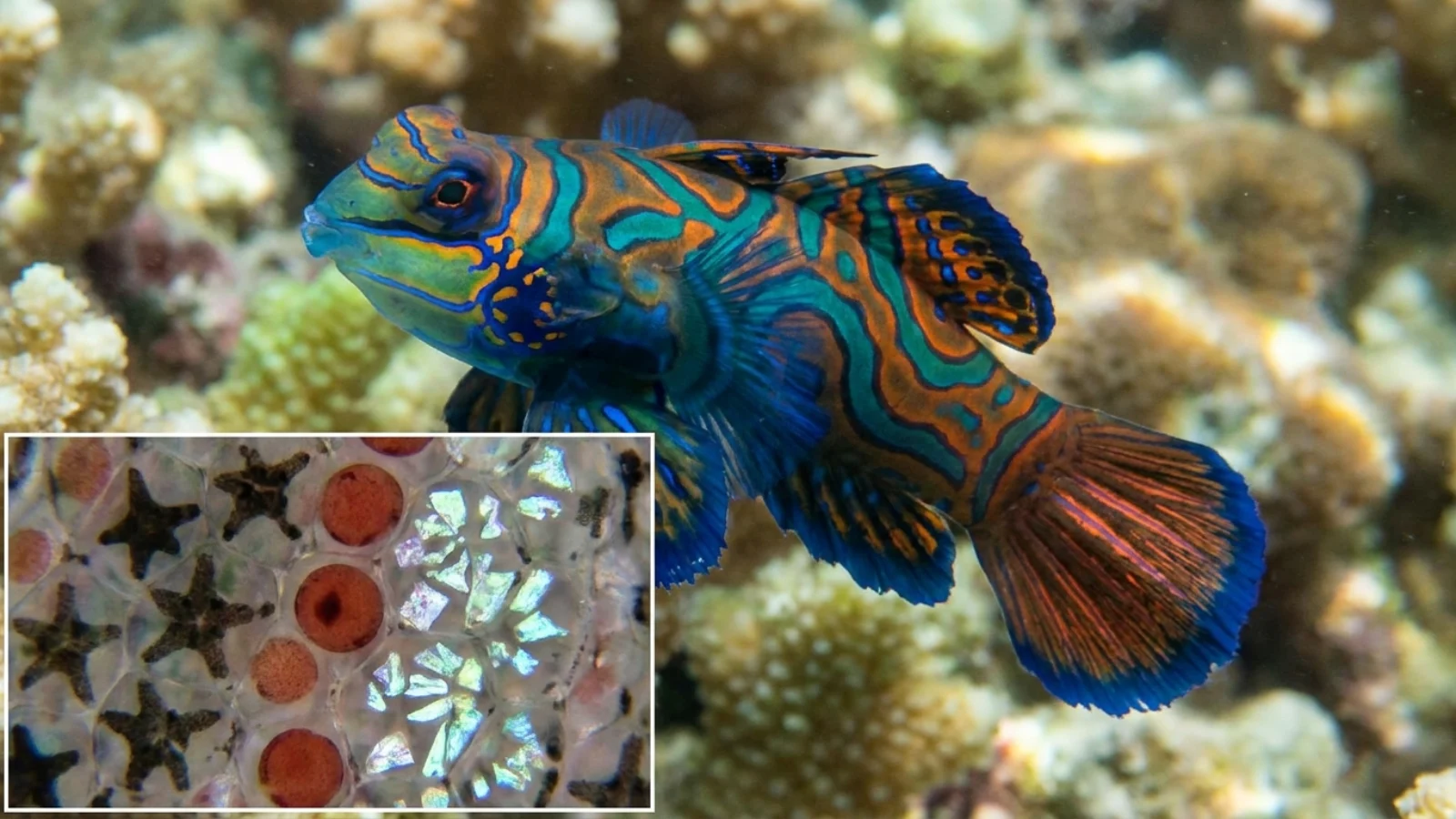
The most colorful fish in the world is usually said to be the mandarinfish, Synchiropus splendidus, a small Indo-Pacific dragonet with swirling blue, orange and green patterns, and one of only two vertebrates known to make blue from a pigment rather than from reflecting structures. Other contenders include the clown and Picasso triggerfish, the emperor angelfish, the royal gramma, the harlequin tuskfish, parrotfish, the mahi-mahi and the opah. Most are coral reef fish, where bright colors can work both as signals at close range and as camouflage at a distance.
Fish produce color with chromatophores, skin cells that contain pigments (melanin for blacks and browns, carotenoids for reds, oranges and yellows) or reflect light structurally to create blues, silvers and iridescence.
How fish make their colors
Every color on a fish is produced by specialised skin cells called chromatophores. Some contain pigments. Melanophores contain melanin, which makes blacks, browns and greys; xanthophores and the related red-pigmented cells contain carotenoids and pteridines, which make yellows, oranges and reds. Others produce color structurally. Iridophores contain stacks of thin, flat, reflective crystals made of purines, and these stacks reflect particular wavelengths of light through thin-film interference, the same physics that colors a soap bubble. That is the source of most silver, iridescent and blue colors in fish. Many fish combine the two, layering pigment cells over reflective cells, and some can change color quickly by moving pigment within the cells.
Fish colors can be static or dynamic. Static colors are permanent patterns, such as stripes and spots. Dynamic displays involve changes in color, or the sudden exposure of hidden colored parts: fins that can be raised at will, a colored mouth lining, or the bright red gill membranes that a male betta reveals when it flares in an aggressive display. Fish carotenoid colors also depend on diet, because fish cannot make carotenoids themselves and must obtain them from their food.
Why are reef fish so colorful?
Coral reef fish are famous for having the most varied and striking colors of any group of animals. For decades, people assumed the colors must make the fish conspicuous, to advertise territory, attract mates or warn predators. Measurements of the colors themselves have complicated that picture. In a 2000 study in the Philosophical Transactions of the Royal Society B, the Australian sensory biologist Justin Marshall used spectrophotometers to measure the colors of reef fish and their backgrounds. He found that the fine, high-contrast patterns of many reef fish are designed to be very conspicuous to a fish with color vision at close range but blend together and become camouflaged at a distance. Blue and yellow, the colors most frequently used by reef fish, can work for camouflage or for communication depending on the background they are seen against. Reef fish, he concluded, combine color with behaviour to control how visible they are.
In other words, a gaudy fish is not necessarily an easy target. Against the blue of open water, a blue fish disappears; against yellowish coral, a yellow fish is hard to pick out; and the same fish can become highly visible to a nearby mate or rival by turning, raising a fin or changing its posture. Some colors do warn, as in the lionfish below, and many fish use more familiar camouflage tricks such as countershading, being dark on top and pale underneath, as tuna do in open water.
1. Mandarinfish
The mandarinfish, Synchiropus splendidus, is the fish most often named as the most colorful in the world. It is a small member of the dragonet family, Callionymidae, which has 10 genera and more than 182 species, and its common name comes from colors said to evoke the robes of an imperial Chinese mandarin. Its species name, splendidus, is Latin for bright or glittering. The body has a bright blue background, with swirling orange stripes and a blue-green face marked with bold blue stripes, and the fins carry vibrant bands of orange and blue.
What makes the mandarinfish truly unusual is how it makes its blue. In almost all animals, blue is structural, produced by thin-film interference in stacks of reflective crystals. The mandarinfish is one of only two vertebrates known to have blue color produced by a cellular pigment, the other being its close relative the psychedelic mandarin, Synchiropus picturatus. The blue pigment cells were described by Goda and Fujii in 1995 in Zoological Science, and the name cyanophore was proposed for them.
Mandarinfish are popular in the aquarium trade but are hard to keep. In the wild, a study published in 2001 found that they eat a mixed diet of harpacticoid copepods, polychaete worms, small snails, amphipods, fish eggs and ostracods, and some never adapt to captivity, refusing anything but live amphipods and copepods. Our profile of the mandarin fish covers its courtship and care.
2. Clown triggerfish
The clown triggerfish, Balistoides conspicillum, also called the bigspotted triggerfish, has one of the boldest patterns on the reef: a black body whose lower half is marked with big, roughly round white spots, a yellowish network around the first dorsal fin that recalls a leopard’s pattern, and a yellowish ring around the mouth surrounded by a fine white ring. It grows to about 50 cm and has a small mouth with strong teeth. Juveniles are black spangled with small white spots, with yellow on the snout and at the base of the first dorsal fin. Because of its coloration it is highly prized as an aquarium fish.
3. Picasso triggerfish
The lagoon triggerfish, Rhinecanthus aculeatus, is better known as the Picasso triggerfish or Picassofish, because its pattern of bars, lines and colored patches looks like an abstract painting. It reaches up to 30 cm and lives on reefs in the Indo-Pacific. It has been studied in a range of research contexts, from locomotion to color vision, which makes it one of the best-understood colorful fish in the laboratory as well as on the reef. See our profile of the Picasso triggerfish.
4. Emperor angelfish
The emperor angelfish, Pomacanthus imperator, is a favourite of photographers, artists and aquarists because of its brilliant pattern, and it is effectively two different fish. Juveniles have a dark blue body marked with concentric curving lines that alternate between pale blue and white. Adults are completely different: striped with blue and yellow horizontal stripes, with a light blue face, a dark blue mask over the eyes and a yellow tail. The emperor angelfish lives on reefs from the Red Sea to Hawaii and the Austral Islands and reaches a maximum of about 40 cm.
5. Royal gramma
The royal gramma, Gramma loreto, is a small Caribbean fish whose front half is bright purple and rear half bright yellow, the two colors fading into each other. It averages slightly over 8 cm. Its natural range covers the Bahamas, Bermuda, the Antilles and the waters around Central America and northern South America, where it feeds mostly on zooplankton. It has a curious habit of orienting itself parallel to the nearest surface, so that under ledges it often swims upside down. It resembles the Indo-Pacific false gramma, which has clear fins and a sharp change between its colors rather than a gradual fade.
6. Moorish idol
The Moorish idol, Zanclus cornutus, is a simple but unforgettable design: a white body with two wide black vertical bands, a yellow patch towards the tail and a yellow saddle on the snout, topped by a long, trailing dorsal fin. It reaches a maximum published total length of 23 cm, although 21 cm is more typical, and lives from the east coast of Africa to Hawaii and Easter Island. See our profile of the Moorish idol.
7. Harlequin tuskfish
The harlequin tuskfish, Choerodon fasciatus, is a wrasse of the western Pacific, brightly coloured in shades of blue, green and orange, with sharp blue teeth that give it its name. It grows to about 30 cm. Specimens from Australia generally have brighter colors than those from elsewhere in its range, which is why Australian fish are especially sought after.
8. Parrotfish
Parrotfish are among the most colorful fish on any reef, and among the most important. The group contains roughly 95 species and is now usually treated as part of the wrasse family. Most species are sequential hermaphrodites: they start life as females, in a drab initial phase, and some later change into males, in a brilliantly colored terminal phase. The difference can be so large that terminal-phase males of some species were once described as separate species. Their fused, beak-like teeth scrape algae from rock and coral, and what they cannot digest they excrete as sand; a humphead parrotfish can produce about 90 kg of sand a year. At night, some species, including the queen parrotfish, secrete a mucus cocoon around themselves, which may hide their scent from predators such as moray eels. See our profile of parrotfish.
9. Mahi-mahi
The mahi-mahi, or dolphinfish, is the most colorful large game fish. Living fish are golden on the flanks, with bright blues and greens on the sides and back, and mature males have prominent foreheads that rise well above the body. The name comes from Hawaiian and means very strong. Read more in our profile of the mahi-mahi.
10. Opah
The opah, or moonfish, is a large, deep-bodied fish of the open ocean with conspicuous coloration: a deep red-orange body grading to rosy on the belly, with white spots covering the flanks. It is colorful in another way too: in 2015 the opah Lampris guttatus was found to have near-whole-body endothermy, keeping the core of its body about 5 °C warmer than the surrounding water. Most fish are entirely cold-blooded or can warm only parts of the body, so the opah is the only fish known to keep all its internal organs warmer than the water.
11. Betta, or Siamese fighting fish
The most colorful freshwater fish on many lists is the Siamese fighting fish, Betta splendens, one of 73 species in its genus. It is native to Southeast Asia and endemic to the central plain of Thailand, where it was domesticated at least 1,000 years ago, among the longest of any fish. Domestication is the source of its color. Wild bettas are generally green, brown and grey with short fins, and show strong colors only when agitated; the brilliant reds, blues and flowing fins of pet-shop bettas are the product of centuries of selective breeding.
12. Lionfish
The lionfish shows the warning side of fish color. Its bold stripes and spreading, feathery fins are a classic example of aposematic coloration: static coloration that tells predators of other species that an animal is dangerous, in this case because of its venomous spines. Lionfish are native to the Indo-Pacific but have become an invasive species in the western Atlantic, including Florida. See our profile of the lionfish.
13. Flame angelfish
The flame angelfish, Centropyge loricula, is a small Pacific angelfish of bright orange-red with a vertical elongated black spot and four or five black bars on the sides, and alternating short purple-blue and black bands on the rear of the dorsal and anal fins. Specimens from the Marquesas lack the black bars. Males are generally larger and slightly more colorful than females. In the wild it eats a varied diet of algae and crustaceans, and it is found, though less commonly, in the Hawaiian Islands.
14. Wrasses
The wrasse family, Labridae, together with the parrotfish that are now included within it, is the group best known for highly varied and bright coloration. Many wrasses change color and pattern as they grow and as they change sex, and the same species can look completely different in its juvenile, female and male forms.
Juvenile colors and colors that change
Several fish on this list look nothing like their parents. The emperor angelfish and the clown triggerfish both have juvenile patterns that differ sharply from the adults, and parrotfish and wrasses change colors when they change sex. Explanations vary from species to species. A distinct juvenile pattern may help a young fish avoid aggression from territorial adults of its own species, which do not recognise it as a rival, and juveniles often live in different habitats from adults, where different colors make better camouflage. Early naturalists, faced with fish that looked completely different at different ages, regularly described the young, the females and the males of the same species under different names, and it took observations of living fish changing color to sort them out.
Do fish see the colors we see?
Fish do not see the reef the way people do. Color vision varies widely between fish species, and many see colors differently from humans. Water also filters light, absorbing red wavelengths quickly, so a red fish seen in deep water can look dark rather than red. A pattern that looks gaudy to a snorkeller in shallow water may look quite different to a predatory fish, or to a mate, at depth. Marshall’s measurements were designed to take this into account by measuring the physical spectra of the colors rather than relying on how they look to human eyes.
Colorful fish and the aquarium trade
Colorful fish drive the marine aquarium trade, and several fish on this list, including the mandarinfish, the clown triggerfish, the royal gramma and the flame angelfish, are among the most sought-after species. Some, like the royal gramma, have been bred in captivity, which reduces pressure on wild reefs. Others are still mostly collected from the wild, and species with specialised diets, such as the mandarinfish, often fare poorly in captivity. Anyone considering a colorful marine fish should look for captive-bred animals where possible and research its diet and space needs first.
Where to see colorful fish in the wild
The richest places to see colorful fish are the coral reefs of the Indo-Pacific, especially around Indonesia, the Philippines and Papua New Guinea. The Red Sea, the Great Barrier Reef, Hawaii and the Caribbean also offer excellent snorkelling and diving. Small, secretive fish such as the mandarinfish usually stay close to rubble and coral, so a slow search with a local guide is the best way to find them. For other ocean superlatives, see the cutest sea animals and the ugliest fish.
What is the most colorful fish in the world?
The mandarinfish, Synchiropus splendidus, is the usual answer, thanks to its swirling blue, orange and green patterns.
Why is the mandarinfish’s blue special?
It is one of only two vertebrates known to make blue with a pigment in cells called cyanophores; almost all other blue in animals is structural.
Why are reef fish so colorful?
Their colors can signal to mates and rivals at close range and act as camouflage at a distance, depending on the background.
How do fish make color?
With chromatophores, skin cells that hold pigments such as melanin and carotenoids or reflect light from tiny crystals.
What is the most colorful freshwater fish?
The betta, or Siamese fighting fish, whose bright colors are the result of more than 1,000 years of domestication.
Do parrotfish change color?
Yes. Many start as dull females and change into brightly colored males.
What do the names mahi-mahi and opah have in common?
Both are colorful open-ocean fish; mahi-mahi means very strong in Hawaiian, and the opah is also called the moonfish.
Is the opah warm-blooded?
Partly. It keeps its whole body core about 5 C warmer than the water, which is unique among fish.
- Marshall, N. J. (2000), “Communication and camouflage with the same ‘bright’ colours in reef fishes”, Philosophical Transactions of the Royal Society B, doi:10.1098/rstb.2000.0676.
- Goda, M. and Fujii, R. (1995), “Blue chromatophores in two species of callionymid fish”, Zoological Science, doi:10.2108/zsj.12.811.
- Wegner, N. C. et al. (2015), “Whole-body endothermy in a mesopelagic fish, the opah, Lampris guttatus”, Science (as summarised by Wikipedia, “Opah”).
- Wikipedia contributors, “Fish coloration”, “Synchiropus splendidus”, “Clown triggerfish”, “Lagoon triggerfish”, “Emperor angelfish”, “Royal gramma”, “Moorish idol”, “Harlequin tuskfish”, “Parrotfish”, “Mahi-mahi”, “Opah”, “Siamese fighting fish”, “Flame angelfish” (2023 snapshot, accessed November 2026).
Blane Perun has been exploring Earth’s oceans and marine life for over 25 years. Founder of TheSea.Org in 1999, underwater photographer, coral aquaculture pioneer, and explorer of 80+ countries.
About Blane Perun →