French Angelfish — The Black-and-Gold Angelfish That Lives in Pairs
The French angelfish (Pomacanthus paru) is a large marine angelfish of the western Atlantic, from Florida and the Bahamas through the Gulf of Mexico and Caribbean to Brazil, plus Ascension Island and St Paul’s Rocks. Adults are black with each scale edged in gold, grow to about 41 cm, can live at least 27 years and are usually seen in territorial, monogamous pairs. Juveniles are black with yellow bands and run cleaning stations for other fish.
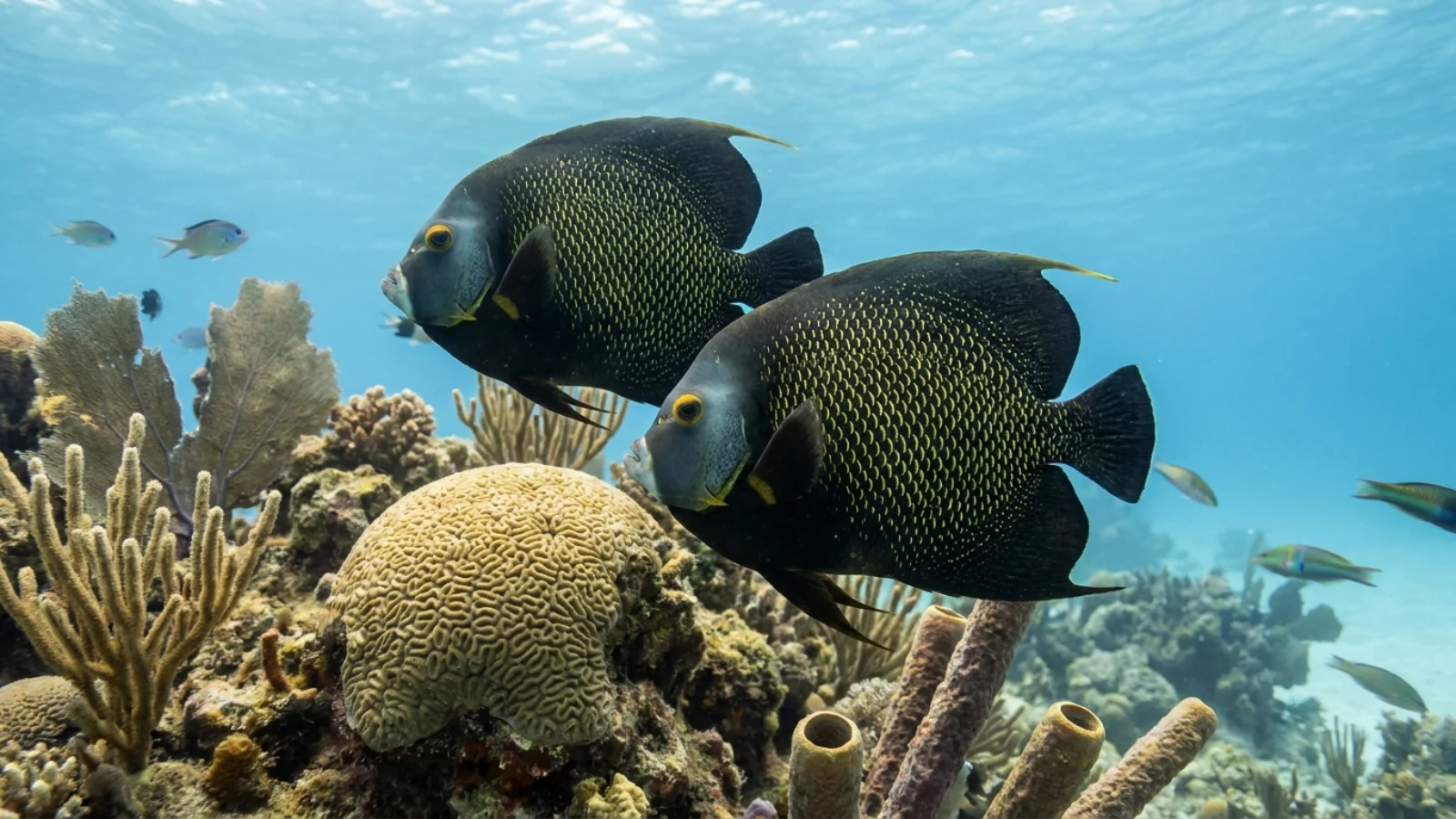
The French angelfish is the Caribbean’s most sociable big angelfish. Where the queen angelfish is often seen alone, French angelfish are usually in pairs, gliding between sea fans and sponges together. Watch them long enough and you will notice that the two fish rarely separate. They are one of the clearest examples of pair-bonding on the reef.
What does a French angelfish look like?
Adults are deep-bodied and black, with every scale rimmed in yellow, a yellow ring around the eye, a yellow bar at the pectoral fin base and a pale chin.
The gold-rimmed scales give a sparkling, chain-mail look. The dorsal and anal fins sweep back into long filaments. Like all marine angelfish, it has a strong spine on the gill cover. The family is covered in our reef angelfish guide, and the butterflyfish group guide covers its neighbours.
How big do French angelfish get?
Up to about 41 cm (16 in), usually around 28 cm.
FishBase gives a maximum reported age of 27 years, a long life for a reef fish of this size, and a length at first maturity of about 23 cm (range 15–25 cm). A Brazilian study by Feitosa and colleagues found the same figure, 23.3 cm total length, for females. Wikipedia’s range for the species starts as far north as New York; FishBase starts it at Florida.
Where do French angelfish live?
On rocky and coral reefs of the western Atlantic, from Florida and the Bahamas through the Gulf of Mexico and Caribbean to Brazil, and around Ascension Island and St Paul’s Rocks in the mid-Atlantic.
They are normally found in pairs on shallow reefs, often near sea fans, from 3 m down to 100 m. Good places to meet them include the Florida Keys, Bonaire, Cozumel and Belize. See also Caribbean coral reefs.
Do French angelfish mate for life?
They form monogamous pairs that are highly territorial, with both fish defending their area against neighbouring pairs.
The closely related gray angelfish (Pomacanthus arcuatus) is also monogamous, but FishBase describes its pairs as home-ranging rather than territorial: they do not defend an exclusive area. French angelfish pairs court at dusk. In the observations summarised by FishBase, a pair swam slowly side by side 25 to 75 cm above the reef, then, shortly after sunset, rose in a broad, shallow arc, travelling roughly 7–10 m horizontally while climbing to 2–3 m, with their bellies close together or touching at the top of the arc. The observers could not confirm whether eggs and sperm were released. Neighbouring pairs made similar arcs at about the same time without interfering with one another. Long-term studies of individual pairs are limited, so “for life” is best read as “stable, long-lasting pairs”.
What do French angelfish eat?
In the Caribbean, mostly sponges; in parts of Brazil, mostly algae.
The rest of the diet includes algae, bryozoans, zoanthids, gorgonians, hydroids, corals and tunicates. Juveniles start out eating parasites from other fish and add sponges as they grow. Sponges are defended with spicules and chemicals, so French and queen angelfish fill a niche few fish share. See sea sponge facts and what eats a sea sponge.
What do juvenile French angelfish look like?
Almost completely black with five vertical yellow bands, from a band around the mouth to one at the tail base.
Juveniles are dedicated cleaner fish. They set up cleaning stations and spend much of their time there, servicing jacks, snappers, morays, grunts, surgeonfish and wrasses. They advertise with a fluttering swim and touch clients with their pelvic fins as they clean. See cleaner wrasse for the Indo-Pacific equivalent.
Why do juvenile and adult French angelfish look so different?
The juvenile pattern advertises a cleaning service and keeps young fish out of the adults’ way.
Many marine angelfish have juvenile colours completely unlike the adults. One widely discussed explanation is that territorial adults attack fish that look like rivals, so a juvenile that looks like a different species is tolerated on the same reef. In French angelfish the bold yellow bands also work as an advertisement: clients recognise the pattern and visit the cleaning station. As juveniles grow past cleaning size and shift to a sponge diet, they lose the bands and pass through a transitional pattern before the gold-edged adult look appears.
How do you identify an adult French angelfish up close?
The family features come first. Marine angelfishes, family Pomacanthidae, look much like butterflyfishes but carry a strong spine at the corner of the preopercle, part of the gill cover. The family name comes from that spine: Greek poma, “cover”, and akantha, “thorn”. In the French angelfish this spine is obvious, while there are no spines on the main gill cover or under the eye. The body is laterally compressed and almost circular, the head is deep, and a short snout ends in a small mouth packed with bristle-like teeth.
FishBase gives ten dorsal spines with 29 to 31 soft rays, and three anal spines with 22 to 24 soft rays. The detail that separates a French angelfish from every other Caribbean fish is in the scales. Most of the body scales are black with a golden-yellow rim, but FishBase notes that the scales at the front, from the nape down to the belly, lack the gold edge. Add the whitish chin, the yellow ring around the eye, a broad orange-yellow bar at the base of the pectoral fin and the yellow filament trailing from the soft dorsal fin, and the identification is complete.
What is known about its sex life?
Less than you might expect, and the sources disagree on one important point. Wikipedia describes the French angelfish as a protogynous hermaphrodite, meaning a female can change sex to become a male if no male is present. The Wikipedia article on the family goes further and says all marine angelfish species are known to be protogynous hermaphrodites.
A study of a Brazilian population, published in Marine and Freshwater Research in 2015 by C. V. Feitosa and colleagues, found something different. They described the population as gonochoristic, with fish developing as either male or female, and found that males grew larger than females, with sex ratios that differed across size classes from 35 to 45 cm total length. Fish in spawning and spent condition turned up nearly every month, which suggests a long breeding season in that region. Whether French angelfish can change sex elsewhere, and under what conditions, is a question the published sources do not settle.
Like other marine angelfishes, French angelfish are pelagic spawners. They release many tiny, buoyant eggs into the water, which drift with the plankton until they hatch. Many are eaten by planktonic feeders long before the young fish settle back onto a reef.
How much of its diet is really sponge?
It depends on where you look. The classic evidence comes from the large gut-content survey of Caribbean reef fishes published by Randall and Hartman in 1968, a study that relied on spearing and dissecting large numbers of fish and is unlikely to be repeated. A 2018 review in PeerJ by Pawlik, Loh and McMurray returned to those data and compared the sponges found in angelfish guts with later laboratory tests of sponge chemical defences.
The result was clear. Chemically undefended sponge species made up 96 percent of the identifiable sponge diet of gray angelfish and 81 percent for French angelfish. In other words, these fish are not eating sponges at random. They pick the palatable species and largely avoid those protected by noxious chemicals. On Caribbean reefs that selectivity matters, because angelfishes help keep fast-growing sponges from overgrowing reef-building corals.
Brazil tells a different story. A 2012 study in the Brazilian Journal of Oceanography by D. Batista and colleagues examined adult French angelfish of 33 to 46 cm standard length from the south-western Atlantic. Across all their sites, algae made up about 63 percent of gut contents and sponges about 32 percent, with 36 sponge species and 26 algal species identified. The authors classed Caribbean adults as sponge-eaters and Brazilian adults as omnivores feeding mainly on algae. A few sponges, including Tedania ignis and Chondrilla nucula, appeared in the diets of both Caribbean adults and Brazilian juveniles, which the authors suggested may reflect a preference.
How do the juvenile cleaning stations work?
Much of what is known comes from Brazil. In 1999 I. Sazima, R. L. Moura and C. Sazima described the cleaning activity of juvenile French angelfish on the reefs of the Abrolhos Archipelago in the western South Atlantic, in Environmental Biology of Fishes. FishBase summarises the behaviour: juveniles tend cleaning stations where they serve a broad range of clients, including jacks, snappers, morays, grunts, surgeonfishes and wrasses.
To attract clients the young angelfish performs a fluttering swim, and while cleaning it touches the client with its pelvic fins. The juvenile picks parasites from the client’s body. As the fish grows, the cleaning habit fades and sponges and algae take over the diet. The gray angelfish follows a similar pattern; FishBase describes its juveniles as part-time cleaners.
What does a French angelfish do at night?
It goes home. French angelfish are active by day and, at dusk, each fish retires to a designated hiding place in the reef, returning to the same spot every night. This habit is shared with most marine angelfishes, which hide among the nooks and crevices of the reef after dark. During the day the larger angelfish species are bold and often approach divers, which is part of their appeal underwater.
Who named the French angelfish?
The German physician and naturalist Marcus Elieser Bloch described the species in 1787 as Chaetodon paru, in the butterflyfish genus Chaetodon. The type locality was given as Brazil and Jamaica. The species name, paru, is the Portuguese name for the fish. Bloch also described it under a second name, Chaetodon aureus, which survives only as a synonym. The species now sits in the genus Pomacanthus, which some authorities split into subgenera.
Is the French angelfish fished or traded?
Yes, on both counts. FishBase describes its flesh as good quality and marketed fresh, although there are reports of ciguatera poisoning from eating it, as there are for other marine angelfishes. In Brazil, Feitosa and colleagues report that the French angelfish is one of the five most exported species in the country’s aquarium trade, and it is also frequently caught as bycatch in fish traps.
Their 2015 study found that spawning females were more abundant than males at the spawning stage, which suggests that females may be more vulnerable to trap fishing during that period. Because traps take adults, the authors argued that managing the aquarium trade through quotas on juveniles alone may not be effective. They recommended monitoring catch rates and setting up trap-free areas on important spawning grounds. A separate age and growth study by Feitosa, Araújo and Ferreira, published in 2017 in the Journal of Applied Ichthyology, added estimates of growth and mortality for the same south-western Atlantic region.
At the southern edge of its range, a 2024 note recorded this subtropical fish in Uruguay, in the south-western Atlantic.
Where are the best places to see French angelfish?
Shallow, sponge-rich reefs with plenty of sea fans, especially in protected areas.
Look for them on the edges of spur-and-groove reefs and around patch reefs where big barrel and vase sponges grow among the gorgonians. They are often seen in the same areas as queen and gray angelfish, so a single sponge-rich slope can give you three species on one dive. Keep low and slow: a pair that feels crowded will turn and leave, but a pair that is left alone will often continue feeding and displaying close by. For photographers, the gold scale edges light up best with a strobe held off to the side.
How do you tell a French angelfish from a gray angelfish?
Look at the scales: French angelfish are black with bright gold scale edges; gray angelfish are grey-brown with a pale mouth and no gold.
| Feature | French angelfish | Gray angelfish |
|---|---|---|
| Scientific name | Pomacanthus paru | Pomacanthus arcuatus |
| Max length | 41 cm | 60 cm |
| Body colour | Black, gold-edged scales | Grey-brown, darker scale centres |
| Pairs | Monogamous, defend a territory | Monogamous, home range not defended |
| Range | Florida and Bahamas to Brazil; Ascension | New England to Brazil |
| IUCN | Least Concern | Least Concern |
Juveniles are trickier. Both are black with yellow bands, and field guides usually separate them by the tail: in French juveniles the tail is edged in yellow, while FishBase describes the gray juvenile’s tail as yellow with a near-rectangular or half-moon black spot in the middle. Gray juveniles also have two yellow bars on the body and three on the head.
Are French angelfish good aquarium fish?
Only for very large fish-only aquariums; they are not reef-safe.
FishBase lists the species in the commercial aquarium trade and notes it has been reared in captivity. Its size, a lifespan that can approach three decades and a wild diet of sponges, zoanthids and other invertebrates make it a long-term commitment and a poor fit for a reef tank. See reef aquarium fish selection.
Are French angelfish endangered?
No. The IUCN lists the species as Least Concern, last assessed in 2009.
The assessment is old, though, and local pressures are real. In Brazil the species is one of the five most exported fish in the aquarium trade and is often caught as bycatch in fish traps, and researchers there have argued that quotas on juveniles alone may not protect it (see below).
How big do French angelfish get?
Up to about 41 cm (16 in), usually around 28 cm.
How long do French angelfish live?
FishBase gives a maximum reported age of 27 years.
Do French angelfish mate for life?
They form stable, territorial monogamous pairs; long-term pair studies are limited.
What do French angelfish eat?
Mostly sponges in the Caribbean, plus algae, gorgonians, zoanthids and tunicates; in parts of Brazil, algae dominate.
What do juvenile French angelfish look like?
Black with five vertical yellow bands; they act as cleaner fish.
How do you tell French from gray angelfish?
French adults are black with gold-edged scales; gray angelfish are grey-brown with a pale mouth.
Are French angelfish reef safe?
No. They eat sponges, zoanthids and other invertebrates.
Are French angelfish endangered?
No. The IUCN lists them as Least Concern.
- Froese, R. & Pauly, D. (eds.). Pomacanthus paru, French angelfish. FishBase.
- Froese, R. & Pauly, D. (eds.). Pomacanthus arcuatus, Gray angelfish. FishBase.
- IUCN Red List. Pomacanthus paru: Least Concern (assessed 2009).
- Wikipedia contributors. French angelfish and Pomacanthidae (marine angelfishes): description, cleaning, pair behaviour, systematics.
- Allen, G. R. (1985). Butterfly and Angelfishes of the World, Vol. 2. Mergus.
- Feitosa, C. V., Marques, S., de Araújo, M. E. & Ferreira, B. P. (2015). Reproduction of French angelfish Pomacanthus paru and implications for management of the ornamental fish trade in Brazil. Marine and Freshwater Research 67: 586–593. doi:10.1071/MF14386
- Feitosa, C. V., Araújo, M. E. & Ferreira, B. P. (2017). Estimates on age, growth and mortality of the French angelfish Pomacanthus paru in the southwestern Atlantic. Journal of Applied Ichthyology 33: 409–414. doi:10.1111/jai.13246
- Batista, D., Muricy, G., Andréa, B. R. & Villaça, R. C. (2012). High intraspecific variation in the diet of the French angelfish Pomacanthus paru in the south-western Atlantic. Brazilian Journal of Oceanography 60(3): 449–454.
- Pawlik, Loh & McMurray (2018). A review of bottom-up vs. top-down control of sponges on Caribbean fore-reefs: what’s old, what’s new, and future directions. PeerJ 6: e4343. doi:10.7717/peerj.4343
- Sazima, I., Moura, R. L. & Sazima, C. (1999). Cleaning activity of juvenile angelfish, Pomacanthus paru, on the reefs of the Abrolhos Archipelago, western South Atlantic. Environmental Biology of Fishes 56: 399–407. doi:10.1023/A:1007531925845
Blane Perun has been exploring Earth’s oceans and marine life for over 25 years. Founder of TheSea.Org in 1999, underwater photographer, coral aquaculture pioneer, and explorer of 80+ countries.
About Blane Perun → More on Reef Fish →