Picasso Triggerfish — The Abstract-Art Fish of Indo-Pacific Lagoons
The Picasso triggerfish (Rhinecanthus aculeatus), also called the lagoon, blackbar or white-banded triggerfish, is an Indo-Pacific triggerfish named for its abstract pattern of blue, yellow, black and white bands. It grows to 30 cm, lives on shallow reef flats and lagoons from East Africa to Hawaii and the Tuamotus, eats almost anything from algae to sea urchins, and fiercely defends its territory and nest.
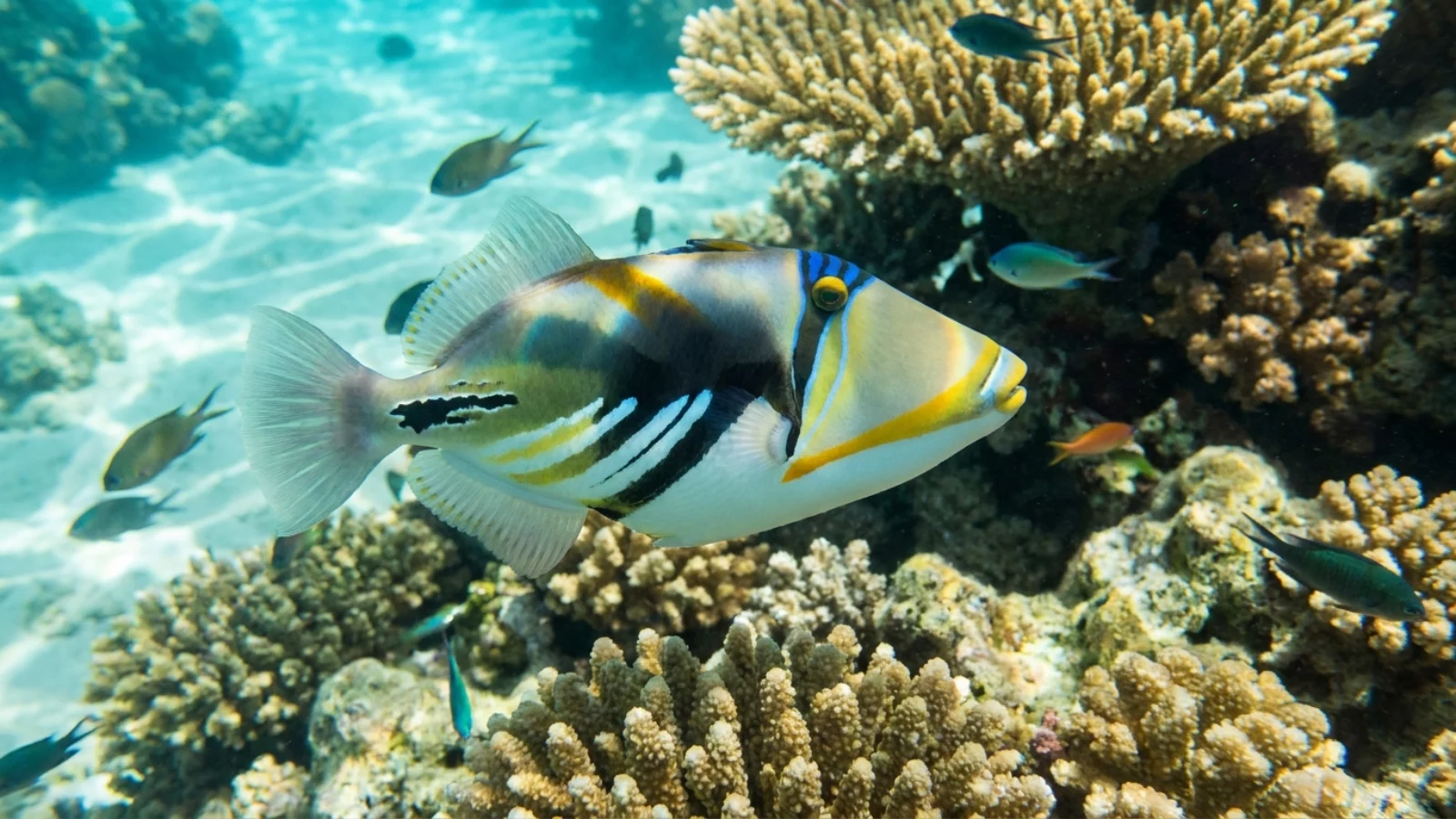
Some reef fish are beautiful. The Picasso triggerfish is something else: it looks designed. A sandy-tan back, a white belly, a band of electric blue and black lines running through the eye, a bright yellow stripe from the mouth back toward the pectoral fin, and slashes of black on the rear flank. It is easy to see why the pattern earned it a painter’s name.
Why is it called the Picasso triggerfish?
Because its bold, geometric pattern of colour bands looks like abstract modern art.
Scientists know it as the lagoon triggerfish, a better description of where it lives. Its closest well-known relative is the reef triggerfish, better known by its Hawaiian name humuhumunukunukuapua‘a and the official state fish of Hawaii. See our humuhumunukunukuapua‘a profile for that story.
What is a triggerfish “trigger”?
A locking dorsal spine: the first spine can be raised and locked upright by the second, smaller spine, which acts as a trigger.
When a triggerfish is threatened it dives into a crevice, erects the first dorsal spine and locks it with the second. Wedged in place, it is almost impossible for a predator to pull it out. Pressing the small second spine, the “trigger”, releases the lock. That is how the family got its name. Our triggerfish family guide and the odd-shaped swimmers group guide cover the wider group, including puffers and boxfish.
How big do Picasso triggerfish get?
Up to 30 cm (12 in), though 15 cm is typical.
Where do Picasso triggerfish live?
Across the Indo-Pacific, from East Africa through northern Australia to Hawaii, the Marquesas and the Tuamotus, and north to southern Japan.
FishBase describes them on subtidal reef flats and in shallow protected lagoons, from the surface to about 50 m. Juveniles are secretive and stay in rubble patches; adults swim openly but are usually shy of divers. They are a common sight for snorkellers on reef flats and in lagoons across that range, including Hawaii.
What do Picasso triggerfish eat?
Almost anything: algae, detritus, molluscs, crustaceans, worms, sea urchins, small fish, corals, tunicates, forams and eggs.
Triggerfish have small mouths but powerful jaws and chisel-like teeth. Picassos bite chunks from the reef, flip rubble to expose prey, blow water at the sand to uncover buried animals, and crush shells and urchins. That broad menu is part of what makes them hardy in aquariums and a menace to invertebrates. See what fish eat sea urchins.
How territorial are Picasso triggerfish?
Very. Both sexes defend territories, some for eight years or longer, and they are especially aggressive while guarding eggs.
Studies of lagoon triggerfish describe a haremic system: Kuwamura’s long-term field study found that each male’s territory overlapped two to three female territories, while Wikipedia’s summary gives one to five; males are reported to hold their territories longer than females. If a fish disappears, its territory is quickly taken over by another. During breeding, they lay eggs in a nest on the bottom and guard them vigorously, including against divers and snorkellers.
Do Picasso triggerfish make noise?
Yes. They make a whirring noise when alarmed, and they sleep lying on their side.
Many triggerfish produce sounds using their swim bladder and pectoral fins or by grinding their teeth. FishBase specifically notes that this species makes a whirring sound when alarmed. At night, Picassos tuck into a crevice and rest on their side, a habit FishBase records for the species.
How does a triggerfish swim?
By rippling its soft dorsal and anal fins, keeping the body almost rigid, and using the tail only for bursts of speed.
Triggerfish are built like a tall, compressed diamond with a tough, leathery skin of plate-like scales. Instead of flexing the body like a snapper, a Picasso sculls along by undulating the long soft fins on its back and belly in waves. This gives fine control for hovering, reversing and turning on the spot, which is ideal for picking prey out of rubble and darting into a crevice. When it needs to escape, the tail kicks in for a sudden burst, and the fish disappears into its hole with the trigger spine locked.
Are Picasso triggerfish safe to eat?
They are caught in small numbers, but FishBase notes reports of ciguatera poisoning, and they are not considered a food fish of note.
Ciguatera comes from toxins produced by microscopic dinoflagellates that build up through the reef food chain. Fish that eat a broad range of reef animals, like triggerfish, can accumulate it. FishBase lists the species as a minor commercial fish, also taken in drive-in nets, and popular in the aquarium trade. For most people, this is a fish to admire on a snorkel, not to put on the grill.
What eats Picasso triggerfish?
Larger reef predators, mainly when the triggerfish are young and away from shelter.
Adult triggers rely on the locking spine and a quick retreat into a crevice, which makes them a difficult meal. Juveniles, which stay close to rubble, are more vulnerable. The cryptic rubble-dwelling habit of young Picassos, described by FishBase, is the main defence while they grow.
Can you keep a Picasso triggerfish in an aquarium?
Yes. FishBase calls it a popular aquarium fish, but it is not reef-safe and it grows to 30 cm.
Its wild diet, which FishBase lists as including molluscs, crustaceans, worms, sea urchins, small fish, corals and tunicates, tells you what it will do to a mixed reef tank. It is territorial, and on the reef it chases intruders away from its patch, so tankmates need to be robust. Read marine vs reef tank and reef aquarium fish selection first.
| Picasso triggerfish care point | Detail |
|---|---|
| Adult size | Up to 30 cm |
| Reef safe | No: eats invertebrates and some corals |
| Temperament | Territorial; aggressive toward other triggers |
| Diet | Varied meaty foods, shellfish, some algae |
| Night behaviour | Sleeps on its side in a crevice |
How do Picasso triggerfish breed?
In a way that turns the usual fish rule upside down. In most bony fishes that lay eggs and fertilise them outside the body, it is the father that guards the eggs. In the Picasso triggerfish it is the mother. The key study is Kuwamura’s long-term field work on wild territorial fish, published in the journal Ethology in 1997.
Kuwamura found that both sexes held territories, some individuals for more than eight years. Pairs spawned around sunrise, laying demersal eggs that stick to sand, coral rubble or algae on the bottom. Only the female cared for them, and the eggs hatched just after sunset on the same day, so the whole period of care lasts less than a day. Wikipedia’s summary of the research adds that the mother stays above the eggs for about 12 to 14 hours, fanning them with her pectoral fins perhaps 30 percent of the time, chasing away most fish that approach and removing intruders such as starfish with her mouth.
That care matters. Kuwamura saw no predation on eggs that were being guarded, but when the females were experimentally removed, the hatching rate fell to nearly zero. Spawning was limited to periods of about a week around the new or full moon, and individual females spawned up to three times in each period.
Why do mothers, not fathers, guard the eggs?
Kuwamura’s explanation is about lost opportunities. Because the eggs hatch the same evening, guarding them does not stop a female from spawning again within the same lunar period, so maternal care costs her little. A male, by contrast, has several females in his territory. If he stayed with one egg mass, he would miss chances to mate with the others. Under those conditions, the paper argues, care by the mother is the evolutionarily stable strategy. Kuwamura went further and suggested that the triggerfish family may have evolved from no care, to maternal care, and then to care by both parents, as seen in some other triggerfish.
Later work showed that the mating system is not fixed. A 2016 study from Okinawa by Ziadi-Künzli and Tachihara, published in Marine Biology, described female defence polygyny and plasticity in the species’ mating system. FishBase summarises the mating system as a possible mixture of polygyny, monogamy and potential promiscuity among solitary females, with polygyny considered the main pattern. FishBase gives a length at first maturity of about 14 cm.
Why do vision scientists study the Picasso triggerfish?
Because it is one of the few reef fish whose colour vision has been worked out in detail, both from the eye’s anatomy and from what trained fish can actually tell apart. The species has one type of single cone, with a pigment most sensitive at about 413 nanometres in the violet, and double cones whose two members are most sensitive at about 480 and 530 nanometres. Those three sensitivities suggest that, like people, it has trichromatic colour vision.
The triggerfish answered a long-standing question about double cones, the most common cone type in fishes, reptiles and birds. They had been thought to handle tasks such as brightness, motion and polarisation rather than colour. In 2010, Pignatelli, Champ and Marshall reported in Biology Letters that Picasso triggerfish can discriminate colours using the difference between the signals of the two members of a double cone. It was the first direct evidence that the halves of a double cone act as independent colour channels.
Since then the fish has become a standard test subject. In a 2022 study in the Journal of Experimental Biology, N. F. Green and colleagues trained triggerfish on Ishihara-style patterns, the dotted circles used in human colour-blindness tests, and measured their thresholds in 21 directions at five locations in colour space. It is described as one of the most comprehensive tests of colour discrimination in any non-human species. The fish were usually less sensitive to differences in saturation than in hue, and less sensitive to strongly saturated colours than to colours near grey.
How does the Picasso triggerfish see its prey?
Researchers studying warning colours use the Picasso triggerfish as a model predator. Its visual system is built into software that predicts how a pattern looks to a fish at different distances. Studies of sea slugs and nudibranchs from eastern Australia have used it this way. A 2023 study by C. P. van den Berg, J. A. Endler and K. L. Cheney found that at a viewing distance of 30 cm there was no difference in detectability or boldness between well-defended and undefended nudibranchs, but closer than 30 cm the well-defended species stood out more. In other words, a toxic sea slug’s warning pattern may work best at the moment a triggerfish is about to bite.
Live triggerfish have also tested these computer models directly. In another 2022 experiment, van den Berg and colleagues timed how quickly triggerfish found patterned targets against a noisy background. The edge statistics that image-analysis software uses to predict detection explained only up to 2 percent of the variation in detection time on their own, and up to 6 percent together, a reminder that what a fish actually does can differ a lot from what a model predicts.
How does a Picasso triggerfish make its whirring sound?
The mechanism was first described in this species. Sound comes from alternate sweeping movements of the right and left pectoral fins, which push a system of three bony scutes against the wall of the swim bladder. A 2018 study led by X. Raick compared the Picasso triggerfish with the reef triggerfish and the orange-lined triggerfish and found the same mechanism in all three, suggesting that most triggerfish can make sounds this way.
The fins that make the sound are part of a precise steering system. By waving the dorsal and anal fins, the Picasso can move forwards or backwards or hover in place above the reef. That lets it back out of a crevice more easily than fish that can swim only forward, which matters for an animal that spends its nights wedged into a hole with its spine locked.
How do you tell a Picasso triggerfish from similar species?
Count on the face and the flank. FishBase gives three dorsal spines, 23 to 26 soft dorsal rays and 21 to 23 soft anal rays, numbers very close to those of the reef triggerfish, so fin counts will not separate them in the water. Pattern and habitat will. The Picasso has blue and black lines through the eye, a yellow stripe from the mouth and several black diagonal bars on the rear flank, and it lives in calm lagoons and on reef flats. The reef triggerfish has one bold black wedge from eye to belly and a gold-edged black wedge at the tail, and it prefers surge-swept outer reefs.
The two species overlap across much of the Indo-Pacific, including Hawaii, so a snorkeller can sometimes see both on the same trip by moving from a sheltered lagoon to the outer reef edge. Both are listed as Least Concern by the IUCN, both reach about 30 cm, and both were assessed in 2022.
How is the Picasso different from the reef triggerfish?
The Picasso has black diagonal bars on the rear flank and lives in calm lagoons; the reef triggerfish has a single black wedge from the eye to the belly and prefers surge-swept outer reefs.
Both reach about 30 cm, share most of their range, and are listed as Least Concern. The reef triggerfish, Rhinecanthus rectangulus, is the official state fish of Hawaii. Juveniles of both use rubble and algae for cover, and both are territorial and eat a wide range of prey.
Why is it called a Picasso triggerfish?
Because its bold, geometric colour bands look like abstract art in the style of Pablo Picasso.
How big do Picasso triggerfish get?
Up to 30 cm (12 in), usually about 15 cm.
Are Picasso triggerfish aggressive?
They are territorial and can nip divers near their nests, but they are among the less aggressive triggerfish.
Are Picasso triggerfish reef safe?
No. They eat shrimp, crabs, snails, clams and some corals.
What do Picasso triggerfish eat?
Almost anything: algae, molluscs, crustaceans, worms, urchins, small fish, corals and eggs.
Where do Picasso triggerfish live?
Indo-Pacific reef flats and lagoons from East Africa to Hawaii and French Polynesia.
Do triggerfish sleep on their side?
Yes. Picasso triggerfish rest on their side in a crevice at night.
Is the Picasso triggerfish the Hawaii state fish?
No. The state fish is its relative, the reef triggerfish, Rhinecanthus rectangulus.
- Froese, R. & Pauly, D. (eds.). Rhinecanthus aculeatus, White-banded triggerfish. FishBase.
- IUCN Red List. Rhinecanthus aculeatus: Least Concern (assessed 2022).
- Wikipedia contributors. Lagoon triggerfish: territories and reproduction.
- Myers, R. F. (1991). Micronesian Reef Fishes, 2nd ed. Coral Graphics.
- Randall, J. E. (2007). Reef and Shore Fishes of the Hawaiian Islands. University of Hawaii Sea Grant.
- Kuwamura (1997). Evolution of female egg care in haremic triggerfish, Rhinecanthus aculeatus. Ethology 103: 1015–1023. doi:10.1111/j.1439-0310.1997.tb00143.x
- Ziadi-Künzli & Tachihara (2016). Female defence polygyny and plasticity in the mating system of the demersal triggerfish Rhinecanthus aculeatus from Okinawa Island. Marine Biology. doi:10.1007/s00227-015-2780-z
- Pignatelli, Champ & Marshall (2010). Double cones are used for colour discrimination in the reef fish, Rhinecanthus aculeatus. Biology Letters. doi:10.1098/rsbl.2009.1010
- Green, N. F. et al. (2022). Colour discrimination thresholds vary throughout colour space in a reef fish (Rhinecanthus aculeatus). Journal of Experimental Biology. doi:10.1242/jeb.243533
- van den Berg, C. P., Endler, J. A. & Cheney, K. L. (2023). Signal detectability and boldness are not the same: the function of defensive coloration in nudibranchs is distance-dependent. Proceedings of the Royal Society B. doi:10.1098/rspb.2023.1160
- van den Berg, C. P. et al. (2022). Using colour pattern edge contrast statistics to predict detection speed and success in triggerfish (Rhinecanthus aculeatus). Journal of Experimental Biology. doi:10.1242/jeb.244677
- Raick, X. et al. (2018). Sound production mechanism in triggerfish (Balistidae): a synapomorphy. Journal of Experimental Biology. doi:10.1242/jeb.168948
Blane Perun has been exploring Earth’s oceans and marine life for over 25 years. Founder of TheSea.Org in 1999, underwater photographer, coral aquaculture pioneer, and explorer of 80+ countries.
About Blane Perun → More on Reef Fish →