Queen Angelfish — The Crowned Jewel of Caribbean Reefs
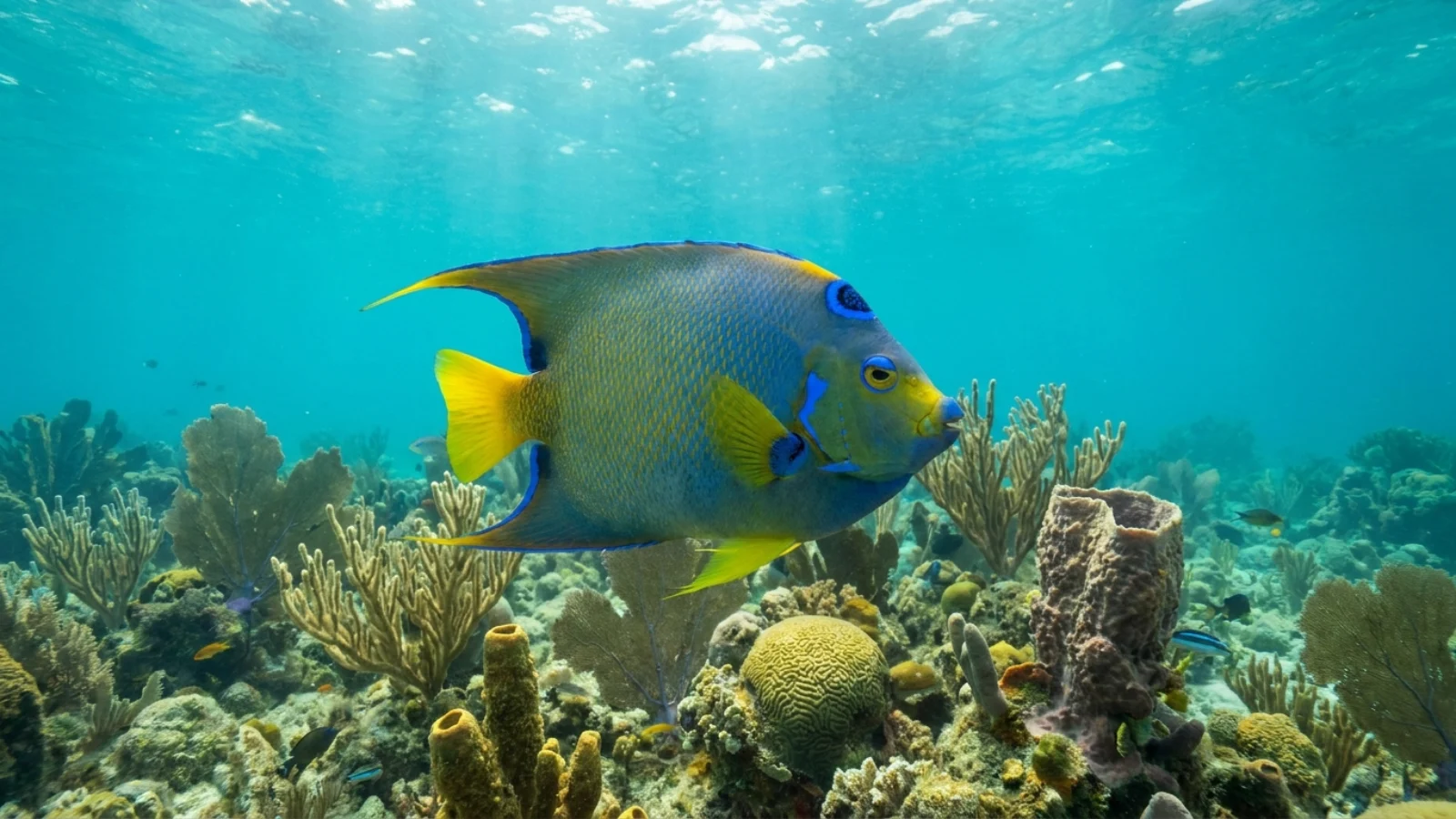
The queen angelfish (Holacanthus ciliaris) is a large marine angelfish of the western Atlantic, from Florida and the Gulf of Mexico through the Caribbean to Brazil. Electric blue and yellow with a bright yellow tail, it is named for the blue-ringed “crown” spot on its forehead. It grows to 45 cm, feeds mainly on sponges, lives in harems of one male and several females, and is listed as Least Concern.
If one fish could stand for the colour of Caribbean reefs, it would be the queen angelfish. Electric blue edged in gold, a yellow tail like a flag and a cobalt crown on the forehead ringed in neon. It is common from the Florida Keys to Brazil, and it is still one of the fish that makes experienced divers stop and stare.
Why is it called the queen angelfish?
Because of the “crown”: a dark blue, eye-like spot on the forehead, ringed in electric blue and speckled with blue dots.
That crown is also the most reliable way to tell the queen from its close relative, the Bermuda blue angelfish (Holacanthus bermudensis), which lacks it. Marine angelfish belong to the family Pomacanthidae and are recognised by a strong spine at the corner of the gill cover. Our reef angelfish guide covers the family, and the butterflyfish group guide covers their butterflyfish cousins.
How big do queen angelfish get?
Up to 45 cm (18 in) and 1.6 kg, though 30 cm is a more typical adult.
FishBase gives a length at first maturity of about 22 cm. Queen angelfish are slow to replace themselves, with a FishBase resilience rating of low (population doubling time of 4.5–14 years), which matters when they are collected for aquariums.
Where do queen angelfish live?
In the western Atlantic, from Florida and the Gulf of Mexico through the Caribbean to Brazil, and around the remote St Peter and St Paul Archipelago in the mid-Atlantic.
They live on coral reefs from 1 to 70 m, moving gracefully among sea fans, sea whips and corals, alone or in pairs. Good places to see them include the Florida Keys, Bonaire, Cozumel and Belize. See Caribbean coral reefs for the wider habitat.
What do queen angelfish eat?
Sponges, mostly. FishBase reports a diet of almost exclusively sponges, with small amounts of algae, tunicates, hydroids and bryozoans.
Studies at different sites show how dominant sponges are. At some Caribbean and Brazilian locations, sponges make up about 90% of the adult diet. At the St Peter and St Paul Archipelago, researchers found more than 30 prey species, of which 68% were sponges, 25% algae and 5% bryozoans. Sponges are packed with glass-like spicules and chemical defences that put off most fish, so queen angelfish fill a feeding niche few others can. See sea sponge facts and what eats a sea sponge.
How do queen angelfish reproduce?
In harems: a territorial male holds a range with two to four females, and spawns with them as pairs.
During courtship, the male and a female swim up off the reef together and release eggs and sperm into the water, after which the pair separate and return to the bottom. The larvae drift in the plankton until they are three to four weeks old, then descend to the reef as juveniles. If the male disappears, the largest female in the harem can change sex and take his place.
What do juvenile queen angelfish look like?
Dark blue with bright blue, curved vertical stripes and a yellow chest area, quite unlike the adult.
Juveniles live alone, in small territories around finger sponges and coral, and run cleaning stations where they pick parasites off larger fish. They look very similar to juvenile blue angelfish; the queen’s stripes are more curved. As they grow they pass through transitional patterns before the crown and full colours appear.
What is a Townsend angelfish?
A natural hybrid between the queen angelfish and the Bermuda blue angelfish, with features of both.
The two species split around 1.5 million years ago and still overlap in range and interbreed. Hybrids, called Townsend angelfish, show a mix of features from both parents, which can make identification tricky in Florida and the Gulf, where both species occur.
| Feature | Queen angelfish | Bermuda blue angelfish |
|---|---|---|
| Scientific name | Holacanthus ciliaris | Holacanthus bermudensis |
| Forehead crown | Yes, blue-ringed spot | No |
| Max length | 45 cm | 45 cm |
| Range | Florida and Gulf to Brazil | Bermuda, Bahamas, southern Florida, Gulf of Mexico |
| Depth | 1–70 m | 2–92 m |
| Hybrid | Townsend angelfish | Townsend angelfish |
How do you identify a queen angelfish in detail?
The crown is the giveaway, but the rest of the fish is worth knowing. FishBase describes the forehead mark as a black spot covered with electric-blue spots and surrounded by a narrow electric-blue ring. The tail and pectoral fins are entirely yellow, there is a large blue spot at the base of the pectoral fin, and the dorsal and anal fins trail back past the body and end in orange-yellow points. The scales are blue-green with yellow tips, and FishBase notes that large adults turn more purplish blue and develop short spines along the scale margins.
For counting, FishBase gives 14 dorsal spines with 19 to 21 soft rays, and 3 anal spines with 20 to 21 soft rays. The body is broad, flat and oval, with a short, blunt snout and a small mouth full of bristle-like teeth, the classic tool kit of a sponge-eater. Males may be larger than females. Like all marine angelfishes, the queen carries a strong spine at the corner of the gill cover.
Are there unusual colour forms?
Yes, and most come from one remote place. Off the Saint Peter and Saint Paul Archipelago, Brazil, researchers have recorded seven other colour morphs. The most common is mostly gold or bright orange. Others are bright blue with patches of yellow, black or white, and some are almost entirely white. A different morph, mostly cobalt blue with white and yellow-orange areas, was recorded off the Dry Tortugas in Florida in 2009.
The same archipelago has produced records of at least two wild queen angelfish with a “pughead” skeletal deformity: a squashed upper jaw with the lower jaw jutting out. Such deformities are mostly seen in captive fish, so wild records are noteworthy.
How picky is a queen angelfish about its sponges?
Very. FishBase cites stomach contents from 26 fish that showed an almost exclusive diet of sponges, supplemented by small amounts of algae, tunicates, hydroids and bryozoans. Wikipedia’s summary of more recent work gives figures by site: around St Thomas and off Salvador in Bahia, Brazil, sponges made up about 90 percent of the adult diet. At the Saint Peter and Saint Paul Archipelago the fish ate more than 30 prey species, with sponges about 68 percent, algae about 25 percent and bryozoans about 5 percent.
The most interesting finding from that archipelago was selectivity. The proportions of prey in the angelfish’s diet did not match how common those prey were on the reef. Instead, the fish targeted relatively uncommon sponges, including Geodia neptuni, Erylus latens, Clathria calla and Asteropus niger. A queen angelfish cruising a reef is therefore not grazing at random. It is searching for particular species, much as the French and gray angelfishes favour sponges that lack chemical defences.
How does a queen angelfish harem work day to day?
Each territorial male holds a large area that includes the ranges of two to four females. Around midday the females forage on their own in different parts of the territory, and the male visits each in turn, rushing at her, circling and feeding next to her. Little is known about the sexual development of the species, but it is presumed to be a protogynous hermaphrodite, which is why the largest female may become a male if the territorial male disappears.
Spawning happens year-round and has been observed around the full moon. In courtship the male shows his side to the female, flicks his pectoral fins at her or “soars” above her. When spawning begins, the female swims toward the surface with the male just below her, his snout pressed close to her vent, and the pair release eggs and sperm together before heading back to the bottom. A female can release between 25,000 and 75,000 eggs a day.
The transparent eggs float for about 15 to 20 hours before hatching. The newly hatched larva has a large yolk sac and no functional eyes, gut or fins. About two days later the yolk has been absorbed and the larva looks much more like a fish. It feeds on plankton and grows quickly, and at three to four weeks old, about 15 to 20 mm long, it settles to the bottom as a juvenile.
Where did the queen angelfish come from?
The genus Holacanthus probably arose between about 10.2 and 7.6 million years ago. Its most basal living member is the Guinean angelfish, Holacanthus africanus, of West Africa, which suggests that the lineage reached the Atlantic from the Indian Ocean. When the Isthmus of Panama closed about 3.5 to 3.1 million years ago, the eastern Pacific species split off from their Atlantic relatives.
The queen’s closest relative is the Bermuda blue angelfish, from which it separated around 1.5 million years ago. The two still overlap and interbreed, and their hybrid, the Townsend angelfish, is fertile: hybrids can breed with each other and with both parent species. That makes the queen angelfish a useful example of a young species pair whose boundary is still leaky.
Who named the queen angelfish?
Carl Linnaeus described it in 1758 as Chaetodon ciliaris in the 10th edition of Systema Naturae, giving the type locality as the western Atlantic and Caribbean. In 1802 the French naturalist Bernard Germain de Lacépède moved it to the genus Holacanthus, from the Greek holos, “full”, and akantha, “thorn”. The species name ciliaris means “fringed”, a reference to the fringed, ciliate scales. Besides queen angelfish, it has been called blue angelfish, golden angelfish and yellow angelfish, names also used for other angelfish and a good reason to use the scientific name when buying or reporting one.
How big is the aquarium trade in queen angelfish?
Large in Brazil. The queen angelfish is not normally targeted as food, although FishBase records minor commercial fisheries and reports of ciguatera poisoning. Its main value is in the aquarium trade, where it is highly prized. In Brazil it is the most common marine ornamental fish sold abroad. Between 1995 and 2000, 43,730 queen angelfish were traded at Fortaleza in the north-east of the country, and in 1995 queen and French angelfish together made up 75 percent of the marine fish sold there.
FishBase rates the species’ resilience as low, with a minimum population doubling time of 4.5 to 14 years, and gives it a fishing vulnerability score of 55 out of 100, which it classes as high. Juveniles adapt to typical aquarium foods and survive better than fish taken as adults, which need a more specialised diet.
Have queen angelfish turned up outside their range?
Several times, almost certainly through the aquarium trade. Queen angelfish were caught in the eastern Adriatic Sea off Croatia in 2011 and off Malta in the Mediterranean in 2020; both are thought to be releases rather than natural colonisations. In 2015 an aquarium-released queen angelfish was found in the Red Sea at the Coral Beach in Eilat, Israel. Its kidney was infected with the bacterium Photobacterium damselae piscicida, which had not previously been recorded in Red Sea fish, raising concern that released aquarium fish could carry disease to native species. It is a strong argument against ever releasing an aquarium fish into the sea.
How does the queen compare with other Caribbean angelfish?
The Caribbean has five common large angelfish; the queen is the most colourful, but not the biggest.
| Species | Max length | Look | Main foods |
|---|---|---|---|
| Queen angelfish, Holacanthus ciliaris | 45 cm | Blue and yellow, crown spot, yellow tail | Sponges |
| Bermuda blue angelfish, H. bermudensis | 45 cm | Blue-grey and yellow, no crown | Sponges |
| Rock beauty, H. tricolor | 35 cm | Yellow front, black body | Tunicates, sponges, zoanthids, algae |
| French angelfish, Pomacanthus paru | 41 cm | Black with yellow-edged scales | Sponges, algae, gorgonians |
| Gray angelfish, P. arcuatus | 60 cm | Grey with pale mouth | Sponges, tunicates, algae |
All five are listed as Least Concern by the IUCN. The gray angelfish is the giant of the group at up to 60 cm. The French and gray angelfish are usually seen in pairs; the queen is seen alone or in pairs. Rock beauty juveniles are often found around fire coral. If you see an angelfish with a ringed crown on its forehead, you have found a queen.
How do queen angelfish behave on the reef?
Calm, deliberate and usually alone or in pairs, swimming between sea fans, sea whips and sponges.
FishBase describes them moving gracefully among gorgonians and corals. Adults tend to keep their distance from divers who chase them but tolerate a slow, low approach. Like other marine angelfish, they carry a sharp spine at the base of the gill cover, used in disputes with rivals. A territorial male’s range is large enough to hold the territories of his two to four females.
Are queen angelfish good aquarium fish?
Only for very large fish-only systems and experienced keepers.
Adults grow large and need a sponge-based diet that is hard to replicate. Fish collected as juveniles adapt better to aquarium foods and survive at higher rates than adults. They will nip sessile invertebrates, so they are not reef-safe. See reef aquarium fish selection before buying.
Are queen angelfish endangered?
No. The IUCN lists the queen angelfish as Least Concern, last assessed in 2009.
Its slow population growth means heavy local collection for the aquarium trade or loss of sponge-rich reef can reduce numbers. Wikipedia notes that the species is significantly fished only off Brazil, and that the wild population appeared stable at the time of assessment. FishBase dates that assessment to 8 October 2009; Wikipedia describes it as published in 2010.
How big do queen angelfish get?
Up to 45 cm (18 in) and 1.6 kg, usually around 30 cm.
What do queen angelfish eat?
Mainly sponges, plus algae, tunicates, hydroids and bryozoans.
Where do queen angelfish live?
Western Atlantic reefs from Florida and the Gulf of Mexico through the Caribbean to Brazil.
How do you tell a queen angelfish from a blue angelfish?
The queen has a blue-ringed crown spot on its forehead and a fully yellow tail.
Are queen angelfish reef safe?
No. They nip sponges, corals and other sessile invertebrates.
Do queen angelfish change sex?
Yes. The largest female in a harem can become male if the male disappears.
What is a Townsend angelfish?
A hybrid between the queen angelfish and the Bermuda blue angelfish.
Are queen angelfish endangered?
No. The IUCN lists them as Least Concern.
- Froese, R. & Pauly, D. (eds.). Holacanthus ciliaris, Queen angelfish. FishBase.
- Allen, G. R. (1985). Butterfly and Angelfishes of the World, Vol. 2. Mergus.
- IUCN Red List. Holacanthus ciliaris: Least Concern (assessed 2009).
- Froese, R. & Pauly, D. (eds.). Holacanthus bermudensis, Pomacanthus arcuatus, Holacanthus tricolor. FishBase.
- Wikipedia contributors. Queen angelfish: taxonomy, evolution, colour morphs, diet by site, harem behaviour, spawning, trade and introductions (with primary references therein).
Blane Perun has been exploring Earth’s oceans and marine life for over 25 years. Founder of TheSea.Org in 1999, underwater photographer, coral aquaculture pioneer, and explorer of 80+ countries.
About Blane Perun → More on Reef Fish →