Porcupine Fish vs Pufferfish — Spines, Beaks and Toxin: How to Tell Them Apart
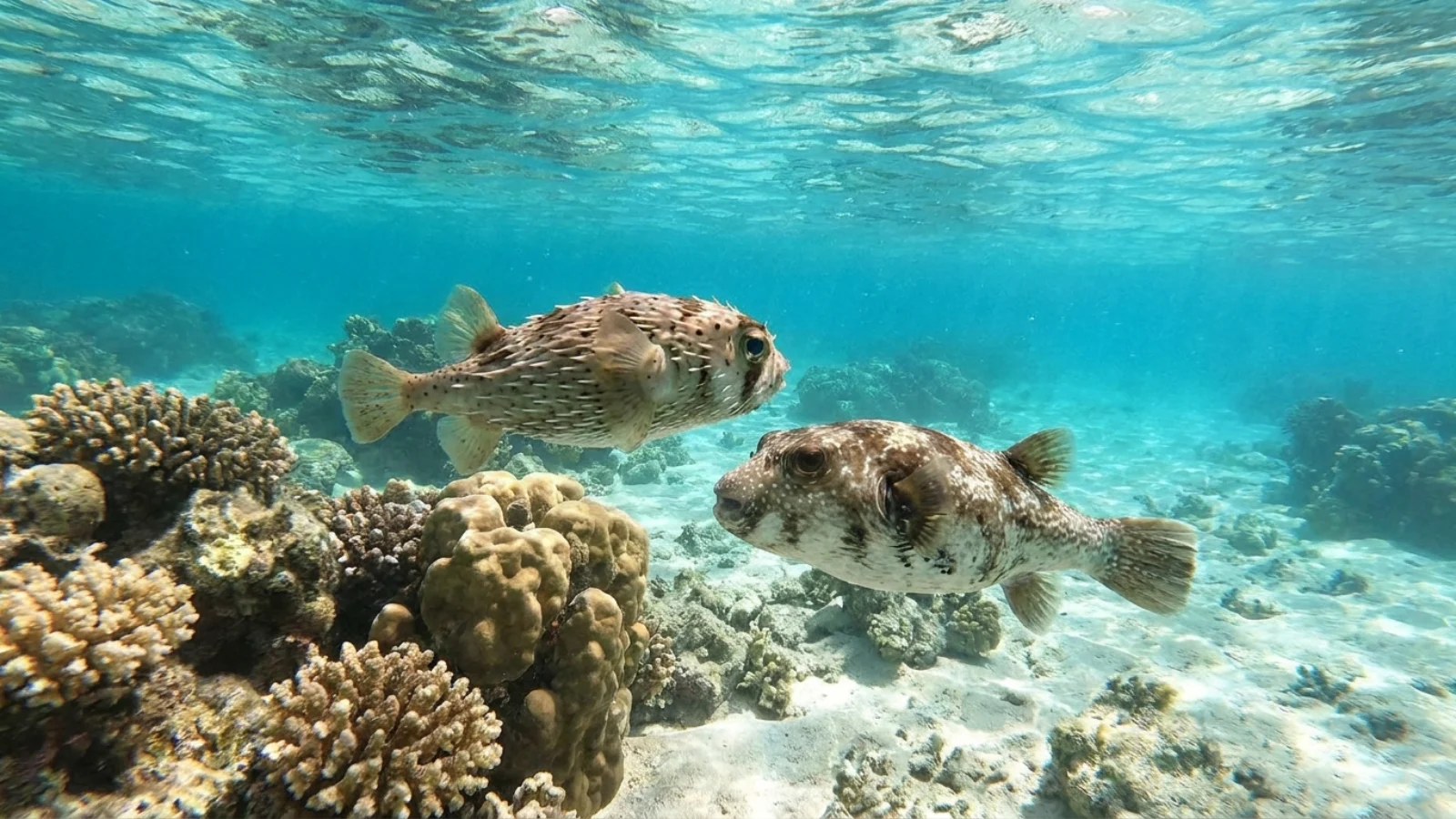
Not quite. Porcupine fish (family Diodontidae, 18 species) and pufferfish (family Tetraodontidae, about 206 species) are close relatives in the order Tetraodontiformes, and both can inflate by swallowing water. The easy differences: porcupinefish carry long, obvious spines all over the body even when deflated, and their teeth are fused into a single plate in each jaw. Pufferfish usually have tiny or hidden spines and four beak-like teeth, two in each jaw.
Every diver has seen it happen. A fish is cornered, gulps water, and seconds later it is a spiky balloon. Most people call any fish that does this a pufferfish, and in a loose sense they are right. But the porcupine fish and the pufferfish are separate families with different teeth, different armour and, in some cases, different risks to people who eat them.
What is the difference between a porcupine fish and a pufferfish?
Spines and teeth. Porcupinefish have long, permanently visible spines and one fused tooth plate per jaw; pufferfish have short or hidden spines and four teeth.
The family names say it. Diodon means “two teeth” and Tetraodon means “four teeth”. In porcupinefish, the upper and lower teeth are each fused into a single parrot-like beak plate. In pufferfish, each jaw has a split down the middle, giving four tooth plates. Both use their beaks to crunch hard-shelled prey such as snails, clams, crabs and sea urchins.
| Feature | Porcupine fish (Diodontidae) | Pufferfish (Tetraodontidae) |
|---|---|---|
| Number of species | 18 | about 206 |
| Teeth | 2 fused plates (1 per jaw) | 4 plates (2 per jaw) |
| Spines | Long, obvious, stand erect when inflated | Small prickles, often only visible when inflated |
| Eyes | Large, suited to night feeding | Variable; eyes can move independently |
| Habitat | Marine and brackish | Marine, brackish and about 35 freshwater species |
| Toxin | Some species carry tetrodotoxin; many reports of low toxicity | Many species highly toxic; fugu |
| Example | Spot-fin porcupinefish, Diodon hystrix | White-spotted puffer, Arothron hispidus |
How do porcupine fish and pufferfish inflate?
Both pump water into a highly elastic stomach until the body is nearly spherical.
A deflated fish is slow and easy prey. Inflated, it is suddenly too big and round to swallow, and in porcupinefish the spines lock out to form a spiked ball. A predator that does swallow one can choke. Out of water, both can inflate with air, which is harmful to them, so never pull a puffer out of the water to make it puff up. Charles Darwin noted that porcupinefish can still swim when inflated, but the change in buoyancy forces them to swim upside down.
Which is bigger, a porcupine fish or a pufferfish?
On reefs, the spot-fin porcupinefish is one of the biggest, at up to 91 cm; common reef puffers such as the white-spotted puffer reach about 50 cm, but the starry puffer can reach 120 cm.
FishBase lists the spot-fin porcupinefish, Diodon hystrix, at up to 91 cm and 2.8 kg, and the long-spine porcupinefish, Diodon holocanthus, at up to 50 cm though usually about 15 cm. The white-spotted puffer, Arothron hispidus, reaches about 50 cm and 2 kg. The largest puffers are marine: FishBase lists the starry puffer, Arothron stellatus, at up to 120 cm. The biggest freshwater species is the mbu puffer of central Africa, at up to 67 cm.
Where do porcupine fish and pufferfish live?
Both are found on tropical and subtropical reefs worldwide, and pufferfish also live in brackish and fresh water.
The spot-fin porcupinefish is circumtropical: from San Diego to Chile and the Galapagos in the eastern Pacific, Massachusetts and Bermuda to Brazil in the western Atlantic, the eastern Atlantic, and across the Indo-Pacific, at 2–50 m. It is a solitary, nocturnal hunter that spends the day in caves and under ledges. Juveniles up to about 20 cm live in open water; adults settle on the reef. The white-spotted puffer ranges from the Red Sea and East Africa to Hawaii and the eastern Pacific from Baja California to Panama, at 1–50 m.
What do porcupine fish and pufferfish eat?
Hard-shelled invertebrates: sea urchins, snails, hermit crabs, clams and crabs, crushed with their beaks.
FishBase records Diodon hystrix feeding at night on sea urchins, gastropods and hermit crabs. Puffers have more varied diets: some eat algae and sponges, others coral tips, worms or other fish. Both families are among the reef fish that eat sea urchins (see what fish eat sea urchins), which links them to the health of the reef itself.
Are porcupine fish poisonous like pufferfish?
Some are, but generally less so. Many pufferfish species are among the most poisonous vertebrates on Earth, while porcupinefish toxicity is usually lower and more variable.
The toxin is tetrodotoxin (TTX), a nerve poison that is at least 1,200 times more potent than cyanide. It is concentrated in the liver and ovaries, with smaller amounts in skin and gut. A study in Okinawa found negligible toxicity in the flesh and organs of the spot-fin porcupinefish, yet poisoning cases from porcupinefish have still been reported, ranging from mild to severe, and FishBase lists D. hystrix as poisonous to eat. In Japan, only licensed chefs may prepare fugu, the tiger puffer, and some farms raise non-toxic puffers on controlled diets. The safe rule: do not eat either unless prepared by a qualified professional. Neither is venomous; touching them is not the danger, though the spines and beak can injure.
Can you keep porcupine fish or pufferfish in an aquarium?
Yes, in fish-only systems; they eat invertebrates and are not reef-safe.
Both families are popular for their personalities. Aquarists describe them as interactive, begging for food at the glass. But they will eat shrimp, crabs, snails and clams, and they grow large, so they need big tanks with heavy filtration. Their beaks grow continuously and must be worn down with hard-shelled foods. See marine vs reef tank for the difference between a fish-only and a reef system.
How do you tell them apart underwater?
Look for long spines lying flat along the body and big round eyes: that is a porcupinefish. A smooth or finely prickled body, often with spots or stripes: a puffer.
Divers on Caribbean reefs will mostly see balloonfish and porcupinefish (both Diodon) hiding under ledges, plus sharpnose puffers and the occasional bandtail puffer in the open. In the Indo-Pacific, the dog-faced, map, star and white-spotted puffers (Arothron) are common, along with porcupinefish in caves.
How are porcupinefish and pufferfish related?
Both families belong to the order Tetraodontiformes, which also contains triggerfish, filefish, boxfish and the ocean sunfish. Within that order, puffers and porcupinefish are sister groups: each other’s closest living relatives. FishBase, following Eschmeyer’s Catalog of Fishes, counts 206 puffer species in 29 genera and 18 porcupinefish species in 7 genera. Other classifications differ slightly, and the Wikipedia family account lists 193 puffer species in 28 genera, so it is safest to say “about 190 to 210” for puffers. The puffer fossil record in FishBase goes back to the early Eocene.
The porcupinefish genera include Diodon, the classic long-spined porcupinefish and balloonfish, and Chilomycterus and Cyclichthys, the burrfishes. Burrfish are worth knowing because they confuse the simple “long spines” rule. Their spines are shorter, blunter and immovable, so a burrfish looks prickly even when relaxed but never raises its spines the way a Diodon does. The striped burrfish of the western Atlantic, Chilomycterus schoepfi, ranges from Nova Scotia and Maine southward, lives in water from about 1 to 11 m deep and reaches about 28 cm, according to FishBase. It is still a porcupinefish, and it still has the single fused tooth plate in each jaw that defines the family.
The puffer family is larger and more varied. It includes the big reef puffers of the genus Arothron, the small sharpnose puffers or tobies of Canthigaster, the temperate fugu of Takifugu, open-water species of Lagocephalus, and about 35 species that live their whole lives in fresh water in tropical South America, Africa and Southeast Asia.
Teeth and skeleton: the details behind the names
The tooth difference is more precise than “two versus four”. FishBase describes porcupinefish jaws as having two fused, parrot-like teeth, with the opposite jaw bones entirely united at the midline. In puffers the jaw teeth are also fused, but each jaw has a median suture down the middle, so the beak looks like four teeth. The beak grows continuously and is worn down by crushing shells, which is why both families need hard foods in captivity.
The skeleton is also adapted for inflation. FishBase notes that puffers lack ribs and epipleural bones, and the Wikipedia family account adds that they lack pelvic fins. The spot-fin porcupinefish also has no pelvic fins. Without a rigid rib cage, the body wall can stretch to take in a large volume of water. In puffers the skin carries small prickles or is almost naked; in porcupinefish the scales are modified into true spines.
How inflation evolved and what it costs
In a 1997 study in Evolution, P. C. Wainwright and R. G. Turingan compared the head anatomy and muscle activity of tetraodontiforms. They found that all members of both the puffer and porcupinefish families can inflate, and that most of their relatives perform two related behaviours: a “cough” and a strong jet of water blown from the mouth to dig prey out of sand. Inflation appears to have evolved from that water-pumping system, with major changes to the head that link lowering the floor of the mouth to expansion of the cavity behind it.
It was long assumed that a puffed-up fish holds its breath. A 2014 study in Biology Letters by G. E. McGee and T. D. Clark tested this in the black-saddled toby, Canthigaster valentini. The fish kept taking up oxygen through its gills while inflated, at up to five times its resting rate, and had almost no ability to breathe through its skin. Recovery was slow, though: after deflating, its aerobic metabolism took an average of 5.6 hours to return to normal. That is one reason divers are asked never to provoke a puffer into inflating.
Breeding: nests versus open water
The two families reproduce differently. FishBase describes puffers as guarders: their eggs are demersal, laid on the bottom in a nest, and probably defended. Porcupinefish are non-guarders that release pelagic eggs, and their young drift in open water before settling inshore. In the spot-fin porcupinefish, juveniles stay pelagic until they are about 20 cm long.
The most famous puffer nest belongs to a small Japanese species, Torquigener albomaculosus, described in 2014. Males build circular sand nests about 2 m across with complex geometric patterns. The structures had been noticed by divers since 1995, but the builder was unknown until the species was identified. TheSea has a separate page on these Japanese puffer circles.
Size records in both families
The biggest members of each family are larger than most divers expect. FishBase gives the spot-fin porcupinefish a maximum of 91 cm, although Wikipedia notes that most observed fish are about 40 cm. Among puffers, FishBase lists the starry puffer, Arothron stellatus, at up to 120 cm, and the silver-cheeked toadfish, Lagocephalus sceleratus, at up to 110 cm and 9 kg, with a common length of about 40 cm. Wikipedia gives a lower figure of about 40 cm for the silver-cheeked toadfish, which matches the common length rather than the record. The tiger puffer used for fugu reaches about 80 cm. The largest freshwater species is the mbu puffer of the Congo basin and Lake Tanganyika, at up to 67 cm.
Where tetrodotoxin comes from
Tetrodotoxin is named after the order Tetraodontiformes, but the fish do not seem to make it themselves. The toxin is produced by bacteria such as Pseudoalteromonas, Pseudomonas and Vibrio, and it builds up in puffers through the food chain. It has also been found in very different animals, including blue-ringed octopuses, rough-skinned newts and moon snails. The toxin blocks voltage-gated sodium channels in nerve cells, so nerves cannot fire; poisoning causes numbness and then paralysis that can stop breathing. There is no approved antidote, and treatment is supportive care until the toxin wears off.
The way it is stored differs between the families. A 2018 study in Marine Drugs by Y. Nagashima and colleagues incubated liver slices with tetrodotoxin. Liver tissue from both toxic and non-toxic puffers took up the toxin, while liver from porcupinefish, including Diodon holocanthus and D. hystrix, and from a boxfish did not. That may help explain why porcupinefish are generally less toxic than many puffers. Because the toxin comes from the diet, puffers raised on controlled diets can be non-toxic, and research on cultured tiger puffers uses this to test what the toxin does inside the fish.
Fugu, the law and real-world poisonings
The danger is real but concentrated. Wikipedia, citing Tokyo public-health statistics, reports 20 to 44 fugu poisoning incidents a year across Japan between 1996 and 2006, with 34 to 64 hospitalisations and 0 to 6 deaths a year, an average fatality rate of 6.8 percent. Of the 23 incidents recorded within Tokyo between 1993 and 2006, only one happened in a restaurant; the rest involved fishermen eating their own catch. That is why licensed preparation matters.
The history is long. Captain James Cook recorded in 1774 that his crew ate a tropical puffer and suffered numbness and shortness of breath, while the pigs fed the leftovers died. The toxin was first isolated and named in 1909 by the Japanese scientist Yoshizumi Tahara. Porcupinefish have a long history as food too: a 2023 study reported porcupinefish remains in archaeological sites on Mindoro in the Philippines dating back about 13,000 years, which the authors interpret as early knowledge of how to prepare a poisonous fish. In the European Union, FishBase notes, legislation prohibits trade in pufferfish products.
The silver-cheeked toadfish is a modern concern. It is native to the Indian and Pacific oceans, entered the eastern Mediterranean through the Suez Canal, and has since been recorded from Israel and Turkey to Greece, Malta, the Adriatic and, at its westernmost, the Strait of Gibraltar. Authorities in several countries have issued warnings not to eat or handle it.
Predators and defence
The combination of inflation, spines and, in some species, toxin means few animals hunt adults. Wikipedia notes that adult porcupinefish are sometimes eaten by sharks and orcas, while juveniles fall prey to the zebra mantis shrimp Lysiosquillina maculata, tuna and dolphins. Charles Darwin, in The Voyage of the Beagle, passed on a second-hand report from a naturalist, Dr. Allen of Forres, who claimed to have found living porcupinefish inside sharks that had eaten their way out through the stomach wall. It is an anecdote, not an observation Darwin made himself, and it should be read that way.
Is a porcupine fish a pufferfish?
It is a close relative in the same order, but a different family: Diodontidae, rather than the true pufferfish family Tetraodontidae.
Which is more poisonous, a pufferfish or a porcupine fish?
Pufferfish are generally far more toxic. Many contain high levels of tetrodotoxin; porcupinefish toxicity is usually lower but not zero.
Do porcupine fish have teeth?
Yes. Their teeth are fused into a single beak-like plate in each jaw, used to crush shells.
How big do porcupine fish get?
The spot-fin porcupinefish reaches up to 91 cm and 2.8 kg; most species are much smaller.
Can a pufferfish kill you?
Eating improperly prepared pufferfish can, because of tetrodotoxin. Touching a live one is not dangerous.
Do porcupine fish spines have venom?
No. The spines are defensive but not venomous.
How many species of pufferfish are there?
FishBase lists about 206 species of Tetraodontidae, and 18 species of porcupinefish (Diodontidae).
Is it bad to make a pufferfish puff up?
Yes. Inflation is stressful, uses a lot of energy and stops the fish feeding. Never handle or provoke one.
- Froese, R. & Pauly, D. (eds.). Diodon hystrix, Diodon holocanthus, Arothron hispidus. FishBase.
- FishBase family summaries. Tetraodontidae (206 species) and Diodontidae (18 species), after Eschmeyer’s Catalog of Fishes.
- IUCN Red List. Diodon hystrix and Arothron hispidus: Least Concern (assessed 2011).
- Darwin, C. (1839). Journal of Researches (The Voyage of the Beagle), notes on Diodon.
- FishBase: Arothron stellatus, Lagocephalus sceleratus, Tetraodon mbu, Takifugu rubripes, Chilomycterus schoepfi species summaries; Tetraodontidae and Diodontidae family summaries (anatomy, reproductive guild, EU trade note).
- Wainwright, P.C. & Turingan, R.G. (1997). Evolution of pufferfish inflation behavior. Evolution 51. doi:10.1111/j.1558-5646.1997.tb02438.x
- McGee, G.E. & Clark, T.D. (2014). All puffed out: do pufferfish hold their breath while inflated? Biology Letters. doi:10.1098/rsbl.2014.0823
- Nagashima, Y. et al. (2018). Difference in uptake of tetrodotoxin and saxitoxins into liver tissue slices among pufferfish, boxfish and porcupinefish. Marine Drugs. doi:10.3390/md16010017
- Boulanger, C. et al. (2023). The exploitation of toxic fish from the terminal Pleistocene in Maritime Southeast Asia. Animals. doi:10.3390/ani13132113
- Wikipedia: Tetraodontidae; Porcupinefish; Burrfish; Tetrodotoxin (incl. Tokyo poisoning statistics); Lagocephalus sceleratus; Torquigener albomaculosus; Tetraodontiformes.
Blane Perun has been exploring Earth’s oceans and marine life for over 25 years. Founder of TheSea.Org in 1999, underwater photographer, coral aquaculture pioneer, and explorer of 80+ countries.
About Blane Perun → More on Reef Fish →