Blue Tang — The Real ‘Dory’, and Why You Should Think Twice Before Buying One
The blue tang (Paracanthurus hepatus), also called the regal, palette or hippo tang, is an Indo-Pacific surgeonfish famous as Dory in Finding Nemo. It is royal blue with a black “palette” pattern and a yellow tail, grows to 31 cm, and lives on current-swept outer reefs from East Africa to Kiribati. Nearly every blue tang in the aquarium trade is wild-caught, because the species was first bred in captivity only in 2016.
There are two fish that people mean when they say “blue tang”. The famous one, Dory, is the Pacific blue tang, Paracanthurus hepatus, the only species in its genus. The other is the Atlantic blue tang, Acanthurus coeruleus, a common Caribbean surgeonfish that is plain blue as an adult and bright yellow as a juvenile. This page focuses on Dory’s species and covers the Atlantic one in its own section below.
What kind of fish is a blue tang?
A surgeonfish, in the family Acanthuridae, the same family as the yellow tang and unicornfish.
Surgeonfish get their name from a scalpel-sharp, blade-like spine on each side of the base of the tail, the caudal peduncle. In the blue tang, the spine sits in a groove and is extended when the fish is threatened. A thrashing tang can cut a hand badly, and FishBase also lists the species as venomous, with a venom gland in the groove. See our surgeonfish family guide for the wider group, and the butterflyfish group guide for how tangs fit among the reef’s disc-shaped grazers.
The pattern is unmistakable: an electric royal-blue body, a black band that loops from the eye to the tail to enclose a blue patch, like an artist’s palette, and a bright yellow tail with a yellow triangle pointing forward to the spine.
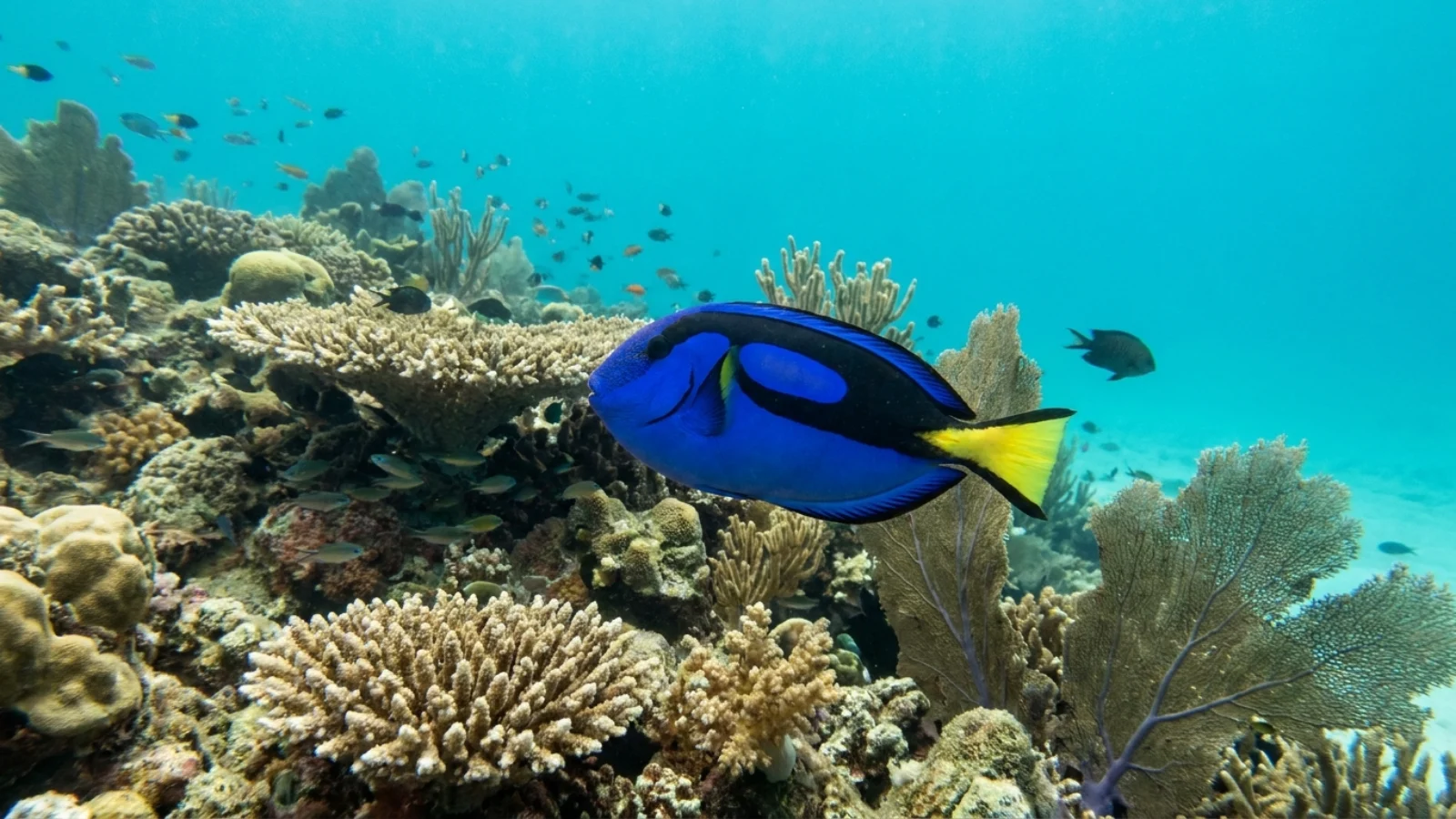
How do you tell Dory’s species from other blue fish?
The Pacific blue tang was named by Linnaeus in 1766 and is the only member of its genus, Paracanthurus. It has collected a long list of common names, including regal tang, palette surgeonfish, hippo tang, royal blue tang, flagtail surgeonfish and blue surgeonfish, and the plain name “blue tang” causes constant confusion with the Atlantic species, Acanthurus coeruleus. Fin counts separate them cleanly. FishBase gives Dory’s species 9 dorsal spines, 19 to 20 dorsal soft rays, 3 anal spines and 18 to 19 anal soft rays, while the Atlantic blue tang has 9 dorsal spines, 26 to 28 dorsal soft rays, 3 anal spines and 24 to 26 anal soft rays. Some popular references repeat the Atlantic counts for the Pacific fish, so FishBase is the safer source here.
The colour pattern also varies a little across the range. Fish from the west-central Indian Ocean are described as having a yellow lower body, in contrast to the all-blue belly typical of Pacific fish. Adults are commonly said to weigh around 600 g, and males are generally larger than females. The body is flattened from side to side and almost disc-shaped, with small scales and a pointed snout. The black “palette” mark is not complete in young fish: its bands only fully join as the fish matures.
How big do blue tangs get?
Up to 31 cm (about 12 in) in total length, far bigger than most people expect from the movie.
That size matters. A fish that grows to 30 cm and swims constantly needs a very large aquarium.
Where do blue tangs live?
On clear, current-swept terraces of seaward reefs across the Indo-Pacific, from East Africa to Kiribati, and from southern Japan to the southern Great Barrier Reef, New Caledonia and Samoa.
FishBase records them at 2–40 m, usually below 10 m. They gather in loose groups a metre or two above the bottom. Juveniles and subadults cluster around isolated heads of cauliflower coral, Pocillopora, and when alarmed they wedge themselves deep among the branches. The species is described as relatively uncommon and highly localised, which is worth remembering when you see dozens of them in a single store tank.
What do blue tangs eat?
Mostly zooplankton, with occasional algae grazing.
That makes Dory a little unusual among surgeonfish, most of which are grazers. In aquariums, blue tangs need frequent feeding of quality marine foods plus algae such as nori to stay healthy,, and captive palette surgeonfish commonly develop lateral line depigmentation, a skin condition covered in its own section below.
Do blue tangs really have short-term memory loss?
No. Dory’s forgetfulness is a storytelling device, not biology.
Reef fish need good memories to survive. A blue tang has to remember where its shelter coral is, which neighbours are dangerous and where food reliably drifts past on the current. Studies on many reef fish show they learn routes, recognise individual fish and remember cleaning stations, and the cleaner wrasse has even passed the mirror test. If anything, the real fish is a good example of how much a small brain can track.
How do blue tangs behave on the reef?
In loose groups that hang in the current, with the young sheltering in branching coral.
Blue tangs spend the day hovering in the current above the reef, picking plankton from the water. FishBase describes the species as benthopelagic, living in loose aggregations a metre or two above the bottom, while juveniles and subadults group around isolated heads of Pocillopora eydouxi and press themselves tightly among the branches when alarmed.
Where did the “Nemo effect” come from?
After Finding Nemo in 2003, demand for clownfish surged, and when Finding Dory came out in 2016 conservationists feared the same for blue tangs.
Dory, voiced by Ellen DeGeneres, made the regal tang one of the most recognised fish in the world. Peer-reviewed work found that online searches for blue tang spiked for two to three weeks after Finding Dory, but import data showed no significant increase in blue tang imports after the film. The fear was justified, though, because of how the species is supplied. Clownfish are routinely bred in captivity. Blue tangs were not bred at all until 2016.
Can blue tangs be bred in captivity?
Yes, but only recently. The first captive-bred Pacific blue tangs were raised in 2016 by the University of Florida’s Tropical Aquaculture Laboratory with Rising Tide Conservation.
The project took about six years. In 2016 the team’s larvae, just over a millimetre long at hatch, reached survival rates as high as 80 percent to day four, and the first juvenile was photographed on day 52 with 26 siblings. The best previous result had been a single larva surviving 21 days. Commercial supply of captive-bred blue tangs is still limited compared with clownfish, so the vast majority of blue tangs in the trade are still collected from the wild.
How do blue tangs spawn in the wild?
The Pacific blue tang is a pelagic spawner, releasing eggs that drift in open water. Spawning takes place in the late afternoon and evening, and it is signalled by a colour change from uniform dark blue to a paler blue. Males court females within the group, and the fish then make a quick upward rush toward the surface, releasing eggs and sperm at the top of the climb. The eggs are about 0.8 mm across, float with the help of a single oil droplet and, by one account, hatch in about 24 hours into small, transparent larvae with silvery bellies and rudimentary tail spines.
The breeding season has been studied directly in at least one wild population. In 2019, H. M. Sang and colleagues followed the ovaries and hormone levels of wild female blue tangs through a reproductive cycle, publishing in the journal Animals. The gonadosomatic index, a measure of how much of the body is given over to the ovaries, stayed high from April to July, and levels of testosterone, oestradiol and the maturation hormone DHP were high from March to July. The authors concluded that DHP may act as the hormone that triggers final egg maturation, information that matters to hatcheries trying to induce spawning on demand.
How was the first blue tang raised in captivity?
The details were published in 2017 in the Journal of the World Aquaculture Society by M. A. DiMaggio and colleagues at the University of Florida. They noted that the Pacific blue tang was consistently among the top 20 marine ornamental species imported into the United States, and that every one was wild-caught. A total of 50,000 eggs were collected from a single broodstock population and stocked in a 1,000-litre tank. From three days after hatching, the larvae were fed three times a day exclusively on copepod nauplii, tiny larval crustaceans. Enriched rotifers were added at 12 days, powdered feed at 20 days and newly hatched brine shrimp at 21 days.
The losses tell the story of why this took so long. Large die-offs came at day 7, linked to starvation, and at day 20, during flexion, when the tail bends up and the fins form. By day 41 most surviving larvae had begun to associate with the bottom of the tank, and on day 50 the first blue pigment marked the start of metamorphosis into juveniles. In all, 27 juveniles were raised, which matches the July 2016 university announcement of a first juvenile photographed on day 52 with 26 siblings, in a greenhouse in Ruskin, Florida. An earlier attempt by part of the same team, published in 2015, had collected eggs spawned in public aquarium exhibits and used DNA to identify them, but the blue tang larvae in that work did not reach metamorphosis.
The 2016 announcement named Craig Watson, director of the UF Tropical Aquaculture Laboratory, and Judy St. Leger of Rising Tide Conservation, with partners including the SeaWorld-Busch Gardens Conservation Fund and the Oceanic Institute of Hawaii Pacific University. It also credited Chad Callan, who had reared the first yellow tangs in Hawaii, the late-2015 breakthrough described on our yellow tang page. The two projects belong to the same push to take pressure off wild surgeonfish by learning to raise them from eggs.
How big is the trade that supplies blue tangs?
The best snapshot of the scale comes from a 2012 study in PLoS ONE by A. L. Rhyne and colleagues, who checked a full year of import invoices for marine aquarium fish entering the United States between May 2004 and May 2005. They counted 11,003,181 fish on 8,015 invoices, representing more than 1,802 species from 125 families. The Philippines and Indonesia dominated, supplying about 5.8 million and 3.3 million fish respectively. The study also found that government declaration forms matched the invoices only 52 percent of the time and overstated total volume by 27 percent, a reminder of how poor trade data can be.
Whether that collection harms particular species is harder to judge. A 2026 productivity-susceptibility analysis in Ecological Applications, by G. A. Baillargeon and colleagues including Rhyne, scored 306 aquarium species for vulnerability to overfishing. It placed 81.4 percent in the least or moderately vulnerable classes and flagged 57 species as higher priority for local assessment, with eels and sharks and rays scoring worst and most bony fishes rated sustainable. The study’s abstract does not single out the blue tang, so this page does not assign it a score.
How fish are caught is a separate problem. Cyanide fishing, in which a cyanide solution is squirted onto reef fish to stun them, remains pervasive in the live reef trade despite being illegal in many countries, according to a 2018 PLoS ONE study by N. E. Breen and colleagues. Their work also showed how hard it is to police: a proposed test for thiocyanate, the breakdown product excreted by exposed fish, could not detect exposure in clownfish dosed at 25 or 50 ppm, so there is still no simple, accepted way for a buyer to tell whether a fish was caught with cyanide. Note too that blue tangs do not come from Hawaii, which lies outside the range FishBase gives for the species; the long legal fight over Hawaiian aquarium collection concerns yellow tangs and other local species.
Did Finding Dory really cause a run on blue tangs?
The fear was widespread in 2016, and the best test of it is a 2020 paper in Ambio by D. Veríssimo, S. Anderson and M. Tlusty. They built Bayesian counterfactual models predicting what three measures would have looked like without the film, then compared them with what actually happened. Global online searches for blue tang rose for two to three weeks after release, but the team found no substantial evidence of an increase in blue tang imports into the United States, or in visits to US public aquariums. The authors warned that conservation messages need to rest on evidence, because exaggerated claims about popular culture can cost credibility and send resources to the wrong problem. That does not make wild collection harmless; it means the case for caution rests on how the fish is supplied rather than on a film-driven buying spree.
What health problems do captive blue tangs face?
Lateral line depigmentation is a common condition in managed tropical saltwater fish, and treatment has been elusive. In a 2023 trial reported in the Journal of Zoo and Wildlife Medicine, M. M. Strobel and colleagues treated 11 affected palette surgeonfish: seven received a single topical application of 4 mg of naltrexone, an opioid-blocking drug that promotes wound healing in mice, mixed into a petroleum paste, while four served as controls. Fish with severe lesions showed clear improvement in lesion size and colour, but the authors stressed that more data are needed before the approach can be recommended.
How does the Atlantic blue tang live?
The Atlantic species has been studied in much more behavioural detail. It switches between three social modes. Territorial fish defend a patch of algae, swim slowly, feed often and chase intruding blue tangs. Schooling fish travel fast in compact groups, sometimes with other species, and use numbers to overwhelm the defences of territorial damselfish. Wandering fish move alone between feeding areas and cleaning stations, which they visit more often than fish in the other modes. Territoriality increases as local blue tang density rises, while schooling is most common where damselfish are dense and peaks around midday.
Young fish behave differently again. Juveniles are mostly solitary and territorial, defending home ranges that grow with body size and overlap with those of Stegastes damselfish, which they tend to avoid. Their colour also changes with age, from a yellow juvenile to a blue subadult with a yellow tail and finally the blue adult. Their diet helps explain the constant grazing: the gut absorbs crushed cell contents well but handles cellulose poorly, so the fish must feed almost continuously on abundant, fast-growing algae close at hand.
Should you buy a blue tang?
Only if you have a large, mature aquarium and can source a captive-bred fish or a trustworthy, net-caught wild fish.
Three reasons for caution. First, size: a 31 cm, constantly swimming fish needs a long, very large tank. Second, supply: destructive collecting methods, including cyanide, remain a documented problem in parts of the Indo-Pacific reef-fish trade. Third, health: captive palette surgeonfish often develop lateral line depigmentation, which veterinarians are still learning to treat. If you want a Dory, read our guides to reef aquarium fish selection and reef tank setup, and ask your supplier where and how the fish was caught.
What is the Atlantic blue tang?
Acanthurus coeruleus, a Caribbean surgeonfish, is a different species that grows to 39 cm and feeds entirely on algae.
It ranges from New York and Bermuda through the Gulf of Mexico and Caribbean to Brazil, and to Ascension Island, at 2–50 m. Adults are powder blue to purple, juveniles bright yellow, and intermediates blue with a yellow tail, which confuses many snorkellers. FishBase describes them in small groups on reefs and in grassy or rocky inshore areas. At Fernando de Noronha in Brazil, juveniles even clean green sea turtles alongside sergeant majors. Like Dory, it is listed as Least Concern.
| Feature | Pacific blue tang | Atlantic blue tang |
|---|---|---|
| Scientific name | Paracanthurus hepatus | Acanthurus coeruleus |
| Max length | 31 cm | 39 cm |
| Range | Indo-Pacific | Western Atlantic, Caribbean |
| Diet | Mostly zooplankton | Entirely algae |
| Colour | Royal blue, black palette, yellow tail | Blue to purple adult; yellow juvenile |
| IUCN | Least Concern | Least Concern |
What kind of fish is Dory?
Dory is a Pacific blue tang, Paracanthurus hepatus, also called the regal or palette tang. It is a surgeonfish.
How big do blue tangs get?
Up to 31 cm (about 12 in). The Atlantic blue tang grows a little larger, to 39 cm.
Are blue tangs poisonous?
They have a sharp spine at the tail base that can cut, and FishBase lists the species as venomous. Eating them has been linked to ciguatera.
Where do blue tangs live?
On Indo-Pacific reefs from East Africa to Kiribati, at 2–40 m, often around Pocillopora coral heads.
What do blue tangs eat?
Mainly zooplankton, plus some algae.
Are blue tangs bred in captivity?
Yes, since 2016, when the University of Florida first raised them. Most blue tangs sold are still wild-caught.
Are blue tangs endangered?
No. The IUCN lists the species as Least Concern, but it is uncommon and localised.
Did Finding Dory increase blue tang sales?
A 2020 study found online searches spiked for two to three weeks after the film, but no substantial increase in US imports of blue tangs.
- Froese, R. & Pauly, D. (eds.). Paracanthurus hepatus, Palette surgeonfish. FishBase.
- Froese, R. & Pauly, D. (eds.). Acanthurus coeruleus, Blue tang surgeonfish. FishBase.
- UF/IFAS (20 July 2016). Finding Dory: UF/IFAS researchers find first-ever method to farm Pacific Blue Tang.
- IUCN Red List. Paracanthurus hepatus: Least Concern (assessed 2010).
- Myers, R. F. (1991). Micronesian Reef Fishes, 2nd ed. Coral Graphics.
- DiMaggio, M. A. et al. (2017). First record of captive larval culture and metamorphosis of the Pacific blue tang, Paracanthurus hepatus. Journal of the World Aquaculture Society. doi:10.1111/jwas.12426
- Cassiano, E. J. et al. (2015). Utilizing public aquariums and molecular identification techniques to address the larviculture potential of Pacific blue tangs and other species. Aquaculture International. doi:10.1007/s10499-014-9813-3
- Sang, H. M. et al. (2019). Changes in plasma and ovarian steroid hormone level in wild female blue tang fish during a reproductive cycle. Animals 9: 889. doi:10.3390/ani9110889
- Veríssimo, D., Anderson, S. & Tlusty, M. (2020). Did the movie Finding Dory increase demand for blue tang fish? Ambio. doi:10.1007/s13280-019-01233-7
- Rhyne, A. L. et al. (2012). Revealing the appetite of the marine aquarium fish trade: the volume and biodiversity of fish imported into the United States. PLoS ONE. doi:10.1371/journal.pone.0035808
- Baillargeon, G. A. et al. (2026). Evaluating species at risk in data-limited fisheries: a productivity-susceptibility analysis for marine aquarium fish. Ecological Applications. doi:10.1002/eap.70272
- Breen, N. E. et al. (2018). Can excreted thiocyanate be used to detect cyanide exposure in live reef fish? PLoS ONE. doi:10.1371/journal.pone.0196841
- Strobel, M. M. et al. (2023). Naltrexone as a promising treatment for clinical signs of lateral line depigmentation in palette surgeonfish. Journal of Zoo and Wildlife Medicine. doi:10.1638/2022-0022
- Wikipedia. Paracanthurus and Acanthurus coeruleus (spawning behaviour, colour variants, social modes; secondary source).
Blane Perun has been exploring Earth’s oceans and marine life for over 25 years. Founder of TheSea.Org in 1999, underwater photographer, coral aquaculture pioneer, and explorer of 80+ countries.
About Blane Perun → More on Reef Fish →