Grunt Fish — Why Caribbean Grunts Grunt, School and Kiss
A grunt is any fish in the family Haemulidae, about 133 species of snapper-like fish found in tropical and warm-temperate seas. They are named for the grunting sound they make by grinding their pharyngeal (throat) teeth, amplified by the swim bladder. On Caribbean reefs, French, bluestriped and white grunts form dense yellow-and-blue schools under ledges by day and spread out over seagrass and sand to feed at night.
Grunts are the background noise of a Caribbean reef, sometimes literally. Drop down beside a coral ledge in Florida, Belize or Bonaire and you will often find a wall of yellow-striped fish hanging motionless in its shadow, dozens or hundreds deep. Those are grunts, and they are one of the most important links between the reef, the seagrass and the mangroves around it.
Why are they called grunts?
Because they make audible grunting sounds by grinding their pharyngeal teeth together, with the swim bladder acting as a resonator.
Like many reef fish, grunts have a second set of teeth in the throat. When a grunt grinds them, its air-filled swim bladder amplifies the vibration into a croak or grunt you can hear if you hold one. The family name Haemulidae is a mouthful; anglers in the American South and the Caribbean simply call them grunts. The Pacific sweetlips are also members of this family. See our sweetlips guide.
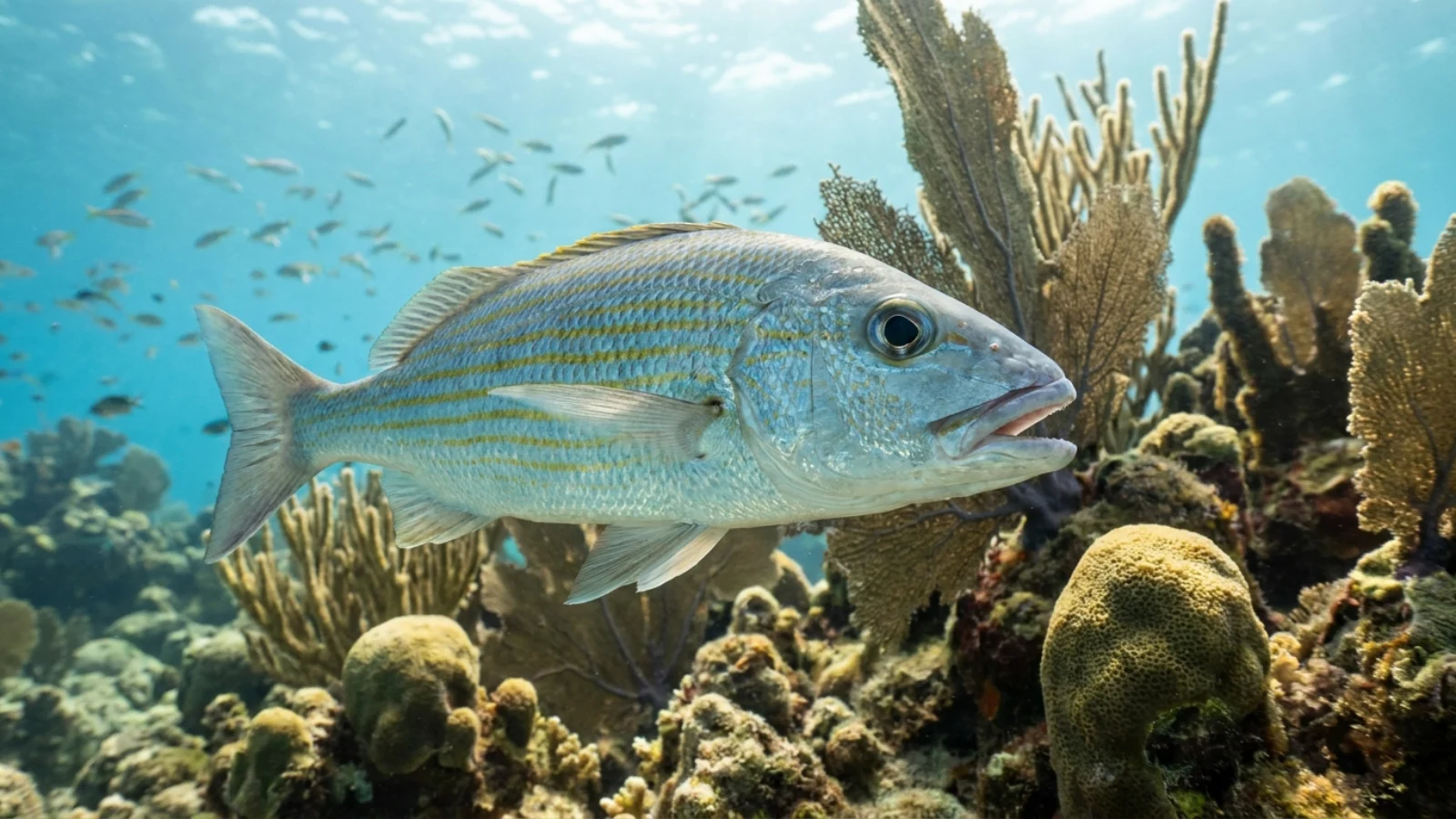
What kind of fish is a grunt?
A medium-sized, snapper-like fish in the family Haemulidae, related to snappers but without the snapper’s large canine teeth.
Grunts look much like small snappers: a deep, oblong body, a single continuous dorsal fin and a forked tail. The difference is in the mouth. Snappers have prominent canine teeth for grabbing fish; grunts have small teeth and feed mostly on invertebrates. The groupers and snappers group guide covers their neighbours on the reef.
What are the most common grunt species?
In the Caribbean and Florida: French grunt, bluestriped grunt, white grunt, tomtate and porkfish.
| Species | Max length | Depth | Notes |
|---|---|---|---|
| French grunt, Haemulon flavolineatum | 30 cm | 0–60 m | Yellow with diagonal blue-white stripes below the lateral line; huge schools near elkhorn coral |
| Bluestriped grunt, H. sciurus | 46 cm, 750 g | 0–30 m | Horizontal blue and yellow stripes; up to 12 years old |
| White grunt, H. plumierii | 53 cm, 4.4 kg | 3–40 m | Largest common species; blue lines on the head; up to 13 years; a game fish |
| Tomtate, H. aurolineatum | 28 cm | Seagrass, sand, patch reefs | Silvery with a yellow stripe and dark tail spot |
| Porkfish, Anisotremus virginicus | 40.6 cm, 930 g | 2–70 m | Yellow and silver with two black bars across the head |
All five are listed as Least Concern by the IUCN.
Why do grunts kiss?
The “kissing” is a territorial display: two fish face off, open their mouths wide and push lip to lip.
The Florida Museum of Natural History describes white grunts confronting each other mouths agape and pushing against each other, which it interprets as a territorial display. Spawning pairs do something similar, though it is not known whether that version is courtship or territory. It is one of the most photographed behaviours on Florida reefs.
When and what do grunts eat?
At night, mostly. Adults school over the reef by day, then move out over seagrass, sand and mud after sunset to hunt crustaceans, molluscs, worms and other small animals.
The Florida Museum notes that white grunts leave the reef shortly after sunset and return just before sunrise, with larger fish leaving first and returning last. Bluestriped grunts take crustaceans, bivalves and the occasional small fish; French grunts eat mainly small crustaceans; porkfish feed at night on molluscs, echinoderms, worms and crustaceans. Ecologists point to this daily commute as one way nutrients move from seagrass beds back to the reef, because grunts feed on the flats at night and rest, and excrete, over the coral by day.
Where do young grunts grow up?
In seagrass beds and mangroves, before moving onto the reef.
Juvenile grunts are abundant in near-shore turtle grass (Thalassia) beds and mangrove areas, where they school by size. Young white grunts even shelter among the spines of the long-spined sea urchin, Diadema antillarum. Later they shift to sand flats, rocky shores and finally coral reefs. That makes grunts a clear example of why coastal ecosystems and reefs depend on each other. See also the long-spined sea urchin.
Why do grunts school under ledges by day?
Safety in numbers and shade. Resting in a tight school under cover makes it hard for predators to pick off one fish.
Because grunts hunt at night, they spend the day resting, and a large, stationary school is a classic anti-predator strategy. Hundreds of identical striped bodies confuse a hunting jack or barracuda, and the ledge blocks attack from above. The Florida Museum notes that white grunts school by day over reefs or sand, often mixed with bluestriped grunts, French grunts and doctorfish. Mixed schools are common: each species benefits from more eyes watching for danger.
| Feature | Grunts (Haemulidae) | Snappers (Lutjanidae) |
|---|---|---|
| Teeth | Small; strong pharyngeal teeth | Prominent canines |
| Main food | Invertebrates | Fish and crustaceans |
| Daytime behaviour | Resting schools under ledges | Schools or hovering hunters |
| Night behaviour | Forage over seagrass and sand | Many also hunt at night |
What eats grunts?
Almost every reef predator: groupers, snappers, jacks, barracudas, moray eels and sharks.
Small, abundant and active at dusk and dawn, grunts are a staple prey fish on Caribbean reefs. The commute between reef and seagrass at sunset and sunrise is the most dangerous time of their day, and you can often watch jacks patrolling the reef edge at those hours. That role as abundant mid-sized prey is one reason grunts are so important to the reef food web. See the coral reef food web.
Are grunts good to eat?
Yes, many are eaten, especially white grunts, which are a traditional food fish in Florida and the Caribbean.
FishBase lists white grunt as a game fish and several species as marketed fresh. Smaller grunts and tomtates are widely used as bait. FishBase also notes reports of ciguatera poisoning from French, bluestriped and white grunts, so local advice matters in ciguatera-prone areas.
How exactly does a grunt grunt?
For a fish named after its voice, the mechanism was surprisingly unclear until 2014. That year F. Bertucci and colleagues published a detailed study of the French grunt in the Journal of Experimental Biology, using high-speed X-ray video and scanning electron microscopy of the throat jaws. They found that a French grunt’s call is a series of stridulatory sounds, made by rubbing hard surfaces together. Each grunt lasts about 47 milliseconds, the grunts come at intervals of about 155 milliseconds, and the dominant frequency is about 700 hertz.
The X-ray footage showed the upper and lower pharyngeal jaws moving in the same pattern the fish uses to process food, and wear marks on teeth of the fourth gill arch suggested those teeth are involved too. The authors concluded that calling is an exaptation: the grunt borrowed a food-crushing machine and turned it into a voice. They also tested hearing. French grunts responded to sounds from 100 to 600 hertz, with the greatest sensitivity at 300 hertz, well below the main frequency of their own calls. That suggests their hearing is not tuned only to the sounds of other grunts.
Most people only hear the sound when they catch one. Wikipedia’s account of the white grunt notes that it normally grunts when distressed or in danger, such as when hooked by an angler.
How do grunts help corals grow?
They fertilise them. In a 1983 paper in Science, J. L. Meyer, E. T. Schultz and G. S. Helfman studied schools of juvenile grunts that fed in seagrass beds at night and rested over coral heads by day. While resting, the fish excreted substantial quantities of ammonium and particulate nitrogen and phosphorus into nutrient-poor reef water. The share of nutrients the fish contributed was comparable to that from other sources, and coral heads with resident fish schools grew faster than those without them.
The study, titled “Fish schools: an asset to corals”, is one of the classic demonstrations that reef fish move nutrients between habitats. The grunts eat in the seagrass and deliver part of that meal to the reef as waste. It is a strong reason to protect grunt schools and the seagrass beds they depend on.
How do young grunts find their way?
Juvenile grunts form mixed-species resting schools over the reef by day. J. C. Ogden and P. R. Ehrlich described the behaviour of these heterotypic schools in Marine Biology in 1977 The twilight commute between the reef and the feeding grounds has since been studied in detail. In 1984 T. P. Quinn and J. C. Ogden reported field evidence that migrating juvenile grunts use compass orientation, meaning that they can hold a direction rather than simply following landmarks.
FishBase and Wikipedia both record juvenile French, white and bluestriped grunts as abundant in shallow beds of turtle grass, Thalassia testudinum. Bluestriped grunt larvae settle into seagrass at lengths of about 9 to 17 mm, and French grunt larvae are reported to spend about two weeks in the plankton before settling among seagrass.
Do mangroves make more grunts?
Evidence suggests that connected coastal habitats matter a great deal. In 2004 P. J. Mumby and colleagues reported in Nature that mangroves in the Caribbean strongly influence the fish communities on neighbouring reefs, acting as an intermediate nursery habitat that may improve the survival of young fish. The biomass of several commercially important species was more than doubled where adult reef habitat was connected to mangroves. The authors noted that global mangrove loss already exceeded 35 percent and urged protection of connected corridors of mangroves, seagrass beds and reefs. FishBase lists both the bluestriped grunt and the porkfish in mangrove areas.
How does a white grunt grow up?
The Florida Museum of Natural History has one of the most complete life histories for any grunt. White grunts spawn offshore over hard bottoms or reefs for much of the year, with regional peaks in May and June off Florida, August and September off Puerto Rico and March and April off Jamaica. The eggs are about 0.9 mm across, transparent and pelagic, and hatch about 20 hours after fertilisation. The larvae measure about 2.7 to 2.8 mm and begin feeding within 48 hours.
Juveniles live inshore over seagrass, sand flats, rocky shorelines and reefs, schooling by size and feeding by day on plankton, mainly copepods. They mature in their third year, at about 20 cm for males and 22 cm for females. Adults switch to night feeding and become generalist carnivores of crustaceans, molluscs, echinoderms and small fish.
Size figures vary. FishBase gives a maximum of 53 cm and 4.4 kg and a maximum reported age of 13 years. The Florida Museum gives a reported maximum of 46 cm and 4.38 kg and estimates maximum age at 9 to 12 years. The Museum puts the usual depth range from the shoreline to about 24 m, occasionally to 35 m offshore; FishBase gives 3 to 40 m.
How do you tell the common Caribbean grunts apart?
Look at the stripes and the head. The French grunt has an almond-shaped body with three yellow to orange stripes above the lateral line and slanting stripes below it. The bluestriped grunt is yellow with thin blue stripes running lengthwise, a distinctive arched stripe below each eye, and a dark soft dorsal fin and tail. The white grunt is silvery cream with narrow yellow and blue stripes and blue lines on the side of the head, and it can turn paler or darker to match its surroundings. The tomtate is silvery white with a yellow mid-body stripe. The porkfish is the easiest of all: yellow and silver stripes with two black bars across the head, one running from above the eye to the upper lip and one from the front of the dorsal fin to the base of the pectoral fin.
Many grunts also have a bright red mouth lining, which shows when they open wide in a kissing contest and explains old names such as redmouth grunt, used for both French and bluestriped grunts. Juveniles are harder. Small bluestriped grunts carry a dark stripe from behind the eye to the base of the tail and change to adult colours at about 50 mm. Young porkfish lack the two black bars and instead have two black stripes along the flank, a black blotch near the tail and a bright yellow head.
Do any grunts work as cleaners?
Yes. FishBase notes that young porkfish pick parasites from the bodies of larger fishes, and grunts themselves are regular clients at cleaning stations. Wikipedia’s article on the family describes a mutualistic relationship with cleaner gobies of the genus Elacatinus, which feed on parasites on the grunts’ bodies.
Who named the Caribbean grunts?
Several of the familiar species carry old names. Linnaeus described the porkfish in 1758 as Sparus virginicus, and when Theodore Gill later created the genus Anisotremus he made it the type species. Bernard de Lacépède described the white grunt in 1801 as Labrus plumierii, from a drawing by the Franciscan friar and naturalist Charles Plumier, whom the name honours. George Shaw named the bluestriped grunt Sparus sciurus in 1803; sciurus means squirrel, because “squirrelfish” was a vernacular name at the time, presumably for its sounds. Anselme Gaëtan Desmarest described the French grunt from Cuba in 1823 as Diabasis flavolineatus, Latin for “yellow-lined”.
The French grunt has a more modern naming story too. One of its parasites, a tiny crustacean called Gnathia marleyi, was named in honour of the reggae singer Bob Marley.
How big is the grunt family?
Wikipedia, following the standard reference Fishes of the World, splits the family Haemulidae into two subfamilies, the Haemulinae (grunters) and the Plectorhynchinae (sweetlips), with about 133 species in 19 genera. A 2012 molecular study by J. J. Tavera and colleagues in BMC Evolutionary Biology described the family as about 17 genera and 145 species. Most species are marine, but members of the family also live in brackish and fresh water in the tropics.
Where can you see grunts?
On almost any reef in Florida, the Bahamas and the Caribbean, especially under ledges and around elkhorn coral.
FishBase records French grunts in large schools on rocky and coral reefs, often under ledges or close to elkhorn coral. Shallow sites in the Florida Keys, Bonaire, Cozumel and Belize are reliable. Shipwrecks are excellent too; grunts treat a wreck exactly like a coral ledge.
Why are grunts called grunts?
They make grunting sounds by grinding their throat teeth, with the swim bladder amplifying the sound.
How many species of grunt are there?
About 133 species in the family Haemulidae worldwide.
What is the biggest grunt in the Caribbean?
The white grunt, up to 53 cm and 4.4 kg.
Why do grunts kiss?
Kissing is a territorial display in which two fish push their open mouths together; spawning pairs do it too.
Are grunt fish good to eat?
Yes. White grunts are a traditional Florida food fish, though some grunts have been linked to ciguatera.
What do grunts eat?
Small crustaceans, molluscs, worms, echinoderms and occasionally small fish, mostly at night.
Are sweetlips grunts?
Yes. The Indo-Pacific sweetlips belong to the grunt family, Haemulidae.
Where do baby grunts live?
In seagrass beds and mangroves, sometimes sheltering among sea urchin spines.
- Froese, R. & Pauly, D. (eds.). Haemulon flavolineatum, H. sciurus, H. plumierii, H. aurolineatum, Anisotremus virginicus. FishBase.
- Florida Museum of Natural History. Discover Fishes: White grunt, Haemulon plumierii.
- Wikipedia contributors. Haemulidae: about 133 species; named for sounds made by grinding pharyngeal teeth.
- IUCN Red List. Assessments for Haemulon spp. (2015) and Anisotremus virginicus (2011): Least Concern.
- Humann, P. & DeLoach, N. Reef Fish Identification: Florida, Caribbean, Bahamas. New World Publications.
- Bertucci, F., Ruppé, L., Van Wassenbergh, S., Compère, P. & Parmentier, E. (2014). New insights into the role of the pharyngeal jaw apparatus in the sound-producing mechanism of Haemulon flavolineatum (Haemulidae). Journal of Experimental Biology. doi:10.1242/jeb.109025
- Meyer, J. L., Schultz, E. T. & Helfman, G. S. (1983). Fish schools: an asset to corals. Science 220: 1047–1049. doi:10.1126/science.220.4601.1047
- Ogden, J. C. & Ehrlich, P. R. (1977). The behavior of heterotypic resting schools of juvenile grunts (Pomadasyidae). Marine Biology 42: 273–280. doi:10.1007/BF00397751
- Quinn, T. P. & Ogden, J. C. (1984). Field evidence of compass orientation in migrating juvenile grunts (Haemulidae). Journal of Experimental Marine Biology and Ecology 81: 181–192. doi:10.1016/0022-0981(84)90005-4
- Mumby, P. J. et al. (2004). Mangroves enhance the biomass of coral reef fish communities in the Caribbean. Nature 427: 533–536. doi:10.1038/nature02286
- Tavera, J. J. et al. (2012). Molecular phylogeny of grunts (Teleostei, Haemulidae). BMC Evolutionary Biology 12: 57. doi:10.1186/1471-2148-12-57
Blane Perun has been exploring Earth’s oceans and marine life for over 25 years. Founder of TheSea.Org in 1999, underwater photographer, coral aquaculture pioneer, and explorer of 80+ countries.
About Blane Perun → More on Reef Fish →