Cleaner Wrasse — The Reef’s Barbershop, and the Fish That Recognises Itself
The cleaner wrasse, usually the bluestreak cleaner wrasse (Labroides dimidiatus), is a small Indo-Pacific wrasse that feeds by removing parasites, dead skin and mucus from other fish at fixed “cleaning stations” on the reef. It grows to about 14 cm, ranges from the Red Sea and Persian Gulf to the central Pacific, and in 2019 became the first fish reported to pass the mirror self-recognition test.
Hang off a coral head on almost any Indo-Pacific reef and you will eventually see something that looks impossible. A big grouper or a moray, a fish that could swallow a small wrasse in one gulp, holds still with its mouth wide open while a slender blue-and-black fish swims in and out of its jaws and gills. That is a cleaner wrasse at work, and it is one of the best-studied partnerships in the ocean.
What does a cleaner wrasse do?
It eats parasites. Cleaner wrasses remove small crustacean parasites, dead tissue and mucus from “client” fish, which visit their cleaning stations specifically to be groomed.
The main prey is gnathiid isopods and other tiny crustaceans that attach to fish skin and gills. The client gets rid of parasites; the cleaner gets a meal. FishBase notes that cleaning intensity is not related to client size or how common a species is. Clients include groupers, snappers, sweetlips, surgeonfish, parrotfish, morays and even manta rays and reef sharks, which visit cleaning stations on many reefs.
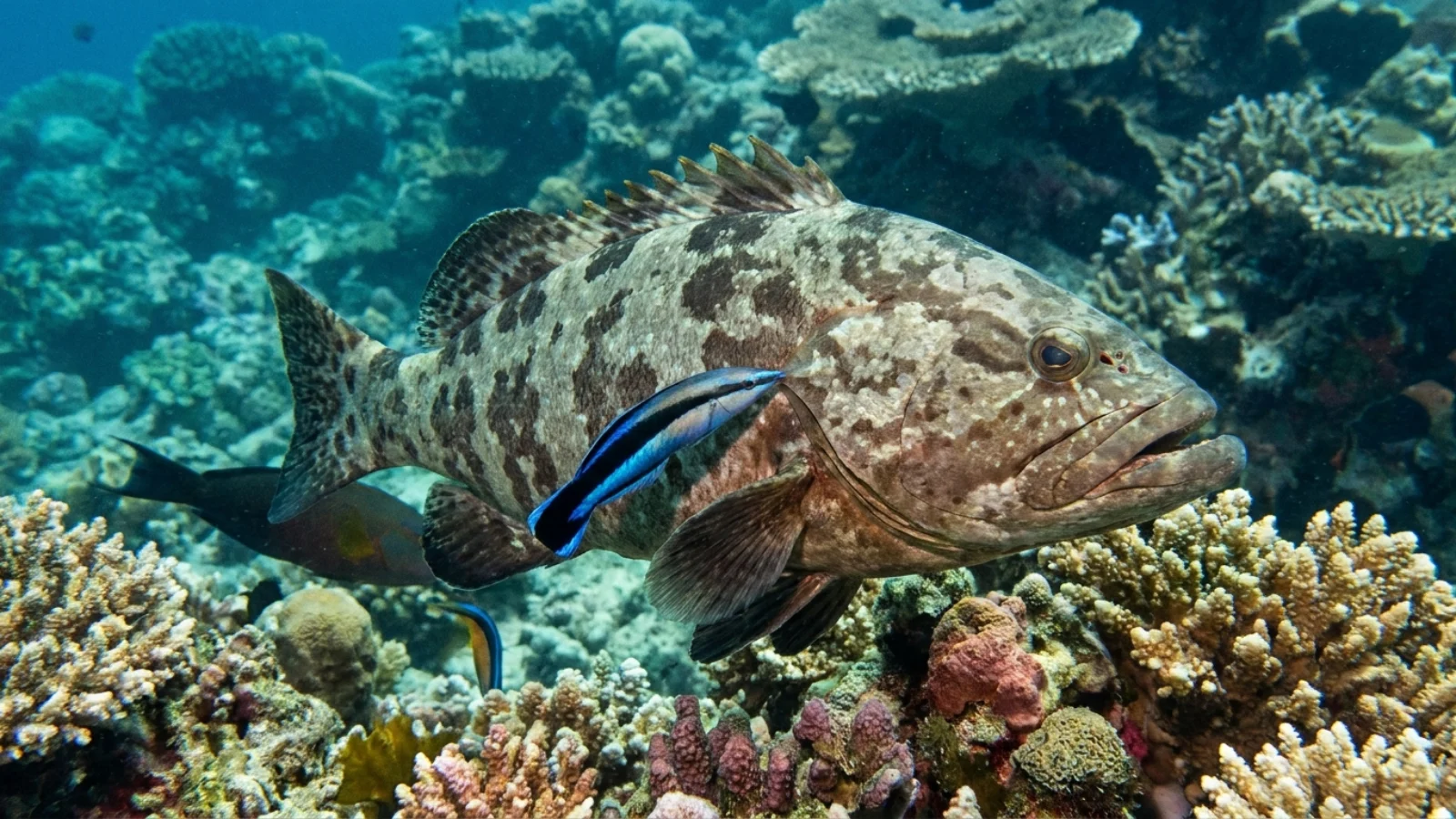
What is a cleaning station?
A fixed spot on the reef, often a prominent coral head or ledge, where cleaners live and clients queue up to be cleaned.
Stations are occupied by a pair of adults, a group of juveniles, or a group of females with a dominant male. A cleaner advertises with a bobbing, dancing swim and its bold stripe. Clients signal that they want service by hovering head-up or head-down, flaring fins and opening mouth and gills, sometimes changing colour. Predators suppress their urge to eat while being cleaned. Our cleaner shrimp guide covers the invertebrates that run similar stations.
Do cleaner wrasses cheat?
Yes. Cleaners prefer client mucus to parasites, and they sometimes bite off mucus, which makes the client jolt.
This is where cleaner wrasses get interesting. Mucus is more nutritious to them than parasites, so there is a temptation to cheat. Clients fight back. A cheated client will chase the cleaner, and other clients watching the interaction learn which cleaners to avoid. Research shows cleaners behave better when they are being watched, feed against their own preferences to keep future clients, and give extra-gentle service to predators. When a pair cleans together, the male punishes the female if she cheats a valuable client. Cleaner wrasses have become a model system for studying cooperation, reputation and even primitive “social intelligence” in fish.
Did a cleaner wrasse really pass the mirror test?
Yes. In 2019, a team led by Masanori Kohda in Japan reported in PLOS Biology that cleaner wrasses passed the mark test, and a 2023 study in PNAS showed they recognise their own face in photographs.
In the mark test, an animal is marked somewhere it can only see in a mirror. Cleaner wrasses given a parasite-like coloured mark on the throat looked at it in the mirror and then scraped their throats on the substrate, behaviour they did not show without the mark or without a mirror. The result was controversial, because the mark test had been treated as a sign of self-awareness in great apes, elephants, dolphins and magpies. In the 2023 follow-up, mirror-experienced fish stopped attacking photographs of themselves but kept attacking photos of strangers. Shown a composite with their own face on a stranger’s body, they did not attack it, but they did attack a stranger’s face on their own body. When shown a photo of themselves with a throat mark, six of eight fish rubbed their own throats. The authors argue the fish use a mental image of their own face, much as humans do.
How big is a cleaner wrasse?
Small and slender: up to about 14 cm, with adults averaging about 10 cm.
Adults have a black band that widens from the snout to the tail, set against a body that shifts from pale yellow-white at the front to vivid blue at the rear. Juveniles are black with a single electric-blue stripe, an advert for their cleaning service.
Where do cleaner wrasses live?
Across the Indo-Pacific, from the Persian Gulf, Red Sea and East Africa to the Line, Marquesas and Ducie islands, and from southern Japan to Lord Howe and Rapa.
They live on coral-rich inner lagoons, reef flats and seaward reefs, usually in the top 30 m. In the Caribbean, the cleaner’s job is mostly done by neon gobies and juvenile fish such as the French angelfish, queen angelfish and Spanish hogfish; see our goby guide.
Do cleaner wrasses change sex?
Yes. They are protogynous: all start as females, and when the dominant male of a group disappears, the largest female becomes a male.
A typical group is one male with several females.
What fish mimic the cleaner wrasse?
The false cleanerfish, a sabre-toothed blenny, copies the cleaner’s colours and dance in order to bite chunks out of unsuspecting clients.
Aspidontus taeniatus looks almost identical to a cleaner wrasse, but instead of removing parasites it tears off scraps of skin and fin. The bluestreak fangblenny, Plagiotremus rhinorhynchos, mimics juvenile cleaners so the real cleaners tolerate it near their stations, where it can attack the clients that gather. In a 2004 study, I. M. Côté and K. L. Cheney found that fangblennies close to juvenile cleaners met nearly twice as many potential victims and struck more often, while juvenile cleaners with a mimic nearby were visited by fewer clients and spent less time feeding. See blennies for more of these clever mimics.
Should you keep a cleaner wrasse in an aquarium?
Most aquarists advise against it. Wild-caught cleaner wrasses often starve in captivity because a home tank cannot supply enough parasites.
Cleaner wrasses have been collected in large numbers for the aquarium trade, and a 2016 Reef Builders review by aquarist J. Kurtz warned that most imported specimens starve, because a home tank rarely offers enough clients or parasites and many will not accept substitute foods. Every cleaner taken also leaves a reef with one fewer cleaning station, and clients on wild reefs depend on them. For parasite control in a reef tank, cleaner shrimp are a far better choice, and a few aquacultured cleaner gobies are available.
How many parasites does one cleaner wrasse eat in a day?
The most widely cited numbers come from A. S. Grutter’s fieldwork at Lizard Island on the Great Barrier Reef, published in Marine Ecology Progress Series in 1996. By timing how often and how long cleaners inspected clients, analysing cleaner stomach contents and manipulating parasite loads, she estimated that a single bluestreak cleaner wrasse spent on average about 256 minutes a day inspecting roughly 2,300 client fish, and ate around 1,200 parasites a day, mostly gnathiid isopod larvae. That works out to about 4.8 parasites per minute of inspection, or about one parasite for every two inspections.
The same study showed why the job never ends. When gnathiid loads on a client wrasse, Hemigymnus melapterus, were cut by about half, they climbed back to normal levels within one to six days, because new larvae attach to fish constantly. A cleaner is therefore not wiping out a fixed stock of parasites; it is skimming off a supply that is continually renewed. Grutter concluded that the predation rate was high enough, relative to the number of parasites on fish and how fast they arrive, for cleaners to affect gnathiid abundance on their clients.
Gnathiids are an odd group. Only the juvenile stage, called a praniza, is parasitic: it attaches to a fish temporarily to feed, then drops off, while the adults live among sponges and may not feed at all. That hit-and-run life cycle is one reason a fish benefits from regular visits to a station rather than a single thorough clean,, and it helps explain why stations stay busy day after day.
Why do client fish visit cleaners?
The obvious answer is parasites, and experiments support it. In a 2001 study in Proceedings of the Royal Society B, Grutter manipulated parasite loads on client fish and placed them next to a cleaner wrasse or a control fish behind glass. Parasitised clients spent more time beside the cleaner than unparasitised clients did, and more time beside the cleaner than beside the control fish, while clean fish showed no special attraction. She argued that parasite infection, rather than simply enjoying the touch, is the proximate reason clients seek cleaners.
Touch still matters. Cleaners often stroke a client with their fins while hovering over it, a behaviour researchers call tactile stimulation. In a 2004 paper in Current Biology, Grutter reported that cleaners performed this tactile dancing more when they were exposed to hungry predatory clients than to well-fed ones, regardless of how many parasites the predator carried. She interpreted it as pre-conflict management: a way for a small fish to calm a client that could eat it. More recent work has asked whether being touched is rewarding in itself; a 2025 laboratory study on butterflyfish clients linked the attraction to the brain’s opioid system, though that line of research is still young.
Mucus, cheating and the audience effect
The conflict at the heart of cleaning is that cleaners do not actually prefer parasites. In a 2003 experiment, Grutter and R. Bshary trained cleaners to feed from plates and offered them parrotfish mucus, parasitic monogenean flatworms, gnathiid isopods and a flour-paste control. The cleaners ate more mucus and monogeneans than gnathiids, and gnathiids only slightly more often than the control. Because gnathiids are the most common parasites on reef fish, this means the cleaner’s appetite and the client’s interest point in different directions.
Clients keep cleaners honest in several ways. A client bitten for mucus jolts, swims off or chases the cleaner. Bystanders watch, too. In a 2006 Nature paper, Bshary and Grutter showed experimentally that clients waiting nearby prefer cleaners they have just seen behaving cooperatively, and that cleaners feed more cooperatively when they are being watched. A 2011 study in Current Biology by A. Pinto, J. Oates, Grutter and Bshary found that cleaners immediately raised their level of cooperation when bystander clients were present, and that bystanders avoided a cleaner that cheated its current client.
Pairs add another layer. When a male and female clean a client together, a cheat by either fish can make the client leave, so both lose the meal. In a 2010 Science paper, N. J. Raihani, Grutter and Bshary showed that males punish their female partner if she cheats while inspecting model clients, and that this punishment makes the female more cooperative and gives the male a direct foraging benefit. It was one of the first demonstrations of third-party punishment that pays the punisher in a non-human animal.
What happens to a reef without cleaner wrasses?
Because cleaner wrasses are small and not especially abundant, their influence was hard to measure until researchers started removing them. On small patch reefs at Lizard Island, Grutter, J. M. Murphy and J. H. Choat excluded cleaners for 18 months. Their 2003 paper in Current Biology reported that those reefs had half the species diversity of fish and one-quarter the abundance of individuals compared with reefs that kept their cleaners. The effect fell almost entirely on species that move between reefs, which suggests that roaming fish choose where to spend time partly by whether a cleaning station is available.
Bshary found a similar pattern at Ras Mohammed National Park in Egypt, reported in the Journal of Animal Ecology in 2003. Over four field seasons he tracked 46 reef patches. When cleaners disappeared or were removed, diversity did not fall at once but declined significantly after about 4 to 20 months; when cleaners arrived or were added, diversity rose within weeks. Visiting species responded most strongly, but even resident fish that rarely interact with cleaners were affected.
The Lizard Island removals continued for years and became the longest experiment of their kind. After eight years, G. E. Clague and colleagues reported in Biology Letters in 2011 that larger lemon damselfish (Pomacentrus moluccensis) on the seven reefs without cleaners grew more slowly and carried more parasitic copepods than fish on nine control reefs, and that the damselfish cleaners chose to inspect were about 27 percent larger than nearby fish of the same species. A 2022 study by J. R. Paula and colleagues used the same set of reefs after 17 years of removals to show that cleaner access changed how damselfish metabolism responded to parasite infection. In the Red Sea, a 2011 study by A. F. H. Ros and colleagues found that resident fish with access to cleaners had better body condition than those without, although stress-hormone levels and several immune measures appeared unaffected, and antibody responses were actually higher in fish without cleaner access.
How intelligent are cleaner wrasses?
Their working life demands a lot of social bookkeeping. A cleaner may deal with thousands of clients a day, many of them repeat visitors, and it has to decide whom to serve first, how honestly to feed and when to placate a predator. That has made the species a favourite in comparative cognition. In a 2012 study in PLOS ONE, L. H. Salwiczek and colleagues gave cleaners and three primate species a choice between two food plates, one of which disappeared if not chosen first, mimicking a visiting client that leaves if it is kept waiting. Wild-caught adult cleaners learned quickly to take the vanishing plate first and relearned the rule when it was reversed. Juvenile cleaners did not, and most capuchins, chimpanzees and orangutans tested failed to beat chance within 100 trials.
These skills depend on the social environment. After cyclones and the 2016 El Niño struck the northern Great Barrier Reef, Z. Triki and colleagues reported in Global Change Biology that cleaner densities around Lizard Island fell by about 80 percent. With fewer cleaners and plenty of clients, cleaners no longer showed the reputation management or the food-choice learning seen before the disturbances. The authors suggested that the abilities should return if population densities recover.
The mirror-test debate in more detail
The 2019 mark-test paper by M. Kohda and colleagues in PLOS Biology described three stages in cleaners shown a mirror: aggression toward the reflection, odd repeated movements in front of it that look like contingency testing, and then long periods of observing their own reflection. Fish marked with a brown, parasite-like spot on the throat tried to scrape it off on the substrate only when a mirror was present. Primatologist F. B. M. de Waal responded in the same journal that the behaviour was ambiguous and that the marks could be physically irritating, placing the fish closer to monkeys than to great apes in mirror understanding.
Kohda’s team replied with more experiments. In a 2022 PLOS Biology paper, 14 of 14 new fish scraped their throats when given a brown mark, but only with a mirror present, while blue and green marks did not trigger scraping. The 2023 PNAS paper reported that across the studies 17 of 18 fish tested had passed the mark test, a rate of about 94 percent, and that all 10 focal fish in the new work passed. The fish used were between about 61 and 78 mm long and were bought from an ornamental aquarium dealer; at that size, the authors note, cleaners are functionally female. The debate over what the results say about self-awareness is not settled, but the experiments have been repeated and extended rather than overturned.
How sex change works in cleaner wrasses
In a 1972 Science paper, D. R. Robertson described groups made up of one male and a harem of females in which larger females dominate smaller ones. The male suppresses sex change by actively dominating the females; when he dies, the dominant female changes sex. FishBase records that sex reversal is completed in 14 to 18 days, and that bidirectional sex change has been confirmed for the species.
That reverse change was tested by T. Kuwamura and colleagues in a 2014 Scientific Reports paper. When they removed some females to create low-density conditions, “widowed” males went looking for a new partner and paired with nearby single fish whether those fish were male or female, and a male that pairs with a larger male can switch back to female. Cleaner wrasses spawn in pairs, releasing pelagic eggs into the water column, so the young begin life drifting in open water before settling on a reef.
Is the bluestreak cleaner wrasse really one species?
Genetic work summarised on Wikipedia found that bluestreak cleaner wrasses fall into two main lineages, with Indian Ocean fish generally differing in stripe width from western Pacific fish, and the two overlapping around Papua New Guinea. Two other cleaner wrasses, Labroides pectoralis and Labroides bicolor, grouped inside the bluestreak lineage, which suggests that what is called L. dimidiatus may include more than one species. The range also keeps growing as people look harder: the species was first recorded from the Kermadec Islands Marine Reserve north of New Zealand in 2015, after researchers reviewed hundreds of hours of unused documentary footage.
Cleaner wrasses compared with cleaner shrimp
Cleaner wrasses share reefs, and sometimes stations, with cleaner shrimp, and the two groups have converged on similar solutions. Both advertise. Cleaner wrasses greet clients with their bobbing dance, while J. H. Becker, L. M. Curtis and A. S. Grutter showed in 2005 that yellow-beaked cleaner shrimp at Lizard Island use a rocking dance, and that hungry shrimp rock more. Both also pick at mucus and dead tissue, not only parasites. The differences are practical: shrimp can be bred in captivity and do not get infected by the fish parasites they eat. In a 2018 study, D. B. Vaughan, Grutter and K. S. Hutson found that cleaner shrimp reduced parasites on a farmed grouper by up to 98 percent, which is why shrimp, rather than wrasses, are the better candidate for parasite control in tanks and on fish farms.
Conservation status and threats
The IUCN Red List assessed the bluestreak cleaner wrasse as Least Concern in 2008, and FishBase rates its vulnerability to fishing as low, 21 on a scale of 100, with a minimum population doubling time of 1.4 to 4.4 years. It is of no interest to fisheries. The main direct pressure is the aquarium trade. A World Aquaculture Society abstract by L. E. Anderson and colleagues at Roger Williams University described it as the 13th most commonly imported marine aquarium fish in the United States, noted that only one previous successful attempt to culture the species had been recorded, and warned that wild removal can reduce reef fish diversity and raise parasite burdens. Indirectly, coral loss and extreme weather can thin populations sharply, as the Lizard Island decline after 2016 showed.
What does a cleaner wrasse eat?
Small crustacean parasites, dead skin and mucus from other fish.
Did a fish pass the mirror test?
Yes. Bluestreak cleaner wrasses passed the mark test in a 2019 study, and a 2023 study showed they recognise their own faces in photographs.
Why don’t predators eat cleaner wrasses?
Both benefit from cleaning, so predators suppress their urge to eat while being cleaned, and cleaners stay at fixed, recognisable stations.
How big do cleaner wrasses get?
Up to about 14 cm, though adults average about 10 cm.
Can you keep a cleaner wrasse in a reef tank?
It is strongly discouraged. Most starve in captivity; cleaner shrimp are a better choice.
Do cleaner wrasses change sex?
Yes. They start as females, and the largest female becomes male if the dominant male disappears.
What fish looks like a cleaner wrasse?
The false cleanerfish, Aspidontus taeniatus, a blenny that mimics it to bite other fish.
How long do cleaner wrasses live?
FishBase gives a maximum reported age of about 4 years.
- Froese, R. & Pauly, D. (eds.). Labroides dimidiatus, Bluestreak cleaner wrasse. FishBase.
- Kohda, M. et al. (2019). If a fish can pass the mark test, what are the implications for consciousness and self-awareness testing in animals? PLOS Biology.
- Kohda, M. et al. (2023). Cleaner fish recognize self in a mirror via self-face recognition like humans. PNAS 120(7).
- IUCN Red List. Labroides dimidiatus: Least Concern (assessed 2008).
- Bshary, R. & Grutter, A. S. Studies of cooperation, punishment and image-scoring in cleaner wrasse–client interactions.
- Grutter, A.S. (1996). Parasite removal rates by the cleaner wrasse Labroides dimidiatus. Marine Ecology Progress Series 130. doi:10.3354/meps130061
- Grutter, A.S. (2001). Parasite infection rather than tactile stimulation is the proximate cause of cleaning behaviour in reef fish. Proc. R. Soc. B. doi:10.1098/rspb.2001.1658
- Grutter, A.S. (2004). Cleaner fish use tactile dancing behavior as a preconflict management strategy. Current Biology. doi:10.1016/j.cub.2004.05.048
- Grutter, A.S. & Bshary, R. (2003). Cleaner wrasse prefer client mucus. Proc. R. Soc. B (Suppl.). doi:10.1098/rsbl.2003.0077
- Bshary, R. & Grutter, A.S. (2006). Image scoring and cooperation in a cleaner fish mutualism. Nature. doi:10.1038/nature04755
- Pinto, A., Oates, J., Grutter, A. & Bshary, R. (2011). Cleaner wrasses are more cooperative in the presence of an audience. Current Biology. doi:10.1016/j.cub.2011.05.021
- Raihani, N.J., Grutter, A.S. & Bshary, R. (2010). Punishers benefit from third-party punishment in fish. Science. doi:10.1126/science.1183068
- Grutter, A.S., Murphy, J.M. & Choat, J.H. (2003). Cleaner fish drives local fish diversity on coral reefs. Current Biology. doi:10.1016/s0960-9822(02)01393-3
- Bshary, R. (2003). The cleaner wrasse is a key organism for reef fish diversity at Ras Mohammed National Park, Egypt. Journal of Animal Ecology. doi:10.1046/j.1365-2656.2003.00683.x
- Clague, G.E. et al. (2011). Long-term cleaner fish presence affects growth of a coral reef fish. Biology Letters. doi:10.1098/rsbl.2011.0458
- Ros, A.F.H. et al. (2011). Does access to the bluestreak cleaner wrasse affect indicators of stress and health in resident reef fishes in the Red Sea? Hormones and Behavior. doi:10.1016/j.yhbeh.2010.11.006
- Paula, J.R. et al. (2022). Access to cleaning services alters fish physiology under parasite infection and ocean acidification. Frontiers in Physiology. doi:10.3389/fphys.2022.859556
- Salwiczek, L.H. et al. (2012). Adult cleaner wrasse outperform capuchin monkeys, chimpanzees and orang-utans in a complex foraging task. PLOS ONE. doi:10.1371/journal.pone.0049068
- Triki, Z. et al. (2017). A decrease in the abundance and strategic sophistication of cleaner fish after environmental perturbations. Global Change Biology. doi:10.1111/gcb.13943
- de Waal, F.B.M. (2019). Fish, mirrors, and a gradualist perspective on self-awareness. PLOS Biology. doi:10.1371/journal.pbio.3000112
- Kohda, M. et al. (2022). Further evidence for the capacity of mirror self-recognition in cleaner fish. PLOS Biology. doi:10.1371/journal.pbio.3001529
- Robertson, D.R. (1972). Social control of sex reversal in a coral-reef fish. Science 177. doi:10.1126/science.177.4053.1007
- Kuwamura, T. et al. (2014). Testing the low-density hypothesis for reversed sex change in polygynous fish: experiments in Labroides dimidiatus. Scientific Reports. doi:10.1038/srep04369
- Côté, I.M. & Cheney, K.L. (2004). Distance-dependent costs and benefits of aggressive mimicry in a cleaning symbiosis. Proc. R. Soc. B. doi:10.1098/rspb.2004.2904
- Vaughan, D.B., Grutter, A.S. & Hutson, K.S. (2018). Cleaner shrimp are a sustainable option to treat parasitic disease in farmed fish. Scientific Reports. doi:10.1038/s41598-018-32293-6
- Anderson, L.E. et al. The effects of broodstock parameters on the spawning behavior of the cleaner wrasse Labroides dimidiatus. World Aquaculture Society meeting abstract.
- Kurtz, J. (2016). 5 cleaner wrasse myths. Reef Builders.
- Wikipedia: Bluestreak cleaner wrasse (genetic clades; Kermadec Islands record); Gnathiidae.
Blane Perun has been exploring Earth’s oceans and marine life for over 25 years. Founder of TheSea.Org in 1999, underwater photographer, coral aquaculture pioneer, and explorer of 80+ countries.
About Blane Perun → More on Reef Fish →