Hogfish — Florida’s Spearfishing Prize, and a Wrasse That Changes Sex
The hogfish (Lachnolaimus maximus) is a large wrasse of the western Atlantic, from Nova Scotia and Bermuda through the Gulf of Mexico and Caribbean to South America, with records confirmed as far south as southern Brazil. It is named for its long, pig-like snout, which it uses to root through sand for molluscs, crabs and urchins. It reaches 91 cm and 11 kg, changes sex from female to male, and is listed as Vulnerable by the IUCN.
Ask a Florida spearfisher to name the fish they most want on the stringer and the answer is usually hogfish. It is a big, slow-moving wrasse with a pig’s snout and three long streamers on its back, it lives in water you can free-dive, and its white, mild flesh has a reputation few reef fish can match. That combination is exactly why the species is now listed as Vulnerable.
What is a hogfish?
The hogfish is a giant wrasse, the only member of the genus Lachnolaimus, closely related to the parrotfishes and cleaner wrasses.
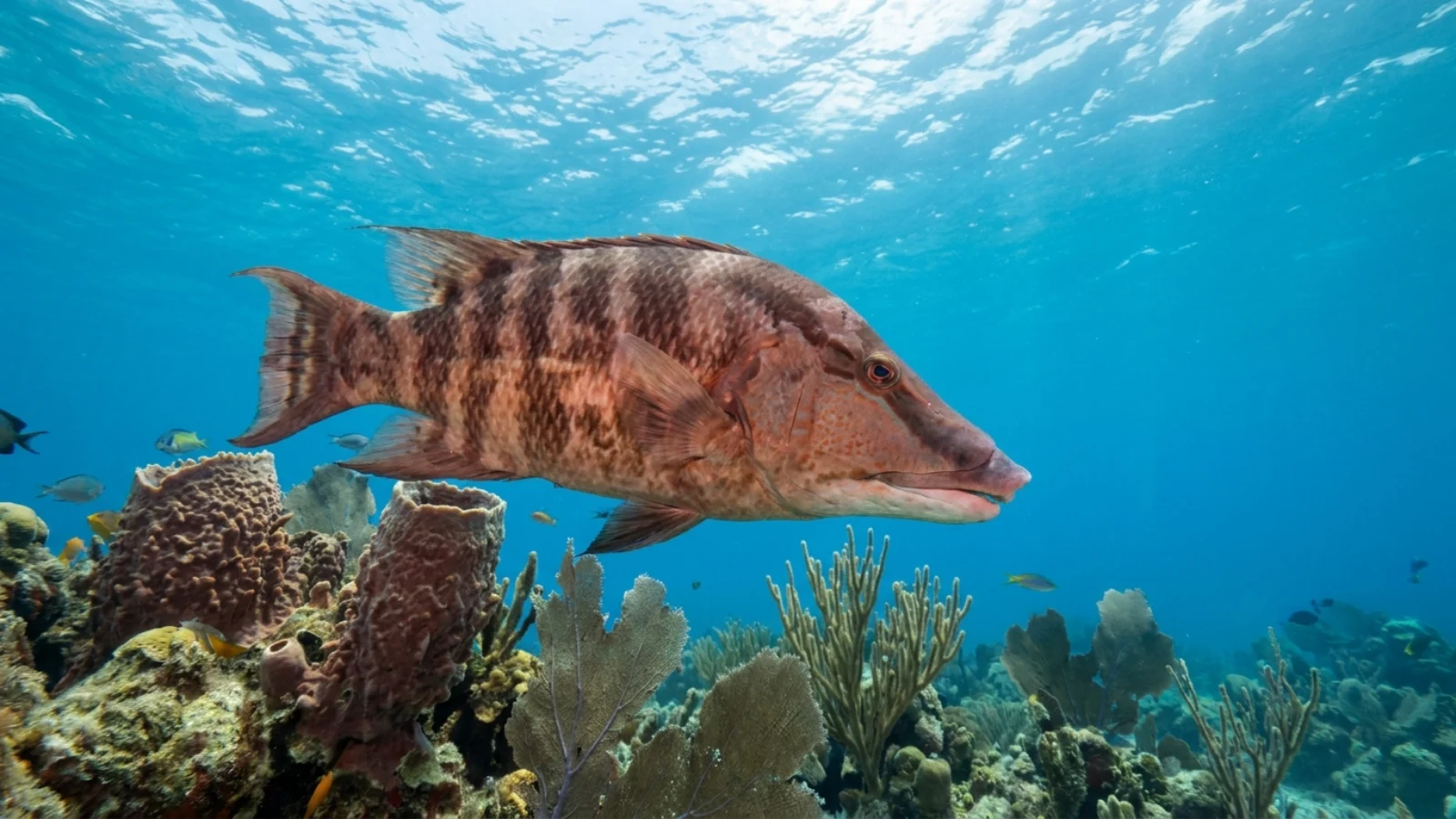
It belongs to the family Labridae, the wrasses, covered in our wrasse guide and in the parrotfishes and wrasses group guide. FishBase describes it as a deep-bodied wrasse with a strongly arched profile. The first three spines of the dorsal fin are drawn out into long filaments, which is the fastest way to identify one underwater. The snout is long and protrusible, and the mouth can shoot forward to vacuum prey out of the sand.
Colour depends on age, sex and mood. Females and juveniles are pale grey, brown or reddish brown, paler below, and can change shade quickly to match the bottom. Terminal-phase males develop a deep, dark band from the snout to the first dorsal spine and a black spot behind the pectoral fin.
How big do hogfish get?
Hogfish reach a recorded maximum of 91 cm (36 in) and 11 kg (24 lb), with a common length of about 35 cm.
FishBase gives a common length of 35 cm and a maximum reported age of 23 years, while other summaries give a maximum of about 11 years, so the true figure probably varies with region and fishing pressure. Maturity comes at about 18 cm. The giants are almost always males, because hogfish grow into their male phase.
Why does a hogfish change sex?
Hogfish are protogynous hermaphrodites: every fish starts life as a female, and the largest become males.
Hogfish spawn in harems, with one male mating with several females in his territory. Sex change begins after a fish has spawned as a female, and it takes months rather than weeks; the details are in the reproduction section below. Spawning in South Florida is usually given as November through June, and histology shows females spawning as often as daily in winter and spring. The system works well until fishing removes the largest fish first. Because spearfishers target the biggest hogfish and the biggest hogfish are males, heavy fishing pressure can skew the sex ratio of a reef. That is a big reason fisheries scientists watch the species closely.
Where do hogfish live?
Over open sandy or rubbly bottom near reefs, and especially where gorgonians are common, at 3–30 m.
The range runs along the western Atlantic from Nova Scotia and Bermuda to northern South America, including the Gulf of Mexico and the Caribbean. Florida is the heart of the fishery. Hogfish are often found on low-relief hard bottom and patch reefs among gorgonians and sea fans, and on the Florida Keys reef tract.
What do hogfish eat?
Mainly molluscs, plus crabs, hermit crabs and sea urchins, which they crush with strong pharyngeal jaws.
The snout works like a probe. The hogfish blows and roots into sand and rubble, then pulls clams, snails and crustaceans out. Wrasses have a second set of jaws in the throat, and in the hogfish these are strong enough to crack shells. This diet is also why the meat tastes so clean.
How do you tell a hogfish from a Spanish hogfish?
Despite the name, the Spanish hogfish (Bodianus rufus) is a different, smaller wrasse with a purple-and-yellow body and no long dorsal streamers.
Divers and anglers mix the two up all the time. The Spanish hogfish shares the hogfish’s range in Bermuda, southern Florida, the Gulf and the Caribbean, but it reaches only about 40 cm and 1 kg, lives from 1 to 70 m, and is listed as Least Concern. Its upper body is violet to purple and the rear half bright yellow. Juveniles act as cleaners, picking parasites from larger fish, a job they share with the cleaner wrasses of the Indo-Pacific and the gobies of the Caribbean.
| Feature | Hogfish | Spanish hogfish |
|---|---|---|
| Scientific name | Lachnolaimus maximus | Bodianus rufus |
| Max length | 91 cm | 40 cm |
| Max weight | 11 kg | about 1 kg |
| Dorsal fin | First 3 spines long streamers | No streamers |
| Colour | White, pink or mottled; males with dark head band | Purple upper body, yellow rear |
| IUCN | Vulnerable | Least Concern |
| Main diet | Molluscs, crabs, urchins | Crustaceans, urchins, brittle stars; juveniles clean |
Are hogfish kept in aquariums?
Small juveniles are occasionally sold, but adults grow far too large for home tanks.
FishBase lists the species as present in the commercial aquarium trade, and public aquariums display adults well. As a mollusc and crustacean eater that can pass 90 cm, it is unsuited to a reef tank. For most hobbyists it is a fish to enjoy on a dive, not in the living room.
What eats hogfish?
Predation on hogfish is poorly documented; for adults, fishing is the best-documented source of mortality.
Small hogfish rely on camouflage and rapid colour change, and large adults have few obvious natural enemies on the reef, but detailed predation studies are lacking. Their curiosity and habit of feeding in open sand make them especially easy for spearfishers to approach.
How does a hogfish change sex, in detail?
The most thorough work on hogfish reproduction is a 2007 study in the Journal of Fish Biology by McBride and Johnson, based on histological sections from 1,662 gonads. It described 13 reproductive classes, defined by size, age, colour phase and gonad state, and confirmed that the hogfish is a monandric protogynous hermaphrodite. Monandric means there are no “primary” males born as males: every male is a former female. Sex change began at the end of the spawning season, across a broad range of sizes and ages, only after a fish had worked as a functional female, and it proceeded more slowly than earlier accounts suggested, taking months. Eventually all individuals changed sex to the terminal male phase.
FishBase summarises the timing: sex change typically starts in fish of about 30 to 40 cm fork length, or three to five years old, but has been seen in fish as large as 69.4 cm and 13 years old, and usually follows one more spawning season as a female. Other summaries put the typical switch at around three years of age and about 14 inches long, which fits the same range.
Females are batch spawners, releasing eggs in many separate bouts, and McBride and Johnson found they could spawn as often as every day in winter and spring. The spawning act itself has been described as a short “spawning rush” with six steps: the pair swims up on its pectoral fins, switches to tail-powered swimming, comes alongside and tilts, releases eggs and sperm, circles and displays, and then swims back down. The 2007 study found no sign of sperm competition or of any alternative male mating strategy.
That combination is what makes the species fragile under fishing. Because males are the largest fish, spearfishers and anglers aiming for big hogfish take males first. And because sex change is slow, a harem that loses its male cannot replace him quickly. McBride and Johnson concluded that harvesting a single male has the potential to reduce the reproductive output of an entire harem.
Why do hogfish grow so differently from place to place?
Growth varies enormously across the range. A 2021 study in the Bulletin of Marine Science by Towne, Arena and Collins aged 227 hogfish from three reef tracts in southeast Florida, collected between January 2016 and August 2017. The average maximum potential length, a growth-curve estimate written as L-infinity, was 414 mm there, against 920 mm for the eastern Gulf of Mexico, an area thought to face less fishing pressure. The authors saw evidence of Lee’s phenomenon, the pattern in which faster-growing fish are fished out first so that the survivors appear to grow more slowly.
Depth made a striking difference within southeast Florida itself. By age nine, fish from the shallowest reef tract, at 4 to 6 m, averaged 564 mm fork length, compared with 405 mm and 351 mm on the middle and deepest tracts, the deepest lying at 15 to 25 m. Shallow-reef fish at that age were on average 61 percent longer and four times heavier than deep-reef fish. Annual survival ran the other way, rising with depth from 42 to 65 to 73 percent. The study read this as a trade-off between growth and longevity, and it means that a single growth curve for “the hogfish” can mislead managers.
How far south does the hogfish live?
Older references end the range in northern South America, but a 2016 note in the Journal of Fish Biology by Sampaio and colleagues confirmed the species off the Brazilian coast, as far south as southern Brazil. The evidence came from museum specimens, photographs and reports from fishers and divers. The authors concluded that the recognised range should be extended by about 3,000 km to the south. Many field guides and older summaries have not caught up, which is why range statements for the hogfish still vary.
How can a hogfish crush shells?
Like other wrasses, the hogfish has a second set of jaws in the throat, the pharyngeal jaws, which it uses to break hard prey. In a 1987 study in the Journal of Zoology, Wainwright tested what limits the size of prey a hogfish can eat, focusing on a commonly eaten snail, Cerithium litteratum. Two limits were possible: how wide the pharyngeal jaws can open, and how hard they can bite. Laboratory feeding trials showed the limit was crushing force, not gape. When those results were compared with the largest snails found in the stomachs of wild hogfish, crushing ability again appeared to set the ceiling. The work became an early example of using performance tests to link a fish’s anatomy to what it actually eats in the wild.
Can hogfish skin sense light?
The hogfish changes colour rapidly, and it has become a model for studying light detection in skin. In 2018, Schweikert, Fitak and Johnsen sequenced the genes active in the retina and the skin. The retina expressed five visual opsin genes, the light-sensitive proteins used for vision, together with the usual vertebrate signalling chain. The skin expressed only one opsin, a short-wavelength-sensitive type known as SWS1, along with what appears to be a different, cAMP-based signalling pathway. The authors suggested that light detection in the retina and skin of some vertebrates may have separate evolutionary histories.
A 2023 paper in Nature Communications by Schweikert and colleagues took the next step. They located the SWS1 opsin in a specialised population of probable photoreceptor cells lying beneath the pigment cells, or chromatophores, that produce colour change. When the chromatophore pigment spreads out, it absorbs exactly the short-wavelength light that the SWS1 opsin needs. The skin photoreceptors can therefore sense how much pigment is spread above them, and the authors proposed that the fish may use this as a feedback system to monitor its own colour change. In other words, a hogfish may be able to feel how dark its skin has gone.
How is the hogfish managed in Florida?
The current rules date from changes that took effect on 24 August 2017, announced by the Florida Fish and Wildlife Conservation Commission on 14 August 2017. Hogfish in the Florida Keys and east Florida had been found to be overfished and undergoing overfishing, and federal law required the South Atlantic Fishery Management Council to end overfishing immediately and adopt a 10-year rebuilding plan. Because most Keys and east Florida hogfish are caught in state waters, Florida matched its rules to the federal ones.
The 2017 package did several things at once. The management boundary, which had followed U.S. Highway 1 through the Keys, moved to 25 degrees 9 minutes north, a line due west of Cape Sable; fish north of it are managed as the Gulf stock and fish south of it, around the tip of Florida and up the Atlantic coast, as the Atlantic stock. FWC said the new line is closer to where the two stocks naturally separate, according to a recent genetic study. In the Atlantic, the recreational bag limit fell from five fish to one, a May 1 to October 31 season was set, and the recreational and commercial minimum size rose from 12 to 16 inches fork length. In the Gulf, where the stock was described as healthy, the minimum size rose from 12 to 14 inches at stakeholders’ request, and a statewide minimum of 14 inches was set for importing and selling hogfish.
As of the FWC page checked in November 2026, legal gear includes spears, gigs, hook and line, seine and cast net; reef fish gear rules apply, including dehooking tools and non-stainless steel hooks in state waters; Biscayne National Park has its own special regulations; and private-boat anglers fishing for certain reef fish need the State Reef Fish Angler designation, renewed each year. Rules change, so check the FWC page before every trip.
Is hogfish good to eat?
Yes, hogfish is one of the most sought-after eating fish in Florida, though FishBase notes reports of ciguatera poisoning from the species.
Hook and line is legal gear, but the hogfish is best known as a spearfishing target, especially for free-divers. If you go after them, learn your local rules, and read our scuba spearfishing guide. Protected areas, including Biscayne National Park, have their own special rules.
What are the hogfish regulations in Florida?
In Gulf waters north of Cape Sable the limit is 5 fish of at least 14 in fork length, open all year. In Atlantic waters, including the Keys, it is 1 fish of at least 16 in, open May 1 to October 31.
| Region | Minimum size (fork length) | Daily bag limit | Season |
|---|---|---|---|
| Gulf (state and federal, north of Cape Sable) | 14 in | 5 per person | Year-round |
| Atlantic (south of Cape Sable, incl. Florida Keys) | 16 in | 1 per person | May 1 – Oct 31 |
Those limits come from the Florida Fish and Wildlife Conservation Commission (FWC). Legal gear includes spears, gigs and hook and line, and private-boat anglers need the State Reef Fish Angler designation. The Keys limit was cut from five fish to one, and the minimum size raised from 12 to 16 in, in August 2017 after the stock in the Florida Keys and east Florida was found to be overfished and undergoing overfishing. Always check FWC’s page before a trip, as rules change.
Why is the hogfish Vulnerable?
The IUCN lists it as Vulnerable because of population decline driven by fishing.
Hogfish are slow-growing, long-lived, territorial and easy to approach, which makes them easy to overfish. Large males are removed first, which reduces spawning success. FishBase rates its vulnerability to fishing as high (59 out of 100). On the positive side, the species has been reared in captivity.
Why is it called a hogfish?
Because of its long pig-like snout, which it uses to root through sand for food, much as a hog roots through soil.
How big do hogfish get?
Up to 91 cm (36 in) and 11 kg (24 lb), with a common length of about 35 cm.
Is hogfish good to eat?
Yes, its white, mild flesh is highly prized. FishBase notes reports of ciguatera from the species, so local advice matters.
Can you catch hogfish on hook and line?
Yes, hook and line is legal gear under FWC rules, though the species is best known as a spearfishing target.
What is the bag limit for hogfish in the Florida Keys?
One fish per person per day, minimum 16 in fork length, open May 1 to October 31 (Atlantic region). Check FWC for current rules.
Is the hogfish a wrasse?
Yes. It is a large member of the wrasse family, Labridae.
Do hogfish change sex?
Yes. They start life as females and the largest become males.
Is the hogfish endangered?
It is listed as Vulnerable by the IUCN, one step below Endangered.
- Froese, R. & Pauly, D. (eds.). Lachnolaimus maximus, Hogfish. FishBase.
- IUCN Red List. Lachnolaimus maximus: Vulnerable (A2bd), assessed 2009.
- Florida Fish and Wildlife Conservation Commission. Hogfish recreational regulations. myfwc.com.
- Keys Weekly (2017). Hogfish rules change: bag limit and size limit changes effective August 24, 2017.
- SEDAR 37 (2014). Hogfish Stock Assessment Report. Southeast Data, Assessment and Review.
- McBride, R. S. & Johnson, M. R. (2007). Sexual development and reproductive seasonality of hogfish, an hermaphroditic reef fish. Journal of Fish Biology. doi:10.1111/j.1095-8649.2007.01580.x
- Towne, Arena & Collins (2021). Habitat specific tradeoffs in growth and survival by hogfish in southeast Florida. Bulletin of Marine Science. doi:10.5343/bms.2020.0075
- Sampaio et al. (2016). Hogfish Lachnolaimus maximus confirmed in the south-western Atlantic Ocean. Journal of Fish Biology. doi:10.1111/jfb.13075
- Wainwright (1987). Biomechanical limits to ecological performance: mollusc-crushing by the Caribbean hogfish. Journal of Zoology. doi:10.1111/j.1469-7998.1987.tb03704.x
- Schweikert, Fitak & Johnsen (2018). De novo transcriptomics reveal distinct phototransduction signaling components in the retina and skin of the hogfish. Journal of Comparative Physiology A. doi:10.1007/s00359-018-1254-4
- Schweikert et al. (2023). Dynamic light filtering over dermal opsin as a sensory feedback system in fish color change. Nature Communications. doi:10.1038/s41467-023-40166-4
- Florida Fish and Wildlife Conservation Commission (14 August 2017). Hogfish conservation measures and boundaries effective Aug. 24.
- Florida Fish and Wildlife Conservation Commission. Hogfish recreational regulations (myfwc.com, checked November 2026).
Blane Perun has been exploring Earth’s oceans and marine life for over 25 years. Founder of TheSea.Org in 1999, underwater photographer, coral aquaculture pioneer, and explorer of 80+ countries.
About Blane Perun → More on Reef Fish →