Finless Porpoises — Indo-Pacific, Narrow-Ridged and Yangtze
The Indo-Pacific finless porpoise (Neophocaena phocaenoides) is a small grey porpoise with no dorsal fin, just a broad band of tiny bumps along its back. It lives in shallow coastal waters from the Persian Gulf to southern China and Indonesia. Its close relative, the narrow-ridged finless porpoise, includes the Yangtze finless porpoise, the world’s only freshwater porpoise.
Most people picture a porpoise or dolphin with a curved fin breaking the surface. Finless porpoises break that rule. They have no dorsal fin at all, just a low ridge along the back, and from a distance they look like smooth grey cylinders rolling through murky coastal water. They are among the least conspicuous cetaceans in Asia, yet they live close to some of the most crowded coastlines and busiest rivers on Earth. That proximity to people has made them one of the most threatened groups in the porpoise family. This page explains how the two finless porpoise species differ, where each lives, what they eat, and why the Yangtze finless porpoise in particular has become a symbol of river conservation in China. For an overview of every porpoise, see our porpoise species guide.
What makes a finless porpoise different
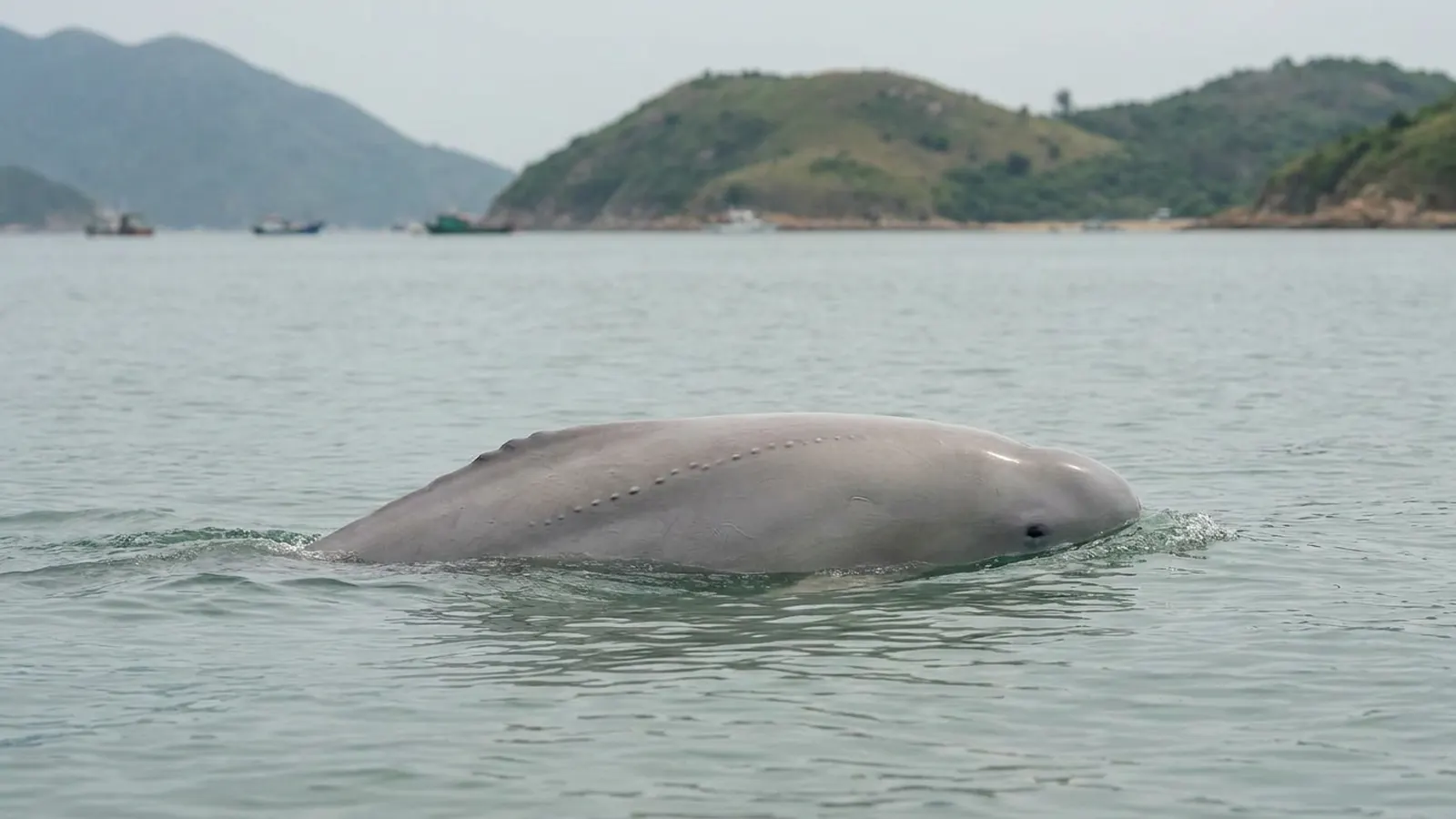
Instead of a fin, finless porpoises have a strip of skin covered in small, hard bumps called tubercles running along the middle of the back.
Finless porpoises are small, with adults usually 1.5 to 1.9 metres long and weighing roughly 30 to 70 kilograms. The head is rounded, with a steep forehead and no beak, giving the face an almost smiling look. The body is grey; newborns are dark, and adults become paler with age, with some older animals looking almost whitish. The mouth is small, with spade-shaped teeth like those of other porpoises.
Where other porpoises have a dorsal fin, finless porpoises have a dorsal ridge: a band of skin covered in rows of tiny tubercles. Its exact function isn’t fully understood. One idea is that it plays a sensory role, and there are observations of calves riding on their mother’s back, gripping the area around the ridge. The shape and width of this ridge is also the main feature used to tell the two species apart.
Indo-Pacific vs narrow-ridged finless porpoise
Finless porpoises were long treated as a single species. Genetic and anatomical work has since separated them into two. The Indo-Pacific finless porpoise, Neophocaena phocaenoides, has a wide, low dorsal ridge, with a broad band of tubercles that can be several centimetres across. The narrow-ridged finless porpoise, Neophocaena asiaeorientalis, has a narrower band of tubercles on a ridge that stands up more distinctly from the back.
The narrow-ridged species is divided into two subspecies. The East Asian finless porpoise lives in coastal seas from the Taiwan Strait north through the East China Sea and Yellow Sea to Korea and Japan. The Yangtze finless porpoise, N. a. asiaeorientalis, lives only in the middle and lower Yangtze River and its two great connected lakes, Poyang and Dongting. Some researchers have argued the Yangtze population is distinct enough to be its own species, because it has been isolated in fresh water and shows genetic adaptations to river life.
| Feature | Indo-Pacific finless | East Asian finless | Yangtze finless |
|---|---|---|---|
| Scientific name | Neophocaena phocaenoides | N. asiaeorientalis sunameri | N. asiaeorientalis asiaeorientalis |
| Dorsal ridge | Wide, low band of tubercles | Narrow, raised ridge | Narrow, raised ridge |
| Range | Persian Gulf to India, SE Asia, Indonesia, southern China | Taiwan Strait north to Yellow Sea, Korea, Japan | Middle and lower Yangtze, Poyang and Dongting lakes |
| Water | Salt and brackish | Salt and brackish | Fresh water only |
| IUCN status | Vulnerable | Endangered (species level) | Critically Endangered |
Where the Indo-Pacific finless porpoise lives
The Indo-Pacific finless porpoise has one of the widest ranges of any small coastal cetacean in Asia. It is found in the Persian Gulf and along the coasts of Pakistan, India, Sri Lanka, Bangladesh and Myanmar, through Thailand, Malaysia and Indonesia, and north to Vietnam, Hong Kong and southern China. It prefers shallow, warm water usually less than about 50 metres deep, including bays, estuaries, mangrove channels and the waters around river mouths. It sometimes travels short distances up rivers.
Because it hugs the coast, its range overlaps heavily with fishing, shipping, port construction, land reclamation and pollution. In Hong Kong, for example, finless porpoises live alongside one of the world’s busiest harbours, and researchers there have studied them for decades, recovering stranded animals and running boat surveys. Our where do porpoises live page compares its range with the other porpoises.
The Yangtze finless porpoise
The Yangtze finless porpoise is the only porpoise in the world that lives entirely in fresh water. It shares the river with what was once a second unique cetacean, the baiji or Yangtze river dolphin, which was declared functionally extinct after an intensive survey in 2006 failed to find a single animal. The baiji’s loss turned attention urgently to the porpoise, which was declining for the same reasons.
Surveys of the river since the 1990s documented a steep fall in numbers. By a major survey in 2012, the population was estimated at only around a thousand animals, and the IUCN listed the subspecies as Critically Endangered. Threats came from every direction: bycatch and illegal electrofishing that killed both porpoises and their prey, sand dredging that destroyed habitat and muddied the water, heavy ship traffic and its noise, dams that changed water flow, and industrial and agricultural pollution.
China has since taken unusually strong action. Protected reserves were set up along the main river and in the lakes, and some porpoises were moved to oxbow lakes cut off from the main channel, such as the Tian’e-Zhou oxbow, where they have bred successfully and act as an insurance population. Most dramatically, a ten-year ban on commercial fishing across the Yangtze basin began in 2020 and 2021. Surveys since then have suggested the population has stabilised and may be increasing slightly, which would be one of the few good-news stories for a river cetacean anywhere.

What finless porpoises eat
Finless porpoises feed on whatever small prey is common in their shallow coastal or river habitat. Marine populations eat small fish such as anchovies, croakers, gobies and sardines, along with shrimp, squid, cuttlefish and octopus. Yangtze finless porpoises eat river fish, including small carp-family species, catfish and gobies, plus shrimp. Like other porpoises, they hunt with high-frequency echolocation clicks, which work well at short range in muddy water where eyesight is of little use.
Because they depend on small fish that people also catch, finless porpoises are vulnerable when fish stocks collapse. On the Yangtze, overfishing and electrofishing were blamed for a sharp fall in prey, one reason the fishing ban was so important. For more on porpoise diets across the family, see what do porpoises eat.
Behaviour, breeding and captivity
Finless porpoises are usually seen alone, in pairs or in small groups of up to around a dozen, though larger gatherings form in good feeding areas. They are shy, surface quietly with little splash, and avoid boats, which makes them hard to count. In calm water, observers may glimpse a grey back rolling forward with no fin at all.
Calves are born after a pregnancy of about 11 months and are roughly 70 to 80 centimetres long at birth. Mothers have been observed carrying calves on their backs. Finless porpoises are one of the few porpoises that have been kept successfully in captivity, in aquariums in Japan and China. Yangtze finless porpoises were first born in captivity in Wuhan in the mid-2000s, and captive animals have contributed a great deal to research on porpoise hearing, echolocation and reproduction. That experience matters for conservation planning, though the focus today is firmly on protecting wild populations and their habitat.
Why are Yangtze finless porpoises endangered?
The short answer is that they live in one of the most heavily used rivers on the planet. The Yangtze basin is home to hundreds of millions of people and carries a huge share of China’s inland shipping. A porpoise that needs clean water, plenty of small fish and a quiet acoustic environment has struggled to survive there. The main causes of decline have been:
Bycatch and illegal fishing. Porpoises drowned in nets and on rolling hook lines, and electrofishing killed them directly or stripped the river of fish. Habitat loss. Sand dredging and channel engineering destroyed shallow feeding areas. Ship traffic and noise. Constant boat noise interferes with echolocation and causes collisions. Dams and water changes. Dams altered flows and lake levels, affecting fish breeding. Pollution. Industrial, agricultural and urban runoff degraded water quality.
The Yangtze story shows how quickly a river mammal can slide toward extinction, but also how much strong protection can achieve. The vaquita in Mexico, by comparison, is down to a handful of animals because protection came too late.
What the finless porpoise tells me about water quality
None of the dive trips I’ve written up on this site were in finless porpoise waters, so I’m not going to describe seeing one. What I can speak to is water. I’ve kept reef systems since 1996 and run a coral farm, and the single biggest lesson from all of it is that everything in a tank depends on water quality. You can have the best lighting and the healthiest fish, but if nutrients build up, oxygen drops or something toxic gets in, the whole system goes downhill fast.
A river is a much bigger version of that system, and the Yangtze finless porpoise sits at the top of it. When the water is dirty, noisy and overfished, the top predator is the first to show it. That’s why I find the Yangtze fishing ban so encouraging: it treats the river as a whole system rather than focusing on the porpoise alone. If you want to read more about rare cetaceans facing similar problems, see our page on which dolphins are endangered and the rarest sea animals list.

Do finless porpoises have a dorsal fin?
No. They have a low ridge covered in small tubercles along the back instead of a fin.
How many species of finless porpoise are there?
Two: the Indo-Pacific finless porpoise and the narrow-ridged finless porpoise, which includes the Yangtze finless porpoise.
Where does the Indo-Pacific finless porpoise live?
In shallow coastal waters from the Persian Gulf through India and Southeast Asia to Indonesia and southern China.
Why are Yangtze finless porpoises endangered?
Bycatch, illegal electrofishing, sand dredging, ship traffic, dams and pollution in the Yangtze River.
How many Yangtze finless porpoises are left?
Recent surveys estimate roughly a thousand or slightly more, with signs of stabilising since the fishing ban.
What is a narrow-ridged finless porpoise?
The northern species, with a narrower, more raised dorsal ridge, found from the Taiwan Strait to Japan and in the Yangtze.
Is the finless porpoise a freshwater animal?
Most live in salt or brackish coastal water; only the Yangtze subspecies lives entirely in fresh water.
- IUCN Red List of Threatened Species: Neophocaena phocaenoides and Neophocaena asiaeorientalis assessments.
- Turvey, S.T. et al. (2007). First human-caused extinction of a cetacean species? Biology Letters 3: 537–540.
- Jefferson, T.A. & Wang, J.Y. (2011). Revision of the taxonomy of finless porpoises (genus Neophocaena): the existence of two species. Journal of Marine Animals and Their Ecology 4: 3–16.
- WWF: Yangtze finless porpoise conservation programme.
Blane Perun has been exploring Earth’s oceans and marine life for over 25 years. Founder of TheSea.Org in 1999, underwater photographer, coral aquaculture pioneer, and explorer of 80+ countries.
About Blane Perun → More on porpoises →