Spectacled Porpoise — The Rarely Seen Porpoise of the Southern Ocean
The spectacled porpoise (Phocoena dioptrica) is a small porpoise of the cold subantarctic Southern Ocean, sharply black above and white below, with a black eye patch ringed in white that looks like a pair of glasses. Adults reach about 2 m. It lives far offshore, so it is one of the least-seen cetaceans; most of what we know comes from strandings.
Some marine mammals are famous because they are easy to see. The spectacled porpoise is the opposite. It is one of the most strikingly patterned small whales in the world, yet very few people have ever seen a live one. It spends its life in the cold, stormy waters that ring Antarctica, far from shore and far from most boats. For much of the twentieth century, scientists knew it almost entirely from bodies washed up on remote beaches. Even today, fewer live sightings have been documented for this porpoise than for almost any other cetacean of its size. This page explains what the spectacled porpoise looks like, where it lives, what little we know about its diet and behaviour, and why it remains such a mystery. For the rest of the family, see our guide to the seven porpoise species.
Why it is called the spectacled porpoise
The name comes from a black patch around each eye, outlined by a thin white ring, that makes the porpoise look as if it is wearing glasses.
The spectacled porpoise has one of the cleanest colour patterns of any cetacean. The upper half of the body is glossy black, the lower half is brilliant white, and the line between them runs high along the flanks, sharp and almost straight, as though someone painted it with a ruler. The black lips and the black eye patch with its thin white rim stand out against the white face. The flippers are white or grey, and there is often a dark stripe from the mouth to the flipper. Its scientific name, dioptrica, refers to the same feature, from the Greek for something you look through.
The species was described in 1912 by the Argentine naturalist Fernando Lahille from a specimen found near Buenos Aires. For decades afterwards, it was known from only a scattering of specimens, most of them from the beaches of Tierra del Fuego.
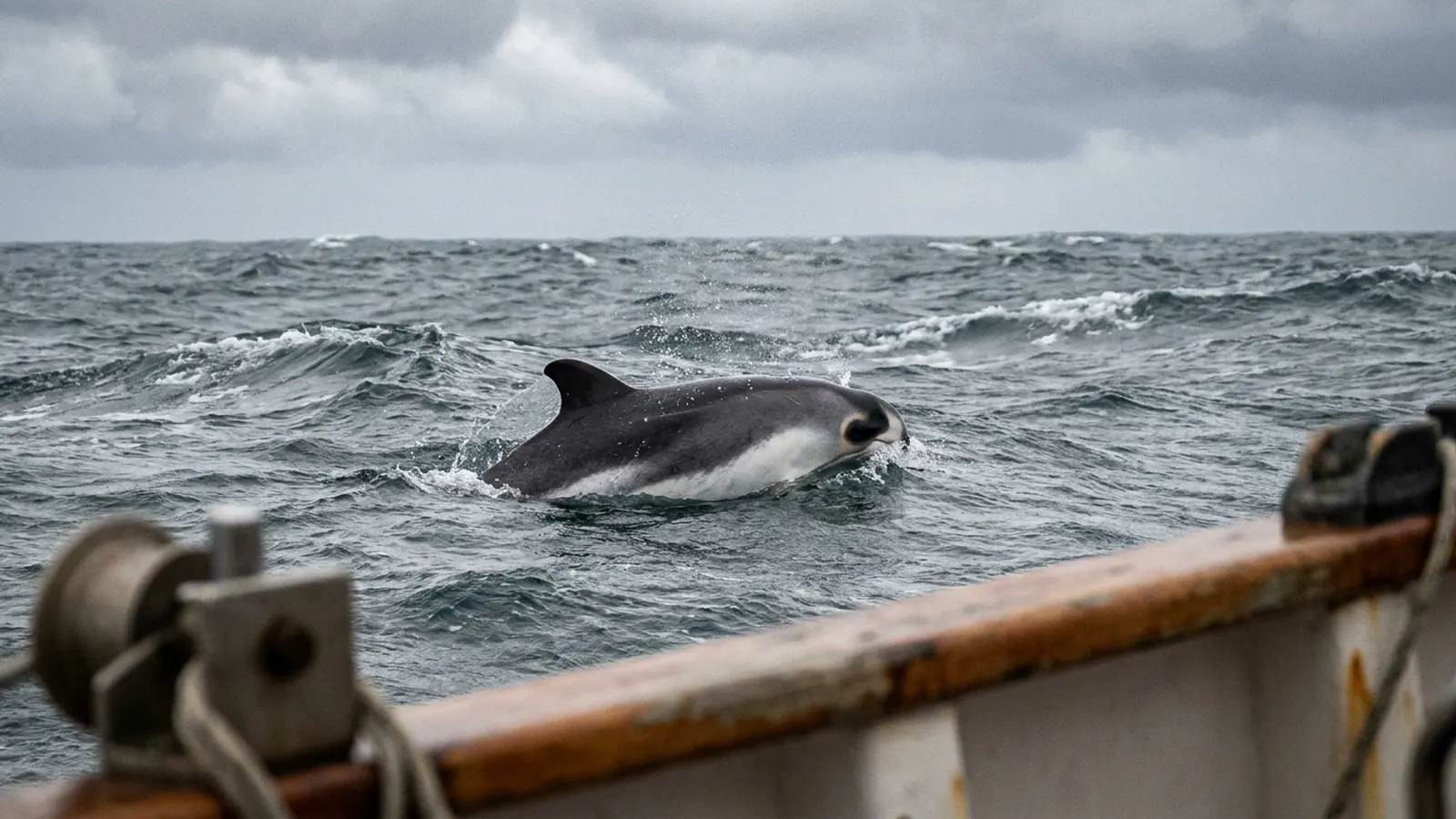
Size, shape and the male’s giant fin
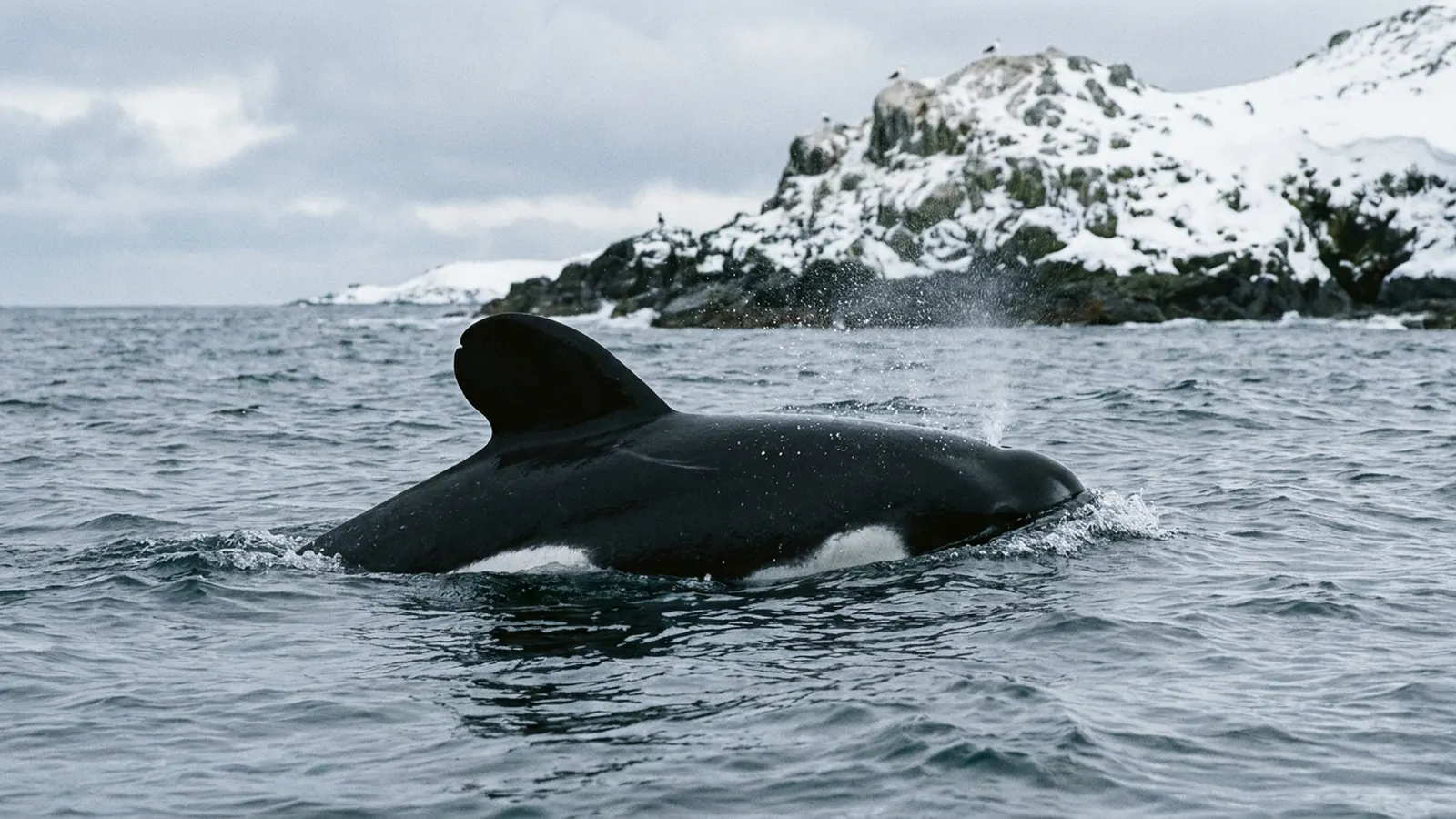
Adult spectacled porpoises are usually 1.3 to 2.2 metres long and can weigh more than 100 kilograms. Unlike most porpoises, males are noticeably larger than females, and adult males are easy to recognise by their dorsal fin. In females and young animals, the fin is a small triangle. In mature males, it becomes very large, broad and rounded, almost paddle-shaped, and stands out above the water in a way no other porpoise matches.
The body is robust and the head small, with no distinct beak, as in other porpoises. The teeth are small and spade-shaped. The dramatic black-and-white pattern has a practical purpose shared by many ocean animals: countershading. Seen from above, the black back blends into the dark water below; seen from beneath, the white belly blends into the bright surface. The same principle works for penguins, orcas and many fish.
| Feature | Spectacled porpoise | Burmeister’s porpoise | Dall’s porpoise |
|---|---|---|---|
| Ocean | Subantarctic Southern Ocean | South American coasts | North Pacific |
| Habitat | Offshore, around remote islands | Shallow coastal, fjords | Offshore and deep inshore channels |
| Colour | Black above, white below, sharp line | Uniform dark grey | Black with white flank patch |
| Eye marking | Black patch ringed in white | None | None |
| Male dorsal fin | Very large, rounded | Low, backswept, spiny edge | Triangular, white-tipped |
| Adult length | About 1.3–2.2 m | About 1.4–2 m | About 1.8–2.4 m |
Where spectacled porpoises live
The spectacled porpoise has a circumpolar range in the cool waters of the Southern Ocean, mostly between about 40°S and 60°S. Records come from the coasts of southern Argentina, Uruguay and southern Brazil, from Tierra del Fuego and the Falkland Islands, from South Georgia, and from subantarctic islands in the Indian and Pacific Oceans, including Kerguelen, Heard, Macquarie and New Zealand’s Auckland Islands. Strandings have also been recorded in southern Australia, Tasmania and New Zealand.
Tierra del Fuego has produced more specimens than anywhere else, partly because researchers have spent decades walking its beaches looking for stranded animals. Live sightings, by contrast, have mostly been made far offshore from research vessels and expedition ships, often in cold water close to the subantarctic islands. That suggests the spectacled porpoise is really an oceanic animal, living in the open sea rather than along coasts like the Burmeister’s porpoise, which shares its South American waters. For a map-style comparison of every porpoise’s range, see where do porpoises live.
What spectacled porpoises eat
Very little is known about the diet of spectacled porpoises because so few stomachs have been examined, and many stranded animals had been dead too long for useful analysis. The handful of samples studied contained small fish, such as anchovies, and squid, along with some small crustaceans. That fits the general porpoise pattern of feeding on small prey that can be swallowed whole.
Like other porpoises, spectacled porpoises almost certainly hunt using very high-frequency echolocation clicks. Recordings made at sea in recent years have helped confirm that they share the narrow-band, high-frequency click type typical of the porpoise family. For more on how porpoises find and catch food, see what do porpoises eat.
Behaviour and life history
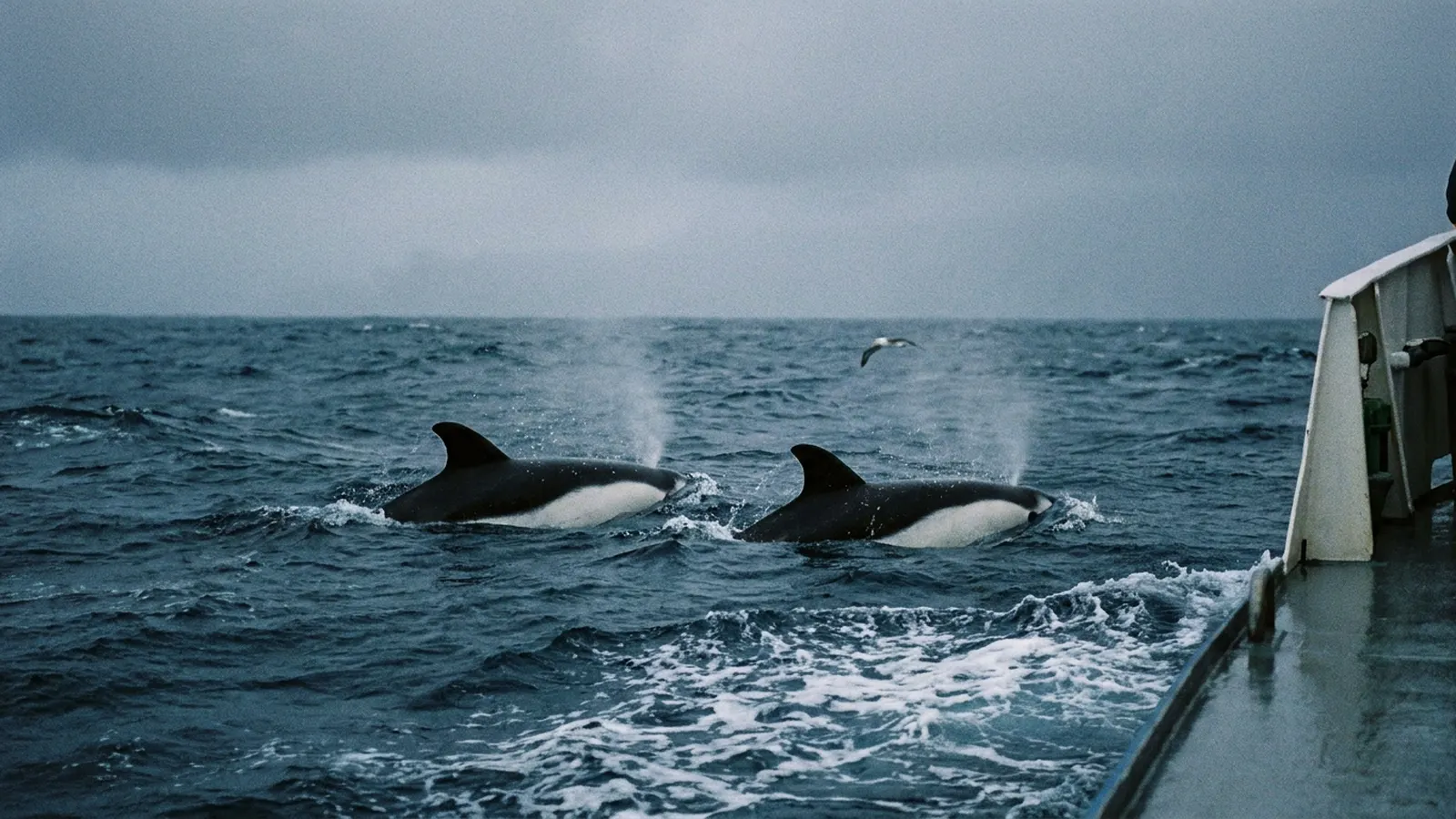
The few observers who have watched spectacled porpoises at sea describe them as usually travelling alone or in pairs, occasionally in small groups. They do not appear to approach boats or ride bow waves, and they tend to surface briefly and inconspicuously, which helps explain why they are so rarely reported. In calm conditions, the black back, white flanks and the male’s big rounded fin can be distinctive; in typical Southern Ocean weather, they are easily lost among whitecaps.
Breeding is thought to occur in the southern spring and summer, with calves born after a pregnancy of roughly 11 months, but the data come from a small number of specimens. Lifespan, age at maturity and population size are all poorly known. Killer whales and large sharks are likely predators, as they are for other porpoises, although direct observations are lacking.
Why so few people have seen one
Several things combine to make the spectacled porpoise one of the least-seen cetaceans on Earth. Its range lies in some of the roughest, most remote seas on the planet, where few ships travel and where sea conditions are often too poor to spot a small animal. It is an offshore species, so it does not appear along popular coastlines where people watch for marine mammals. It is small and does not seek out boats. And its low surfacing profile gives observers only a moment to see it.
The result is that photographs of living spectacled porpoises are rare, and the first good images and video of free-swimming animals were only obtained in the last few decades. Much of the scientific foundation was laid by researchers in Tierra del Fuego who collected and catalogued stranded animals over many years, giving the world its first detailed look at the species’ anatomy and life history. It is a reminder that even in the twenty-first century, some large animals remain almost unknown. Our page on what lives in the Southern Ocean covers the other animals that share its world.
Threats and conservation status
Because it lives far offshore, the spectacled porpoise is probably less exposed to coastal gillnets than many of its relatives. Even so, some animals have been recorded drowned in nets off Argentina, Uruguay and Tierra del Fuego, and bycatch in trawl and gillnet fisheries is the main known threat. Other possible pressures include pollution, noise, and changes in the Southern Ocean food web linked to warming water and fishing for krill and small fish.
The IUCN currently lists the spectacled porpoise as Least Concern, reflecting its huge range and the lack of evidence for major declines. But scientists stress that population size and trends are unknown, so the assessment rests on limited information. Within its range, it benefits from protection in several marine reserves around subantarctic islands, and from national laws protecting cetaceans in Argentina, Australia and New Zealand.
How I’d think about finding one
The Southern Ocean isn’t among the places I’ve dived, so I’ll keep this to perspective rather than pretend to a sighting. If I were determined to see a spectacled porpoise, I wouldn’t book a whale-watching tour. I’d look at expedition voyages that spend time around the Falklands, South Georgia or New Zealand’s subantarctic islands, and I’d accept that seeing one would be luck, not a guarantee. Calm seas and a good pair of binoculars would matter more than anything else.
What fascinates me about this animal is how much it says about the limits of our knowledge. I’ve kept reef systems since 1996, and any reef keeper knows that live rock can hide small, cryptic animals that go unnoticed for a long time, even in a closed tank you look at every day. Scale that up to an ocean that circles a continent, and it isn’t surprising that a two-metre whale can hide in plain sight. If you want to see how the spectacled porpoise fits with its relatives, the harbor porpoise page covers the best-known member of the family, and the Dall’s porpoise page covers the other black-and-white porpoise, at the opposite end of the world.
Why is it called the spectacled porpoise?
Because of the black patch around each eye, ringed in white, which looks like a pair of glasses.
Where does the spectacled porpoise live?
In cold subantarctic waters around the Southern Hemisphere, including Tierra del Fuego, the Falklands, South Georgia and subantarctic islands.
How big is a spectacled porpoise?
About 1.3–2.2 m long and up to roughly 115 kg; males are larger than females.
Is the spectacled porpoise endangered?
It is listed as Least Concern, but its population size and trends are essentially unknown.
What does the spectacled porpoise eat?
The few stomachs studied contained small fish such as anchovies, squid and small crustaceans.
Why is the spectacled porpoise rarely seen?
It lives far offshore in remote, stormy seas, avoids boats and surfaces briefly.
How can you tell a male spectacled porpoise?
Adult males have a very large, rounded, almost paddle-shaped dorsal fin.
- IUCN Red List of Threatened Species: Phocoena dioptrica assessment.
- Goodall, R.N.P. (2009). Spectacled porpoise Phocoena dioptrica. In Perrin, Würsig & Thewissen (eds.) Encyclopedia of Marine Mammals, 2nd ed. Academic Press.
- Jefferson, T.A., Webber, M.A. & Pitman, R.L. (2015). Marine Mammals of the World, 2nd ed. Academic Press.
- Australian Antarctic Division: Spectacled porpoise species information.
Blane Perun has been exploring Earth’s oceans and marine life for over 25 years. Founder of TheSea.Org in 1999, underwater photographer, coral aquaculture pioneer, and explorer of 80+ countries.
About Blane Perun → More on porpoises →