Coral Reef in Destin, Florida — Artificial Reefs, Jetties and the Truth About Coral
No — Destin has no natural tropical coral reefs. It lies on Florida’s Panhandle on the northern Gulf of Mexico, where winter water is too cool and the sea floor too sandy for reef-building corals. Destin’s underwater life is built instead around artificial reefs, sunken vessels and natural limestone ledges offshore, plus the rock jetties at East Pass, which are the area’s best-known snorkelling spot. These structures carry sponges and soft corals and attract snapper, grouper and huge schools of baitfish — which is why Destin calls itself the “World’s Luckiest Fishing Village.” Florida’s true coral reefs lie far to the south-east, in the Florida Keys.
Destin’s emerald water and sugar-white beaches look as tropical as anywhere in the Caribbean, so it is no surprise that so many visitors search for a coral reef here. The reality is different but still rewarding. Beneath the surface off Destin lies a patchwork of sand, seagrass, natural rock ledges and hundreds of man-made reef structures, all thick with fish. This guide explains why Destin has no coral reefs, what you can see instead, the best places to snorkel and dive, the wildlife you are likely to meet, and where to go if you want to see Florida’s living coral.
Does Destin have coral reefs?
Destin has corals on rock and wrecks, but no coral reefs — an important distinction.
A coral reef is a structure built over centuries by colonies of stony corals laying down limestone skeletons, layer upon layer, until they form a framework that shelters thousands of other species. That process happens only in warm, clear, shallow tropical water. Destin sits far north of that belt, on a coast where winter cold fronts can cool the Gulf sharply.
What you will find on hard surfaces off Destin are reef-like communities: sponges, sea whips, soft corals, hydroids and the occasional small, hardy stony coral that can tolerate cooler water. These organisms colonise rock ledges, jetties and sunken structures. They create habitat and attract fish, but they do not build reefs. So when local dive shops and charter captains talk about “reefs,” they almost always mean artificial reefs — and they are very good ones.
Destin reef map
The map shows Destin on the Gulf Panhandle, far north of the mapped coral reefs of southern Florida.
This map shows the coastline only, because there is no mapped shallow coral reef off Destin in the global reef datasets. Florida’s coral reefs are concentrated hundreds of kilometres to the south-east, along the Florida Keys and the south-east coast. For the full picture see our map of coral reefs in Florida. The neighbouring Panhandle resort of Panama City Beach tells the same story, covered on our coral reef in Panama City Beach page.
The map also helps explain Destin’s fishing fame. East Pass connects Choctawhatchee Bay to the Gulf, and the continental shelf here is relatively narrow, so deep water and productive offshore grounds lie within a short boat ride of the harbour.
Why there are no coral reefs in Destin
Three factors rule out reefs on the northern Gulf coast: winter cold, sandy sea floor and variable water quality.
Cold winters. Reef-building corals generally need water that stays above roughly 18°C (the mid-60s °F) all year. Summer Gulf water off Destin is very warm, but winter cold fronts drop nearshore temperatures well below that, and a few cold weeks are enough to prevent reef corals from establishing.
Sand, not limestone. Coral larvae need a hard surface to settle on. The Florida Keys sit on a shallow limestone platform; the Panhandle shelf is mostly quartz sand washed down from the Appalachians over very long periods — the same sand that makes Destin’s beaches so white.
River influence. Rivers carry fresh water, nutrients and sediment into the northern Gulf, lowering salinity and clarity at times. Reef corals depend on sunlight reaching their symbiotic algae and on stable, clear, salty water.
Together, these explain why the entire northern Gulf coast from Texas to the Panhandle lacks shallow tropical reefs. Corals do grow in deeper, more stable parts of the Gulf, such as the Flower Garden Banks far off Texas and Louisiana and the Florida Middle Grounds off the Big Bend, but neither is within reach of a casual trip from Destin.
Artificial reefs and natural ledges
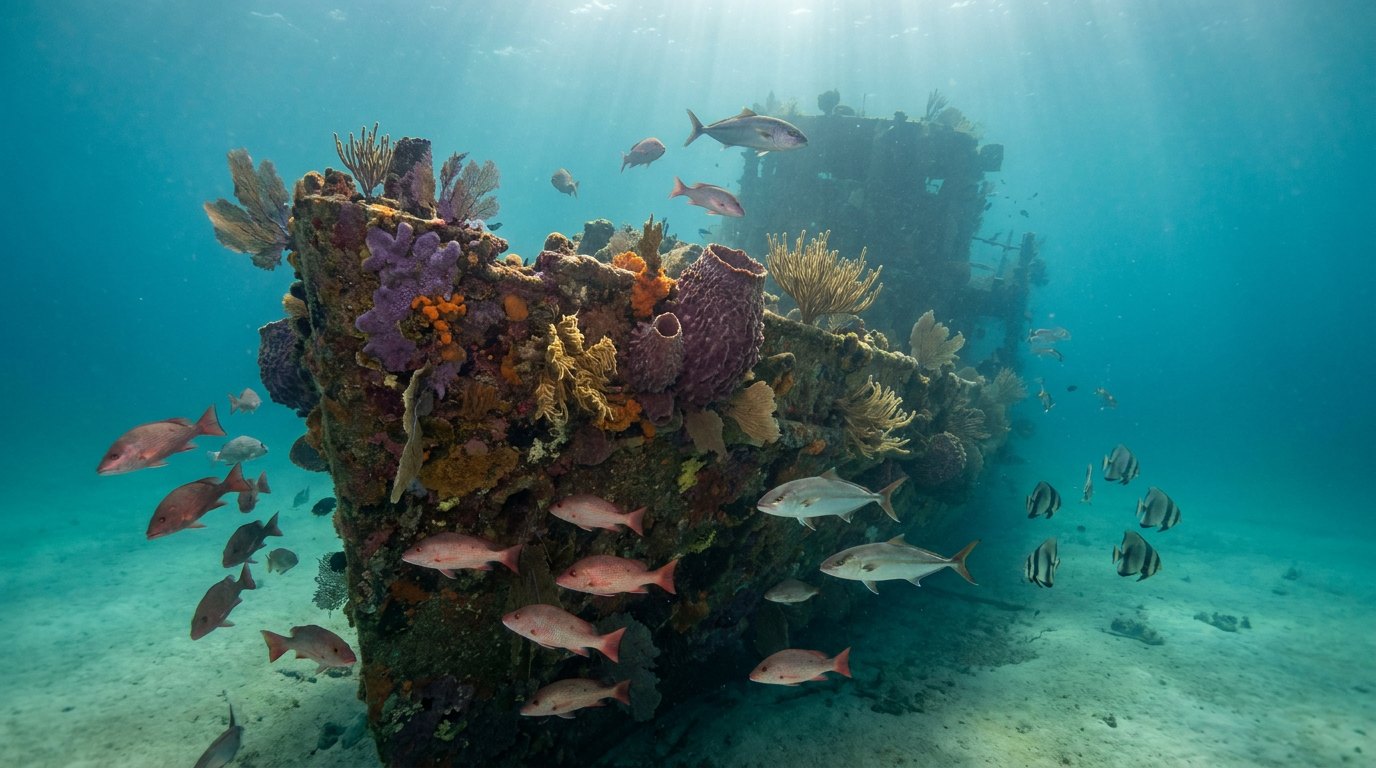
What Destin lacks in coral, it makes up for with an extensive network of artificial reefs.
Like much of the Florida Panhandle, the waters off Destin and Okaloosa County have been deliberately seeded with structures to create fish habitat on an otherwise sandy sea floor: concrete reef modules, pyramids and domes, bridge spans, rubble, retired tugboats and other vessels. Once in place, they are colonised quickly by algae, barnacles and sponges, followed by soft corals and a growing community of fish. Within a few years a bare structure can support a dense population of snapper, grouper, triggerfish and amberjack.
Some reefs are placed close to shore in shallow water specifically for snorkellers and beginner divers, while others lie farther offshore for anglers and experienced divers. Nearby, an underwater sculpture park off Grayton Beach in neighbouring Walton County combines art with artificial reef habitat.
Natural limestone ledges and hard-bottom patches are scattered across the shelf as well. These outcrops support sponges, sea fans and soft corals and attract the same fish as the artificial reefs. They are the closest thing to a natural reef in the area, and many are prized fishing spots whose exact locations are closely guarded.
| Feature | What it is | What lives there |
|---|---|---|
| East Pass jetties | Rock jetties at the entrance to Choctawhatchee Bay | Sheepshead, sergeant majors, small reef fish, rays |
| Nearshore artificial reefs | Shallow reef modules placed for snorkellers | Juvenile fish, sponges, crabs |
| Offshore artificial reefs | Concrete modules, bridge spans, sunken vessels | Snapper, grouper, amberjack, triggerfish |
| Limestone ledges | Natural hard-bottom outcrops | Sponges, soft corals, reef fish |
| Seagrass and sand flats | Shallow bay and sound bottoms | Rays, crabs, juvenile fish, sea stars |
Snorkelling and diving in Destin
The East Pass jetties are Destin’s classic snorkel; divers head offshore to wrecks and reef modules.
The Destin jetties. The rock jetties lining East Pass are the most popular snorkelling spot in Destin. The rocks attract sheepshead, sergeant majors, small groupers, damselfish and crabs, with rays and the occasional sea turtle over the sand nearby. Visibility is usually best on an incoming tide, when clear Gulf water flows into the pass. The pass is also a busy boat channel with strong tidal currents, so snorkel only in the protected areas near the rocks, use a dive flag where required and avoid the channel itself.
Nearshore reefs and Crab Island. Shallow artificial reefs off the beaches give snorkellers another option on calm days. Crab Island, a sandbar just inside the pass, is famous more for boat parties than marine life, but its clear shallow water can hold rays, crabs and small fish.
Offshore dives. Dive charters run from Destin harbour to artificial reefs and wrecks offshore, ranging from relatively shallow sites to deeper wrecks for experienced divers. Conditions vary with season and weather; late spring through early autumn usually brings the calmest seas and best visibility. Many of the same structures are fished heavily, so divers should follow the captain’s briefing and watch for fishing line.
For other options in the state, see our best snorkeling in Florida guide, and check rip current and beach warning flag advice before swimming.
The World’s Luckiest Fishing Village
Destin’s real underwater fame is its fishing, built on structure and a short run to deep water.
Destin’s charter fleet is one of the largest in the Gulf, and its nickname reflects how quickly boats can reach productive water. Red snapper, grouper, amberjack, triggerfish and cobia are prized targets around the reefs and ledges, while king mackerel, mahi-mahi and billfish are caught farther offshore. Federal and state seasons, size limits and bag limits control the harvest of the most popular species.
The same artificial reefs that support the fishery support divers and wildlife, which is why careful management matters. Overfished structures hold fewer and smaller fish, so following the rules keeps both anglers and divers happy.
Wildlife you can see off Destin
Dolphins, turtles and rays are more reliable sightings in Destin than coral.
Bottlenose dolphins are common in Choctawhatchee Bay and along the beaches, and dolphin cruises leave the harbour daily in season. Loggerhead and other sea turtles feed nearshore and some nest on local beaches in summer, when beachfront lighting rules apply. Stingrays and eagle rays cruise the sand flats, and schools of baitfish attract diving pelicans and terns. In the bay, seagrass beds shelter juvenile fish, crabs and scallops. Read more about dolphins in Destin and sea turtles.
Not everything in the water is welcome. Jellyfish, including moon jellies and the occasional Portuguese man o’ war, drift in with onshore winds at certain times of year, and purple flags on the beach warn of dangerous marine life. Invasive lionfish have also reached the artificial reefs and ledges offshore, where they eat large numbers of small native fish; local spearfishing tournaments and divers help keep their numbers down. On the positive side, the same clear water that draws swimmers makes Destin one of the easiest places on the Gulf coast to watch marine life from a boat, a paddleboard or the end of a pier, without ever putting on a mask.
Where to find real coral reefs in Florida
To see living coral, head to the Florida Keys and the south-east coast.
The Florida Reef Tract is the only extensive living coral barrier reef in the continental United States. It runs from the Dry Tortugas along the Florida Keys and up the south-east coast toward Palm Beach County, where warm currents keep water temperatures high enough year-round. The most accessible places to see it are John Pennekamp Coral Reef State Park and the other reefs off Key Largo, the reefs around Key West, and Dry Tortugas National Park.
Those reefs face severe pressures of their own — disease, bleaching and storms — and a visit there shows both the beauty of living coral and the work underway to protect it. Destin’s Gulf waters, meanwhile, face coastal development, runoff, red tide, storms and fishing pressure, and depend on the same care. Read more on our coral reef conservation pages.
Before swimming, check for Vibrio vulnificus advisories, watch for sea lice in late spring, and leave the water when storms approach (see lightning on the beach).
Related on TheSea
- Brazil Coral Reef Maps
- Columbia Coral Reef Maps
- Ecuador Coral Reef Maps
- Nicaragua Coral Reef Maps
- Venezuela Coral Reef Maps
- Costa Rica Coral Reef Maps
- Panama Coral Reef Maps
- Honduras Coral Reef Maps
- Mexico Coral Reef Maps
- Belize Coral Reef Maps
- Key West Coral Reef Maps
- Tropical Americas Coral Reef Maps
Are there coral reefs in Destin, Florida?
No natural tropical coral reefs. The northern Gulf is too cool in winter and too sandy for reef-building corals. Destin has artificial reefs, wrecks and limestone ledges covered in sponges and soft corals instead.
Where is the best snorkelling in Destin?
The rock jetties at East Pass are the most popular spot, best on a calm day and incoming tide. Shallow nearshore artificial reefs are another option. Avoid the boat channel and its strong currents.
Why is the water in Destin so clear and green?
White quartz sand on the sea floor reflects sunlight, and on calm days the clear Gulf water over it looks emerald green. Visibility still varies with wind, waves, tides and runoff.
What is the closest coral reef to Destin?
The nearest shallow coral reefs you can visit are in the Florida Keys, on the Florida Reef Tract. Deeper coral areas exist in the Gulf, such as the Florida Middle Grounds, but they are far offshore.
Can you see sea turtles in Destin?
Yes. Sea turtles feed in nearshore waters and some nest on local beaches in summer. Keep your distance, fill in holes on the beach and follow lights-out rules near nests.
Why is Destin called the World’s Luckiest Fishing Village?
Because deep, productive water lies a short boat ride from East Pass, and artificial reefs and ledges offshore hold snapper, grouper, amberjack and other prized fish.
Blane Perun has been exploring Earth’s oceans and marine life for over 25 years. Founder of TheSea.Org in 1999, underwater photographer, coral aquaculture pioneer, and explorer of 80+ countries.
About Blane Perun → More Coral Reef Maps →