Lightning on the Beach — Why Florida Leads the Nation in Lightning Deaths
There is no safe place on a beach in a thunderstorm. If you can hear thunder, you are close enough to be struck. Leave the beach and the water immediately for a substantial building or a hard-topped vehicle with the windows up, and stay there for at least 30 minutes after the last thunder. Florida recorded 498 lightning deaths from 1959 to 2017, the most of any state, and the National Lightning Safety Council found beach activities were the second-largest cause of leisure-time lightning deaths. If someone is struck, call 911 and start CPR: victims carry no charge and are safe to touch.
When thunder roars, go indoors: off the sand, out of the water and into a building or hard-topped car, and wait 30 minutes after the last thunder.
Why is the beach so dangerous in a thunderstorm?
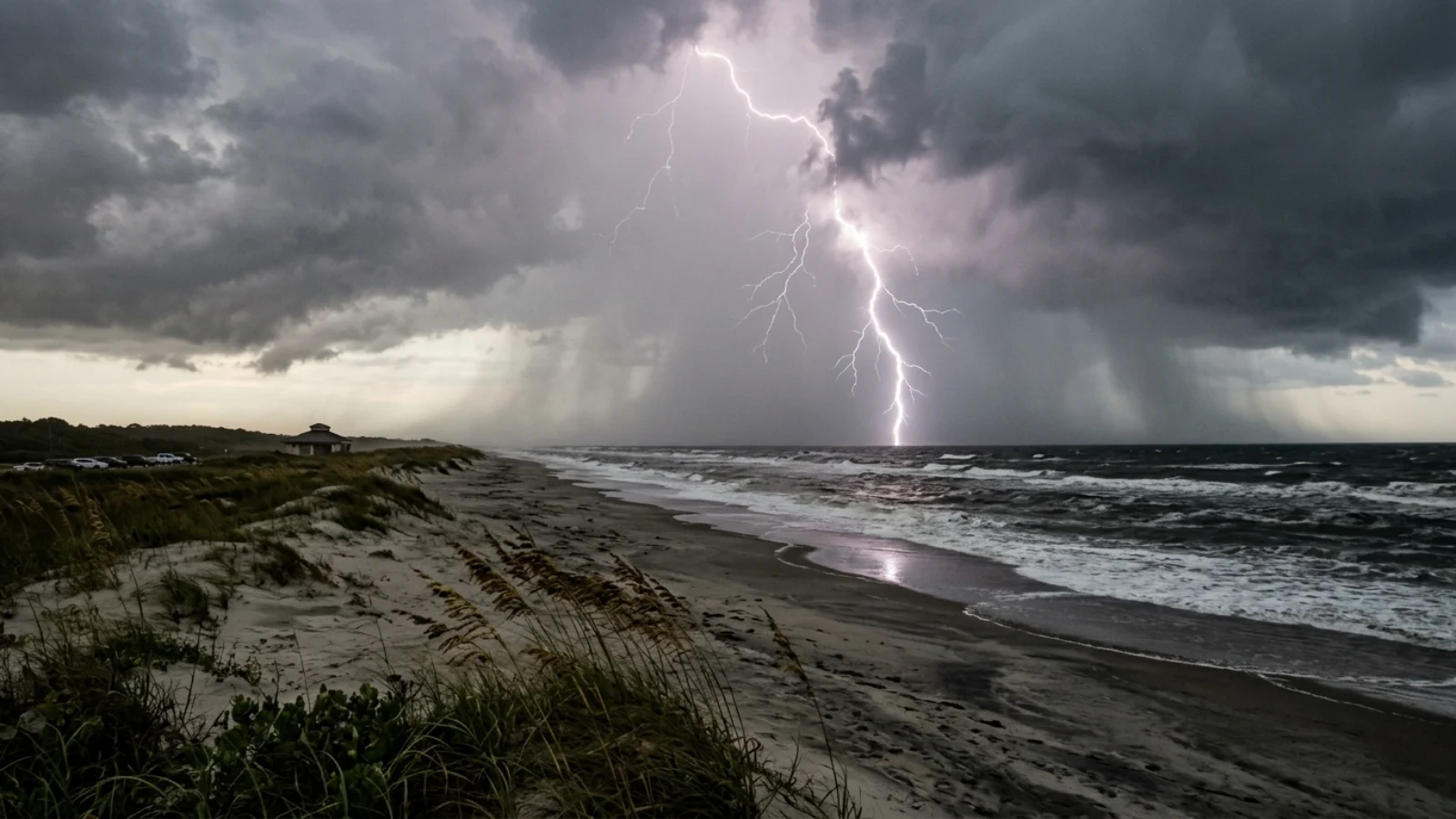
A beach is close to the worst place you can be when lightning is around. It is wide, flat and open, a person standing on it is often the tallest object for hundreds of yards, and the nearest safe shelter, usually a car or a building, may be a long walk away across soft sand. The water is no better. A swimmer, a paddleboarder or a person standing in the surf is exposed in the same way, and boats and jet skis offer no protection unless they have a fully enclosed cabin.
The National Weather Service (NWS) adds three reasons why beaches produce so many lightning casualties. The sound of thunder is hidden by the surf and by people having fun, so the first warning is easy to miss. Safety, typically a car, may be some distance away. And on the Atlantic coast, beachgoers face east toward the ocean while many storms approach from the west, behind them. The lesson for any coast is to watch the sky in every direction, not just out to sea.
The NWS’s lightning safety message is short: there is no safe place outside when thunderstorms are in the area. If you hear thunder, you are likely within striking distance of the storm. When thunder roars, go indoors.
How many people does lightning kill in Florida?
Florida is the lightning death capital of the United States by total numbers. An analysis by Ronald Holle of Vaisala, published by the NWS, counted 498 lightning deaths in Florida from 1959 to 2017, the highest of any state and more than twice the 226 recorded in Texas, which ranked second. Adjusted for population, Florida ranked fifth, at 0.76 deaths per million people per year, behind Wyoming, New Mexico, Arkansas and Colorado. Nationally, the National Lightning Safety Council notes that the Southeast and the Gulf Coast have the most lightning fatalities, and the Northwest, Upper Midwest and Northeast the fewest.
National numbers have fallen over time. The NWS says that from 1989 to 2018 the United States averaged 43 reported lightning deaths a year, and from 2009 to 2018 the average fell to 27. Its preliminary tally for 2016 to 2025 gives a 10-year average of 20 deaths a year. For 2025 the NWS gives 20 deaths on its 2025 page, last updated in July 2025, and 21 in the year-by-year chart on its 2026 page; the difference reflects later updates to the preliminary data.
In 2026, the NWS list as of its 22 September update recorded 16 lightning deaths nationwide, 6 of them in Florida. Two were on or in the water in Southwest and west-central Florida: a 51-year-old man killed while in the water at Fort Myers Beach on 3 July, and a 41-year-old man killed while jet skiing at Fort De Soto on 26 August. Others that year included a woman walking on the beach at Wrightsville Beach in North Carolina and a man sitting on the beach at Cape Charles in Virginia. In 2025 the NWS list included a man struck while standing in the water at New Smyrna Beach on Florida’s Atlantic coast.
What the national data say about beaches and water
The most detailed study of who is killed by lightning comes from John Jensenius of the National Lightning Safety Council, who analysed every US lightning death from 2006 to 2024. Of 492 deaths in that period, almost two thirds happened to people enjoying outdoor leisure activities, and water-related activities topped the list. Fishing accounted for 42 deaths, beach activities for 32 and boating for 25. Fishermen died three times as often as golfers, and beach activities, boating and camping each accounted for about twice as many deaths as golf.
Within water-related deaths, fishing contributed about 40 percent, boating 24 percent, beach activities about 29 percent and swimming about 8 percent. The report describes beach-related activities as the second-largest contributor to leisure deaths and suggests why: the sound of the surf may have masked the thunder that would have given earlier warning, and some victims had walked or run along the beach and were far from safety when the storm arrived. Many victims across all activities were heading for safety, or were steps away from it, when they were struck.
The study also shows who dies. About 80 percent of victims were male, most were aged 10 to 60, and more than 72 percent of deaths occurred in June, July and August, when lightning is most frequent and most people are outdoors. Fridays, Saturdays and Sundays had slightly more deaths than other days, which fits the pattern of weekend trips to the beach and the water.
How lightning strikes people
The NWS describes five ways lightning injures and kills. A direct strike makes the person part of the main lightning channel; it is less common than the other mechanisms but potentially the most deadly, and it happens most often in open areas such as beaches. A side flash occurs when lightning hits a taller object nearby, such as a tree, a lifeguard stand or a pole, and part of the current jumps to a person within a foot or two of it. Ground current spreads outward through and along the ground from a strike; because it affects a much larger area, the NWS says it causes the most lightning deaths and injuries. Conduction carries current along metal wires and surfaces, such as fences, railings and plumbing. And streamers, which rise from the ground as lightning approaches, can also injure people.
These mechanisms explain much of the standard advice. Sheltering under an isolated tree or a beach umbrella invites a side flash; the NWS says being under a tree is the second leading cause of lightning casualties. Open-sided picnic pavilions, beach huts and lifeguard stands do not protect you. Lying flat on the sand increases exposure to ground current. Metal does not attract lightning, the NWS says, but it does conduct it, so stay away from metal fences, railings and bleachers, and do not waste time taking off jewellery.
Lightning also travels much farther from a storm than most people realise. The NWS says lightning often strikes more than three miles from the centre of a thunderstorm, far outside the rain, and so-called bolts from the blue can strike 10 to 15 miles away. Blue sky overhead and dry sand are not proof that you are safe. The NWS also cites research showing that successive lightning flashes are often about 9 kilometres apart, which led to advice that a safe distance from the previous flash is at least 10 to 13 kilometres, or 6 to 8 miles.
Lightning myths that keep people on the beach
Several popular beliefs keep people on the sand longer than they should stay, and the NWS lists them as myths. The first is that crouching down makes you safer. It does not; the NWS says crouching does not make you any safer outdoors, and the only real protection is to get to a substantial building or a hard-topped vehicle. The second is that lightning never strikes the same place twice. Tall, pointed, isolated objects are struck repeatedly; the NWS notes that the Empire State Building is hit an average of 23 times a year.
The third myth is that you are safe if it is not raining or the cloud is not directly overhead. Lightning often strikes more than three miles from the centre of a storm, and on a beach the rain may still be well inland when the first strikes arrive. The fourth is that metal attracts lightning. Height, a pointed shape and isolation control where lightning strikes, the NWS says, and the presence of metal makes no difference, although metal does conduct current once lightning hits. The last, and the one that costs the most lives on beaches and playing fields, is that it is fine to finish what you are doing first. Many lightning casualties happen because people do not seek shelter soon enough, and the NLSC study found many victims were on their way to safety, or just steps from it, when they were struck.
What counts as safe shelter?
The NWS defines safe shelter narrowly. It is either a substantial building with electricity or plumbing, or an enclosed, metal-topped vehicle with the windows up. On a typical beach that means a fully enclosed building such as a restaurant, a restroom block with plumbing or a hotel, or your car. It does not mean a beach umbrella, a tent, a cabana, a picnic shelter, a pier, a lifeguard stand or an open-sided bar.
Once inside, stay there for at least 30 minutes after you hear the last thunder. Inside a building, the NWS advises staying off corded phones and away from plumbing, electrical equipment, windows, doors and porches.
In the water and on a boat
Being in the water puts you in the open with no shelter, often well away from the beach and slow to get out. The NWS last-resort advice is to get out of and away from bodies of water immediately. That applies to swimmers, waders, snorkelers, kayakers and paddleboarders as much as to people on the sand.
Boats are even more exposed. Anglers and boaters, the NLSC study notes, are often far from shore when a storm develops, may not hear thunder over an engine or waves, and need extra time to reach safety. Its advice is to watch the weather closely and react early. A small open boat, a jet ski or a kayak offers no protection at all. If you are on the water in summer, check the forecast and radar before you go out, keep an eye on the sky in all directions, and head in at the first sign of building storms rather than the first rumble of thunder.
A beach day plan for lightning season
The NWS beach safety page suggests a few habits that remove most of the risk. Keep a watchful eye on the sky in all directions, not just out to sea. Monitor the forecast and radar on your phone, and get to a safe place, such as a vehicle or a large, fully enclosed building, at any sign of an approaching or developing storm. If you are camping on a beach, keep a hard-topped metal vehicle nearby and get into it at the first sign of a thunderstorm.
On Florida beaches in summer, that translates into a simple routine. Know where your car or the nearest enclosed building is, and how long it takes to get there with children and beach gear. Leave the gear if you need to. Set the rule before you arrive that the whole group leaves the water and the sand at the first thunder, and do not wait for lifeguards to blow whistles or for rain to start. The NWS myth list puts it bluntly: no game is worth death or life-long injuries, and adults are responsible for children’s safety.
If someone is struck by lightning
The NWS says a lightning strike can cause cardiac arrest at the moment of injury, and that immediate medical attention, including calling 911, starting CPR and using an AED, may be critically important to keep the person alive. A person struck by lightning does not carry an electrical charge. The human body does not store electricity, the NWS says, and it is perfectly safe to touch a lightning victim to give first aid. The real danger to rescuers is the storm itself, so move yourself and the victim to a safer place as soon as you can.
Surviving does not mean escaping harm. The NWS estimates that only about 10 percent of people struck by lightning are killed, and that the other 90 percent are left with various degrees of disability; some survivors have lifelong neurological damage. Anyone struck, even if they seem fine, should be checked by a doctor.
The odds, in perspective
The NWS estimates that, based on averages for 2009 to 2018, the odds of being struck by lightning in a given year are about 1 in 1,222,000, and over an 80-year lifetime about 1 in 15,300. Counting the family and friends of victims, the odds of being affected by a strike are about 1 in 1,530. Those odds are not evenly shared. They are higher for people who spend long hours outdoors in summer, especially on the water and on the beach, and highest for those who wait too long to leave when a storm builds. On a Florida beach on a summer afternoon, the person who heads for the car at the first rumble of thunder has removed nearly all of that risk.
Is it safe to be on the beach during a thunderstorm?
No. There is no safe place outdoors in a thunderstorm; leave for a building or hard-topped car.
Can lightning strike you in the ocean?
Yes. The NWS advises getting out of and away from water immediately when thunderstorms threaten.
How far away can lightning strike?
Often more than 3 miles from the storm, and “bolts from the blue” can strike 10 to 15 miles away.
How long should you wait to go back to the beach after thunder?
At least 30 minutes after the last thunder you hear.
Is a beach umbrella or pavilion safe in lightning?
No. Only substantial buildings and enclosed, hard-topped vehicles are safe shelters.
Is it safe to touch someone struck by lightning?
Yes. The body does not store electricity; call 911 and start CPR if needed.
Which state has the most lightning deaths?
Florida: 498 deaths from 1959 to 2017, more than twice Texas in second place.
- National Weather Service, “National Weather Service Lightning Fatalities in 2026” (updated 22 September 2026) and “… in 2025” (updated 31 July 2025), preliminary data courtesy of J. Jensenius, National Lightning Safety Council.
- Jensenius, J. S., Jr., “A Detailed Analysis of Lightning Deaths in the United States from 2006 through 2024”, National Lightning Safety Council (January 2025).
- Holle, R. L., Vaisala Inc., “Lightning Fatalities by State, 1959-2017” (updated May 2018), via weather.gov.
- National Weather Service, “How Dangerous is Lightning?”, “Lightning Tips”, “Lightning Myths”, “Lightning Science: Five Ways Lightning Strikes People”, “Lightning Safety” and “Beach Hazards and Safety” (accessed November 2026).
Blane Perun has been exploring Earth’s oceans and marine life for over 25 years. Founder of TheSea.Org in 1999, underwater photographer, coral aquaculture pioneer, and explorer of 80+ countries.
About Blane Perun →