Rip Currents in Florida — How They Form, How to Spot One and How to Escape
A rip current is a narrow, fast channel of water flowing away from the beach through the surf. Most flow at 1 to 2 feet per second, but the strongest reach about 8 feet per second, faster than an Olympic swimmer. They do not pull you under; they pull you away from shore, and people drown when they tire fighting them. If you are caught, don’t swim against it: swim parallel to the beach or float and wave for help. Florida accounted for 21 of the 99 surf-zone deaths in the National Weather Service’s preliminary 2025 list.
Swim near a lifeguard, check the rip current outlook, and if a current carries you out, escape sideways or float, and never swim straight back against it.
What is a rip current?
A rip current is a strong, narrow flow of water that runs from close to the shoreline, out through the line of breaking waves, and often beyond it. The National Weather Service calls rip currents “rivers of the sea”: they carry sand, plankton and anything floating in them away from the beach. They occur on almost any beach with breaking waves, on ocean coasts, sheltered bays and even the shores of the Great Lakes, and Florida’s long sandy coastline, with its offshore sandbars, piers and jetties, provides every setting in which they form.
The single most important thing to understand is what a rip current does to a swimmer. It does not drag people under the water. It carries them away from the beach and into deeper water. People get into trouble because they panic, try to swim straight back to shore against the flow, and become exhausted. The NWS compares a rip current to a treadmill: a swimmer who fights it makes little progress and tires quickly. Most rip current deaths are drownings from that exhaustion.
The term “rip tide” is common but wrong. Tides are the slow rise and fall of the sea over roughly 6 to 12 hours. Rip currents are driven by breaking waves, and they can run on a rising or falling tide. The NOAA National Ocean Service reserves “rip tide” for a different hazard: fast tidal currents in inlets, the mouths of estuaries and harbour entrances. “Undertow” is also misused. True undertow is a slow return flow along the bottom, and the NWS states plainly that neither undertow nor rip currents will pull a person under the water.
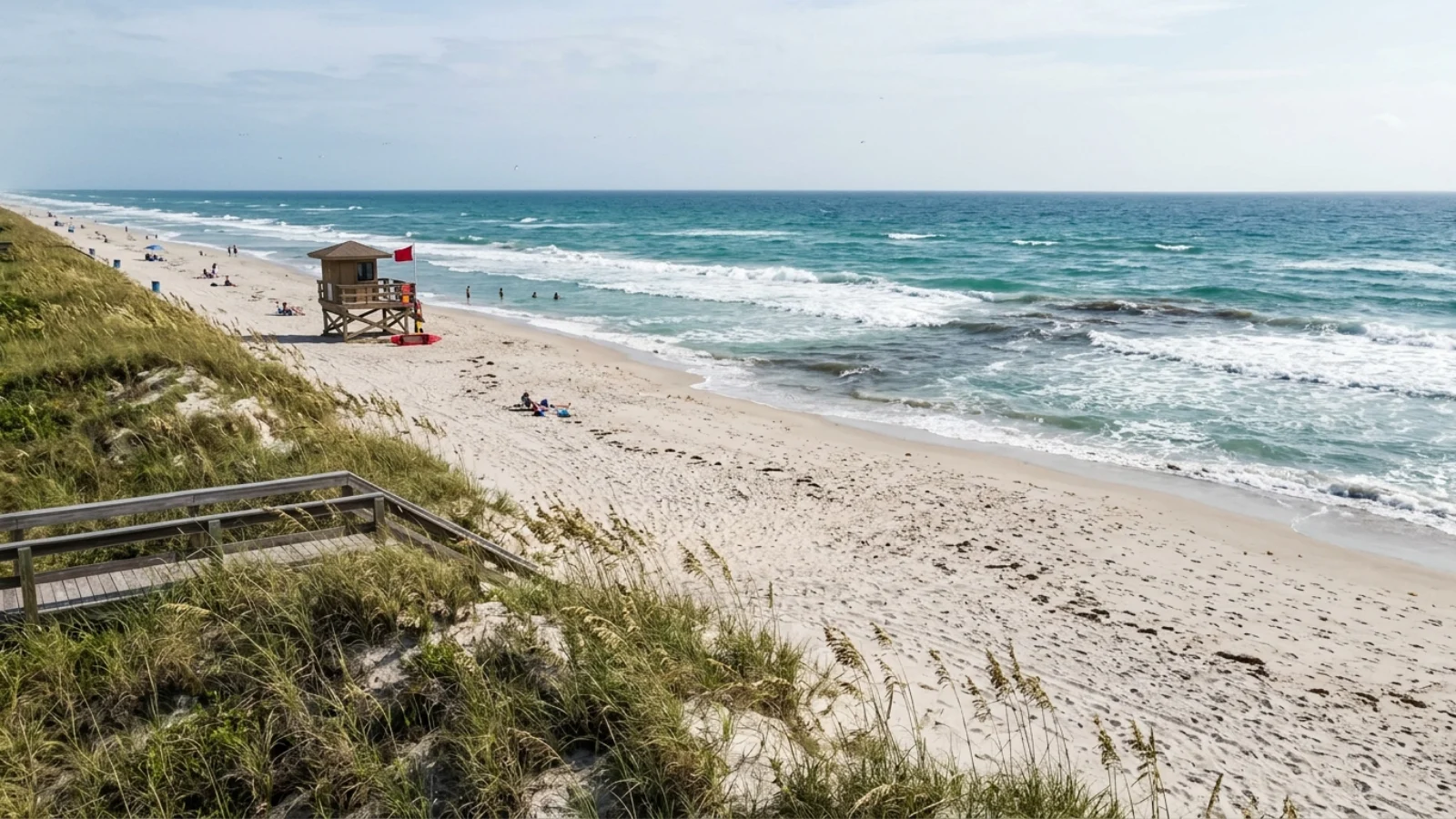
How rip currents form
Breaking waves push water toward the shore. That raises the water level near the beach very slightly, an effect scientists call wave setup, which the NWS says is often about 10 percent of the breaking wave height. When waves break unevenly along a beach, the setup is uneven too: higher where waves break heavily over a sandbar, lower where they break less, for example over a deeper gap in the bar. Water flows “downhill” along the shore from the high spots toward the low spot. There the flows, called feeder currents, converge and turn seaward as a narrow, fast current: the rip.
A rip has three parts. The feeders run along the beach, the neck is the narrow, fast channel that runs out through the surf, and the head is where the current spreads out and slows, usually beyond the breaking waves. The NWS notes that the flow is fastest in the neck, often around halfway out, and fastest toward the middle of the channel and just below the surface. The neck is where most swimmers first realise they are in trouble.
Scientists classify rip currents by what causes the uneven wave breaking. Channelized rips, the best understood type, occupy deeper channels cut through shore-parallel sandbars. The NWS says they typically range from 5 to 100 yards wide, are about 3 to 10 feet deep or more, and may be spaced anywhere from 50 to 500 yards apart. They can stay in the same place for days, weeks or months. One of the NWS’s own photographs of a channelized rip was taken at Pensacola Beach in Florida.
Structural rips form beside piers, jetties, groins and rock outcrops. Waves or longshore currents push water against the structure, and the only outlet is seaward along its side. These rips stay put and can run even when waves are small, which is why the NWS’s Low Risk outlook still warns that life-threatening rips often occur near groins, jetties, reefs and piers. Flash rips, by contrast, are short-lived. They form on straight beaches with no fixed features when waves from different directions interfere or break in short sections, and they appear as plumes of churning, sandy water heading offshore for a few minutes before fading. They cannot be predicted to a precise time or place.
How fast is a rip current?
The NWS says channel rip currents typically flow at about 1 to 2 feet per second and may reach up to 8 feet per second, comparable to the top speeds of the fastest Olympic swimmers. Even a weaker rip can make it hard to stand at waist depth, and the combination of waves and current is disorienting.
Two things make the speed unpredictable. The first is pulsing. When a set of larger waves breaks, the water level near shore rises for a short time and the rip can speed up sharply for 30 seconds to a minute; the NWS says the flow can more than double during a pulse, and that pulses are often what lead people into trouble. Waders who were standing comfortably can lose their footing and be carried out. The second is the tide. On beaches with a tidal range under 6 feet, which includes most of Florida’s open coast, rips often flow fastest an hour or two on either side of low tide, when water over the sandbars is shallowest and waves break hardest. Rips can stop altogether at high tide. Contrary to a common belief, the NWS says rip currents have not been found to be stronger on a falling tide than a rising one; only the water level matters.
The NWS also corrects another myth. Sandbars do not suddenly “collapse” under waders. Sandbars shift over days to months, or hours in a big storm. What usually catches people on a bar is a set of larger waves that raises the water level and triggers a rip pulse.
How many people die in rip currents in Florida?
Exact numbers are hard to pin down because, as the NWS notes, many surf-zone deaths go unreported. The NWS keeps a preliminary list of surf-zone fatalities caused by rip currents, high surf and sneaker waves. Its 2025 list totals 99 deaths across the United States and its territories, and 21 of the entries are in Florida, from Pensacola, Destin, Panama City and Cape San Blas in the Panhandle to Fort Lauderdale, Lake Worth Beach, Vero Beach, Daytona Beach and Jacksonville on the Atlantic side. Three of the 2025 Florida entries were on the Gulf coast close to Southwest Florida: Bean Point Beach in late August, and Turtle Beach and Siesta Key in September. As of 8 November 2026, the 2026 list stood at 59 deaths nationwide, 10 of them in Florida, mostly on the Atlantic coast between Juno Beach and Ormond Beach, plus Panama City Beach.
NOAA’s National Ocean Service estimates that rip currents kill about 100 people a year in the United States, while lifeguards rescue tens of thousands. The NWS says the typical victim of a surf-zone hazard is male and aged 10 to 29, and that most deaths happen in June and July and in the NWS Southern Region, which includes Florida.
Hurricanes add to the toll even when they never come near the beach. Large swells from a distant storm can arrive on a sunny day. The National Hurricane Center points out that in 2008 Hurricane Bertha, more than 1,000 miles offshore, caused rip currents that killed three people in New Jersey and required 1,500 lifeguard rescues in Ocean City, Maryland, in a week, and that in 2009 all six US deaths directly attributed to tropical cyclones were drownings in large waves or rip currents. The NWS calls this the “best weather, worst conditions” problem: the beach looks perfect while swell from an offshore storm builds strong rips.
Rip currents on Southwest Florida’s Gulf beaches
Rip currents need breaking waves, so on the Gulf coast of Southwest Florida, where the sea is often calm, they are less frequent than on the Atlantic coast or in the Panhandle. They still happen. The NWS fatality lists show they can turn deadly on Gulf beaches when stronger winds or storm swells build surf. The NWS office in Tampa Bay issues surf zone forecasts for this stretch of coast, with a daily rip current outlook of Low, Moderate or High Risk.
Two features of the Southwest Florida coast deserve particular caution. The first is structures. Piers, jetties and groins create structural rips that persist even in small surf, so swimming right beside a pier or a rock groin is a poor choice on any day. The second is the passes between barrier islands. The currents that race through these inlets on a changing tide are tidal currents, not rip currents, but they are strong enough to carry swimmers away from shore, and they are exactly what the National Ocean Service means by a true “rip tide”. Swimming in or near a pass is a separate hazard from the surf, and local signs and rules at each pass should be followed.
Many Southwest Florida beaches have no lifeguards, which makes the forecast and your own observation more important. The NWS and the United States Lifesaving Association both say the safest choice is a beach with lifeguards; the NWS, citing the USLA, puts the chance of drowning at a lifeguarded beach at 1 in 18 million.
How to spot a rip current
Rips can be hard to see, especially from the water’s edge, and the NWS says to watch the water for several minutes because conditions change. Look from somewhere high: a dune walkover, a boardwalk, a pier or a parking area. The clues are these:
- A narrow gap of darker, seemingly calmer water between areas of breaking waves and whitewater
- A channel of churning, choppy or rippled water that looks different from the water on either side
- A line of foam, seaweed or debris moving steadily seaward through the surf
- A plume of sandy, muddy-looking water spreading beyond the breakers
- Scalloped curves in the shoreline, which long-lived rip channels can erode
The calm-looking gap is the trap. Waves break over the shallow sandbars on either side and do not break over the deeper channel, so the channel looks like the gentlest place to swim. The NWS also suggests polarised sunglasses, which make the darker water over deep channels easier to see. And it is not always possible to spot a rip at all, which is why the forecast and the lifeguard matter. When you arrive, ask the lifeguard where the rips are.
What to do if you are caught in a rip current
The NWS advice comes down to a few steps. First, recognise what is happening. People rescued from rips often say they did not realise they were in one; the first sign is usually that you are swimming toward shore and making no progress. As soon as you think you may be in danger, act.
Do not swim straight back against the current. If you have the strength, swim sideways, parallel to the beach, until you are out of the flow. Rips are narrow, so a short swim to either side usually reaches slower water. Once you are out of the rip, swim back toward shore at an angle and let the breaking waves help push you in. Areas where waves are breaking consistently are clues to a sandbar, and you may be able to stand up on it.
If you are tired or not a strong swimmer, stop swimming. Float on your back or tread water, and wave and shout for help. Some rip currents recirculate within the surf zone and may carry a floating swimmer back toward shore. Floating conserves energy until help arrives or the current weakens, and the NWS notes that rips carry people away from shore, not under the water.
Helping someone else
The NWS is blunt about rescues: leave them to trained professionals whenever possible. A panicking swimmer can push a rescuer under, causing a double drowning, and the NWS notes that each year would-be rescuers die in incidents where the original swimmer escapes. If you feel you must act, call 911 or have someone else call first, and take a flotation device with you, ideally a US Coast Guard approved life jacket. Keep the flotation between you and the victim unless it is a life jacket you are wearing, as lifeguards do, and be ready to back away. From the beach, you can help by keeping the swimmer in sight and pointing them out to rescuers.
How to check the rip current risk before you go
The NWS issues surf zone forecasts from coastal offices around the country, including Jacksonville, Melbourne, Miami, Tallahassee and Tampa in Florida and Mobile for the far western Panhandle. Each includes a daily rip current outlook in three levels. Low Risk means the risk is low, but life-threatening rips often occur near groins, jetties, reefs and piers. Moderate Risk means life-threatening rips are possible in the surf zone. High Risk means life-threatening rips are likely in the surf zone.
On the beach itself, Florida’s uniform warning flags summarise surf conditions. The Florida Department of Environmental Protection notes that the flags give a general warning about overall surf conditions and do not specifically warn of rip currents, which is why the state has also distributed national rip current signs, developed by the NWS, Sea Grant and the United States Lifesaving Association, since 2004. See Florida beach warning flags for what each colour means.
Who is most at risk
The NWS profile of a typical surf-zone victim, a male aged 10 to 29, reflects who swims in rough water. But anyone can be caught. Visitors who swim in the sea only on holiday may not know what a rip looks like. Weak swimmers can be carried out of their depth from water that was knee-deep a minute earlier. Children are especially vulnerable to the strong backwash on steep beaches, which the NWS says can knock small children and older adults off their feet. The USLA safety advice relayed by the NWS covers the rest: learn to swim, remember that the ocean is not a pool, never swim alone, keep watching your children and friends, and treat a Coast Guard approved life jacket as the only safe flotation device. When in doubt, don’t go out.
Are there rip currents on Florida’s Gulf coast?
Yes. They are less frequent than on the Atlantic side, but NWS lists show deaths on Gulf beaches when surf builds.
Is a rip current the same as a rip tide?
No. Rip currents are driven by breaking waves; “rip tide” properly means a strong tidal current in an inlet.
Can a rip current pull you underwater?
No. It pulls you away from shore. People drown from exhaustion and panic, not from being pulled down.
How fast is a rip current?
Usually 1 to 2 feet per second, and up to about 8 feet per second in the strongest rips.
What should you do in a rip current?
Don’t fight it. Swim parallel to the beach, or float and wave for help, then swim back at an angle.
When are rip currents strongest?
Often an hour or two either side of low tide on low-tide-range beaches, and when swell from distant storms arrives.
How do I check the rip current risk?
Read the NWS surf zone forecast for a Low, Moderate or High Risk outlook, check the beach flags and ask a lifeguard.
- National Weather Service, “Rip Current Science” (accessed November 2026), including the classification of Castelle et al. (2016).
- National Weather Service, “2021 Rip Current Basics and Safety Information” slide notes; “How to Avoid Getting Caught in a Rip Current”; “NWS Offices Issuing Surf Zone Forecasts” (accessed November 2026).
- National Weather Service, “Surf Zone Fatalities in the United States in 2025” (99, preliminary) and “… in 2026” (59 as of 8 November 2026).
- NOAA National Ocean Service, “What is a rip current?” (last updated 23 September 2026).
- National Hurricane Center, “Tropical Cyclone Hazards” (Bertha 2008; 2009 tropical cyclone deaths), accessed November 2026.
- Florida Department of Environmental Protection, “Beach Warning Flag Program” (last modified 17 July 2025).
Blane Perun has been exploring Earth’s oceans and marine life for over 25 years. Founder of TheSea.Org in 1999, underwater photographer, coral aquaculture pioneer, and explorer of 80+ countries.
About Blane Perun →