Coral Reef in Panama City Beach — Wrecks, Artificial Reefs and Where the Real Coral Is
No — Panama City Beach has no natural tropical coral reefs. The town sits on Florida’s Panhandle on the northern Gulf of Mexico, where winter water is too cool and the sea floor too sandy for reef-building corals. What it does have is one of the best artificial-reef and shipwreck diving scenes in the southern United States: dozens of sunken ships, barges, bridge spans and concrete reef modules that are now crusted with sponges and soft corals and surrounded by snapper, grouper and amberjack. Florida’s living coral reefs lie far to the south-east, along the Florida Keys and south-east coast.
“Coral reef Panama City Beach” is a common search, and the honest answer surprises many visitors. The emerald water and white quartz sand look tropical, but the reef-building corals that create the Caribbean’s reefs cannot survive a Panhandle winter. What lies offshore instead is a man-made underwater landscape of sunken ships and reef structures that has become one of the most productive fishing and diving grounds on the Gulf coast. This guide explains why there are no coral reefs here, what you can actually see underwater, where to snorkel and dive, and where to go in Florida if you want living coral.
Does Panama City Beach have coral reefs?
There are no natural shallow coral reefs off Panama City Beach — but there is plenty of hard structure covered in life.
Panama City Beach lies in Bay County on the Florida Panhandle, roughly midway between Pensacola and the Big Bend. The coast here is a long barrier-island and beach system facing the open Gulf, with St Andrew Bay behind it. The nearshore sea floor is mostly sand, sloping gently into deeper water, with scattered natural limestone ledges and hard-bottom patches farther offshore.
On those hard surfaces you will find sponges, sea whips, small soft corals and encrusting animals — and occasionally small, solitary stony corals that can tolerate cooler water. None of these build reefs. A coral reef is a structure built over centuries by colonial stony corals laying down limestone skeletons, and that process needs conditions the northern Gulf does not offer. So when local businesses talk about “reefs” off Panama City Beach, they almost always mean artificial reefs.
Panama City Beach reef map
The map shows Panama City Beach on the Gulf Panhandle, well north of Florida’s coral reef belt.
This map shows the coastline only, because there is no mapped shallow coral reef extent off Panama City Beach in the global reef datasets. That absence is the point. Florida’s shallow coral reefs are concentrated in the far south, along the Florida Keys and the south-east coast from Miami toward Palm Beach County. Compare it with our map of coral reefs in Florida, which shows the full Florida Reef Tract, and with the neighbouring Panhandle page on the coral reef in Destin, Florida, which tells the same story a little further west.
Why there are no coral reefs on the Panhandle
Reef-building corals need warm, clear, shallow water over hard ground all year round. The northern Gulf fails on more than one count.
Winter temperature. Tropical reef corals generally need water that stays above roughly 18°C (the mid-60s °F) through the coldest months. Summer water off Panama City Beach is warm enough, but cold fronts in winter push nearshore temperatures well below that threshold. A few cold weeks are enough to stop reef corals from establishing.
Sandy sea floor. Coral larvae need hard surfaces to settle on. The northern Gulf shelf here is largely sand and sediment, without the shallow limestone platforms that underlie the Florida Keys.
Water clarity and runoff. Rivers draining the south-eastern US deliver nutrients, sediment and fresh water to the northern Gulf, which reduces clarity and salinity at times. Reef corals depend on sunlight reaching their symbiotic algae and on stable, clear seawater.
The same reasons explain why the whole northern Gulf coast, from Texas to the Panhandle, lacks shallow tropical coral reefs. The Gulf does have coral in deeper, more stable places: the Flower Garden Banks far offshore of Texas and Louisiana support true coral reefs on salt-dome banks, and the Florida Middle Grounds off the Big Bend are a hard-bottom area with corals and sponges. Deep reefs such as Pulley Ridge lie west of the Florida Keys. None of these are within reach of a day trip from Panama City Beach.
The ‘Wreck Capital of the South’
Panama City Beach turned its lack of coral into a diving identity built on sunken ships and reef structures.
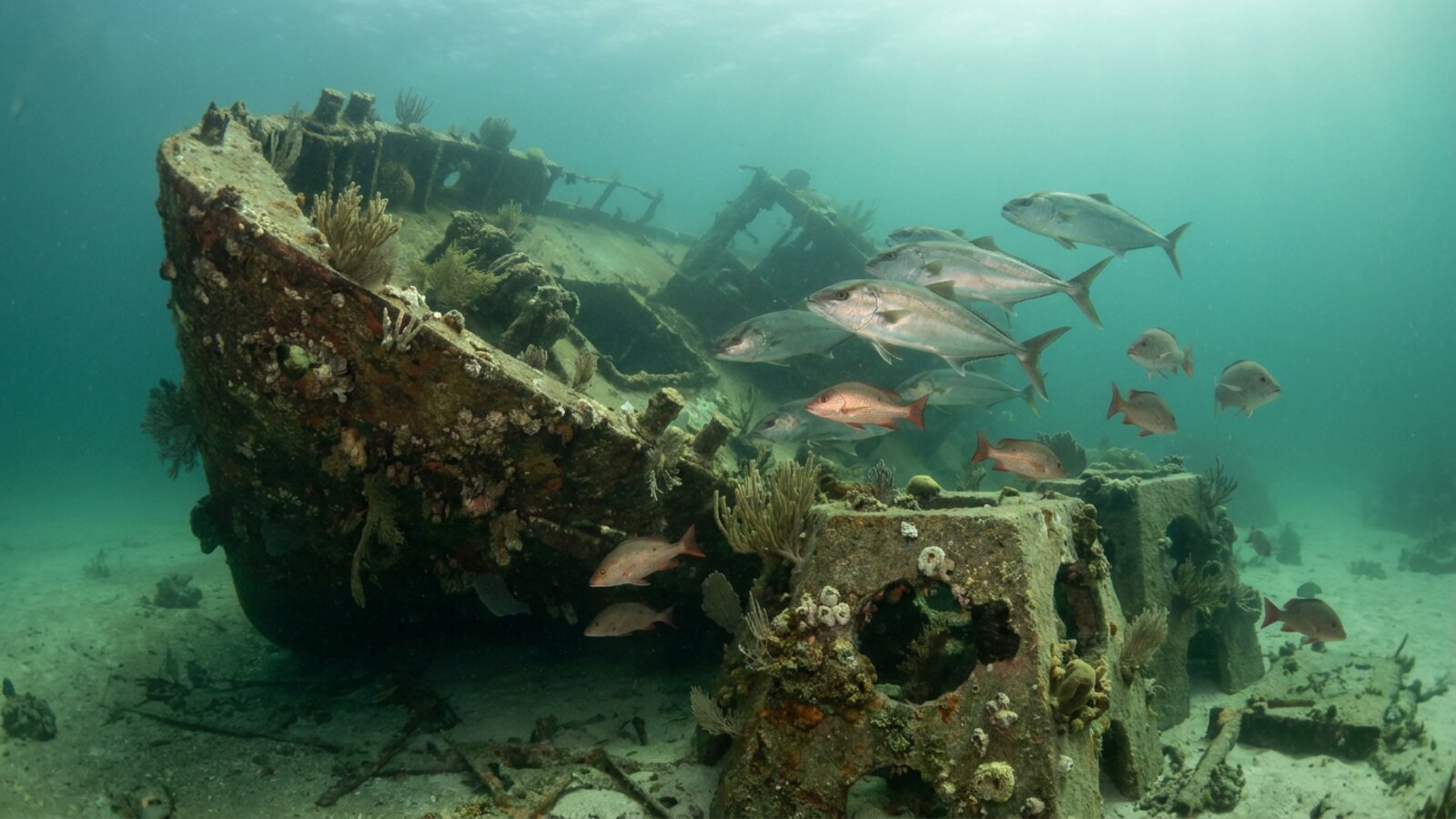
Over decades, local governments, fishing clubs and dive groups have sunk vessels and materials offshore to create habitat. The list includes former military vessels, tugs, freighters, barges, bridge spans and purpose-built concrete reef modules. Well-known dives include the USS Strength, a former Navy minesweeper, and the Black Bart, a sunken offshore supply vessel; many smaller wrecks and reef sites lie scattered across the shelf. Some structures are in water shallow enough for newer divers, while others are deeper and suited to advanced divers.
Once on the bottom, a wreck is colonised quickly. Barnacles, algae, hydroids and sponges cover the hull, followed by soft corals, sea whips and encrusting animals. Small fish shelter in the openings; larger predators — snapper, grouper, amberjack, barracuda, sometimes sharks — patrol the structure. Many divers find a fish-covered wreck in the Gulf as compelling as a coral reef, though the experience is very different: less colour and coral diversity, more structure, history and big fish.
| Feature | What it is | What lives there |
|---|---|---|
| Shipwrecks | Sunken vessels offshore, many deliberately placed | Grouper, snapper, amberjack, barracuda |
| Artificial reef modules | Concrete reef structures and rubble | Baitfish, snapper, sponges, soft corals |
| Bridge-span reefs | Old bridge material placed on the sea floor | Structure-loving fish, encrusting life |
| Limestone ledges | Natural hard-bottom offshore | Sponges, soft corals, reef fish |
| Jetties | Rock jetties at St Andrews pass | Sergeant majors, sheepshead, small reef fish |
| Sandy Gulf floor | Open sand and seagrass patches | Rays, flatfish, crabs, sand dollars |
Snorkelling and diving at Panama City Beach
Snorkellers stay close to shore at the jetties; divers head offshore by boat to the wrecks.
St Andrews State Park. The best-known snorkelling in the area is at St Andrews State Park, at the eastern end of Panama City Beach. Its rock jetties and the sheltered pool behind them attract a mix of fish, from sergeant majors and sheepshead to small groupers and occasional rays. Conditions depend on tide and wind: water is usually clearest on an incoming tide and calm day, and currents in the pass itself can be strong, so stay in the protected areas.
Shell Island. Across the pass lies Shell Island, an undeveloped barrier island reached by shuttle or boat. Its shallow, clear water over sand and seagrass is popular with snorkellers and families looking for rays, crabs and small fish, and dolphins are often seen on the way out.
Offshore wrecks. Scuba divers reach the wrecks and artificial reefs by charter boat from local marinas. Many sites lie within a relatively short run of shore. Visibility in the Gulf varies widely with season, wind and runoff, and summer usually brings the calmest conditions. Fishing is popular on the same structures, so divers should follow charter briefings and stay aware of lines and hooks.
Safety first. The Gulf can look calm from the beach while rip currents run along the sand bars, especially after storms. Check the beach warning flags before swimming, never snorkel alone, and stay well away from boat channels in the pass. Jellyfish are common at certain times of year, so a thin rash guard is useful as well as sun protection. If you plan to dive offshore, choose a charter that briefs on currents, depth and ascent procedures, because some of the larger wrecks lie at depths that call for advanced training.
For other snorkel options in the state, see our best snorkeling in Florida guide.
Marine life off Panama City Beach
The northern Gulf may lack reefs, but it is rich in fish, turtles and dolphins.
Bottlenose dolphins are common in St Andrew Bay and along the beaches, and dolphin-watching cruises are a staple of local tourism. Sea turtles — mainly loggerheads, with green turtles and occasionally Kemp’s ridleys — feed in nearshore waters and some nest on Panhandle beaches in summer. Rays glide over the sand, and seasonal migrations of fish such as cobia and king mackerel draw anglers each spring.
On the wrecks and ledges, the community resembles a scaled-down reef: snapper, grouper, triggerfish, spadefish and angelfish shelter among the structure, while jacks and barracuda hunt around it. Invasive lionfish have also colonised many Gulf artificial reefs, and spearfishing tournaments are used to reduce their numbers. Read more about dolphins in the Gulf of Mexico and sea turtles.
Where to find real coral reefs in Florida
To see living coral reefs, head south: Florida’s reef tract runs along the Keys and the south-east coast.
The Florida Reef Tract is the only extensive living coral barrier reef in the continental United States. It arcs from the Dry Tortugas, west of Key West, along the ocean side of the Florida Keys and up the south-east coast toward Palm Beach County. Here, warm water carried by currents from the Caribbean and the Gulf Stream keeps temperatures high enough year-round for reef-building corals.
The easiest places to see it are John Pennekamp Coral Reef State Park and the other reefs off Key Largo, the reefs around Key West, and Dry Tortugas National Park. From Panama City Beach that is a long drive or a short flight south — but well worth it if your goal is coral rather than wrecks.
Protecting the Gulf environment
The wrecks and fish of Panama City Beach depend on a healthy Gulf.
The waters here face pressures from coastal development, polluted runoff, harmful algal blooms such as red tide, oil and gas activity in the wider Gulf, and powerful storms — Hurricane Michael in 2018 caused severe damage along this part of the Panhandle. Heavy fishing pressure on popular artificial reefs can also deplete groupers and snappers, which is why size limits, seasons and bag limits are enforced.
Because there are no tropical coral reefs here, the coral bleaching crisis does not play out on this sea floor directly. But warming seas are changing the whole Gulf, shifting fish ranges and intensifying storms. Divers and snorkellers can help by following fishing rules, using mooring lines rather than anchoring on structure, removing lionfish where permitted, and taking all rubbish home. The wider story of reef and ocean health is told across our coral reef conservation pages.
Related on TheSea
- Panama Coral Reef Maps
- Brazil Coral Reef Maps
- Columbia Coral Reef Maps
- Ecuador Coral Reef Maps
- Nicaragua Coral Reef Maps
- Venezuela Coral Reef Maps
- Costa Rica Coral Reef Maps
- Honduras Coral Reef Maps
- Mexico Coral Reef Maps
- Belize Coral Reef Maps
- Key West Coral Reef Maps
- Tropical Americas Coral Reef Maps
Are there coral reefs in Panama City Beach?
No natural tropical coral reefs. The northern Gulf is too cool in winter and too sandy for reef-building corals. The area is instead known for shipwrecks and artificial reefs that support sponges, soft corals and abundant fish.
Where can you snorkel in Panama City Beach?
The jetties and sheltered pool at St Andrews State Park are the most popular spot, and Shell Island across the pass has clear, shallow water over sand. Check tides and currents before entering the water.
Why is Panama City Beach called the Wreck Capital of the South?
Because so many ships, barges, bridge spans and reef structures have been sunk offshore as artificial reefs, giving divers a large choice of wreck dives within reach of shore.
What is the closest coral reef to Panama City Beach?
The nearest shallow, visitable coral reefs are in the Florida Keys, along the Florida Reef Tract. Deeper coral areas such as the Florida Middle Grounds and the Flower Garden Banks exist in the Gulf but are far offshore.
Is the water clear in Panama City Beach?
It can be very clear on calm summer days, giving the famous emerald colour, but visibility changes with wind, waves, tides and runoff, and is usually lower than in the Florida Keys.
Can you see sea turtles at Panama City Beach?
Yes. Loggerheads and other sea turtles feed in nearshore Gulf waters and some nest on Panhandle beaches in summer. Give them space and follow local lighting and nesting rules.
Blane Perun has been exploring Earth’s oceans and marine life for over 25 years. Founder of TheSea.Org in 1999, underwater photographer, coral aquaculture pioneer, and explorer of 80+ countries.
About Blane Perun → More Coral Reef Maps →