Sea Lice in Florida — What Causes Seabather’s Eruption, When It Peaks and How to Treat It
“Sea lice” in Florida are the larvae of tiny jellyfish, not lice. The rash they cause, seabather’s eruption, appears under swimsuits and hair, usually 4 to 24 hours after swimming, as itchy red bumps. The main culprit is the larva of the thimble jellyfish, Linuche unguiculata. Outbreaks are most common on Florida’s southeast coast, especially Palm Beach and northern Broward counties, from March to August. Take your swimsuit off before you shower, wash it with detergent and dry it with heat; antihistamines and hydrocortisone cream help the itch. See a doctor for severe reactions, fever in children or signs of infection.
Get out of the wet swimsuit first, then shower; treat the itch with an antihistamine and hydrocortisone cream; and call a doctor if a child develops a fever or the reaction is severe.
What are sea lice in Florida?
The name is misleading twice over. True sea lice are small crustacean parasites that live on fish, and they do not bite people. What Floridians call “sea lice” is a skin rash, known medically as seabather’s eruption, caused by the microscopic larvae of tiny jellyfish and, less often, sea anemones. The Florida Department of Health (DOH) is direct about it: the rash is caused by tiny jellyfish larvae trapped under bathing suits, not by lice.
The main culprit in Florida and the Caribbean is the thimble jellyfish, Linuche unguiculata. The adult is a small jellyfish with a straight-sided, flat-topped bell, up to about 16 millimetres across and 20 millimetres tall, coloured orange-brown by symbiotic algae living in its tissues. Thimble jellyfish live in the warm western Atlantic, particularly around the West Indies and the Bahamas, and they form swarms near the surface of warm seas; aggregations covering about a million square metres have been reported. Their larvae, far too small to see, drift in the water in clouds.
A related problem farther north has a different cause. On the east coast of North America outside Florida, a similar rash follows exposure to the larvae of the sea anemone Edwardsiella lineata. And in the Indo-Pacific, the related Linuche aquila is known to cause the same condition.
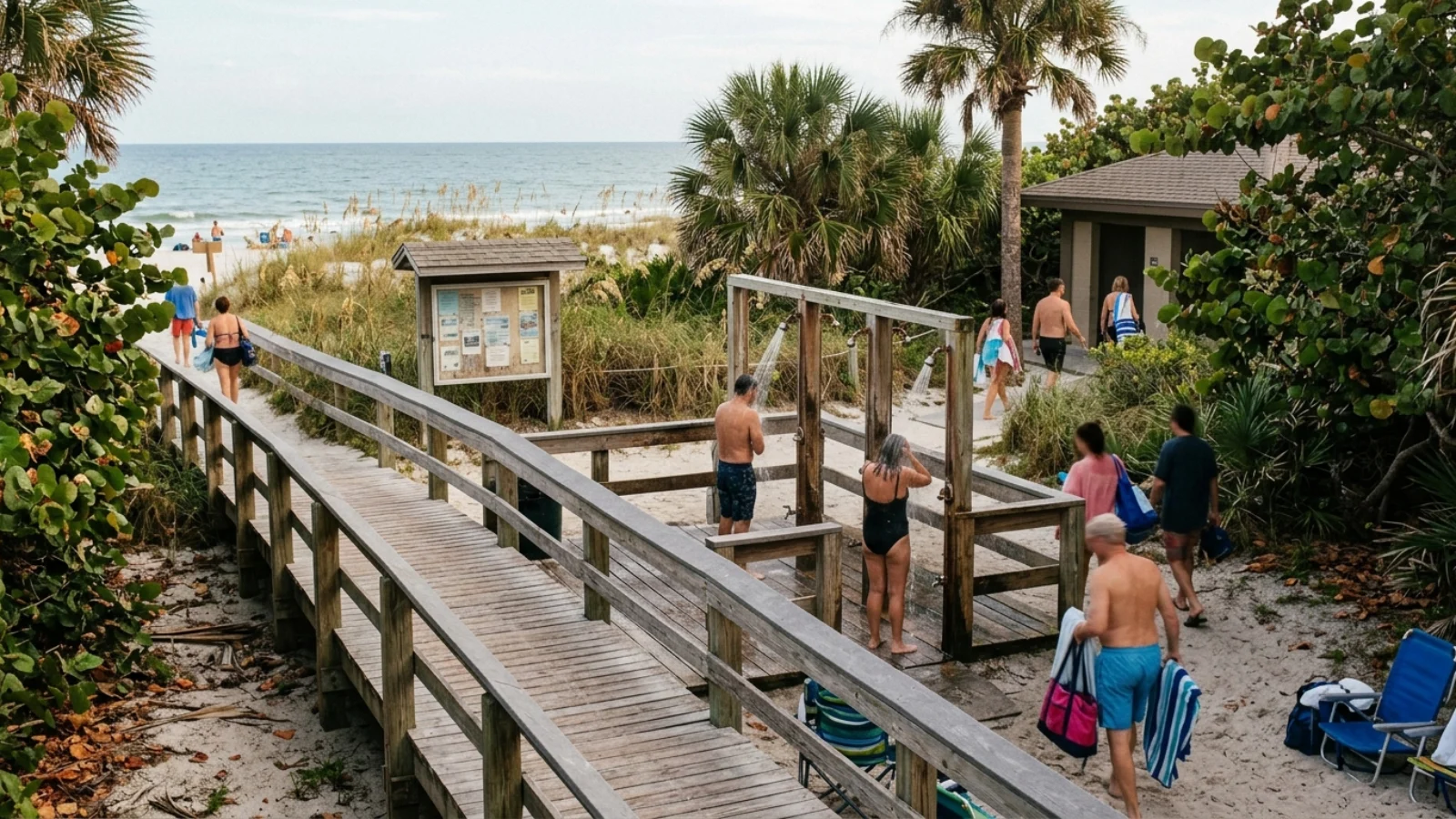
How the rash happens
Each larva carries a stinging cell, or nematocyst, the same kind of microscopic harpoon that adult jellyfish use. While the larvae drift freely in sea water, the cells are not triggered. The trouble starts when larvae become trapped. Because they are tiny and sticky, large numbers can be caught in the narrow gaps between skin and swimwear, or in long hair. When the swimmer leaves the water, the trapped larvae are squeezed, dried out or exposed to fresh water, and they fire their stinging cells into the skin.
That explains the rash’s odd pattern. It appears mostly in areas covered by a swimsuit, a T-shirt or a wetsuit, and on the neck where wet hair rests against the skin. Pressure makes it worse: the DOH notes that pressure on the skin from exercise, surfboards or lying on the beach can release the stinging cells. The DOH’s Miami-Dade office, citing the work of Russell and Tomchik, reports that 200 or more stings can be found under one person’s swimsuit.
It also explains why a freshwater shower in a swimsuit is a bad idea. Fresh water can trigger the remaining stinging cells, so showering with the suit still on can add more stings. The DOH advice is to take the suit off first.
Where and when sea lice occur in Florida
Seabather’s eruption is mainly a problem on Florida’s southeast coast. The DOH in Palm Beach County describes it as documented along about 250 miles of Florida’s southern Atlantic coast since the 1900s. The condition disappeared for about 20 years, returned in the mid-1980s and has become more severe since; shifts in ocean currents are believed to play a part. Incidence is highest in Palm Beach and northern Broward counties, where the Gulf Stream passes closest to shore.
The season runs from March through August. The DOH’s Miami-Dade guidance, based on 1992 data, puts the peak from early April through early July. That fits the biology described in reference works on the thimble jellyfish, which state that in Florida most cases occur between March and August.
On the Gulf coast, sea lice are much less common. When reports came from Walton County in the Panhandle in 2016, a University of Florida IFAS extension agent described the condition as a newcomer to the northern Gulf and noted, citing Florida Sea Grant, that seabather’s eruption had mainly been a problem in South Florida and the Caribbean, with reports from the northern Gulf uncommon. Swimmers on Southwest Florida’s Gulf beaches are far more likely to meet ordinary jellyfish than sea lice, but outbreaks can occur wherever thimble jellyfish larvae drift inshore.
How common is seabather’s eruption?
The best figures come from studies in the early 1990s summarised by the DOH. In 1992, an estimated 10,000 cases occurred, which the authors described as a conservative estimate because many people treat themselves and never see a doctor. In a survey of 1,433 swimmers, about 1 in 4 developed the rash. The true numbers in any given year are unknown, and they vary with the size of the larval swarms and the currents that bring them inshore.
Symptoms: what sea lice look like
The rash usually appears 4 to 24 hours after ocean exposure, according to the DOH, although some people feel a prickling sensation while still in the water. It is intensely itchy. It takes the form of small red bumps, which reference works describe as papules about 1 millimetre to 1.5 centimetres across, sometimes with blisters, and people who have been stung before may develop hive-like welts. The rash is concentrated under the swimsuit and in other covered areas.
The DOH says the itching usually lasts 2 to 4 days, and sometimes up to two weeks; its Miami-Dade guidance says the rash usually resolves in about a week but can recur for several weeks. Some people have more general symptoms. The DOH lists headache, fever, nausea and blisters among more severe reactions, and its review of 1992 cases also recorded trouble sleeping, vomiting, diarrhoea, chills, muscle spasms, joint pain and malaise.
Children deserve close watching. Among 57 emergency department cases in the 1992 data, 8 people had a fever above 101 degrees Fahrenheit, and all 8 were children aged 11 or younger; the highest was 103.4 degrees. The DOH notes that children may develop a high fever.
Seabather’s eruption is not contagious. Several people in the same household often have it at once because they swam together, not because they caught it from each other. It should also not be confused with swimmer’s itch, which is a different condition.
Why outbreaks come and go
Sea lice seasons vary from year to year because they depend on the thimble jellyfish, an animal of the open ocean whose numbers and position change with conditions offshore. The adult swims constantly by pulsing its bell, rotating as it moves, and feeds on plankton drawn past its tentacles; it is eaten in turn by fish, sea turtles and other predators. Reference works note that its presence in any particular place depends on food, temperature, salinity and the oxygen content of the water, and that although it is a surface swarmer it has been recorded at depths of around 5,000 metres.
Thimble jellyfish have separate sexes and release fertilised eggs into the sea, which develop into the drifting larvae that cause the rash. A University of Florida extension article notes that the larvae are more common near the surface, which is why swimmers and snorkelers are affected more than divers deeper down. The DOH adds an important detail: the adults themselves do not cause the rash, and the larvae can keep causing outbreaks after the adult swarm has died off. A beach can therefore have a sea lice outbreak with no adult jellyfish in sight.
Currents decide which beaches are hit. The DOH links the high incidence in Palm Beach and northern Broward counties to the Gulf Stream, which runs closest to the coast there, and believes shifts in ocean currents were behind the return of seabather’s eruption to South Florida in the mid-1980s after about 20 years of absence. When onshore winds and currents carry a cloud of larvae toward the beach, many swimmers are affected on the same days; a few miles away, or a few days later, the water may be clear. Lifeguard postings and local beach reports are the best guide to whether larvae are present on a given day, which is why the DOH puts checking them first in its prevention advice.
Surfers, snorkelers and swimmers with long hair
Some beach activities raise the risk. Anything that traps water against the skin traps larvae too, so T-shirts, rash guards and wetsuits worn in the sea can hold large numbers, which is why the DOH suggests sunscreen instead of a T-shirt for sun protection in the water. Pressure helps fire the stinging cells: the DOH specifically mentions surfboards, exercise and lying on the beach. A surfer lying on a board in a rash guard during an outbreak is about as exposed as anyone can be.
Long hair is another trap. The DOH notes that lesions on the neck can come from hair dangling in the water and resting against the skin, so tying long hair up or wearing a swim cap makes sense during an outbreak. Snorkelers, who spend long periods at the surface where the larvae concentrate, are also commonly affected. If you notice a prickling sensation in the water, the DOH’s advice is the same as for everyone: get out, get the swimsuit off as soon as you can, then shower and wash the suit.
How to prevent sea lice
The DOH’s prevention advice centres on the swimsuit:
- Check local beach reports and lifeguard postings, and avoid swimming during outbreaks, especially if you have reacted before
- Wear sunscreen rather than a T-shirt in the water; loose fabric traps more larvae
- Consider smooth, tightly woven swimwear, and two-piece suits, which leave less fabric against the skin
- Get out of the wet swimsuit as soon as possible after swimming, then shower, rather than showering with the suit on
- Wash swimsuits with detergent and dry them with heat; the DOH says air-drying does not stop the stinging cells from firing
- People with a history of severe reactions should stay out of the sea during outbreaks or use a pool
The point of removing the suit before showering is to separate the larvae from your skin before fresh water triggers them. Stinging cells can stay in a swimsuit after it dries, so a suit that has not been washed and heat-dried can sting you again the next day.
Treatment
For most people, seabather’s eruption is a nuisance rather than a danger, and treatment is aimed at the itch. The DOH recommends an oral antihistamine to relieve itching and an over-the-counter cortisone cream. Its two county guides differ slightly on strength: the Miami-Dade guidance suggests 0.5 percent hydrocortisone cream, and the Palm Beach brochure suggests 1 percent cortisone cream or a sting-relief product. Both strengths are sold over the counter; follow the label.
The Miami-Dade guidance adds comfort measures such as colloidal oatmeal baths and calamine lotion, which it suggests for children, but warns against combining diphenhydramine-containing creams or lotions with an oral antihistamine because of the risk of toxicity. Keep children’s fingernails short to limit scratching, and keep the skin clean, especially in the groin area, to prevent a secondary bacterial infection.
Advice from other sources varies. A University of Florida extension article suggested that diluted vinegar or rubbing alcohol applied after removing the suit may help neutralise toxin left on the skin, while also noting that vinegar, like fresh water, can fire stinging cells that are still loaded. The same article lists other suggested remedies, including sodium bicarbonate, sugar, urine, olive oil and meat tenderiser, and warns that some of them may increase the release of toxin and aggravate the rash.
When to see a doctor
The DOH’s clinical guidance is that any rash deserves a thorough evaluation to rule out other causes, and that people should seek care for severe, widespread or recurrent reactions. It recommends a dermatologist for pus-filled lesions that are not healing, which may mean a secondary infection, and close watching of children for fever. The key clue for a doctor is the timing: an itchy rash under the swimsuit within about 24 hours of swimming in the sea, often in several members of the same family. Mention where and when you swam.
Sea lice and jellyfish on Florida beaches
Sea lice belong to the larger family of cnidarian stings that Florida beachgoers deal with, alongside jellyfish and the Portuguese man o’ war. The difference is scale and timing. A jellyfish sting is immediate and painful, from an animal you might have seen; sea lice are invisible, painless at first, and announce themselves hours later. For stings from adult jellyfish, see jellyfish sting treatment and what a jellyfish sting looks like. On beaches with lifeguards, the purple flag warns of dangerous marine life; see Florida beach warning flags.
What are sea lice in Florida?
Not lice: the rash, seabather’s eruption, comes from tiny larvae of thimble jellyfish trapped under swimsuits.
When is sea lice season in Florida?
March to August, peaking from early April to early July, mainly on the southeast coast.
Where are sea lice worst in Florida?
Palm Beach and northern Broward counties, where the Gulf Stream passes closest to shore.
How long does a sea lice rash last?
Usually a few days to about a week; it can last up to two weeks.
How do you treat sea lice?
An oral antihistamine and over-the-counter hydrocortisone cream; see a doctor for severe reactions.
Should you shower after sea lice?
Yes, but take your swimsuit off first; fresh water on trapped larvae can trigger more stings.
Are sea lice contagious?
No. People with the rash cannot pass it on.
- Florida Department of Health in Palm Beach County, “Sea Lice” information brochure (2017).
- Florida Department of Health, Miami-Dade County, “Seabather’s Eruption or ‘Sea Lice’: New findings and clinical implications” (Russell, M. and Tomchik, R., based on 1992 data).
- University of Florida IFAS Extension, Franklin County, “They Call it ‘Sea Lice'” (11 June 2016).
- Wikipedia contributors, “Seabather’s eruption” and “Linuche unguiculata” (2023 snapshot via Kiwix mirror, accessed November 2026).
Blane Perun has been exploring Earth’s oceans and marine life for over 25 years. Founder of TheSea.Org in 1999, underwater photographer, coral aquaculture pioneer, and explorer of 80+ countries.
About Blane Perun →