Black Sand Beaches — How Volcanoes Make Them, and the Best 10
A black sand beach is made of dark grains instead of the usual pale ones, and there are two main kinds. Volcanic black sand is mostly basalt: when lava flows into the sea it cools so fast that it shatters into glassy fragments, and a large flow can build a new beach almost overnight. Heavy-mineral black sand, sometimes called ironsand, is rich in magnetite and other dense minerals that waves sort from lighter grains. Volcanic black sand beaches are often short-lived because nothing replaces the sand once storms carry it away, which is one reason Hawaii prohibits taking black sand from its beaches. Black sand also gets hot enough in the sun to burn bare feet.
A volcanic black sand beach is a snapshot of a single eruption. Its grains record how lava met the sea, and its short life shows how fast a coast without a steady sand supply can change.
Most beaches are built over thousands of years from grains delivered a few at a time. Some black sand beaches on Hawaii Island were built in days, by lava that exploded into fragments as it reached the surf.
Black sand beaches — at a glance
- Volcanic type: Basalt fragments from lava quenched by seawater
- Mineral type: Magnetite-rich ironsand and placer sands
- Formation speed: A large lava flow can build a beach almost overnight
- Lifespan: Often short; sand is not replenished after the eruption ends
- Hawaii rule: Removing black sand from beaches is illegal
- Hazard: Dark sand absorbs sunlight and can burn bare feet
- Iceland: Reynisfjara: six fatal accidents this century (to 2025)
What is a black sand beach?
A black sand beach is simply a beach whose grains are black or very dark grey. The colour is not a stain or a coating: it is the colour of the minerals themselves. Two very different processes produce it, and most black sand beaches belong clearly to one or the other.
The first, and the one most people picture, is volcanic. On volcanic coasts the sand is made of tiny fragments of basalt, the dark, iron- and magnesium-rich lava rock that builds Hawaii, Iceland and many other ocean islands. The second is mineral sorting. Black sand can form where dense, dark minerals such as magnetite are concentrated by waves or rivers, leaving a heavy, glossy, partly magnetic layer. Miners and prospectors call these deposits placers, and they treat black sand as a sign that gold or other heavy minerals may be nearby.
Even ordinary golden or white beaches often hold some black sand. After storms, larger waves can sort the grains and leave dark streaks of heavy minerals exposed on the face of a freshly cut beach. Black sand is therefore not rare in itself; what is rare is a whole beach built of it.
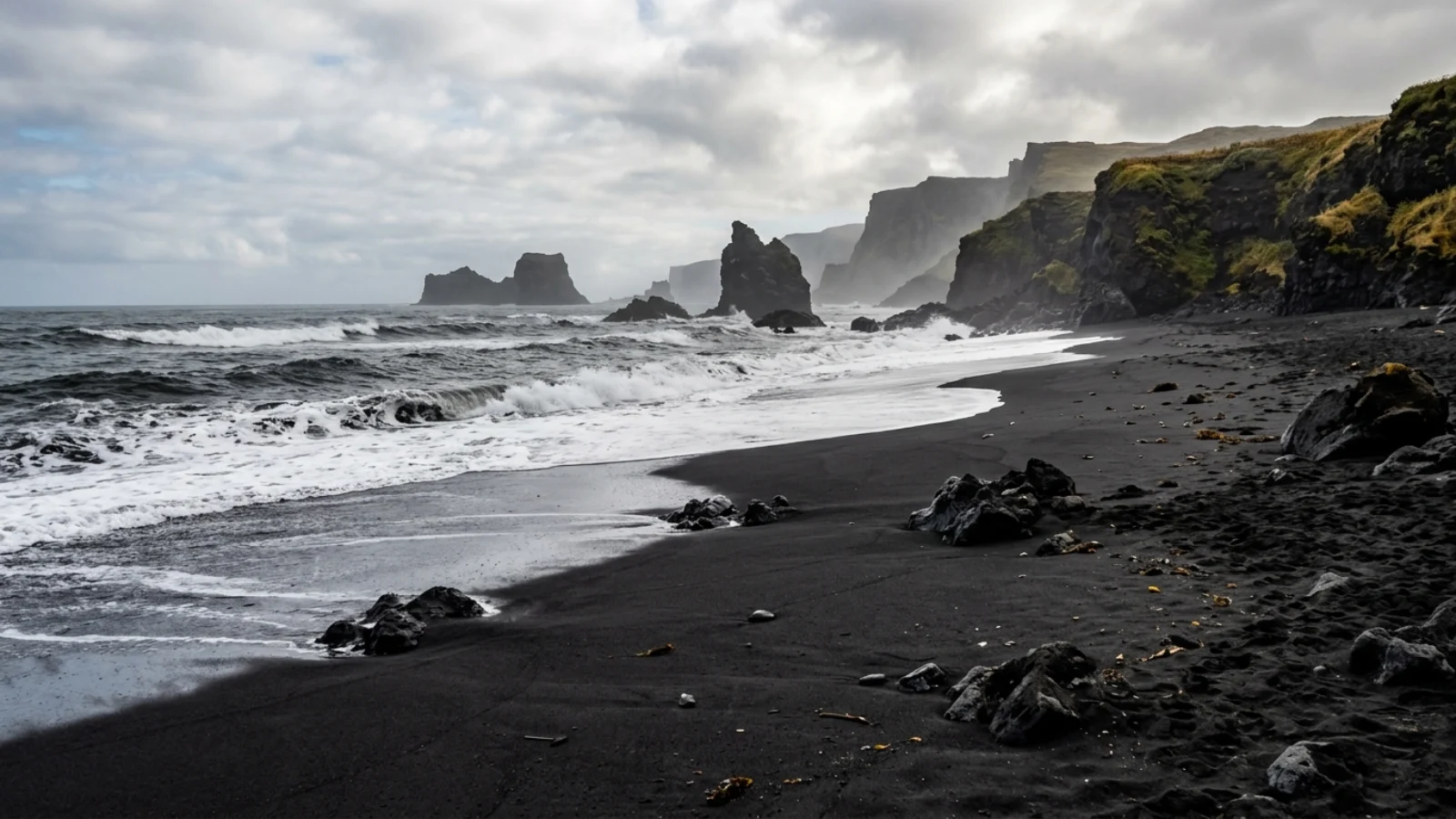
How lava makes black sand
When lava reaches the sea, the contact between molten rock and cold seawater is violent. The surface of the lava cools so rapidly that it cannot crystallise slowly into solid rock. Instead it shatters into glassy fragments of many sizes, from boulders and gravel down to sand. Steam explosions at the ocean entry throw the debris about and break it further, and the surf then rounds and sorts what remains. Much of the result is fine enough to count as sand.
The speed of this process is the striking thing. A large lava flow entering the ocean can produce enough basalt fragments to build a new black sand beach almost overnight. Hawaii’s best-known black sand beaches, including Punalu’u and Kehena on Hawaii Island, were created more or less instantaneously by the interaction between hot lava and seawater. Kehena Beach in the Puna district formed in a 1955 lava flow, and a point of rocks at one end still marks where that flow stopped.
The most recent demonstration came in 2018. During the lower Puna eruption of Kilauea, lava flows covered about 35 square kilometres of land by early August and created about 875 acres of new land in the ocean. At Isaac Hale Beach Park on Pohoiki Bay the lava stopped a few hundred feet short of the boat ramp, but the eruption delivered so much sediment that the ramp was partly buried under a new black sand beach, which also impounded a geothermal pool now reached from the park.
Why black sand beaches can vanish
Many beaches are fed continuously, by a reef offshore, by rivers or by eroding cliffs. A volcanic black sand beach usually has no such supply. It was made by one lava flow in a one-time event, and once the eruption ends no new sand arrives. If currents or storms carry the sand into deeper water, it is not replaced, so many of these beaches are short-lived on any timescale.
Lava can also take away what lava made. Kaimu Beach on Hawaii Island, famous for its black sand and the coconut palms that shaded it, lay on Kaimu Bay in the Puna district. Eruptions from the Kupaianaha vent of Kilauea began to affect the area in 1983, and by 1990 lava had completely covered the town of Kaimu and its beach. The old bay now lies under some 15 metres of rock. A new black sand beach has since formed on Kaimu Bay from the 1990 flows, and locals and visitors have been planting sprouted coconuts there to replace the lost trees. Kamoamoa, another black sand beach on the same coast, was even shorter-lived.
Why you should never take black sand home
Because volcanic black sand is finite, Hawaii has made it illegal to remove black sand from its beaches. The rule protects the beaches themselves and the animals that use them, and it is worth extending as a personal rule anywhere. A bottle of sand seems trivial, but on a beach with no new supply every bottle is a permanent loss. On beaches with nesting turtles or basking animals, the sand is also habitat.
Black sand gets hot
Black sand absorbs much more sunlight than pale sand. Unlike walking on white or green sand, walking barefoot on black sand on a sunny day can cause burns. Ironsand is similar: in New Zealand, the magnetite-rich sand of popular west-coast surf beaches such as Piha can heat up enough in direct sunlight to cause minor burns. Wear sandals, and take particular care with children and dogs.
Heavy-mineral black sand and ironsand
Not every black beach is volcanic in the simple sense. Ironsand is sand with heavy concentrations of iron, typically dark grey or blackish, composed mainly of magnetite with small amounts of titanium, silica, manganese, calcium and vanadium. On New Zealand’s west coast, Piha’s black sand gets its high iron content from minerals that originated in Mount Taranaki and earlier volcanoes in the region, so the ultimate source is still volcanic, but the sand has been transported and sorted rather than quenched at an ocean entry.
Placer black sands can be economically valuable. Concentrates from placer mining are mostly black sand, and they often contain rare earth elements, thorium, titanium, tungsten, zirconium and gem minerals such as garnet as well as precious metals. Ironsand has also been smelted for iron for centuries. In Japan, where iron ore deposits were scarce, iron-making based on ironsand, called satetsu, developed from around the 8th century and supplied, among other things, the steel for traditional swords. In New Zealand, an ironsands mining operation at Taharoa on the North Island’s west coast was officially opened on 24 November 1973.
Some black sand beaches have nothing to do with recent volcanoes at all. Wikipedia’s survey of black sand beaches gives Langkawi in Malaysia as an example of a non-volcanic black sand beach, and Praia de Teixidelo near Cedeira in Galicia, Spain, as another.
The best black sand beaches in the world
The ten beaches below were chosen to show the range of the phenomenon: new and old, volcanic and mineral, tropical and subarctic. Rules and conditions change, so check local park information before visiting.
1. Punalu’u Beach, Hawaii Island. Between Pahala and Na’alehu on the island’s southeast coast, Punalu’u is often called simply Black Sand Beach. Its sand is basalt created by lava that exploded on reaching the ocean. Endangered hawksbill and threatened green sea turtles feed in the bay, where red seaweed grows on the rocks, and green turtles often bask on the black sand; visitors must stay at least 20 feet (6 metres) from them. Cold fresh water from springs seeps into the bay, and the Hawaiian name is usually explained as “spring diver”, after a tradition that people dived with jugs to collect fresh water from the seabed in times of drought. The swimming area is rocky and can be dangerous. Three pre-contact heiau, or temple sites, stand near the beach, and anchialine pools, brackish ponds connected to the sea through underground cracks, support native shrimp and the rare orange-black damselfly. Fewer than 80 hawksbills are estimated to nest in all the Hawaiian islands, most of them on Hawaii Island.
2. Kehena Beach, Hawaii Island. A narrow black sand beach on the island’s east shore in Puna, formed by a 1955 lava flow. Spinner dolphins often use the water offshore, and the beach is also known as Dolphin Beach.
3. Pohoiki, Isaac Hale Beach Park, Hawaii Island. The newest beach on this list, formed by sediment from the 2018 lower Puna eruption. It is a rare chance to see a beach that is only a few years old, still being shaped by the surf.
4. Wai’anapanapa State Park, Maui. Wai’anapanapa is the Maui example in Wikipedia’s black sand list, which names both the Wai’anapanapa and Honokalani black sand beaches inside the state park. Maui is built around the Haleakala volcano, and its black sand is volcanic like Hawaii Island’s.
5. Reynisfjara, Iceland. Near the village of Vik i Myrdal on Iceland’s south coast, Reynisfjara is framed by the basalt sea stacks of Reynisdrangar and by columns of basalt at the foot of the mountain Reynisfjall. The beach was ranked in 1991 as one of the ten most beautiful non-tropical beaches in the world. Legend says the stacks are trolls who were dragging a three-masted ship to land when daylight turned them to stone. Reynisfjara is also dangerous, as the next section explains. Vik lies just south of the Myrdalsjokull glacier, which covers the Katla volcano; Katla has not erupted since 1918, longer than its typical dormant period.
6. Stokksnes, Iceland. A headland on the southeast coast near Hofn that includes the mountain Vestrahorn, Stokksnes is listed among Iceland’s black sand beaches together with Vik and the Reykjanes peninsula.
7. Piha, New Zealand. One of the best-known black sand beaches in the Southern Hemisphere, on Auckland’s west coast. Its black ironsand is rich in iron from Mount Taranaki and older volcanoes, and it gets hot enough to burn. Piha is a surf beach exposed to the Tasman Sea, and the surf there demands respect.
8. Perissa and Perivolos, Santorini, Greece. Santorini is a volcanic caldera island, the site of the Late Bronze Age Minoan eruption, and Perivolos beach on the south coast appears on Wikipedia’s list of black sand beaches. See our guide to Santorini for the island’s volcanic history.
9. Playa Jardin, Tenerife, Canary Islands. Tenerife is a volcanic island, and several of its beaches are black, including Playa Jardin and Playa El Bollullo near Puerto de la Cruz and Playa Las Gaviotas near Santa Cruz, all listed in Wikipedia’s survey.
10. Mosteiros, Sao Miguel, Azores. The Azores are volcanic islands in the middle of the North Atlantic, and the beach at Mosteiros on Sao Miguel, facing a group of offshore islets, is one of the archipelago’s listed black sand beaches, together with Sao Roque on the same island.
Reynisfjara and the danger of sneaker waves
Reynisfjara’s beauty hides one of the most dangerous stretches of tourist coast in Europe. Large waves can arrive without warning and run far up the steep beach, and strong rip currents can form near the basalt columns during high wave activity. A spokesperson quoted by Iceland Monitor in August 2025 said there had been six fatal accidents at the beach this century, four of them drownings. The cases listed were an American woman in her eighties pulled into the sea by surf in 2007; a Chinese man in his forties who fell on rocks in the surf zone in 2016; an American woman who fell on rocks near the walking path in 2018; a Chinese woman in her thirties struck by waves near the basalt columns in 2021; a Canadian man struck by waves near the columns in 2022; and a nine-year-old German girl swept into the sea in 2025. The last three fatal accidents all happened near the basalt columns.
Warning lights at the beach are linked to the Icelandic Road and Coastal Administration’s wave forecast: green means low danger, yellow moderate and red high. The 2025 accident happened while a yellow light was flashing. The practical rules are simple. Never turn your back on the sea, stay well up the beach even on apparently calm days, keep children within reach, and follow closures when the light is red.
Wildlife on black sand
Black sand beaches are habitat as well as scenery. At Punalu’u, green turtles haul out on the sand, and researchers with the US National Marine Fisheries Service have studied the green turtles along that coast since 1982. A rare Hawaiian monk seal sighting was reported near the boat ramp in September 2006, and humpback whales and spinner dolphins pass offshore. Native coastal plants such as naupaka kahakai, the beach morning glory pohuehue and the shrub ilima grow on the sand and lava behind the beach. On new beaches like Pohoiki, the first plants and animals to arrive offer ecologists a chance to watch a coastline being colonised from scratch. For the other two colours of rare sand, see green sand beaches and pink sand beaches; for the volcanoes behind them, see underwater volcanoes.
- Newest: Pohoiki, Hawaii (2018 eruption)
- Lost to lava: Kaimu, Hawaii (buried by 1990)
- Turtles: Punalu’u, Hawaii Island
- Most dangerous: Reynisfjara, Iceland (sneaker waves)
What causes black sand beaches?
Most are basalt fragments formed when lava hits the sea and shatters; others are heavy-mineral sands rich in magnetite, concentrated by waves.
Where is the most famous black sand beach?
Punalu’u on Hawaii Island and Reynisfjara in Iceland are the best known.
Can you take black sand from Hawaii?
No. Removing black sand from Hawaii’s beaches is illegal.
Is black sand hot?
Yes. It absorbs sunlight and can burn bare feet on sunny days.
Why do black sand beaches disappear?
They are usually made by a single lava flow, so once storms carry the sand away, nothing replaces it.
Is Reynisfjara dangerous?
Yes. Sudden large waves and rip currents have caused several drownings; follow the warning lights and stay well back from the water.
Is black sand magnetic?
Sand rich in magnetite, such as ironsand, is partly magnetic; basalt sand generally much less so.
- Wikipedia contributors, “Black sand”, “Ironsand”, “Punalu’u Beach”, “Kehena Beach”, “Kaimu, Hawaii”, “Isaac Hale Beach Park”, “2018 lower Puna eruption”, “Piha”, “Reynisdrangar”, “Vik i Myrdal”, “Stokksnes”, “Taharoa” (2023 snapshot via Kiwix mirror, accessed November 2026).
- Iceland Monitor (mbl.is), “The light was yellow: last three accidents in the same spot” (August 2025).
Blane Perun has been exploring Earth’s oceans and marine life for over 25 years. Founder of TheSea.Org in 1999, underwater photographer, coral aquaculture pioneer, and explorer of 80+ countries.
About Blane Perun →