Sea Caves — How Waves Carve Them, and the Greatest on Earth
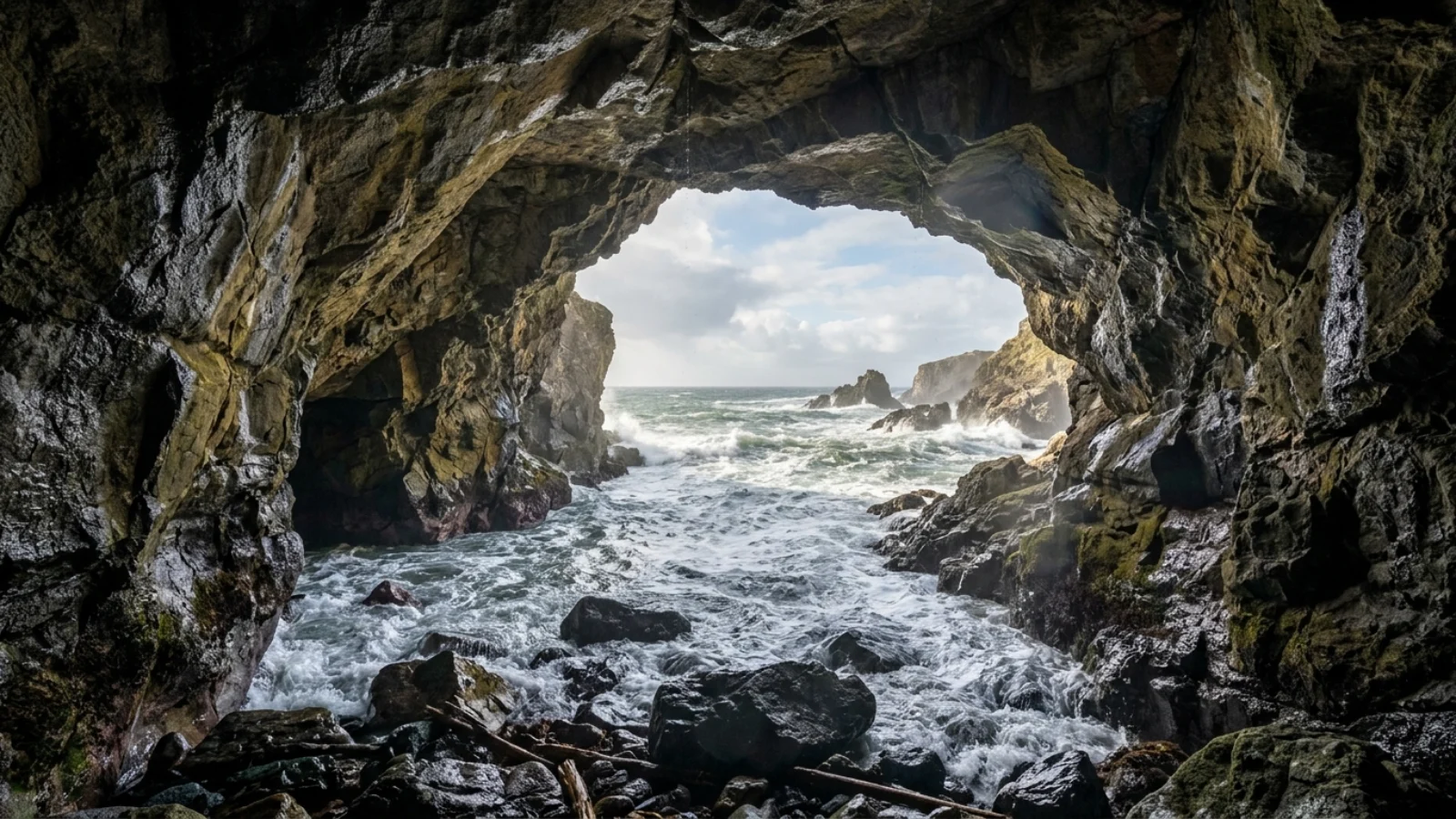
A sea cave, or littoral cave, is a cave formed mainly by the wave action of the sea. Waves attack a zone of weakness in a cliff, such as a fault, a dike or a boundary between hard and soft rock, and the confined force of the water, the air it compresses and the sand and stones it carries enlarge the crack into a cave. Most sea caves are small: a 2014 compilation of surveys found only two longer than 1,000 metres and 108 longer than 100 metres. The longest known is Matainaka Cave in New Zealand, about 1.5 km of passage; the largest by volume is Rikoriko Cave in the Poor Knights Islands, at 221,494 cubic metres. When caves break through headlands or collapse, they leave blowholes, arches and sea stacks.
A true sea cave is cut by waves. Some coastal caves were dissolved in limestone and only later reached by the sea, as in Phang Nga Bay; these are called hybrid caves.
A sea cave is a wave’s way of finding a flaw. Every cliff has one somewhere, a crack, a fault, a soft band of rock, and the sea will work at it twice a day for centuries until the flaw becomes a room.
Sea caves — at a glance
- Also called: Littoral caves
- Made by: Wave action exploiting faults, dikes and weak layers
- Longest: Matainaka Cave, Otago, New Zealand: about 1.5 km
- Largest volume: Rikoriko Cave, Poor Knights Islands: 221,494 m³
- Oldest dated: Halvikshulen, Norway: formed over at least a million years
- Most famous: Fingal’s Cave, Scotland; Blue Grotto, Capri
- Life cycle: Cave → blowhole or arch → stack → stump
What is a sea cave?
A sea cave, also known as a littoral cave, is a type of cave formed primarily by the wave action of the sea, and the main process involved is erosion. Sea caves are found throughout the world. Some are actively forming along today’s coastlines, while others are relict caves on former coastlines that now stand above or below present sea level. Some of the largest wave-cut caves in the world are on the coast of Norway, but they are now 100 feet or more above the sea, lifted out of the waves’ reach. They still count as littoral caves, because waves made them.
Sea caves should not be confused with inland caves that happen to have been cut open when a sea cliff retreated, or with dissolution caves formed in limestone near the shore on tropical islands. In places such as Phang Nga Bay in Thailand and Ha Long Bay in Vietnam, caves that were originally dissolved out of limestone have been flooded by the rising sea and are now being enlarged by waves, a new phase in their history. These are called hybrid caves. The distinction matters because the two kinds grow in different ways and in different rocks.
How waves carve a sea cave
To form a sea cave, the host rock must first contain a weak zone. In igneous or metamorphic rock this is typically a fault, as in the caves of California’s Channel Islands, or a dike, a sheet of intruded rock, as in the large sea caves of Kauai’s Na Pali Coast in Hawaii. In sedimentary rock it may be a parting along a bedding plane or a contact between layers of different hardness. The same can happen in volcanic rock: on Santa Cruz Island in California, waves have attacked the contact between andesitic basalt and a weaker agglomerate.
The driving force is wave action. Erosion goes on wherever waves batter a rocky coast, but where a cliff contains a zone of weakness, rock is removed along it faster than elsewhere. As the sea reaches into the fissure, several forces work together. There is the direct hydraulic impact of the surf. There is abrasion, as sand and stones carried by the water grind against the walls. And there is compressed air: a wave entering a confined space traps and squeezes the air inside, and when the wave retreats the air expands violently, prising rock apart. Most sea-cave walls are irregular and chunky, reflecting an erosional process in which the rock is fractured piece by piece.
Other agents help. Rainwater carrying carbonic and organic acids from the soil can weaken rock within fissures, and small speleothems, the mineral formations familiar from limestone caves, can grow in sea caves too. Even animals take part. Sea urchins drill their way into the rock, and over successive generations they can remove considerable bedrock from the floors and lower walls of a cave.
Why some sea caves grow huge
Most sea caves are small compared with limestone caves. A compilation of sea-cave surveys as of July 2014 listed two caves over 1,000 metres long, six over 400 metres, nine over 300 metres, 25 over 200 metres and 108 over 100 metres. Many large caves almost certainly remain unsurveyed because they are remote or face dangerous seas.
Several factors decide how big a cave can grow. One is its orientation: on Santa Cruz Island the largest caves face into the prevailing northwest swell, which also makes them harder to survey, while caves in sheltered bays tend to be smaller. Another is the host rock. Most of the large sea caves of the western United States and Hawaii are in basalt, a strong rock in which a cave can penetrate far into a cliff while the surrounding surface erodes slowly. In weaker rock, the cliff face retreats almost as fast as the cave grows. Yet the longest sea cave known formed in heavily fractured sandstone, which overturned the idea that only strong rock can host large sea caves.
Time is the third factor. Over the Pleistocene, repeated ice ages moved sea level up and down over a vertical range of some 200 metres. Significant sea caves formed in the California Channel Islands are now completely submerged by the rise in sea level over the last 12,000 years. Where land rises steadily, continued wave erosion can produce caves of great height: Painted Cave on Santa Cruz Island is almost 40 metres high at its entrance. On the Norwegian coast, huge sea caves have been lifted 30 metres or more above sea level, and sediment dating in the largest of them, Halvikshulen in Osen, 340 metres long, shows that it formed over at least a million years.
Complexity grows with size. Most sea caves are a single passage or chamber. Caves formed along faults tend to have straight, canyon-like passages; in Seal Canyon Cave on Santa Cruz Island, light from the entrance is still visible from the back of the cave, 189 metres in. Caves formed along horizontal bedding planes are wider with lower ceilings. Where faults intersect, caves become labyrinths: in Catacombs Cave on Anacapa Island at least six faults meet, and in several Channel Islands caves long fissure passages open into large chambers wherever a second, roughly perpendicular fault crosses the first.
The record holders
Matainaka Cave, New Zealand. Until 2013 the largest known sea caves were on the west coast of the United States, in the Hawaiian islands and in Shetland. That year the survey of Matainaka Cave, on the Otago coast of New Zealand’s South Island, was announced, and it proved to be the world’s most extensive sea cave at about 1.5 kilometres of passage. It formed in heavily fractured Caversham sandstone and has 12 separate entrances into which waves can penetrate, with numerous joints along which intersecting passages have developed. Also in 2013, a newly surveyed complex at Bethells Beach on the North Island was reported to reach just over a kilometre.
Rikoriko Cave, Poor Knights Islands, New Zealand. The largest sea cave in the world by volume lies in the Poor Knights Islands, a nature reserve and marine reserve about 22 kilometres off the east coast of Northland. Rikoriko’s cavern measures 221,494 cubic metres. It is about 130 by 80 metres, with a ceiling 35 metres high, extends 26 metres below the water, and has an entrance large enough for small tour boats to enter. The islands also have spectacular arches, including Cathedral Arch on Archway Island, about 40 metres tall.
Halvikshulen, Norway. At 340 metres, this cave in Osen is now lifted above the waves. Sediment dating shows it took at least a million years to form, which makes it a rare clock for how slowly waves can work.
Fogla Skerry, Shetland. An exceptionally large cave lies under Fogla Skerry, an islet off Papa Stour. It has not been surveyed, but estimates place it at almost 500 metres of passage.
Famous sea caves to visit
Fingal’s Cave, Scotland. On the uninhabited island of Staffa in the Inner Hebrides, Fingal’s Cave is a spacious cave some 70 metres long, formed entirely in hexagonally jointed basalt columns within a Paleocene lava flow, like the Giant’s Causeway in Northern Ireland. The columns formed as the lava cooled and contracted, cracking first into blocky shapes and then into regular hexagons that grew inward from the cooling surfaces; the waves have since cut a cross-section through them. The naturalist Sir Joseph Banks brought the cave to the attention of the English-speaking world in 1772. Its name comes from the hero of James Macpherson’s Ossian poems, and its natural acoustics inspired Felix Mendelssohn, who visited in 1829, to write his overture The Hebrides, also known as the Fingal’s Cave Overture. Jules Verne used it in The Green Ray. Today the National Trust for Scotland owns it as part of a national nature reserve.
Blue Grotto, Capri, Italy. The Grotta Azzurra is famous for the luminous blue light that fills it. Sources give its size differently, as extending about 50 metres into the cliff or as 60 metres long and 25 metres wide. Its entrance is only about two metres wide and roughly a metre high at low tide, so visitors lie flat in a small four-person rowboat while the oarsman pulls it through using a chain fixed to the wall, and entry is only safe when the tide is low and the sea calm. The light comes mainly from a larger opening below the waterline. As sunlight passes through the water, red light is filtered out and only blue light enters the cave, and objects placed in the water look silver because tiny bubbles on their surface refract light differently. The Romans built a stairway at the back of the cave and a now-collapsed tunnel to the surface. Swimming in the grotto is forbidden.
Sea Lion Caves, Oregon. North of Florence on the Oregon coast, Sea Lion Caves is a connected system of caves open to the Pacific. The main cavern has a floor of about 2 acres and a vaulted dome about 125 feet (38 metres) high, and a low passage runs about 1,000 feet south to another opening, flooded at high tide. The caves and the rocks just outside are the only known mainland rookery and wintering haul-out of the Steller sea lion, used to a lesser extent by California sea lions, and the high vault is a resting place for pigeon guillemots, Brandt’s cormorants, gulls and tufted puffins. A local seaman, Captain William Cox, is credited with discovering the caves in 1880 by rowing in through the western channel on a calm day.
Phang Nga Bay, Thailand. The limestone islands of Phang Nga Bay are riddled with caves and collapsed cave systems. Around 10,000 years ago, when sea level was lower, it was possible to walk between Phuket and Krabi. These hybrid caves, dissolved in limestone and now attacked by waves, are a reminder that not every coastal cave began as a sea cave.
Blowholes, arches and the end of a cave
A sea cave is not a final form. When a cave grows landward and upward into a vertical shaft that breaks the surface, it becomes a blowhole, or marine geyser. Waves surging into the cave compress the water and air inside and release them through the opening above, often with a loud noise and a wide spray. The height of the spray depends on the geometry of the cave and shaft, the tide and the swell. Blowholes are most common where faults intersect and on windward coasts that receive high wave energy from the open ocean, and some, such as Kiama Blowhole in New South Wales, are major tourist attractions.
Cave chambers can also collapse, leaving a littoral sinkhole; Oregon’s Devil’s Punchbowl and the Queen’s Bath on Kauai’s Na Pali coast are examples. Small peninsulas and headlands often have caves cut right through them, because they are attacked from both sides, producing natural arches. And when a cave tunnel through a headland collapses, it can leave a free-standing sea stack offshore. California’s Anacapa Island is thought to have been split into three islets by exactly this process. The next stage of the story is told in our guide to sea stacks.
Exploring sea caves safely
Sea caves are among the most hazardous places on any coast. Swell can surge into a cave far higher than it looks from outside, compressed air and spray can disorient anyone inside, and entrances that are open at low tide may close at high tide. The Blue Grotto shows how carefully even a famous, commercially operated cave must be managed: entry depends on the tide and sea state, swimming is banned, and in 2011 a visitor suffered a broken neck while entering on a day when, it was later concluded, conditions were unsuitable. Visit with experienced local operators, check tides and swell, and never enter a cave on a rising tide or in a swell. For other places where the sea has carved the coast, see the Cliffs of Moher; for a cave of a very different kind, the drowned limestone shafts called blue holes.
- Longest: Matainaka, New Zealand: about 1.5 km
- Biggest room: Rikoriko, Poor Knights: 221,494 m³
- Most musical: Fingal’s Cave, Staffa
- Brightest blue: Blue Grotto, Capri
How are sea caves formed?
Waves exploit a weak zone in a cliff, such as a fault, dike or soft layer, enlarging it by hydraulic force, compressed air and abrasion by sand and stones.
What is the largest sea cave in the world?
Matainaka Cave in New Zealand is the longest, at about 1.5 km; Rikoriko Cave in the Poor Knights Islands is the largest by volume.
What is the difference between a sea cave and a blowhole?
A blowhole is a sea cave that has grown a vertical shaft to the surface, through which waves force spray.
Why is the Blue Grotto blue?
Sunlight enters through an underwater opening; the water filters out red light, so only blue light fills the cave.
Where is Fingal’s Cave?
On the island of Staffa in the Inner Hebrides of Scotland.
Are sea caves dangerous?
Yes. Swell, rising tides and compressed air make them hazardous; enter only in calm conditions with local knowledge.
Can a sea cave become a sea stack?
Yes. Caves can cut through headlands to form arches, and when an arch or tunnel collapses it can leave a stack.
- Wikipedia contributors, “Sea cave” (citing Bunnell and Kovarik 2013 and the 2014 survey compilation), “Fingal’s Cave”, “Blue Grotto (Capri)”, “Poor Knights Islands”, “Sea Lion Caves”, “Blowhole (geology)”, “Phang Nga Bay” (2023 snapshot via Kiwix mirror, accessed November 2026).
Blane Perun has been exploring Earth’s oceans and marine life for over 25 years. Founder of TheSea.Org in 1999, underwater photographer, coral aquaculture pioneer, and explorer of 80+ countries.
About Blane Perun →