Pink Sand Beaches — Foraminifera, Reefs and Where to Find Them
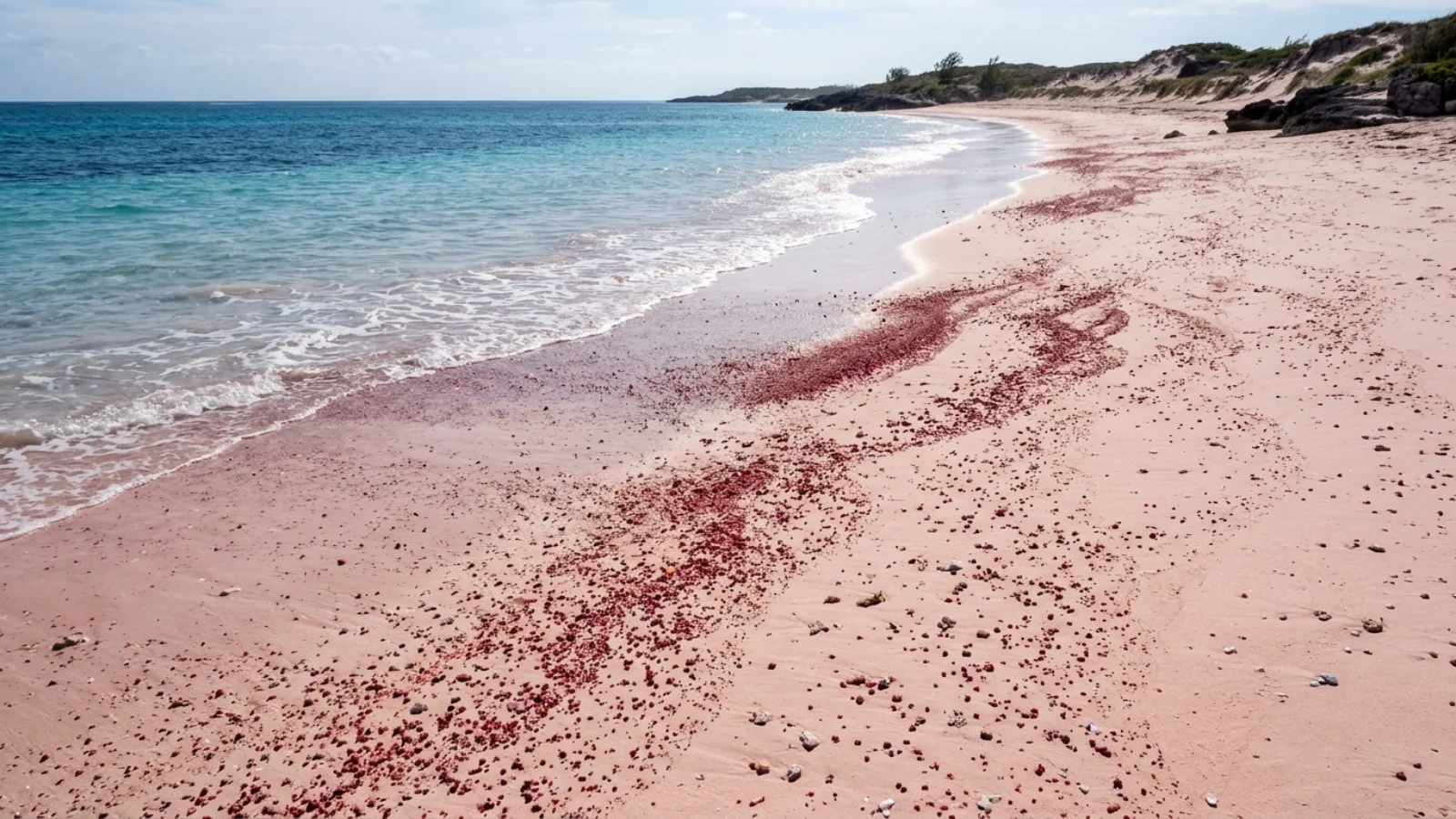
Pink sand is biological. On the famous pink beaches of Bermuda and Harbour Island in the Bahamas, the colour comes from Homotrema rubrum, a bright red foraminifer, a single-celled organism with a calcium carbonate shell that grows on the undersides of coral ledges and on reef rubble. When it dies, waves break its shell into sand-sized pieces and wash them ashore, where they mix with the white crushed skeletons of other reef organisms to give a pink tint. Other pink beaches have other ingredients: fragments of red organ pipe coral at Komodo’s Pink Beach, and bryozoans and a different foraminifer at Budelli in Sardinia. Because the colour depends on living reefs, pink beaches last only as long as their reefs stay healthy.
The red grains on a pink beach are a sediment tracer. Geologists use them to work out where reef sand travels, and even to detect storm surges that carried reef sand inland.
Look closely at a handful of Bermuda’s beach sand and the pink resolves into individual grains: most white, a scattering of bright red. Each red grain is a fragment of a shell built by a single cell on the reef just offshore.
Pink sand beaches — at a glance
- Main colour source: Homotrema rubrum, a red encrusting foraminifer
- Where it lives: Undersides of coral ledges and reef rubble
- Famous pink beaches: Bermuda; Harbour Island, Bahamas
- Komodo: Foraminifera plus organ pipe coral fragments
- Budelli, Sardinia: Bryozoan and foram fragments; beach closed to walking
- Elafonisi, Crete: Pigmented micro-organisms with seaweed
- Rule: Never take pink sand; it depends on living reefs
What makes sand pink?
Ordinary sand colours come from rock: quartz is pale, basalt black, olivine green. Pink sand is different, because its colour is made by living organisms. On reef coasts, much of the beach is built from the broken skeletons of marine life, corals, shells, sea urchins and calcareous algae, which are mostly white or cream. Pink appears when one of the contributors has a strongly red skeleton and is common enough for its fragments to tint the whole beach.
In the Atlantic and Caribbean, the main contributor is a foraminifer. Foraminifera, or forams, are single-celled organisms, amoeboid protists that typically build an external shell called a test. Many tests are made of calcium carbonate, the same material found in corals, lobster shells and mussel shells. The Bermuda Institute of Ocean Sciences notes that more than 4,000 foram species live in the world’s oceans and that most average less than a millimetre across; Wikipedia gives a wider estimate of 6,700 to 10,000 living species among more than 50,000 known when fossils are included. Most live on the seabed, and only a few dozen species drift in the plankton.
How a single cell builds a shell
Forams are among the most remarkable single-celled organisms in the sea. The French naturalist Alcide d’Orbigny, writing in 1826, thought they were tiny cephalopods, mistaking their streaming cytoplasm for tentacles, and named the group foraminiferes, “hole-bearers”, after the holes in the divisions between the chambers of their shells. Their tests may consist of one chamber or many, and depending on the species they are built of protein, sediment particles glued together, calcite, aragonite or, in one case, silica. Unusually, a foram’s test lies inside the cell membrane rather than outside the animal, as a mollusc’s shell does.
A living foram reaches out through openings and pores in its test with a net of fine pseudopodia, threads of cytoplasm in which tiny granules stream in both directions. Foraminifera are unique in having this granular, branching kind of pseudopod, and they can extend and retract it quickly by assembling and dismantling the microtubules that support it. With it they catch food, from organic particles and diatoms to, in some species, small animals such as copepods.
Many forams also farm. A number of species, both bottom-living and planktonic, carry single-celled algae inside their cells as endosymbionts, drawn from green algae, red algae, golden algae, diatoms and dinoflagellates, and these mixotrophic forams are especially common in nutrient-poor tropical waters, the same clear waters where reefs grow. That fits the suggestion that symbiotic algae lie behind the red colour of the pink-sand foram. Most forams reproduce through an alternation of generations, switching between a sexual and an asexual form.
Homotrema rubrum: the pink-sand foraminifer
Homotrema rubrum is a colonial foraminifer first described by the French naturalist Jean-Baptiste Lamarck. It is a strong red in colour and grows encrusted on hard surfaces in tropical reefs, on coral rubble on the reef crest, and, as the Bermuda Institute of Ocean Sciences describes it, on the undersides of coral ledges. Scientists believe that symbiotic algae living within the forams contribute to their red colour, and a 1986 paper in the journal PALAIOS used chemical and isotopic analyses to identify a symbiosis in the species.
When the foraminifer dies, its test is no longer protected by living tissue. Waves and surge break it into sand-sized pieces, and tides and currents carry these ashore, where they mix with the white crushed skeletons of other marine organisms. The beach is pink because a minority of bright red grains is spread through a majority of white ones. The proportion varies from beach to beach and with how far the grains have travelled, which is exactly what makes them useful to scientists.
Red grains as sediment tracers
Because Homotrema lives in a particular part of the reef and its fragments are so easy to spot, geologists use it to follow sand as it moves. A 1965 study in the Journal of Sedimentary Research by Mackenzie and colleagues called it an excellent indicator of the direction of transport of sand-sized carbonate sediment on the Bermuda Platform. The foraminifer lives mainly on the outer shoals around the platform, and its distribution showed that sand from those shoals is dispersed for long distances down the Bermuda slope but is not carried very far into Bermuda’s lagoons.
The condition of the grains tells a story too. A 2002 study of reef sediments in northeastern Brazil, by Machado and Moraes, compared two settings. At Praia do Forte, where wind-driven waves break on a narrow shelf, 82.41 percent of the Homotrema fragments were still reddish and 63.88 percent had sharp points, because the waves were fragmenting living tests and depositing them near their source. At Sioba and Rio do Fogo, on a broad shelf swept by strong currents, 51.59 percent of the fragments were polished with rounded edges and some had faded to white, a sign of long reworking. Researchers have since used the same kind of evidence elsewhere: a 2011 study by Pilarczyk and Reinhardt used Homotrema taphonomy as an indicator of storm overwash in marine ponds on Anegada in the British Virgin Islands, and a 2016 study examined its distribution, abundance and calcification on Tennessee Reef in the Florida Keys. In other words, the pink grains that delight beachgoers also record hurricanes.
Bermuda’s pink beaches
Bermuda is the classic pink-sand destination. Its pink sand beaches and clear water are among its main attractions, and many of its hotels lie along the south shore, where beaches such as Astwood Park show the colour well. Bermuda’s geology helps explain the sand. The islands sit on an old volcanic seamount capped by limestone, and much of the land above sea level consists of eolianite, wind-blown carbonate sand that was cemented into rock during past interglacial periods. Bermuda is in fact the type locality for these eolianites. The beaches are therefore part of a very long cycle in which reef organisms make sand, waves and wind move it, and time turns it into rock.
The pink component is fragile. The Bermuda Institute of Ocean Sciences article stresses that the colour comes from red foraminifera growing on the reefs, and a beach can only stay pink as long as those reefs keep producing them.
Harbour Island, Bahamas
Harbour Island in the Bahamas is famous for its pink sand beaches, which run along the whole east side of the island. As in Bermuda, the hue comes from a foraminifer with a reddish-pink shell. The island’s tourism has a long history: in the mid-1960s the American actor Brett King and his wife Sharon established the Coral Sands Hotel there. For the reefs that feed the beaches, see our guide to the Bahamas coral reef.
Pink Beach, Komodo, Indonesia
On the southeast side of Komodo Island, within Komodo National Park, a UNESCO World Heritage Site, lies Pink Beach, or Pantai Merah. An August 2026 explainer by Good News From Indonesia attributes its colour to two sources. Foraminifera, with Homotrema rubrum the type most commonly cited, live attached to reef surfaces near the shore. Organ pipe coral, Tubipora musica, adds fragments of its dark red skeleton when waves break it down. Organ pipe coral is unusual: it is an octocoral, a soft coral, native to the Indian Ocean and the central and western Pacific, yet it builds a hard calcium carbonate skeleton of many organ-pipe-like tubes, and it is the only species in its genus. The red fragments mix with white sand from broken coral and clam shells.
Pink Beach is reached by boat from Labuan Bajo, a trip of about two to three hours depending on weather and vessel. Visitors are asked not to take sand or coral fragments home, and the same article makes the point that damaged reefs would mean less red material and a paler beach.
Spiaggia Rosa, Budelli, Sardinia
The Spiaggia Rosa, or Pink Beach, on the southeastern shore of Budelli in the Maddalena archipelago off northern Sardinia, shows that pink sand is not only a tropical phenomenon. Its colour comes from microscopic fragments of corals and shells, including the bryozoan Myriapora truncata and the foraminifer Miniacina miniacea. The beach became famous after it appeared in Michelangelo Antonioni’s 1964 film Red Desert.
Budelli is a small island, about 1.6 square kilometres in area with a coastline of 12.3 kilometres, rising to 87 metres at Monte Budello. It lies several hundred metres south of the islands of Razzoli and Santa Maria and is one of the seven islands that make up the Arcipelago di La Maddalena National Park. The Romans used it in antiquity, and for decades in the modern era it passed between private owners.
Budelli is also the clearest example of what happens when a pink beach becomes too popular. Under rules imposed from the 1990s by La Maddalena National Park, tourists have not been allowed to walk on the pink beach or swim there, although day trips by boat and a path behind the beach have been permitted. The island itself has had an eventful recent history. A planned 2013 sale to a New Zealand businessman for 2.94 million euros was contested by the government, and after a three-year court battle a Sardinian judge returned the island to the state, with the park planning to use it for environmental education. Its caretaker, Mauro Morandi, lived on Budelli as its sole occupant from 1989 until his eviction in April 2021.
Elafonisi, Crete
Elafonisi, “deer island”, lies close to the southwestern corner of Crete and can be reached on foot through shallow water in fine weather. It is known for its pink sand, created by tidal and wave deposits of pigmented micro-organisms that live in a symbiotic relationship with the native seaweed. The island is a protected nature reserve. Its history is darker than its sand: a plaque at the highest point commemorates the killing of several hundred Greeks, mostly women and children, by Ottoman soldiers on Easter Sunday, 18 April 1824, and a wooden cross marks the graves of 38 people who died in a lifeboat when the steamer Imperatrix was wrecked there on 22 February 1907. The wreck of the Austrian Lloyd steamer still lies on the seabed off the island’s cliffs, and it was the reason a lighthouse was later built nearby. Elafonisi covers about 1.5 square kilometres and belongs administratively to the municipality of Kissamos in the regional unit of Chania.
Forams and the rocks of the ancient world
Foraminifera have been noticed for a very long time. The earliest known reference comes from Herodotus, who in the 5th century BCE noted them in the rock of the Great Pyramid of Giza; they are now recognised as the large fossil foram Nummulites. Antonie van Leeuwenhoek described and illustrated foraminiferal tests in 1700, calling them minute cockles. The same organisms that colour a modern Bahamian beach have been building limestone for hundreds of millions of years, and a pink beach is a small, living demonstration of how biological sand becomes rock.
Visiting pink beaches responsibly
The rules are simple and they matter more here than almost anywhere. Do not take sand: at Komodo visitors are asked to leave sand and coral fragments, and at Budelli the beach was closed to walking altogether. Do not stand on or touch reefs while snorkelling, because the reef is the factory that makes the colour. For other unusual sands, see black sand beaches and green sand beaches, and for a beach made entirely of shells, Playa Conchal in Costa Rica.
- Organism: Homotrema rubrum (foraminifer)
- Best known: Bermuda; Harbour Island, Bahamas
- Coral-coloured: Pink Beach, Komodo (organ pipe coral)
- Closed to walking: Spiaggia Rosa, Budelli
Why is the sand pink in Bermuda?
Fragments of the red foraminifer Homotrema rubrum, which grows on reefs, are mixed with white reef sand.
What is a foraminifera?
A single-celled organism, an amoeboid protist, that usually builds a tiny shell called a test, often of calcium carbonate; most species live on the seabed.
Where are the best pink sand beaches?
Bermuda, Harbour Island in the Bahamas, Pink Beach on Komodo, Elafonisi in Crete and Budelli in Sardinia.
Can you take pink sand home?
No. The colour depends on living reefs; parks such as Komodo ask visitors to leave sand and coral fragments.
Can you walk on Budelli’s Pink Beach?
No. Since the 1990s the national park has not allowed visitors on the beach, though boat trips and a path behind it are permitted.
Is pink sand made of coral?
Partly at some beaches, such as Komodo, where organ pipe coral adds red fragments; in Bermuda the red comes mainly from foraminifera.
- Bermuda Institute of Ocean Sciences, “Our unique pink sand” (27 April 2012).
- Mackenzie et al., “Homotrema rubrum (Lamarck), a sediment transport indicator”, Journal of Sedimentary Research (1965); Machado and Moraes, Anais da Academia Brasileira de Ciencias 74 (2002); Pilarczyk and Reinhardt, Natural Hazards (2011); Phalen et al., Journal of Foraminiferal Research 46 (2016) (Crossref records).
- Good News From Indonesia, explainer on Pink Beach, Komodo (24 August 2026).
- Wikipedia contributors, “Homotrema rubrum”, “Foraminifera”, “Bermuda”, “Harbour Island, Bahamas”, “Budelli”, “Elafonisi”, “Tubipora musica” (2023 snapshot via Kiwix mirror, accessed November 2026).
Blane Perun has been exploring Earth’s oceans and marine life for over 25 years. Founder of TheSea.Org in 1999, underwater photographer, coral aquaculture pioneer, and explorer of 80+ countries.
About Blane Perun →