Sea Stacks — How Waves Turn Headlands Into Pillars
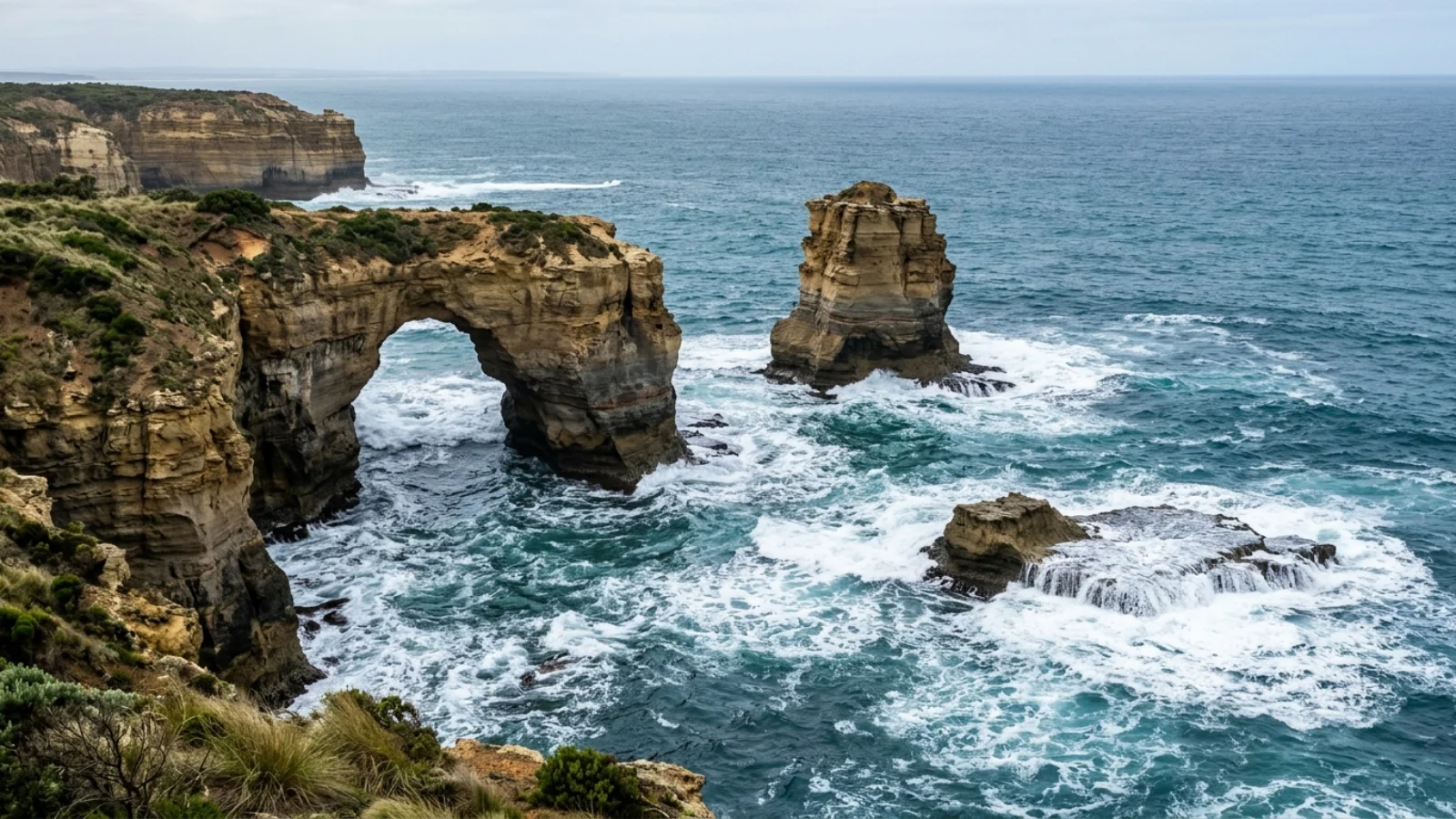
A sea stack is a steep, often vertical column of rock standing in the sea near a coast, formed by wave erosion. The sea attacks lines of weakness in a headland, such as joints and small faults; the cracks grow into caves; a cave that cuts right through the headland becomes an arch; and when the arch collapses, the seaward pillar is left standing alone. In time the stack itself falls to a stump that the tide covers. Stacks form best in horizontally bedded sedimentary or volcanic rock of medium hardness, such as limestone. The tallest is Ball’s Pyramid off Lord Howe Island, 572 metres high, the eroded plug of a volcano. Many stacks are young: the Old Man of Hoy is probably less than 250 years old.
An arch still connects to the land; a stack stands free; a stump is a stack worn down so low that high tide covers it. They are stages of one process.
Sea stacks look permanent, the kind of landmark that appears on postcards for generations. In fact they are among the most fleeting landforms on any coast, and several famous ones have changed shape within living memory.
Sea stacks — at a glance
- What: Free-standing rock pillar in the sea, cut from a headland
- Sequence: Crack → cave → arch → stack → stump
- Best rocks: Bedded limestone, sandstone, chalk and some volcanic rock
- Tallest: Ball’s Pyramid, Lord Howe group: 572 m
- Tall UK stack: Old Man of Hoy, Orkney: 137 m
- Recent loss: A Twelve Apostles stack, July 2005
- Arch collapses: London Bridge 1990; Azure Window 2017
What is a sea stack?
A stack, or sea stack, is a geological landform consisting of a steep and often vertical column or columns of rock in the sea near a coast, formed by wave erosion. Stacks are created over time by wind and water as part of the ordinary processes of coastal geomorphology. They form when part of a headland is eroded by hydraulic action, the force of the sea crashing against rock, which weakens cracks until sections collapse and leave free-standing pillars, sometimes large enough to be small islands. Stacks can also form without the sea’s direct help, when a natural arch collapses under gravity because of weathering from rain, frost and wind.
The term is also used loosely for steep-sided, rocky oceanic islets of volcanic origin, sometimes called volcanic stacks. These are not cut from a headland in the classic way but are the eroded remains of volcanoes, and the tallest stack in the world belongs to this group.
How a sea stack forms
The process usually begins when the sea attacks lines of weakness in a cliff face, such as steep joints or small fault zones. Waves force water and air into the cracks, and the compression and release of air, together with the impact of the water and the sand and stones it carries, enlarge them. The cracks gradually widen into caves, as described in our guide to sea caves.
Headlands are especially vulnerable because they are attacked from both sides. Where caves on opposite sides meet, or where one cave cuts right through, the result is an arch: a bridge of rock with the sea flowing beneath it. The arch is the stack’s immediate ancestor. As erosion continues, the opening widens, the roof thins, and eventually it falls. The pillar of harder rock left standing away from the coast is the stack. Over further centuries, waves undercut its base until it too collapses, leaving a stump, usually a small rock island low enough for high tide to submerge.
The Old Harry Rocks in Dorset show the whole sequence in one view. They are three chalk formations at Handfast Point on the Isle of Purbeck, including a stack and a stump, at the eastern end of the Jurassic Coast World Heritage Site. The chalk there was once part of a long ridge running to the Isle of Wight. As the ridge was broken, the remaining headland suffered hydraulic action along joints and bedding planes; first caves, then arches formed, and the arch tops collapsed after being weakened by rainfall. Old Harry’s original “wife” fell in 1509, and new stacks keep forming as narrow necks of chalk are breached.
Which rocks make good stacks?
Stacks typically form in horizontally bedded sedimentary or volcanic rocks, particularly limestone. Rocks of medium hardness resist abrasion well enough to stand as pillars but are weak enough along joints for the sea to cut them apart. A more resistant layer may form a capstone. Cliffs of weaker rock, such as claystone or highly jointed rock, tend to slump and erode too quickly to leave stacks standing, while very hard rocks such as granite erode in other ways.
The arrangement of the rock matters as much as its type. On discordant coastlines, where rock bands run at right angles to the coast, wave refraction concentrates energy on headlands, and arches form where caves break through them; when these arches fall, they leave stacks and stumps. On concordant coastlines, where bands run parallel to the shore, a resistant layer can protect softer rock behind it until the sea breaks through. Durdle Door on the Dorset coast is a limestone arch formed on such a concordant coast: a narrow band of resistant Portland limestone once ran along the shore, and nearly all of it has been removed by the sea except the small headland that holds the arch. A 120-metre isthmus ties that limestone to the chalk behind it, made of a 50-metre band of Portland limestone, a compressed band of Cretaceous Wealden clays and sands, and narrow bands of greensand and sandstone. Durdle Door is privately owned by the Weld family’s Lulworth Estate but open to the public, and UNESCO teams monitor the arch and its beach.
The tallest: Ball’s Pyramid
Ball’s Pyramid, an uninhabited islet in the Pacific Ocean southeast of Lord Howe Island, is the tallest sea stack in the world. It is 572 metres high, 1,100 metres long and only 300 metres across. Sources differ slightly on the distance from Lord Howe Island, giving 20 or 23 kilometres. It is not a piece of cut headland but the eroded plug of a shield volcano and caldera that formed about 6.4 million years ago. It is named after the Royal Navy lieutenant Henry Lidgbird Ball, who reported discovering it in 1788 on the same voyage on which he reported Lord Howe Island.
It is also a climbing landmark. A Sydney team, organised by the young adventurer Dick Smith, tried for the summit in 1964 but turned back on the fifth day when food and water ran short. The first ascent came on 14 February 1965, by Bryden Allen, John Davis, Jack Pettigrew and David Witham of the Sydney Rock Climbing Club. Climbing was banned in 1982 under amendments to the Lord Howe Island Act, all access was banned in 1986, and the policy was relaxed in 1990 to allow some climbing under strict conditions.
Ball’s Pyramid’s greatest fame, though, is biological. The Lord Howe Island stick insect, Dryococelus australis, once common on Lord Howe Island and used there as fishing bait, was believed extinct soon after the supply ship SS Makambo ran aground in 1918 and black rats got ashore; none were found after 1920. The 1964 climbers found and photographed a dead specimen on the pyramid. In 2001, the scientists David Priddel and Nicholas Carlile, with two assistants, landed to search. They found large insect droppings under a single Melaleuca shrub growing in a crevice about 100 metres above the shore and went on to find a population of just 24 insects living in an area of about 6 by 30 metres. In 2003 two breeding pairs were taken to the mainland, one to a private breeder and one to Melbourne Zoo, and by the beginning of 2016 Melbourne Zoo had hatched 13,000 eggs and sent eggs to zoos in Bristol, San Diego and Toronto. A 2017 DNA study confirmed that the Ball’s Pyramid insects belong to the same species as old museum specimens from Lord Howe Island. A single sea stack had kept an insect alive for more than eighty years after it vanished from its home island.
The Old Man of Hoy: a young stack
The Old Man of Hoy is a 449-foot (137-metre) sea stack on Hoy in Orkney, off the north coast of Scotland, and one of the tallest in the United Kingdom. It is made of Old Red Sandstone, layers of soft, sandy and pebbly sandstone and harder flagstones, perched on a plinth of basalt, and is separated from the mainland by a 60-metre chasm strewn with debris. The west coast of Hoy is a high-energy coast: winds exceed 8 metres per second for nearly a third of the time, gales blow on average 29 days a year, and the sea deepens quickly to 60 metres.
The stack is remarkably young. It is not mentioned in the Orkneyinga saga, written around 1230, and the Blaeu map of 1600 and McKenzie’s map of 1750 both show a headland where it now stands. By 1819 it had been separated from the mainland, and the artist William Daniell sketched it as a wider column with an arch at its base, the “legs” from which the Old Man got its name. Sometime in the early 19th century a storm washed away one leg, leaving the single pillar seen today. By 1992 a 40-metre crack had opened in the top of the south face, leaving a large overhang that will eventually fall. The stack is probably less than 250 years old and may be in danger of collapsing.
Climbers made the first ascent on 19 July 1966: Chris Bonington, Rusty Baillie and Tom Patey. On 8 and 9 July 1967 a climb was broadcast live by the BBC as The Great Climb, watched by around 15 million people. There are now seven routes, and as many as fifty ascents are made each year.
The Twelve Apostles that were never twelve
The Twelve Apostles are limestone stacks off Port Campbell National Park beside the Great Ocean Road in Victoria, Australia, on the traditional lands of the Eastern Maar peoples. They are cut from the Port Campbell Limestone, deposited in the middle to late Miocene, about 15 to 5 million years ago. The harsh weather of the Southern Ocean erodes the soft limestone into caves, then arches, and the arches collapse to leave stacks up to 50 metres high.
Their name is aspirational. The stacks were originally known as the Pinnacles and as the Sow and Pigs, and the name Twelve Apostles was made official even though the viewpoint never showed more than nine. In July 2005 a 50-metre stack collapsed, leaving eight. Because the cliffs keep eroding, existing headlands are expected to become new stacks in the future.
Nearby stands a lesson in how quickly change can come. London Arch, formerly London Bridge, was a double-span natural arch in the same national park. On 15 January 1990 the span nearest the shore collapsed without warning, stranding two tourists on the outer span until a police helicopter rescued them. No one was hurt.
The Needles, the Azure Window and James Bond Island
The Needles, Isle of Wight. A row of three chalk stacks rising about 30 metres out of the sea off the western tip of the Isle of Wight. They take their name from a fourth, needle-shaped pillar called Lot’s Wife, which collapsed in a storm in 1764; the remaining rocks are not needle-like at all. A lighthouse built in 1859 stands at the outer end and has been automated since 1994. The cliffs above held an artillery battery from the 1860s until 1954, and the surrounding waters and seabed are now part of a marine conservation zone. Boat trips from Alum Bay give close views of the stacks.
The Azure Window, Malta. A 28-metre limestone arch on Gozo, formed by the collapse of a sea cave probably in the 19th century. After a century of erosion in which large sections broke off, it collapsed in stormy weather on 8 March 2017.
Ko Tapu, Thailand. In Phang Nga Bay, the limestone islet of Ko Tapu stands about 20 metres tall and widens from about 4 metres at the waterline to about 8 metres at the top, a shape produced by tidal erosion at its base. It became famous as “James Bond Island” after appearing in The Man with the Golden Gun in 1974, and since 1998 tourist boats have been forbidden to approach it, to slow erosion that might eventually topple it. It appeared again, with Phang Nga Bay standing in for Vietnam’s Ha Long Bay, in Tomorrow Never Dies in 1997.
Reynisdrangar, Iceland. Basalt stacks below the mountain Reynisfjall near Vik, rising off the black sand beach of Reynisfjara. Legend says they are trolls who were caught by daylight while dragging a ship ashore. See black sand beaches for the beach and its dangers.
Watching stacks safely
Stacks and arches fail without warning, and the cliffs that face them are often undercut. Stay behind barriers, keep off arch tops and cliff edges, and treat closures seriously; the tourists stranded on London Bridge in 1990 were lucky. For more of the coast’s sculpture, see sea caves, the Cliffs of Moher and the Coastal Wonders hub.
- Tallest: Ball’s Pyramid: 572 m
- Youngest famous: Old Man of Hoy: under 250 years
- Latest fall: Twelve Apostles stack, July 2005
- Lost arches: London Bridge 1990; Azure Window 2017
How is a sea stack formed?
Waves erode cracks in a headland into caves, caves cut through to form an arch, and when the arch collapses the seaward pillar is left as a stack.
What is the tallest sea stack in the world?
Ball’s Pyramid, in the Pacific southeast of Lord Howe Island, at 572 metres.
What happens to a sea stack over time?
It is undercut by waves until it collapses into a stump, a low rock covered at high tide.
How many Twelve Apostles are left?
Eight remain at the viewpoint after a stack collapsed in July 2005; there were never more than nine.
How old is the Old Man of Hoy?
Probably less than 250 years; it was still part of the headland on a map of 1750.
What is the difference between a sea stack and a sea arch?
An arch is still joined to the land with water passing beneath it; a stack stands completely free.
Can you climb sea stacks?
Some, such as the Old Man of Hoy, are climbed regularly; climbing on Ball’s Pyramid has been tightly restricted since 1982.
- Wikipedia contributors, “Stack (geology)”, “Sea arch / Natural arch”, “Ball’s Pyramid”, “Lord Howe Island stick insect”, “Old Man of Hoy”, “Twelve Apostles (Victoria)”, “London Arch”, “Azure Window”, “The Needles”, “Old Harry Rocks”, “Durdle Door”, “Ko Tapu / Khao Phing Kan”, “Reynisdrangar” (2023 snapshot via Kiwix mirror, accessed November 2026).
Blane Perun has been exploring Earth’s oceans and marine life for over 25 years. Founder of TheSea.Org in 1999, underwater photographer, coral aquaculture pioneer, and explorer of 80+ countries.
About Blane Perun →