Yellow Tang — Hawaii’s Aquarium Icon, and the Fight Over Collecting It
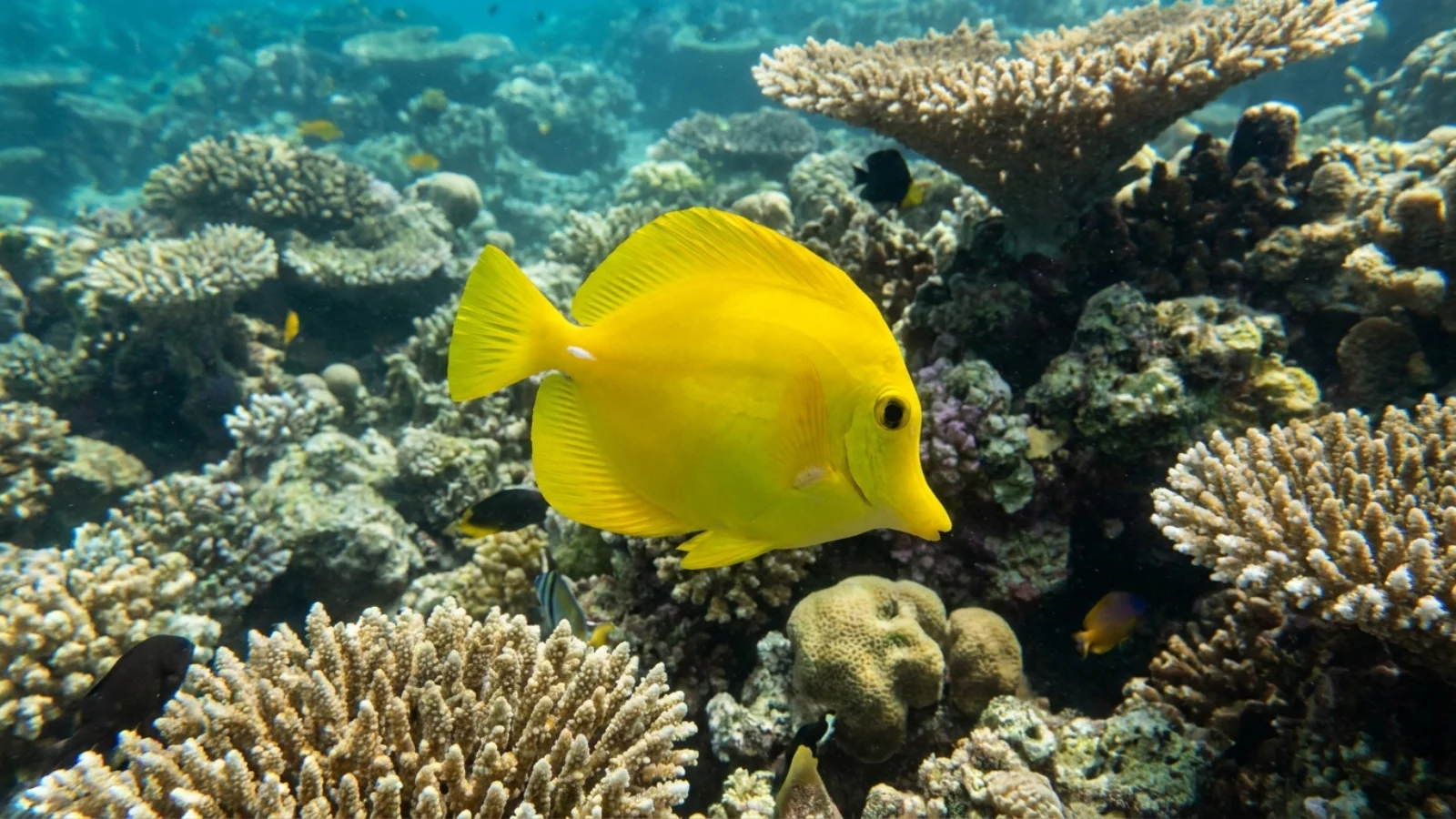
The yellow tang (Zebrasoma flavescens) is a bright yellow surgeonfish of the Pacific, found from the Ryukyu Islands to Hawaii, where it is one of the most common reef fish. It grows to about 20 cm, grazes filamentous algae, and can live for more than 40 years in the wild. It has long been the top marine aquarium fish exported from Hawaii, which made it the centre of a decade-long legal fight over aquarium collecting.
Snorkel any healthy reef on the Kona coast of the Big Island and you will see yellow tangs: bright lemon discs drifting over the lava and coral in loose groups, grazing as they go. It is one of the most familiar fish in Hawaii and, for decades, one of the most familiar fish in home aquariums worldwide. Those two facts are connected.
What kind of fish is a yellow tang?
A surgeonfish in the genus Zebrasoma, the sailfin tangs, closely related to the blue tang.
Like all surgeonfish, it carries a sharp, retractable spine on each side of the tail base. In the yellow tang the spine is white and easy to see against the yellow body. The body is a tall, laterally compressed disc with a long, pointed snout built for nipping algae from crevices. The English naturalist Edward Turner Bennett described the species in 1828 from Hawaii. The surgeonfish guide covers the family, and the butterflyfish group guide shows where tangs fit among the reef’s disc-shaped fish.
At night the yellow fades slightly and a brownish patch with a pale horizontal band appears on the side, a camouflage pattern that surprises night divers seeing their first sleeping yellow tang.
How big do yellow tangs get?
About 20 cm (8 in) total length.
FishBase gives a length at maturity of about 6.3 cm. Yellow tangs are long-lived for small fish: individuals in the wild have been reported to live for more than 40 years.
Where do yellow tangs live?
In the Pacific: the Ryukyu, Mariana, Marshall, Marcus, Wake and Hawaiian islands, in coral-rich lagoon and seaward reefs from just below the surge zone to about 46 m.
Hawaii holds the most famous populations. FishBase also notes records off Florida, almost certainly released aquarium fish. On the reef, yellow tangs live singly or in loose groups,. See our Hawaiian coral reef ecosystem guide.
What do yellow tangs eat?
Filamentous algae, which they crop from rock and dead coral all day.
Yellow tangs are true herbivores, and their grazing helps stop algae from smothering corals. On the reef they are part of the herbivore team with parrotfish and other surgeonfish described in the reef fish hub. In aquariums they need a mostly vegetable diet, such as nori and spirulina-based foods. Aquarists also value them because they graze nuisance hair algae.
Where can you see yellow tangs in Hawaii?
Almost anywhere with healthy coral and lava rock, but the leeward coasts of the Big Island and Maui are the classic spots.
Calm, clear west-facing shores are where yellow tangs gather in the biggest numbers, often in loose groups of dozens grazing over the reef. On Maui, the crater rim of Molokini and the reefs off the south and west shores are reliable, and on O‘ahu, protected bays near Honolulu give beginners easy views. See our Maui and Honolulu travel guides. Go early in the morning, before wind and crowds stir up the water, and keep a respectful distance: tangs that are chased simply stop feeding and move off.
How do you tell a yellow tang from other yellow reef fish?
Look for the tall disc shape, long pointed snout, solid yellow colour with no markings, and the white spine at the base of the tail.
Several reef fish are mostly yellow, including some butterflyfish, damselfish and angelfish, but none combine the yellow tang’s plain colour with that disc-and-snout silhouette. Butterflyfish usually have an eye band or spots. Angelfish carry a spine on the gill cover rather than at the tail. The white tail spine is the giveaway for a surgeonfish.
How do yellow tangs reproduce?
Group spawning and pair spawning both occur, in batches throughout the year, with activity peaking around the full moon.
FishBase describes territorial males courting passing females and lunar periodicity in spawning. The eggs and larvae drift in the open ocean before juveniles settle onto the reef, which is why protecting adults on one reef can seed others nearby.
Can yellow tangs be bred in captivity?
Yes. A team at the Oceanic Institute of Hawaii Pacific University first bred yellow tangs in captivity in late 2015, and captive-bred fish are now sold.
That breakthrough matters because, before it, every yellow tang in the trade came from the wild. Today aquarists can choose captive-bred fish, which are already used to aquarium food and carry fewer parasites.
Why did Hawaii stop collecting yellow tangs?
Because of a series of court rulings requiring environmental review of the aquarium trade, beginning in 2017.
For decades, yellow tangs were the top marine aquarium fish exported from Hawaii. Estimates of the annual take range from nearly 400,000 (Callan and colleagues, 2018) to about half a million juveniles from the Island of Hawaii alone (Christie and colleagues, 2010), and Hawaii supplied up to about 70% of the yellow tangs in the global aquarium trade. Nine marine protected areas were established off Hawaii to protect the fish.
| Year | Event |
|---|---|
| 2017 | Hawaii Supreme Court rules that aquarium collection requires environmental review, creating a de facto halt to commercial collection |
| 2020 | State land board rejects the industry’s first environmental impact statement |
| 2021 | Second statement for West Hawaii accepted by default after a tie vote; community groups sue |
| 2023 | Board votes unanimously in December to begin rulemaking toward a statewide ban |
| 2024 | Hawaii Supreme Court, 4–1, finds the revised West Hawaii statement legally adequate (August 28) |
| 2025 | Board votes in October to start rulemaking to regulate West Hawaii collection; the draft would allow up to 7 permits over 5 years |
The fight is not over. According to Earthjustice, which represents the community groups opposing collection, the proposed West Hawaii rules would allow 100,000 yellow tangs a year to be taken, public hearings were expected in early 2026, and a separate lawsuit over the board’s authority to ban collection by rule was pending in late 2025. Whether and how West Hawaii reopens depends on those proceedings.
How long do yellow tangs live?
More than 40 years: an otolith study in Hawaii aged the oldest fish at 41.
Their longevity is one reason conservation groups argue that removing hundreds of thousands of adults a year was unsustainable: a slow-maturing, long-lived fish replaces itself slowly.
Are yellow tangs good aquarium fish?
They are hardy and popular, but they need space, plenty of algae and care with other tangs.
Yellow tangs swim constantly and grow to 20 cm, so they need a long tank. They are aggressive toward other tangs, especially similar-shaped Zebrasoma, unless introduced together in a very large system. Choose a captive-bred fish if you can. See reef aquarium fish selection.
Anatomy and the differences between males and females
FishBase describes the yellow tang as very deep-bodied, its depth fitting 1.4 to 1.75 times into its standard length, with a moderately protruding snout and a small mouth. The teeth are spatulate, close-set and finely serrated along their edges, a design for cropping fine algae rather than tearing. The number of teeth grows with the fish: FishBase gives 12 upper and 14 lower teeth in juveniles and 18 upper and 22 lower teeth in an adult of 15 cm standard length. The dorsal fin has five spines and 23 to 26 soft rays, and the anal fin three spines and 19 to 22 soft rays. FishBase also notes grooves on the fins associated with venom glands in some surgeonfishes, but whether the yellow tang has a venom gland could not be determined, possibly because adults lose them.
The scientific name is straightforward. Zebrasoma refers to the zebra-like bars of the genus’s type species, the sailfin tang, and flavescens is Latin for yellowish. Within the genus, the yellow tang forms a species pair with the scopas tang, Zebrasoma scopas.
Males and females look alike to a diver, although males change colour and perform a “shimmering” display when courting. The differences show up in growth. In a 2009 study in Marine Ecology Progress Series, J. T. Claisse and colleagues aged yellow tangs from their otoliths, the ear stones that lay down growth rings, and confirmed with chemical marking that one ring forms each year. Males grew faster as juveniles and reached a larger average maximum length, about 179 mm against 156 mm for females. Males also moved from deeper, coral-rich habitat to shallow reef dominated by algal turf at a median size about 20 mm larger and an age about two years older than females, and the move coincided with higher reproductive output.
Why a 41-year lifespan matters
The same study found the oldest yellow tang to be 41 years old, a remarkable age for a fish that tops out at about 20 cm. Longevity like that changes how a population responds to fishing. A long-lived fish can ride out years of poor recruitment because adults keep breeding, but once adults are removed they are replaced slowly. FishBase rates the yellow tang’s vulnerability to fishing as high, 57 on a scale of 100, while giving a minimum population doubling time of 1.4 to 4.4 years and a fecundity above 10,000 eggs. The aquarium fishery mostly took juveniles, which reduces the direct loss of breeders but removes the next generation instead.
The West Hawaii experiment
West Hawaii became one of the best-studied aquarium fisheries in the world. According to a 2010 study in PLOS ONE by M. R. Christie, B. N. Tissot and colleagues, juvenile yellow tangs made up 80 percent by number and 70 percent by value of all fish collected by the aquarium trade on the Island of Hawaii. To sustain the fishery, the state set up a network of nine marine protected areas along the Kohala-Kona coast in 1999, closing about 35 percent of the 150 km West Hawaii coastline to commercial aquarium collection.
The network became a test case for a question marine managers had argued about for years: do protected areas actually seed fished areas with young fish? Christie’s team genotyped adults and newly settled juveniles and found four parent-offspring pairs, revealing larval dispersal distances of 15 to 184 km. Because yellow tangs move less than about 1 km after settling, those distances are a minimum for how far the larvae drifted. In two cases, larvae had travelled from a protected area to an unprotected one. The authors described it as the first direct evidence of large-scale connectivity within an existing, effective network of marine protected areas.
How yellow tangs were finally bred in captivity
Breeding yellow tangs was difficult because the larvae are tiny and need very small live food. A 2014 report in the Global Aquaculture Advocate by C. K. Ferna and colleagues at the Oceanic Institute described the problem. Larvae could be raised through first feeding on copepod nauplii, but rotifers were not eaten and brine shrimp were too large at first. In one run, development stalled around day 50 and mortality rose through day 60; the best larva survived to day 83 with early signs of settlement but did not complete it. Clear water, high water exchange and ultraviolet sterilisation all helped.
The breakthrough came in late 2015, when a team led by Chad Callan at the Oceanic Institute raised the first yellow tangs through to juveniles. Even then, survival was very low. In a 2018 paper in the Journal of the World Aquaculture Society, Callan and colleagues compared two feeding schedules using the copepod Parvocalanus crassirostris, rotifers and brine shrimp before weaning to dry and frozen food. Survival was 0.13 and 0.29 percent, and on the revised diet 41 percent of the fish had completed the change to juvenile colour by 70 days after hatching. Those figures explain why captive-bred yellow tangs reached the market slowly.
Yellow tangs and green turtles
Yellow tangs are grazers, and their grazing sometimes extends to unusual surfaces. Wikipedia’s species account notes that in the wild yellow tangs provide cleaning services to sea turtles by removing algal growth from their shells. Green turtles in Hawaii are known to visit reef fish for cleaning; a 1994 paper in Copeia by Losey, Balazs and Privitera described cleaning of green turtles by the saddle wrasse, Thalassoma duperrey. For a diver, a turtle resting at a station surrounded by bright yellow tangs is one of the classic sights of the Kona coast, and it is a good reason to keep a respectful distance rather than approach.
Records outside the natural range
The yellow tang’s natural range is limited to the North Pacific islands listed above, but released aquarium fish have turned up far away. FishBase notes records off Florida in the western central Atlantic, and Wikipedia reports a single fish filmed in Spanish waters of the Mediterranean in 2008, likely an aquarium release. Releasing aquarium fish into the wild can introduce diseases and parasites as well as the fish themselves, and it is prohibited in many jurisdictions.
Predators and threats on the reef
A 20 cm fish with a scalpel at the tail is not easy prey, but yellow tangs are eaten by a range of predators. Wikipedia lists larger fish, sharks, crabs and octopuses, and juveniles, which shelter among branching coral, are the most exposed. The tail spine is the main defence: when threatened, a surgeonfish can flick its tail sideways and slash an attacker or a careless hand, which is why aquarists net and handle tangs with care.
Beyond predation, the threats facing yellow tangs are those facing Hawaiian reefs generally: polluted runoff from land, physical damage from destructive fishing and careless snorkelling, overfishing, and the loss of coral that juveniles use as cover. Christie and colleagues stressed the yellow tang’s ecological role as an abundant herbivore on the reefs of the Island of Hawaii, cropping turf algae that would otherwise compete with corals for space. That role is one reason the debate over collection has been about more than a single species: removing large numbers of grazers changes the balance between algae and coral on a reef.
How big do yellow tangs get?
About 20 cm (8 in) total length.
How long do yellow tangs live?
They have been reported to live more than 40 years in the wild.
Where are yellow tangs found?
In the Pacific, especially Hawaii, plus the Ryukyu, Mariana, Marshall, Marcus and Wake islands.
What do yellow tangs eat?
Filamentous algae. In aquariums, nori and other vegetable-based foods.
Are yellow tangs banned in Hawaii?
Commercial aquarium collection has been largely halted since a 2017 court ruling, but a 2024 Hawaii Supreme Court decision allows the state to consider new permits for West Hawaii.
Are yellow tangs captive bred?
Yes. They were first bred in captivity in 2015, and captive-bred fish are now sold.
Do yellow tangs change colour at night?
Yes. The yellow fades slightly and a brownish patch with a pale band appears on the side.
Are yellow tangs endangered?
No. The IUCN lists them as Least Concern.
- Froese, R. & Pauly, D. (eds.). Zebrasoma flavescens, Yellow tang. FishBase.
- IUCN Red List. Zebrasoma flavescens: Least Concern (assessed 2010).
- Maui Now (28 August 2024). Hawaii Supreme Court rules in commercial aquarium fish collection case.
- Hawaii Division of Aquatic Resources. West Hawaii Regional Fishery Management Area.
- Randall, J. E. (2007). Reef and Shore Fishes of the Hawaiian Islands. University of Hawaii Sea Grant.
- Claisse, J.T., Kienzle, M., Bushnell, M.E., Shafer, D.J. & Parrish, J.D. (2009). Habitat- and sex-specific life history patterns of yellow tang Zebrasoma flavescens in Hawaii, USA. Marine Ecology Progress Series 389:245–255. doi:10.3354/meps08114
- Christie, M.R., Tissot, B.N. et al. (2010). Larval connectivity in an effective network of marine protected areas. PLOS ONE. doi:10.1371/journal.pone.0015715
- Callan, C.K. et al. (2018). Development of improved feeding methods in the culture of yellow tang, Zebrasoma flavescens. Journal of the World Aquaculture Society. doi:10.1111/jwas.12496
- Ferna, C.K. et al. (2014). O.I. advances yellow tang culture. Global Aquaculture Advocate, Nov/Dec 2014.
- Christian Science Monitor (2016). Farming Dory: movie-star fish bred in captivity for the first time (late-2015 yellow tang breakthrough at the Oceanic Institute).
- Losey, G.S., Balazs, G.H. & Privitera, L.A. (1994). Cleaning symbiosis between the wrasse, Thalassoma duperry, and the green turtle, Chelonia mydas. Copeia. doi:10.2307/1447184
- Maui Now (28 August 2024). Hawaii Supreme Court rules in commercial aquarium fish collection case (4–1 decision; 2020 and 2021 EIS history).
- Earthjustice (2024, updated November 2025). The latest on commercial aquarium collection in Hawai‘i (advocacy source; 2023 and 2025 board votes, proposed West Hawaii rules).
- Wikipedia: Yellow tang (taxonomy, night colouration, turtle cleaning, records outside range).
Blane Perun has been exploring Earth’s oceans and marine life for over 25 years. Founder of TheSea.Org in 1999, underwater photographer, coral aquaculture pioneer, and explorer of 80+ countries.
About Blane Perun → More on Reef Fish →