Mandarin Fish — The Scaleless Dragonet With True Blue Pigment
The mandarin fish or mandarinfish (Synchiropus splendidus) is a small dragonet, family Callionymidae, from the western Pacific between the Ryukyu Islands and Australia. It grows to about 7 cm, has no scales, is covered in a bitter, smelly mucus that deters predators, and is one of only two vertebrates known to get blue colour from a cellular pigment rather than from light-scattering structure.
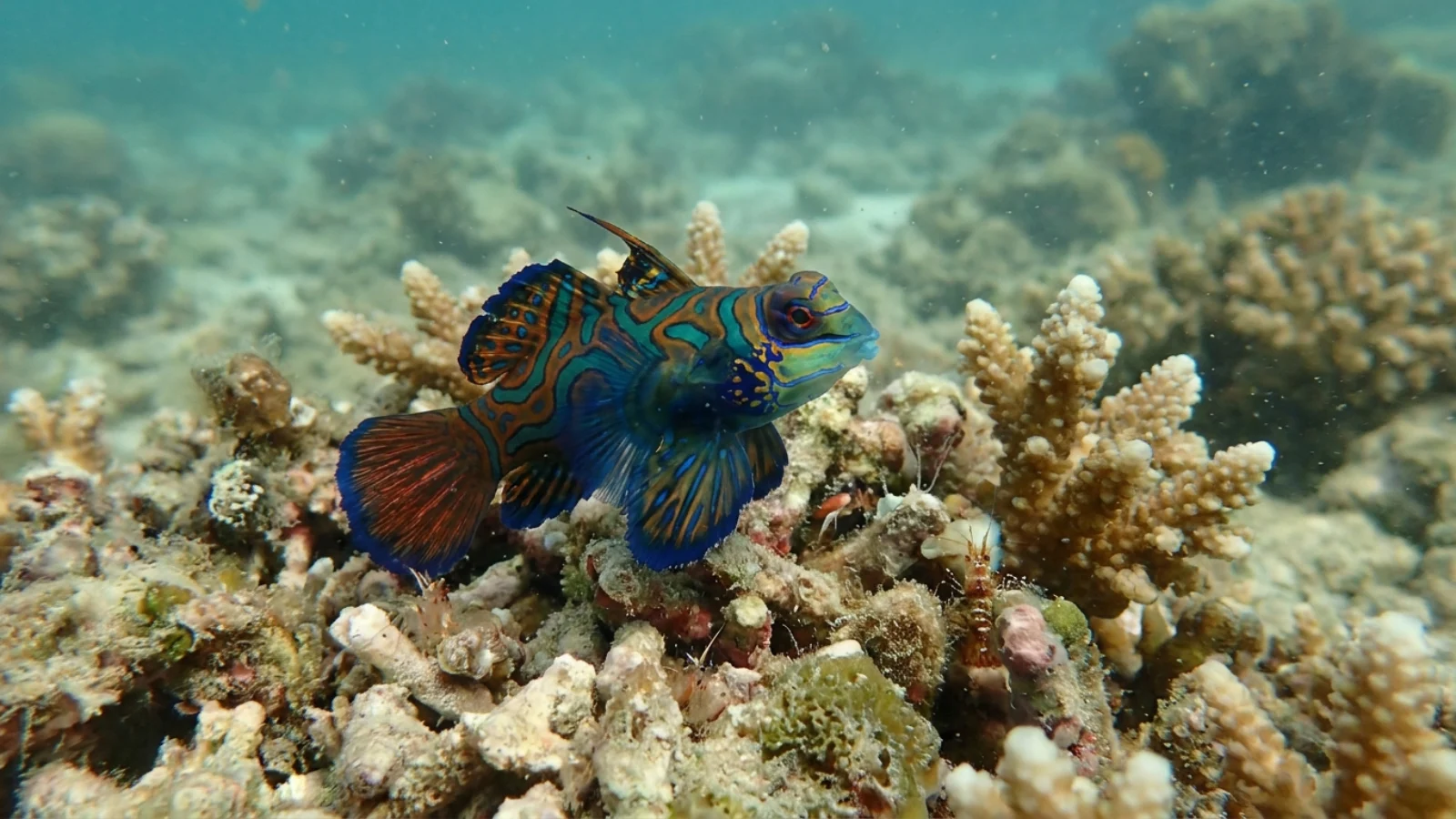
The mandarin fish looks like someone painted a goby with a highlighter set: swirls of electric blue, orange, green and yellow, with blue-edged fins and a face like stained glass. Divers travel to the Philippines, Indonesia, Palau and Papua New Guinea just to watch it court at dusk. It is also one of the most common reef fish sold into home aquariums, and one of the most commonly starved there.
What kind of fish is a mandarin fish?
A dragonet, not a goby: it belongs to the family Callionymidae, small bottom-dwelling fish that hop over the reef on their pelvic fins.
Dragonets look goby-like but differ in having a strong spine on the gill cover, no scales and males with tall, elaborate dorsal fins. Our dragonet family guide covers the whole group, and the bottom dwellers group guide puts it alongside the reef’s other ground-level fish. The closely related spotted mandarin, Synchiropus picturatus, has green and black ringed spots instead of stripes.
How big is a mandarin fish?
Tiny: about 6–7 cm (under 3 in) at most, with males larger than females.
Males are bigger and carry a much taller, spike-like first dorsal fin, which they raise during courtship. That small size, together with secretive habits, means most snorkellers swim straight past them.
Why is the mandarin fish so blue?
It is one of only two vertebrates known to produce blue with a cellular pigment instead of structural colour.
Nearly every blue animal you have seen, from blue jays to blue tangs, is not actually blue. Its cells reflect and scatter light so that blue wavelengths reach the eye. The mandarin fish is different: its blue comes from pigment inside specialised colour cells called cyanophores. The other known case is its relative, the spotted mandarin. The bold colours are thought to be a warning (aposematic) signal that advertises the fish’s unpleasant slime.
Does a mandarin fish have scales?
No. Instead, it has a thick layer of mucus that smells and tastes bad and appears to repel predators and disease.
Without scales, the mucus does the protective job. Several aquarium and museum sources describe the slime as toxic or distasteful, and the fish’s confident, slow behaviour in the open supports the idea that predators learn to leave it alone. It is not dangerous to people.
How do mandarin fish move?
They hop and hover rather than swim, using their pelvic fins like little legs.
A mandarin spends most of its time a few centimetres off the bottom, shuffling over rubble and coral, then pausing to peck. When disturbed it darts a short distance and settles again into cover. It has a large, upturned mouth that can protrude to snap up prey, and big eyes for picking out tiny copepods against the background. Unlike many reef fish, it does not school or patrol in open water; a mandarin’s world is the square metre of reef around it.
What is the difference between a male and a female mandarin fish?
Males are larger, with a tall, spiky first dorsal fin; females are smaller with a short, rounded dorsal fin.
That spiky fin is the male’s courtship flag. At dusk, males flare it, spread their fins and circle females. Animal Diversity Web describes the mating system as polygynandrous, meaning both males and females mate with multiple partners over a season. In aquariums, two males will fight, so a single fish or a true pair is the rule.
What eats mandarin fish?
Very little, as far as researchers can tell, which is consistent with the protective mucus.
Most small reef fish are eaten constantly. Mandarins forage in the open in daylight and at dusk without much sign of fear, and predation on adults appears to be rarely reported. Scorpionfish and other ambush hunters share the same rubble, but the combination of slime, warning colours and a sharp gill-cover spine appears to make mandarins a poor meal.
Who named the mandarin fish, and where does it sit in the fish tree?
The species was first described in 1927 by Albert William Herre, an American ichthyologist then working in the Philippines, who called it Callionymus splendidus. It was later moved to the genus Synchiropus, and older aquarium books also use the names Neosynchiropus and Pterosynchiropus. The genus name comes from Greek roots meaning roughly “together” and “hand-foot”, a nod to the way dragonets prop themselves on their pelvic fins, while splendidus is Latin for bright or glittering. The English name is said to refer to the robes of officials of imperial China. It should not be confused with the freshwater “mandarin fish” of China, Siniperca chuatsi, a predatory perch-like fish that is only distantly related.
Within the dragonets, the mandarin sits in the subgenus Pterosynchiropus with the spotted mandarin, S. picturatus, and S. occidentalis. FishBase gives the fin formula as four dorsal spines, eight dorsal soft rays, no anal spines and six to eight anal soft rays, and notes that rare individuals show a strong red colour. Aquarists sell these as “red mandarins”, but they are the same species. The big, fan-like fins near the belly that the fish appears to walk on are the pelvic fins; the true pectoral fins sit further back on the sides and are nearly transparent.
Higher up the tree, molecular studies have moved dragonets into the order Syngnathiformes, the same broad group as seahorses, pipefishes and seadragons. A 2021 paper in G3 by Stervander and Cresko sequenced the mandarin’s nuclear genome, producing an assembly of about 483 million base pairs, partly so that it could serve as a close outgroup for studying how seahorses and pipefishes evolved their unusual body plans and male pregnancy.
How does a fish make blue pigment?
The blue cells were described in 1995 by Goda and Fujii in Zoological Science, in a paper on blue chromatophores in two callionymid species, the mandarin and the spotted mandarin. They proposed the name cyanophore for these cells. In nearly every other vertebrate, blue is produced by stacks of thin, reflective purine crystals inside cells called iridophores, which interfere with light and send back blue wavelengths. A mandarin’s cyanophores, by contrast, hold an actual blue-coloured material.
Later work found a second unusual cell type in the same fish, a dichromatic cyano-erythrophore that can produce both blue and red. The 2021 genome paper lists both cell types as part of the reason the species was chosen for sequencing: having the genome makes it possible to hunt for the genes behind a pigment system no other vertebrate group is known to use. The chemical identity of the blue pigment has not been settled in the sources reviewed here, so treat any precise claim about it with caution.
What is in the mandarin’s slime?
In 2005, Sadovy, Randall and Rasotto compared the skin of six dragonet species in the Journal of Fish Biology. All six had skin rich in ordinary mucous (goblet) cells, as expected for fish that live pressed against sand and rubble. But only two of the six, the mandarin and the spotted mandarin, also had a second, distinctive gland type called the sacciform cell. These are exactly the two most brightly patterned species in the comparison, which fits the idea that loud colour and a chemical defence travel together, the classic pattern of warning coloration. The authors suggest the secretions probably serve several functions, including defence against predators and protection for skin in constant contact with the bottom.
No published work found for this page measures a specific toxin in the slime or tests how predators react to it, so the “toxic” label sometimes used in aquarium circles goes further than the evidence. What can be said is that the skin is unusual, that it produces secretions other dragonets lack, and that predators seem to take adults rarely.
Where do mandarin fish live?
In the western Pacific, from the Ryukyu Islands of Japan south to Australia, in sheltered lagoons and inshore reefs at 1–18 m.
FishBase describes them on silty bottoms with coral and rubble, usually in small groups spread over a small area. They favour thickets of branching coral, rubble patches and areas near long-spined urchins, where they can slip into cover. The Philippines, Indonesia (including Lembeh), Palau and Papua New Guinea are classic places to see them. See scuba diving in the Philippines.
What do mandarin fish eat?
Tiny invertebrates, picked one at a time from rubble and coral: harpacticoid copepods, polychaete worms, small snails, amphipods, fish eggs and ostracods.
They feed slowly and almost continuously through the day, hovering and pecking. That feeding style is the single biggest problem in captivity, because a small tank cannot produce enough copepods to keep one alive.
How do mandarin fish reproduce?
Small groups gather at dusk; a male pairs with a female, and the two rise about a metre above the reef, side by side, to release eggs and sperm.
Animal Diversity Web describes females spawning only once a night, releasing clutches of 12 to 205 eggs, and spawning roughly weekly over several months. Larger males mate more often, and females prefer them. Eggs hatch in about 12 hours, and the larvae drift for about 12–14 days before settling. The species has been reared in captivity, and captive-bred mandarins that eat prepared foods are now available.
| Life stage | Timing |
|---|---|
| Eggs hatch | About 12 hours |
| Flexion stage | 8–11 days |
| Settlement | 12–14 days |
| Wild lifespan | 10–15 years |
| Typical captive lifespan | 2–4 years |
Can you keep a mandarin fish in a reef tank?
Yes, but only in a mature system with a large, self-sustaining copepod population, or with a captive-bred fish trained to eat prepared food.
Wild mandarins often refuse anything but live copepods and amphipods and slowly starve in new or small tanks, which is one reason the captive lifespan is often quoted at just 2–4 years, against an often-quoted 10–15 in the wild. The usual advice is a well-established tank with plenty of live rock and a refugium to culture pods (see our mangrove reef tank guide for one approach), no competing pod-eaters such as other dragonets or some wrasses, and ideally a captive-bred individual. Fish that adapt to aquarium food are described as hardy and disease resistant. Start with our reef fish selection guide.
Is the mandarin fish endangered?
No. The IUCN lists it as Least Concern, although collection for the aquarium trade is heavy in parts of the Philippines and Indonesia.
Mandarins are relatively common in suitable habitat, but they live in small, patchy groups in shallow lagoons that are also exposed to reef damage, siltation and coral loss. Choosing captive-bred fish takes pressure off wild populations.
What did 400 hours of watching mandarins in Palau reveal?
The most detailed field study of the species was published in 2022 in Environmental Biology of Fishes by Yvonne Sadovy de Mitcheson and colleagues. Working on shallow inshore coral off Malakal Island, Palau, across five survey periods between 1997 and 2001, the team logged more than 400 hours underwater. Because each mandarin’s swirling pattern is slightly different, they could recognise individuals by sight and follow them night after night without catching or tagging them. Adults in the study area measured 25 to 60.5 mm in total length; females ran 25 to 39 mm and males 32.5 to 60.5 mm.
Timing turned out to be extraordinarily precise. Spawning was only seen within about 20 minutes of official sunset: all 198 timed spawns fell between 16 minutes before and 18 minutes after sunset, and the average nightly spawning window lasted about 28 minutes. Each spawn itself was quick, with the paired ascent lasting 7 to 12 seconds and rising about a metre above the coral before eggs and sperm were released.
The fish gathered at loosely defined spawning sites holding one to eight females and one to five males. Averaged over 34 sites and 131 nights, there were 2.68 males and 3.32 females per site. Females spawned once a night or not at all, on 77 percent of observed days, in runs of one to at least six consecutive nights separated by one to three nights off. Males could spawn up to eight times in a night, though about three-quarters of nights saw a male spawn two times or fewer. Females only spawned with males larger than themselves, and larger males won more spawnings.
A removal experiment showed how strong that preference was. At four sites with ten males and fifteen females, the four largest males took 98 percent of spawnings. When the researchers removed three of them, three medium-sized males picked up 61 percent of spawnings, but the two largest females stopped spawning altogether. Activity areas were small, roughly 1 to 8 square metres, overlapped heavily and were not defended. Some males stayed at one site while others roamed among up to five, and the stay-at-home males did as well or better. In more than 400 hours the team recorded only three predation attempts: two failed strikes by lizardfish and one trumpetfish that grabbed a spawning pair in mid-ascent.
How does aquarium collecting affect wild mandarins?
The mandarin is collected extensively in Southeast Asia, mainly in the Philippines, and the fishery is not managed, according to a 2020 genetic study in Zoological Studies by P. T. Y. Leung and colleagues, including Sadovy de Mitcheson. Collectors prefer males because of their tall first dorsal fins. The team sampled five sites in Bohol, Philippines, which had been fished heavily for a long time, and one unexploited site in Palau. At four of the Bohol sites the male-to-female ratio was very low, between 0.12 and 0.30, while the Palau sample had a ratio of 2.3. That Palau figure comes from the genetic sampling; the separate Palau behaviour study, counting fish at spawning sites, found close to even numbers with slightly more females, so the two figures measure different things and should not be read as a contradiction.
Put the two studies together and the concern becomes clear. Females in Palau chose males larger than themselves, and when the largest males were removed experimentally, the largest females stopped spawning. A fishery that strips out big males could therefore cut egg production by more than the number of fish taken would suggest. The genetic study itself found high connectivity among the Philippine sites and Palau, but the authors suggest this may reflect historical range expansion rather than present-day exchange of larvae, and they warn that heavily localised fishing could leave strongly skewed sex ratios. The IUCN still lists the species as Least Concern, in an assessment dated October 2018, but those local effects do not show up in a global category.
What has research learned about rearing mandarin larvae?
Early development was described by Sadovy and colleagues in 2001 in Aquarium Sciences and Conservation, the source for most of the life-history figures repeated elsewhere. As summarised by Animal Diversity Web, the eggs are 0.7 to 0.8 mm across and hatch in about 12 hours. Eyes are pigmented and the mouth is well formed by about 36 hours after fertilisation, flexion of the tail occurs at 8 to 11 days, and settlement at 12 to 14 days. At 18 to 21 days the body darkens and the dorsal spines appear, and adult colour develops in the second month, at about 10 to 15 mm long.
The hard part is the first feeding. A 2018 study in Aquaculture showed the importance of copepods as live feed for the larvae, and a 2020 follow-up by Shao and Zeng tested copepods alone against copepods mixed with rotifers, the standard first food in fish hatcheries. Larvae fed the copepod Parvocalanus crassirostris did not benefit from added rotifers. At every age tested, the larvae positively selected copepods, never rejected them after capture, but rejected up to 60 percent of captured rotifers. A 2024 study in the Journal of Fisheries and Environment went on to test dietary carotenoids on survival, growth and colour pigment in the species, part of a wider push to make captive production reliable.
Commercial breeding followed. Around 2010 the hatchery ORA announced captive-bred spotted mandarins, saying its fish had been trained to eat commercially available frozen foods and pellets and recommending feeding at least twice a day; it said the green mandarin would follow. Those are the company’s own claims, but they explain why aquarists who want a mandarin are usually told to look for captive-bred stock.
How can you see mandarins in the wild?
The Palau data make the timing simple: be on the site before sunset, because the action is over within about half an hour. In the study area the fish were watched in just 1 to 3 m of water, and the wider survey covered 1 to 9 m, so this is often a shallow, easy dive or even a careful snorkel, with long periods of hovering still. Spawning sites are reused night after night, which is why local guides can take divers to the same coral head repeatedly. Look for males raising their tall dorsal fins and nudging alongside females; a pair that drifts upward together is about to spawn. Keep lights low and off the fish, give the pair room to rise, and avoid kicking up the silt that the species lives on.
How big does a mandarin fish get?
About 6–7 cm (under 3 in). Males are larger than females.
Are mandarin fish poisonous?
They are not dangerous to people, but their scaleless skin is covered in bitter, smelly mucus that appears to deter predators.
What do mandarin fish eat?
Tiny invertebrates, especially copepods and amphipods, plus small worms, snails and fish eggs.
Where are mandarin fish found?
In the western Pacific from the Ryukyu Islands to Australia, in sheltered lagoons and inshore reefs at 1–18 m.
Why are mandarin fish blue?
They are one of only two vertebrates known to have blue pigment in their cells (cyanophores) rather than structural blue.
How long do mandarin fish live?
10–15 years in the wild, but often only 2–4 years in captivity because of their specialised diet.
Are mandarin fish hard to keep?
Wild-caught ones are, because they need a constant supply of live copepods. Captive-bred fish trained on prepared food are much easier.
When do mandarin fish spawn?
Around dusk and into the night, when pairs rise off the reef to release eggs.
- Froese, R. & Pauly, D. (eds.). Synchiropus splendidus, Mandarinfish. FishBase.
- Animal Diversity Web. Synchiropus splendidus, University of Michigan Museum of Zoology.
- IUCN Red List. Synchiropus splendidus: Least Concern (assessed 2018).
- Nausicaá, Centre National de la Mer. Mandarinfish species profile.
- Sadovy de Mitcheson, Y. et al. (2022). Mating system in a small pelagic spawner: field case study of the mandarinfish, Synchiropus splendidus. Environmental Biology of Fishes. doi:10.1007/s10641-022-01281-1
- Leung, P. T. Y. et al. (2020). Population genetic structure of a marine pelagic egg producer and popular marine aquarium species, the mandarinfish. Zoological Studies 59:68. doi:10.6620/ZS.2020.59-68
- Sadovy, Y., Randall & Rasotto (2005). Skin structure in six dragonet species: interspecific differences in glandular cell types and mucus secretion. Journal of Fish Biology. doi:10.1111/j.0022-1112.2005.00692.x
- Goda & Fujii (1995). Blue chromatophores in two species of callionymid fish. Zoological Science. doi:10.2108/zsj.12.811
- Stervander & Cresko (2021). A highly contiguous nuclear genome assembly of the mandarinfish Synchiropus splendidus. G3 Genes|Genomes|Genetics. doi:10.1093/g3journal/jkab306
- Shao & Zeng (2020). Survival, growth, ingestion rate and foraging behavior of larval green mandarin fish fed copepods only versus co-fed copepods with rotifers. Aquaculture. doi:10.1016/j.aquaculture.2020.734958
- Sadovy, Y. et al. (2001). Early development of the mandarinfish, Synchiropus splendidus. Aquarium Sciences and Conservation 3: 253–263 (as summarised by Animal Diversity Web).
- ORA (c. 2010). Captive-bred mandarin release announcement, reported by AquaNerd (commercial source).
Blane Perun has been exploring Earth’s oceans and marine life for over 25 years. Founder of TheSea.Org in 1999, underwater photographer, coral aquaculture pioneer, and explorer of 80+ countries.
About Blane Perun → More on Reef Fish →