Moorish Idol — The Last of Its Family, and Why It Struggles in Captivity
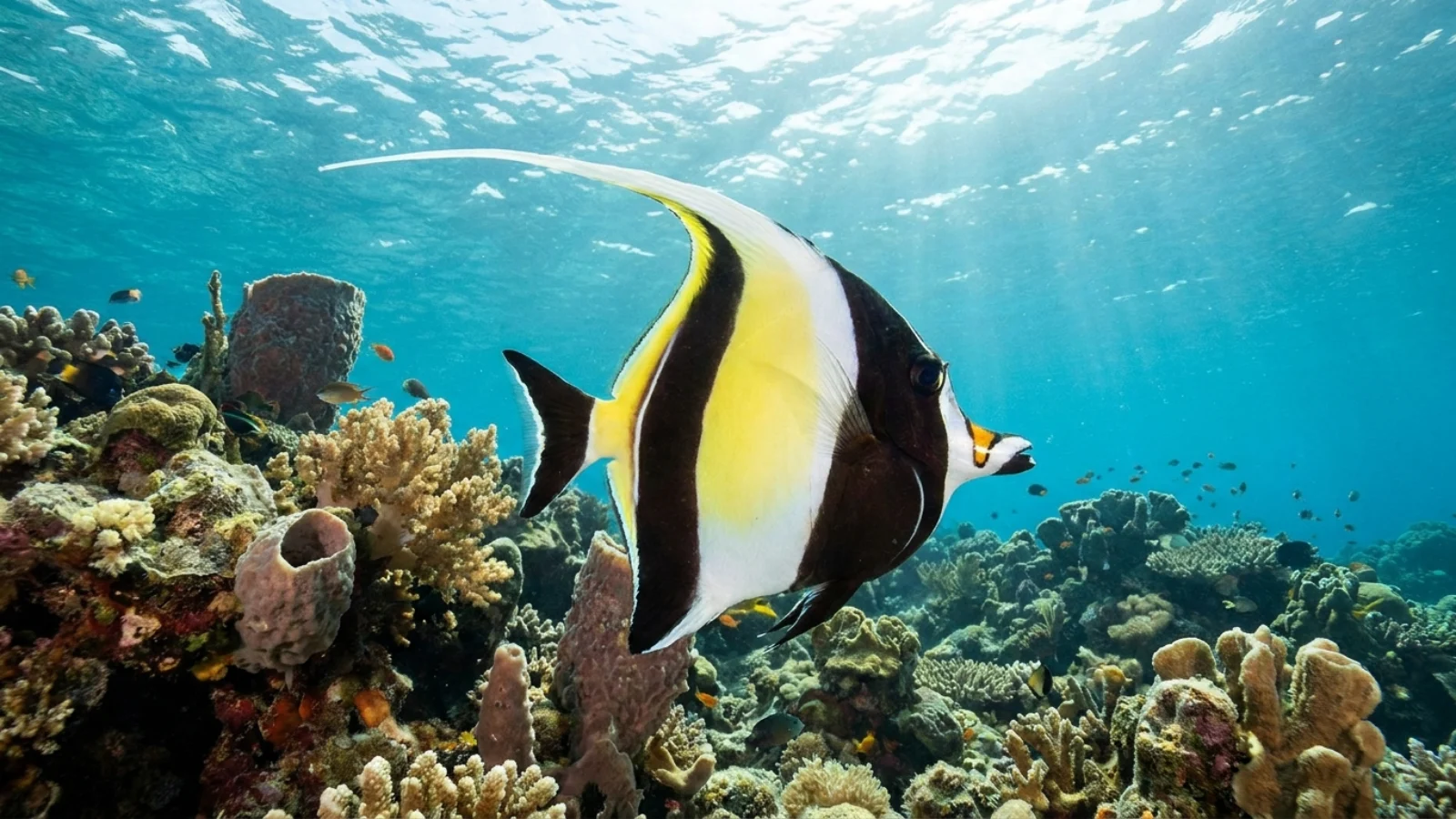
The Moorish idol (Zanclus cornutus) is a disc-shaped reef fish with bold black, white and yellow bands, a tube-like snout and a long, white, sickle-shaped dorsal fin streamer. It is the only living member of the family Zanclidae and ranges from East Africa across the Indo-Pacific to the Gulf of California and Peru. It grows to 23 cm, feeds largely on sponges and other encrusting animals, and is notoriously difficult to keep alive in aquariums.
Few reef fish are as instantly recognisable as the Moorish idol. Three bold bands of black, white and yellow, a long snout tipped with orange, and a dorsal fin that trails behind it like a white ribbon. It glides rather than darts, usually in twos or threes, and looks the same whether you see it in Mozambique, the Maldives, Maui or Mexico. It was Gill, the scarred leader of the tank gang in Finding Nemo, a character obsessed with escaping his aquarium. That turns out to be fitting.
What family does the Moorish idol belong to?
Its own: Zanclidae, in which it is the only living species.
The Moorish idol is a relict, the lone survivor of a lineage closely related to the surgeonfishes. Some authors have lumped it into the surgeonfish family, Acanthuridae, but it lacks the scalpel-like tail spines that define surgeonfish such as the blue tang. Linnaeus described it in 1758 as Chaetodon cornutus, placing it with the butterflyfish it resembles. The genus name Zanclus comes from the Greek for “sickle”, for the curved dorsal fin, and cornutus means “horned”, for the small bony bumps above the eyes of adults.
Why is it called a Moorish idol?
Reportedly because fishermen in parts of Southeast Asia respected the fish, releasing it when caught and bowing to it.
The word “Moorish” is a colonial-era misnomer. It usually referred to people of North Africa, where the fish does not live, but in colonial South Asia Muslims were also called “Moors”, which may explain the name. In Hawaii it is known as kihikihi.
How big is a Moorish idol?
Up to about 23 cm (9 in), with the dorsal streamer adding to its apparent height.
Where do Moorish idols live?
Across the Indian and Pacific Oceans, from East Africa to the Rapa and Ducie islands, north to southern Japan and Hawaii, south to Lord Howe Island, and in the eastern Pacific from the Gulf of California to Peru.
That is one of the widest ranges of any reef fish. FishBase records them from turbid inner lagoons and reef flats to clear seaward rocky and coral reefs, from the surface to 182 m. They are usually seen in twos or threes, sometimes alone, and occasionally in big schools.
The secret of that enormous range is the larva. Moorish idols spend a long time drifting in the open ocean, and the post-larvae grow to about 7.5 cm before changing into juveniles and settling onto a reef. Long drifting mixes populations across whole oceans, which is why the fish’s colour pattern shows no geographic variation.
What do Moorish idols eat?
Small encrusting animals picked from the reef with that long snout; sponges are the food most often cited.
The snout and small mouth are built for reaching into cracks and plucking at sessile invertebrates. Sponges are a defended, difficult food that few fish can eat, and that specialised diet is the root of the Moorish idol’s problems in captivity.
How do Moorish idols behave?
Calmly, in small groups, on a steady circuit of the reef.
Adults are usually seen in pairs or threes, cruising slowly along the reef edge and stopping to pick at the rock. They are not territorial in the way damselfish are, and they rarely react to divers who stay still. The long dorsal streamer is delicate and often looks frayed in older fish. Its function has not been established.
What happens at the Moorish idol spawning in Palau?
In Palau, Moorish idols gather in schools of hundreds to spawn, and grey reef sharks hunt them in a feeding frenzy.
Unlike most places, where only pair spawning has been reported, Moorish idols in Palau form tight, synchronised schools in the morning, moving up and down the reef until midday. Packs of grey reef sharks follow. When a school moves off the reef into open water to spawn, the sharks attack together; researchers in Palau estimated that perhaps only 10 percent of ascending fish return to the same reef area (details below). The scene appeared in the first episode of the BBC series Asia. See Palau’s reefs and our reef shark guide.
Why do Moorish idols struggle in captivity?
Because they are picky, sponge-eating specialists that often refuse aquarium food, stress easily and need lots of swimming room.
FishBase says flatly that the species is a popular aquarium fish but rarely survives in tanks. In practice, many newly imported idols never start eating. Common problems include:
| Problem | Why it happens |
|---|---|
| Refusing food | Natural diet is sponges and encrusting invertebrates |
| Wasting away | Even feeding fish may not get the right nutrition |
| Stress | Long shipping chain from wild collection |
| Space | Constant cruising swimmer that reaches 23 cm |
| Aggression | Bullied by tangs and other competitive feeders |
For that reason, many aquarists keep look-alikes instead: the schooling bannerfish (Heniochus diphreutes) and pennant coralfish (H. acuminatus) are butterflyfish with a similar banded pattern and long dorsal fin, and they are far hardier. Read our reef aquarium fish selection guide before taking on any specialist feeder.
How do you tell a Moorish idol from a bannerfish?
Check the snout and the tail: Moorish idols have a long tube snout with an orange saddle and a black tail; bannerfish have a short snout and a yellow tail.
Bannerfish are butterflyfish of the genus Heniochus. They have two black bands rather than the idol’s arrangement of black, white and yellow, their dorsal streamer is part of the fin rather than a separate sweep, and they have no bony bumps above the eyes.
Are Moorish idols endangered?
No. The IUCN listed the Moorish idol as Least Concern at its last assessment in 2015.
The species benefits from its huge range and long-distance larvae. The bigger long-term threat is the same one facing every sponge- and coral-dependent fish: reef degradation from bleaching and pollution. See coral reef threats.
Anatomy of a Moorish idol up close
The Moorish idol’s body is strongly compressed, almost a disc seen side-on, which lets it slip along the reef face and turn sharply among coral heads. FishBase describes a tubular snout with a small mouth containing numerous long, bristle-like teeth, a tool for scraping and plucking small animals from rock rather than biting chunks. Adults develop small bony bumps in front of the eyes, the “horns” that give the species name cornutus.
The famous streamer is part of the dorsal fin. The fin has six or seven spines, and these are drawn out into a long, whip-like white filament, followed by about 39 to 43 soft rays according to FishBase; Wikipedia gives a slightly wider range of 39 to 45. The anal fin has three spines and 31 to 37 soft rays. There are no spines or serrations on the gill cover or on the base of the tail, which is one of the clearest anatomical differences from surgeonfish.
The colour pattern is consistent across the species’ huge range: a white background, two broad black vertical bands, a yellow patch toward the rear of the body, a yellow saddle on the snout and a black tail with a white margin. FishBase gives a maximum length of 23 cm, with 21 cm a more typical size for adults.
A tangled taxonomic history
Carl Linnaeus described the fish in 1758, in the tenth edition of Systema Naturae, as Chaetodon cornutus, with “Indian Seas” given as the type locality. In the same work he also named Chaetodon canescens, a name now treated as a synonym of the Moorish idol. Placing it in Chaetodon, the butterflyfish genus, was a reasonable guess from its shape and colours, and the confusion with butterflyfish has never quite gone away.
Georges Cuvier gave the species its own genus, Zanclus, in 1831, and Pieter Bleeker proposed the family Zanclidae in 1876. Today the family sits in the suborder Acanthuroidei alongside the surgeonfishes, including the unicornfishes. Some authors have folded it into the surgeonfish family, but the lack of tail spines keeps most classifications separate.
The family has a fossil relative. Eozanclus brevirostris, an extinct species from the Eocene epoch, is classified in Zanclidae and appears intermediate between surgeonfishes and the Moorish idol. More broadly, D. R. Bellwood and colleagues showed in 2014 that Eocene surgeonfish fossils already included specialised long-snouted forms that were probably pair-forming crevice feeders, much like some living species. The Moorish idol’s way of life, in other words, is an old one on reefs.
The Palau spawning in detail
The most detailed account of Moorish idol spawning comes from M. T. Etpison and P. L. Colin, who described aggregations on Palau’s western barrier reef in the aquarium journal aqua in 2018. They found that Moorish idols gathered around the first-quarter moon from December to March, with the largest groups in January and February. The fish arrived near the sites in the morning, bunched together and moved up and down the reef face in late morning, attracting predators. Around midday they rose off the reef into open water to spawn.
Dive guides had known about the aggregations since the 1990s, and the mass midday ascent was first seen in 2009. From the late 1990s to 2005 the groups at Blue Corner were estimated at 5,000 to 10,000 fish. Later, numbers there appeared to fall while numbers at nearby Siaes Corner rose, and during 2015 to 2017 the largest groups, estimated at 1,000 to 3,000 fish, were at Siaes Corner. The authors stress that these are rough visual estimates.
Grey reef sharks gather along the wall in roughly the hour before spawning. As the idols ascend, the sharks follow them to the surface and attack in a feeding frenzy lasting several minutes, followed by a slower picking-off of the fish left schooling at the surface. Etpison and Colin estimated, qualitatively, that perhaps only 10 percent of the fish that ascended returned to the same reef area. Over the following days the schools shrank from several thousand fish to a few hundred, and in years when spawning and predation were heavy in December and January, the fish often did not aggregate again in February and March. This is unusual behaviour: most reef fish that release eggs into the water stay within sight of shelter, releasing gametes within about 5 to 10 m of the reef, and the authors called it “blue water spawning”. Orangespine unicornfish (Naso lituratus) use the same sites in the same months, around the last-quarter moon.
The scene reached a wide audience in the first episode of the BBC series Asia, which aired in November 2024. Palau’s Island Times reported that a crew led by producer Mark Wheeler worked in Palau for about two years, guided by local divers including the Etpison family, and filmed at Siaes Corner and Blue Corner.
How the larvae explain the range
Moorish idols are pelagic spawners: eggs and sperm are released into the water, and the fertilised eggs drift away on the current. The larval stage is long, and FishBase gives the size at which post-larvae metamorphose into juveniles as 7.5 cm. A long-drifting larva can be carried across ocean basins, which explains why the species occurs from East Africa to the eastern Pacific and why, as FishBase notes, its colour pattern shows no geographical variation.
Sources differ slightly on the edges of the range. FishBase gives East Africa to Rapa and the Ducie islands, north to southern Japan and Hawaii and south to Lord Howe Island, plus the eastern Pacific from the southern Gulf of California to Peru. Wikipedia describes it as reaching from East Africa between Somalia and South Africa east to Hawaii and Easter Island, and includes the Galapagos and Cocos Island in the eastern Pacific. FishBase gives a depth range of 0 to 182 m, usually below about 5 m.
Feeding in more detail
FishBase says simply that Moorish idols feed on small encrusting animals. Wikipedia lists sponges, coral polyps, tunicates and other bottom-living invertebrates. Sponges are the item most often cited, and they are a hard food to live on: many contain spicules of silica or calcium carbonate and defensive chemicals. The idol’s long snout and bristle teeth let it pick at sponge surfaces and reach into crevices that deeper-bodied fish cannot.
This is also why behaviour in captivity is so erratic. Wikipedia notes that idols tend either to refuse food and perish, or to eat everything all at once, and that they need large tanks, often more than 380 litres.
Fisheries and conservation
The IUCN assessed the Moorish idol as Least Concern on 10 March 2015. FishBase lists it as a subsistence-fishery species and a commercial aquarium fish, and rates its vulnerability to fishing as low, 12 on a scale of 100. Its huge range, long-drifting larvae and lack of a fishery give it a buffer that many reef specialists lack. The concern is local rather than global: spawning aggregations like those in Palau are predictable in time and place, which makes them valuable for divers and vulnerable if they are disturbed.
Where and when to see Moorish idols
Moorish idols are common on most Indo-Pacific reefs, usually in pairs or small groups along the reef edge, and are easy to see while snorkelling as well as diving. In Hawaii they are a familiar shallow-reef fish, known locally as kihikihi. For the spawning spectacle, Palau’s Blue Corner and Siaes Corner are the known sites, with aggregations from December to March and peaks in January and February around the first-quarter moon. Dive operators now run trips timed to the spawning, and divers should keep well back from both the fish and the hunting sharks.
Why is it called a Moorish idol?
Reportedly because fishermen in parts of Southeast Asia honoured the fish, releasing it and bowing to it. “Moorish” is a colonial-era misnomer.
Is a Moorish idol a butterflyfish?
No. It is the only living member of its own family, Zanclidae, closely related to surgeonfish.
How big do Moorish idols get?
Up to about 23 cm (9 in).
What do Moorish idols eat?
Mainly sponges and other small encrusting animals, plus some algae.
Why are Moorish idols hard to keep?
They are specialist feeders that often refuse aquarium food and rarely survive long in captivity.
What fish was Gill in Finding Nemo?
Gill, leader of the tank gang, was a Moorish idol.
Where do Moorish idols live?
Across the Indo-Pacific from East Africa to the eastern Pacific, including Hawaii, from the surface to 182 m.
Are Moorish idols endangered?
No. The IUCN lists them as Least Concern.
- Froese, R. & Pauly, D. (eds.). Zanclus cornutus, Moorish idol. FishBase.
- IUCN Red List. Zanclus cornutus: Least Concern (assessed 2015).
- Myers, R. F. (1991). Micronesian Reef Fishes, 2nd ed. Coral Graphics.
- Wikipedia contributors. Moorish idol: taxonomy, etymology, Palau spawning aggregations and aquarium notes.
- BBC. Asia, episode 1: Moorish idol spawning and grey reef sharks, Palau.
- Etpison, M.T. & Colin, P.L. (2018). Blue water spawning by Moorish idols and orangespine surgeonfish in Palau: is it a “suicide mission”? aqua, International Journal of Ichthyology 23(4).
- Borja, E.M. (2024). Palau’s spawning events of Moorish idols and orange spine surgeonfish featured in BBC’s new series. Island Times, 19 November 2024.
- Bellwood, D.R. et al. (2014). Fifty million years of herbivory on coral reefs: fossils, fish and functional innovations. Proc. R. Soc. B. doi:10.1098/rspb.2013.3046
- Wikipedia: Moorish idol (taxonomy, synonyms, range, diet, aquarium notes); Zanclidae (Eozanclus brevirostris).
Blane Perun has been exploring Earth’s oceans and marine life for over 25 years. Founder of TheSea.Org in 1999, underwater photographer, coral aquaculture pioneer, and explorer of 80+ countries.
About Blane Perun → More on Reef Fish →