Whitetip Reef Shark — The Cave-Resting Night Hunter of the Reef
The whitetip reef shark (Triaenodon obesus) is a slender requiem shark of Indo-Pacific coral reefs, named for the bright white tips on its first dorsal fin and upper tail lobe. Adults average about 1.6 m and rarely exceed 2 m. Unlike most requiem sharks, it can lie still on the bottom, and divers usually see it resting in caves by day; at night it hunts in loose packs, wriggling into crevices after fish. It is listed as Vulnerable by the IUCN.
Whitetip Reef Shark
How do you identify a whitetip reef shark?
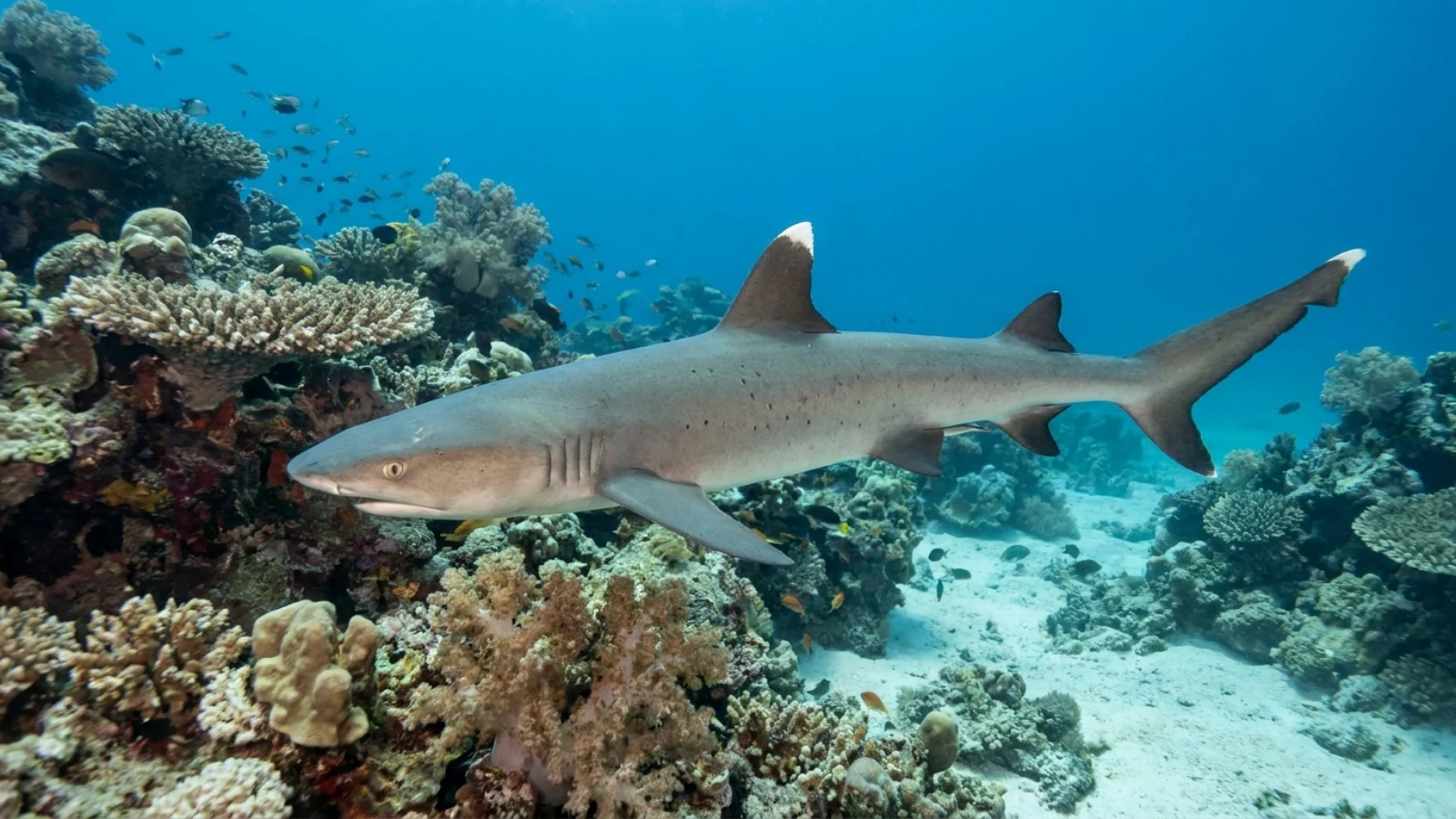
Look for a slim, grey shark with a short, broad, blunt snout and bright white tips on the first dorsal fin and the upper lobe of the tail. The white tips are the giveaway.
The body is long and slender, grey to brownish above and paler below, often with a few dark spots on the sides. The head is flattened, the snout broad and rounded, with prominent tubular flaps by the nostrils, and the eyes have a horizontal oval shape. The first dorsal fin sits farther back on the body than in most requiem sharks. Adults average about 1.6 m and 18–20 kg, and rarely exceed 2 m. Don’t confuse it with the oceanic whitetip, a much larger, bolder open-ocean shark with broad, rounded, mottled white fin tips, or with the silvertip shark, which has white edges on all its fins.
Why do whitetip reef sharks rest in caves?
Whitetip reef sharks spend the day resting on the bottom in caves, under ledges and in sand channels, often piled together. Unlike most requiem sharks, they can pump water over their gills while lying still.
Most requiem sharks need to keep swimming to breathe (obligate ram ventilation). The whitetip reef shark can actively pump water over its gills with its mouth and throat, so it can lie motionless for hours. Individuals return to the same cave day after day for months, and groups of several sharks often share a favourite ledge. Each shark lives within a small home range of about 2 km², and the longest yearly movement recorded is only about 3 km, so the same individuals can be recognised by divers on the same reef over many years. For the wider question of how sharks rest, see our guide to whether sharks sleep.
How do whitetip reef sharks hunt?
At night whitetip reef sharks become active, hunting alone or in loose groups. Their slender bodies let them squeeze into holes and crevices to flush out fish that are hiding or sleeping.
The diet is mostly bony reef fish such as parrotfish, surgeonfish, damselfish, goatfish, triggerfish, squirrelfish and eels, plus octopus, lobsters and crabs. Packs of whitetips sweep across the reef after dark, and when one shark corners a fish in a crevice the others converge, sometimes jamming their heads into the same hole or even breaking pieces of coral in the scramble. The most famous place to see this is Cocos Island, Costa Rica, where hundreds of whitetips hunt the reef at night, one of the great night-diving spectacles in the world.
Where do whitetip reef sharks live?
Whitetip reef sharks live on coral reefs across the Indian and Pacific Oceans, from South Africa and the Red Sea to Hawaii, and in the eastern Pacific from Costa Rica to Panama and the Galápagos.
They are found from very shallow water to about 330 m, but most live at 8–40 m, typically on reefs with plenty of caves and sand channels. They are among the most commonly seen sharks on Indo-Pacific dives, from the Red Sea and Maldives to Palau, Fiji, Hawaii and the Great Barrier Reef. Our Red Sea reef and Hawaiian reef guides describe two places where they are regular.
How do whitetip reef sharks reproduce?
Whitetip reef sharks are placental viviparous. Females give birth to small litters of 1 to 6 pups, usually 2 or 3, about every other year.
Pups are born at roughly 50–60 cm. Published gestation estimates vary widely, from about five months to more than a year. Both sexes mature at around five years and about 1–1.1 m long, and the maximum lifespan is thought to be about 25 years. Mating has been filmed: the male grips the female’s pectoral fin and the pair may sink to the bottom together. With so few pups, populations recover slowly from fishing.
Are whitetip reef sharks dangerous?
Not usually. Whitetip reef sharks are docile around divers and rarely approach people. The ISAF lists 5 unprovoked bites and no deaths; most incidents involve spearfishing or provocation.
Whitetips are curious and may approach spearfishers carrying fish, and they can bite if cornered in a cave or grabbed. Otherwise they are among the easiest sharks to observe calmly: a resting whitetip will usually let divers watch from a respectful distance.
Are whitetip reef sharks endangered?
Yes, the species is listed as Vulnerable by the IUCN (2020). Reef-shark fishing and small home ranges have caused steep local declines.
Because each shark lives in such a small area, fishing on a single reef can wipe out its local population. A 2020 global survey of reef sharks, the Global FinPrint study, found sharks functionally absent from about one in five reefs surveyed. Marine protected areas such as Cocos Island, the Galápagos and many Pacific shark sanctuaries hold healthy populations, and dive tourism there shows that a living reef shark is worth far more than a dead one.
How does the whitetip reef shark compare with other reef sharks?
The whitetip is the smallest and most bottom-oriented of the three classic Indo-Pacific reef sharks, alongside the grey reef shark and the blacktip reef shark.
The grey reef shark is bulkier and patrols the open water off reef walls; the whitetip hunts inside the reef itself. In the Atlantic, the Caribbean reef shark and the nurse shark fill similar roles.
| Species | Max length | Max weight | Unprov. bites (ISAF) | Lifespan | IUCN |
|---|---|---|---|---|---|
| Whitetip reef shark | ~1.6 m (rarely 2 m) | ~20 kg | 5 | ~25 yrs | VU |
| Grey reef shark | 2.55 m | ~34 kg | 9 | 25+ yrs | EN |
| Caribbean reef shark | 3.0 m | 70 kg | 4 | ~20 yrs | EN |
| Blacktip shark | 2.8 m | 123 kg | 35 | 12–15 yrs | VU |
| Nurse shark | 3.08 m | ~110 kg+ | 9 | 24–40+ yrs | VU |
| Oceanic whitetip | 4.0 m | 170 kg | 15 | 22 yrs | CR |
Bite counts: Florida Museum International Shark Attack File, species-implicated table (1580–2022). * Genus-level total. IUCN: LC Least Concern, NT Near Threatened, VU Vulnerable, EN Endangered, CR Critically Endangered, DD Data Deficient.
Are whitetip reef sharks dangerous?
Not usually. They are docile with divers. The ISAF lists 5 unprovoked bites and no deaths, mostly linked to spearfishing.
How big do whitetip reef sharks get?
Adults average about 1.6 m and 18–20 kg, and rarely exceed 2 m.
Is a whitetip reef shark the same as an oceanic whitetip?
No. The oceanic whitetip is a much larger, open-ocean shark with broad, rounded fins and mottled white tips. The whitetip reef shark is a small, slender reef dweller.
Do whitetip reef sharks have to keep swimming?
No. They can pump water over their gills while resting, so they often lie still on the bottom in caves during the day.
Where can you see whitetip reef sharks?
On coral reefs throughout the Indo-Pacific, including the Red Sea, Maldives, Great Barrier Reef, Palau, Fiji, Hawaii, Cocos Island and the Galápagos.
What do whitetip reef sharks eat?
Mostly reef fish such as parrotfish, surgeonfish and eels, plus octopus, lobsters and crabs, caught mainly at night.
Are whitetip reef sharks endangered?
They are listed as Vulnerable by the IUCN (2020) because of reef fishing and their small home ranges.
How long do whitetip reef sharks live?
About 25 years at most, maturing at around five years old.
Blane Perun has been exploring Earth’s oceans and marine life for over 25 years. Founder of TheSea.Org in 1999, underwater photographer, coral aquaculture pioneer, and explorer of 80+ countries.
About Blane Perun → All Shark Species A–Z →