Grey Reef Shark — The Reef Shark With a Warning Display
The grey reef shark (Carcharhinus amblyrhynchos) is a stocky requiem shark of Indo-Pacific coral reefs, recognisable by the broad black edge on the back of its tail and plain grey dorsal fin. Adults usually measure about 1.5–1.8 m, reaching about 2.55 m. It is famous for a hunched, side-to-side threat display it performs before attacking when cornered, and for gathering in hundreds in reef passes. It is listed as Endangered by the IUCN.
Grey Reef Shark
What is the grey reef shark threat display?
When a grey reef shark feels cornered or threatened, it raises its snout, drops its pectoral fins, arches its back and swims with an exaggerated side-to-side motion, sometimes in loops or figure-eights. If the threat keeps coming, it may attack at high speed, then flee.
This “agonistic display” is the best-studied threat display in any shark. Researchers first documented it in detail in the 1970s at Enewetak Atoll in the Marshall Islands, when grey reef sharks approached by divers and small submersibles hunched up, swam stiffly and then struck, in some cases biting the submersible. The display is triggered by fast approach, being followed or cornered, sudden movements and noise. It is a warning, not aggression for its own sake: the shark is saying “back off” to something it sees as a competitor or predator. For divers the rule is simple. If a grey reef shark starts to hunch, stop, give it room and slowly back away while facing it.
How do you identify a grey reef shark?
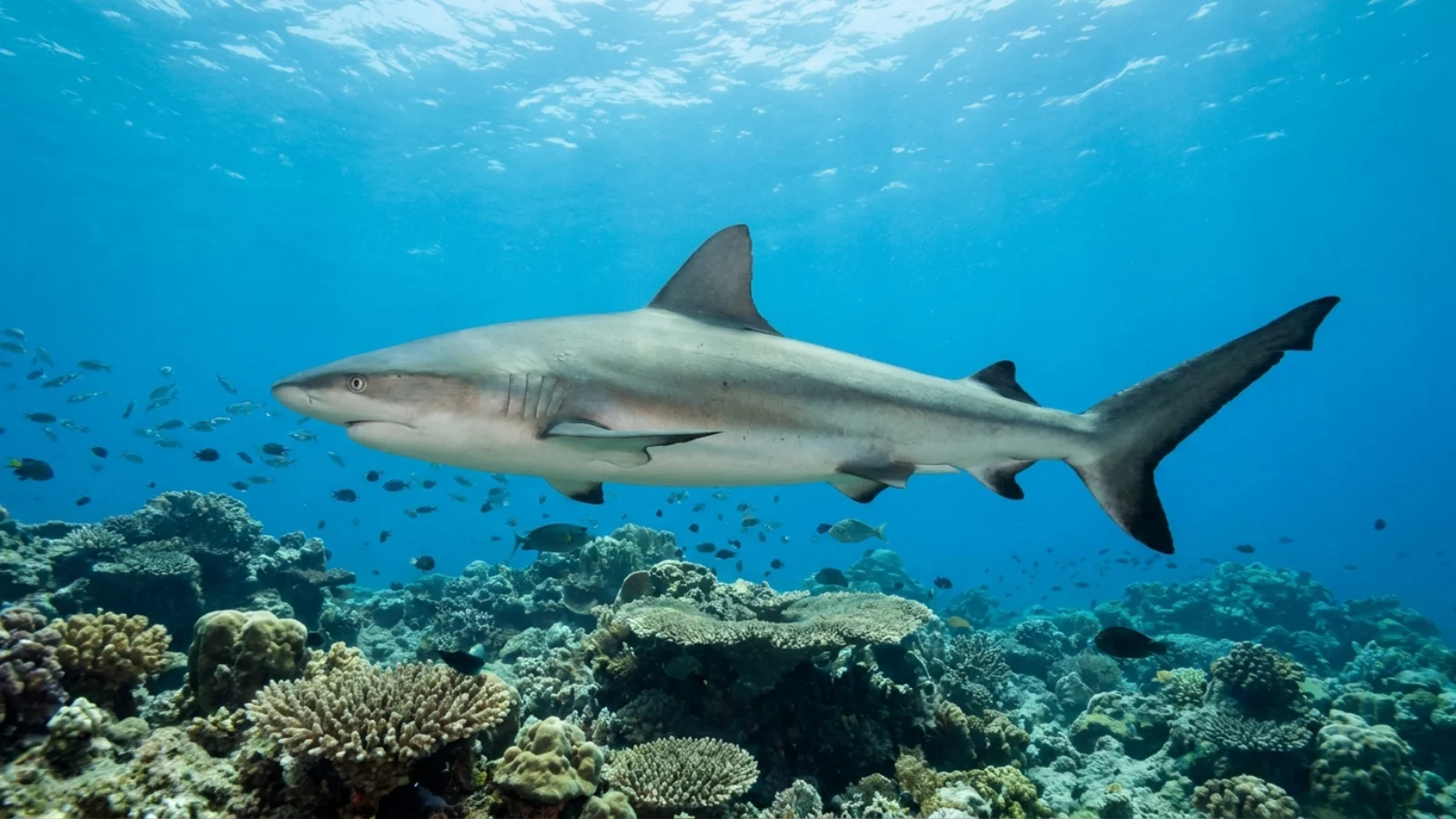
A grey reef shark is a classic torpedo-shaped requiem shark: grey to bronze-grey above, white below, with a broad black band along the trailing edge of the tail, dusky pectoral fins and a plain grey first dorsal fin.
The snout is fairly short and rounded (amblyrhynchos means “blunt-snouted”), the eyes large and round. The plain first dorsal fin separates it from the blacktip reef shark, which has a bold black tip on the dorsal, and from the whitetip reef shark, which has a white one. Some populations in the western Indian Ocean have a thin white edge on the first dorsal. Adults usually measure about 1.5–1.8 m and weigh up to about 34 kg, with a maximum of about 2.55 m.
Where do grey reef sharks live?
Grey reef sharks live on coral reefs across the Indian and Pacific Oceans, from the Red Sea and East Africa to Hawaii and the Pitcairn Islands, mostly near drop-offs, passes and outer reef slopes.
By day, grey reef sharks often gather in loose groups along reef walls and in passes where strong currents bring food, and they disperse at night to hunt across the reef. Most are found in the upper 60 m, though they have been recorded much deeper. Famous places to see them include Palau’s Blue Corner, the channels of the Maldives, the Coral Sea, Rangiroa and Fakarava in French Polynesia, and the reefs of the Red Sea. Our guides to the Maldives and Australian reefs cover these habitats.
What happens at Fakarava’s shark wall?
In the south pass of Fakarava atoll, French Polynesia, hundreds of grey reef sharks gather each year, and during the June–July camouflage grouper spawning they hunt the groupers in coordinated packs at night.
Research led by Johann Mourier estimated about 700 grey reef sharks in the pass, far more than the fish biomass there should be able to support. The explanation is that sharks feed on large pulses of food, such as thousands of spawning groupers, and on prey moving through the pass from the open ocean, so the pass acts as a food funnel. At night the sharks hunt together, chasing groupers into the coral, and filming showed that a shark that catches a fish often has it torn apart by others. Fakarava is part of a UNESCO biosphere reserve, and the “wall of sharks” dive is one of the most famous in the world.
What do grey reef sharks eat?
Grey reef sharks eat mostly small reef fish under about 30 cm, plus squid, octopus, crabs, lobsters and shrimp. They hunt mainly at night and at dawn and dusk.
They are fast, agile predators that rely on bursts of speed, often working in groups to herd and trap fish against the reef. In the open water near reef passes they also take prey moving in from offshore. Larger sharks, especially tiger sharks, sometimes prey on them.
How do grey reef sharks reproduce?
Grey reef sharks are placental viviparous. After about 9–12 months, females give birth to 1–6 pups, each 45–60 cm long, usually every other year.
Both sexes mature at about 7 years, at 1.2–1.45 m, and grey reef sharks live at least 25 years. Pups are born in sheltered lagoons and shallow reef areas, where juveniles stay in groups. With so few pups and late maturity, grey reef shark populations can be fished down very quickly and take decades to recover.
Are grey reef sharks dangerous?
Grey reef sharks can be dangerous if harassed, cornered or competing for food. The ISAF lists 9 unprovoked bites, one of them fatal. Most dives with grey reef sharks are completely peaceful.
Are grey reef sharks endangered?
Yes. The IUCN uplisted the grey reef shark to Endangered in 2020, after estimating major declines across much of its range from reef fisheries and the fin trade.
Grey reef sharks are strongly tied to individual reefs, which makes them easy to catch and slow to replace. The Global FinPrint study, published in Nature in 2020, surveyed 371 reefs in 58 countries and found sharks functionally absent from about one in five. Where they are protected, as in Palau’s national shark sanctuary, French Polynesia and remote Pacific reserves, grey reef sharks remain abundant and support valuable dive tourism.
How does the grey reef shark compare with other reef sharks?
The grey reef shark is the largest and boldest of the classic Indo-Pacific reef trio, alongside the whitetip and blacktip reef sharks.
The whitetip reef shark rests in caves and hunts inside the reef; the grey reef shark patrols the open water off the wall. In the Caribbean, the Caribbean reef shark occupies the same niche. Like the silky shark, it uses a hunched threat display.
| Species | Max length | Max weight | Unprov. bites (ISAF) | Lifespan | IUCN |
|---|---|---|---|---|---|
| Grey reef shark | 2.55 m | ~34 kg | 9 | 25+ yrs | EN |
| Whitetip reef shark | ~1.6 m (rarely 2 m) | ~20 kg | 5 | ~25 yrs | VU |
| Caribbean reef shark | 3.0 m | 70 kg | 4 | ~20 yrs | EN |
| Blacktip shark | 2.8 m | 123 kg | 35 | 12–15 yrs | VU |
| Silky shark | 3.5 m | 346 kg | 3 | 22–23 yrs | VU |
| Tiger shark | 5.5 m | 900 kg | 142 | 27–50 yrs | NT |
Bite counts: Florida Museum International Shark Attack File, species-implicated table (1580–2022). * Genus-level total. IUCN: LC Least Concern, NT Near Threatened, VU Vulnerable, EN Endangered, CR Critically Endangered, DD Data Deficient.
Are grey reef sharks dangerous?
They can be if harassed or cornered. The ISAF lists 9 unprovoked bites, one fatal. Watch for the hunched threat display and back away.
What is the grey reef shark threat display?
The shark raises its snout, drops its pectoral fins, arches its back and swims stiffly side to side or in loops. It warns that the shark may attack if the threat continues.
How big do grey reef sharks get?
Usually about 1.5–1.8 m, with a maximum of 2.55 m (8.3 ft) and about 34 kg.
How can you tell a grey reef shark from a blacktip reef shark?
Grey reef sharks have a plain grey first dorsal fin and a broad black edge on the tail. Blacktip reef sharks have a bold black tip on the dorsal fin.
Where can you dive with grey reef sharks?
Fakarava and Rangiroa (French Polynesia), Blue Corner (Palau), the Maldives, the Coral Sea, the Great Barrier Reef and the Red Sea.
Are grey reef sharks endangered?
Yes, they have been listed as Endangered by the IUCN since 2020.
What do grey reef sharks eat?
Mostly small reef fish under 30 cm, plus squid, octopus, crabs, lobsters and shrimp.
How long do grey reef sharks live?
At least 25 years, maturing at about 7.
Blane Perun has been exploring Earth’s oceans and marine life for over 25 years. Founder of TheSea.Org in 1999, underwater photographer, coral aquaculture pioneer, and explorer of 80+ countries.
About Blane Perun → All Shark Species A–Z →