What Attacks Killer Whales? — Orca Predators, Enemies and the Animals That Fight Back
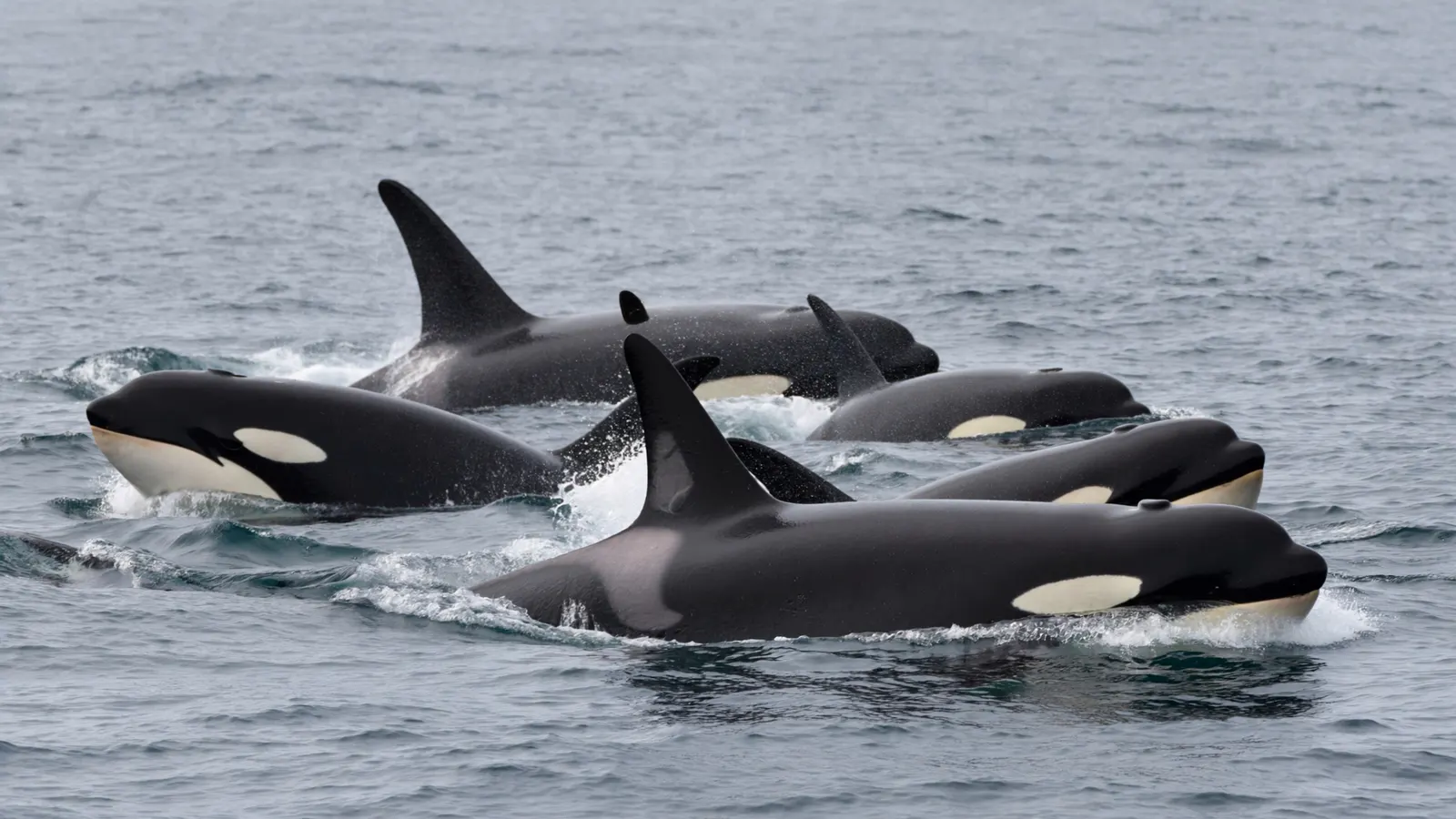
Nothing regularly hunts adult killer whales. Orcas are apex predators. But they are not untouchable: other orcas occasionally fight and even kill one another; humpback whales often charge in to break up orca hunts; pilot whales have been seen mobbing and chasing orcas; and very young or sick orcas could be vulnerable to large sharks. The biggest threats to orcas, though, are human: pollution, prey depletion, vessel noise, entanglement and past live capture.
An animal at the top of its food chain with no natural predators as an adult. Orcas eat fish, squid, seals, sea lions, dolphins, sharks, seabirds and even large whales, depending on the population (ecotype).
Why do adult killer whales have no natural predators?
The killer whale is the largest member of the dolphin family. NOAA Fisheries gives a maximum length of about 32 feet (roughly 9.8 metres) and a maximum weight of around 11 tons, with adult males carrying proportionally taller dorsal fins, broader flippers and bigger flukes than females. An animal of that size, able to accelerate quickly and armed with a mouthful of interlocking conical teeth, is simply too large and too dangerous for any other marine predator to tackle. Even the biggest great white sharks are a fraction of the mass of a bull orca.
Size is only half the story. Orcas live in stable family groups, and in most well-studied populations offspring stay with their mothers for life. A predator would never face a lone adult; it would face a coordinated pod whose members communicate constantly with calls and clicks and have hunted together for decades. That social structure is also why orcas live long lives in the wild. NOAA estimates that males average about 30 years and can reach at least 60, while females average about 50 years and can live to 90 or more. Females give birth to a single calf after a pregnancy of 15 to 18 months, and in some populations a female calves only about once every five years. A species that breeds so slowly can only persist if adults rarely die from predation, and that is exactly the pattern we see.
So when people ask what attacks killer whales, the honest answer has three parts. Almost nothing tries to eat them. A handful of species will fight them, chase them or drive them off, usually in defence of their own young. And the animals that kill the most orcas, by a wide margin, are people, through pollution, prey depletion, oil spills, capture, entanglement and occasionally guns.

Do humpback whales attack killer whales?
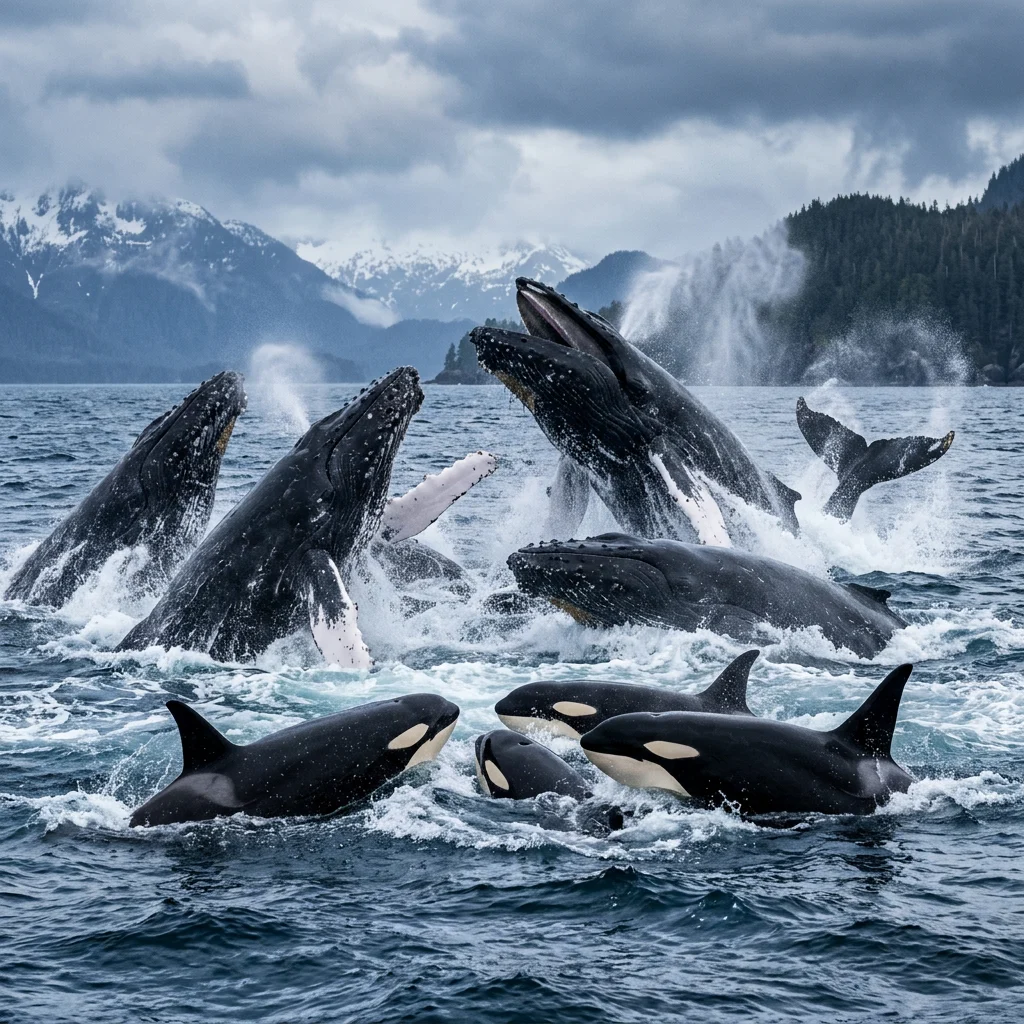
Yes, frequently, when orcas are hunting.
A 2017 study by Robert Pitman and colleagues in Marine Mammal Science reviewed 115 interactions between humpbacks and killer whales. Humpbacks often rushed toward orcas attacking seals, sea lions, gray whale calves and other prey, trumpeting and slashing with their long, barnacle-studded flippers and flukes. The behaviour seems to begin as defence of their own calves and may have generalised into “mobbing” orcas wherever they hunt. See humpback whale.
The numbers in the Pitman study are striking. Of the 115 interactions reviewed, humpbacks initiated 57%, and 95% of the killer whales involved were the mammal-eating type rather than fish-eating residents. When mammal-eating orcas approached humpbacks, they attacked in 85% of cases and targeted only calves. When the humpbacks were the ones approaching, the orcas were nearly always attacking or feeding on prey at the time, and only 11% of that prey was humpback. The other 89% involved ten other species, including three other cetaceans, six kinds of seals and sea lions and one fish. In one widely reported case in Antarctica, a humpback lifted a Weddell seal onto its chest, out of reach of the orcas that had washed it off an ice floe.
The authors suggest that humpbacks respond to the calls that mammal-eating orcas make once an attack is underway, without knowing which species is the target. Defending their own calves makes evolutionary sense, but there is no obvious benefit to rescuing a sea lion, so the researchers could not rule out what they called unintentional interspecific altruism. Whatever the motive, the humpback is the only animal that routinely seeks out orcas to confront them.
Do orcas attack other orcas?
Rarely, but it happens.
The first documented case of infanticide in killer whales was observed on 2 December 2016 off northeastern Vancouver Island, British Columbia, by cetacean ecologist Jared Towers and colleagues, who described it in Scientific Reports in 2018. An adult male Bigg’s (transient) killer whale, about 32 years old and unrelated to the calf’s mother, was seen carrying a newborn calf in his mouth, apparently drowned, with his own mother helping him. The calf’s mother and relatives chased and rammed the male hard enough to draw blood, but could not make him release it. The orcas did not eat the calf.
The researchers suggested the killing was sexually selected: by removing a nursing calf, a male may bring its mother back into breeding condition sooner, a strategy known in lions and some primates. Tooth-rake scars on many orcas show that rough contact within and between groups is common, but lethal violence between killer whales appears to be rare. Different ecotypes that share the same waters, such as fish-eating residents and mammal-eating Bigg’s orcas in the Pacific Northwest, generally avoid each other rather than fight.
Do sperm whales fight back against killer whales?
Sperm whales are among the few animals orcas attack that can seriously injure them in return. Adult male sperm whales are as long as or longer than the biggest orcas, and their lower jaws carry large teeth. The best-documented attack took place in October 1997 about 130 kilometres off central California, when roughly 35 killer whales assaulted a group of nine sperm whales for about four hours. The sperm whales formed a defensive rosette, often called a marguerite formation, with their heads together at the centre and their tails pointing outward, so that the orcas faced a ring of thrashing flukes. The defence was only partly successful: one sperm whale was killed and eaten, and the others were badly, perhaps fatally, wounded.
The incident, published by Robert Pitman and colleagues in Marine Mammal Science in 2001, shows that the marguerite is a real anti-predator strategy rather than a myth, but it also shows who usually wins. There are no confirmed cases of sperm whales killing a killer whale, although orcas may well be injured by flukes and teeth during such fights. For the reverse question, whether sperm whales prey on sharks, see do sperm whales eat sharks?
Is there any shark that actually bites killer whales?
One, and it is not a large predator. The cookiecutter shark is a small, cigar-shaped dogfish of the open ocean, rarely longer than about half a metre, that attaches itself to much larger animals with its suctorial lips, spins, and removes a neat plug of flesh with its saw-like lower teeth. It leaves round or oval scars on tuna, dolphins, whales and even submarine sonar domes. Killer whales that spend time far offshore can be covered in these scars.
In 2024, Josh McInnes and Andrew Trites of the University of British Columbia described in Aquatic Mammals a group of 49 killer whales photographed off California and Oregon between 1997 and 2021, many of them marked with healed cookiecutter wounds. Because cookiecutter sharks live in deep oceanic waters, the scars suggested that these orcas spend much of their time well offshore, and the researchers proposed that they may be a distinct, little-known oceanic population. The bites are painful-looking but superficial; nobody has suggested they kill orcas. In that sense the cookiecutter is a parasite, not a predator, and it is the only shark known to take flesh from a living adult killer whale on a regular basis.
Can sharks or other whales attack orcas?
Only in unusual circumstances.
| Animal | Interaction with orcas |
|---|---|
| Pilot whales | Have been seen mobbing and chasing orcas off Iceland and elsewhere |
| Sperm whales | Form defensive “marguerite” circles; adults may injure attacking orcas |
| Great white sharks | Avoid orcas, which kill and eat them; flee areas when orcas appear |
| Large sharks | Could in theory take a sick or orphaned calf, but no confirmed cases |
| Cookiecutter sharks | Bite small plugs of flesh from offshore orcas; parasitic, not lethal |
In fact the reverse is common: orcas off South Africa have killed great white sharks for their livers. See orca and will dolphins kill sharks.
Do great white sharks attack orcas?
No. The evidence runs the other way: when orcas show up, great whites leave, sometimes for the rest of the season.
White sharks at Southeast Farallon Island have been studied intensively, and between 2006 and 2013 researchers fitted 165 of them with acoustic tags. A 2019 study in Scientific Reports led by Salvador Jorgensen of the Monterey Bay Aquarium, with Point Blue Conservation Science, combined that tracking with long-term seal and shark observations. In November 2009, after orcas from two pods passed the island, all 17 tagged sharks that had been feeding there for months disappeared within about eight hours, and most did not return until the next season. The same pattern was seen on three more occasions in later years, even though the orcas were only passing through. On average researchers there record around 40 elephant seal kills by white sharks a season; after the orcas showed up, the kills stopped. Point Blue’s summary of the study put the drop in shark predation in orca years at about 62%, and in 1997, when a pair of orcas killed a white shark near the island and ate its liver, at about 95%.
Off Gansbaai, South Africa, two male orcas known as Port and Starboard, named for their collapsed dorsal fins, have been linked to white shark deaths since 2017. Researchers led by Alison Towner of Rhodes University recorded eight white shark carcasses there, seven of them with the liver removed, and some missing their hearts. The same pair has also killed broadnose sevengill sharks, with 17 dead sevengills recorded after a single attack. White shark sightings in bays where they had been common for decades have fallen sharply, and tracking shows tagged sharks leaving the area after orca visits. A shark’s liver is huge and rich in oil, which probably explains why orcas target it.
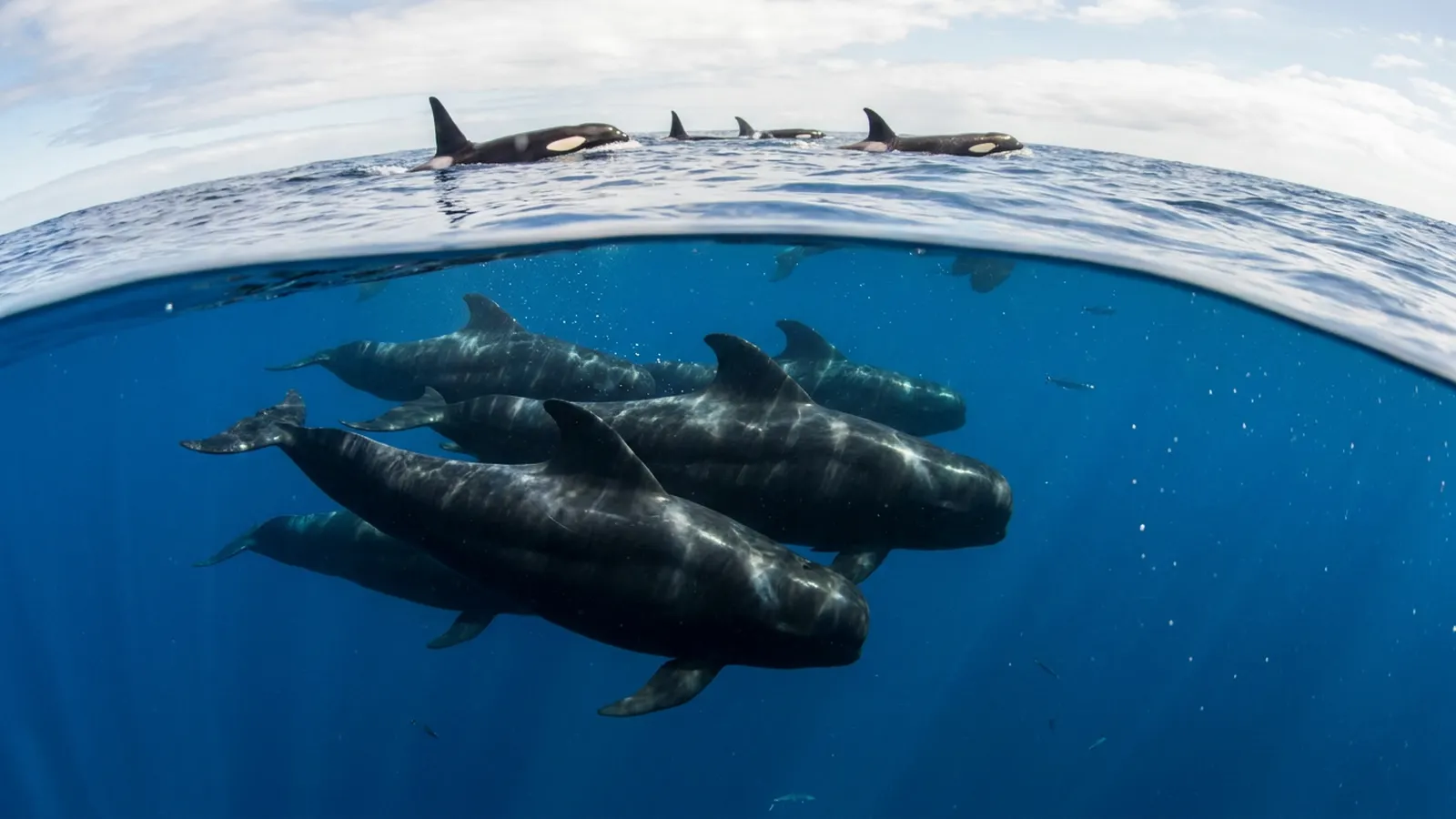
Are orcas afraid of pilot whales?
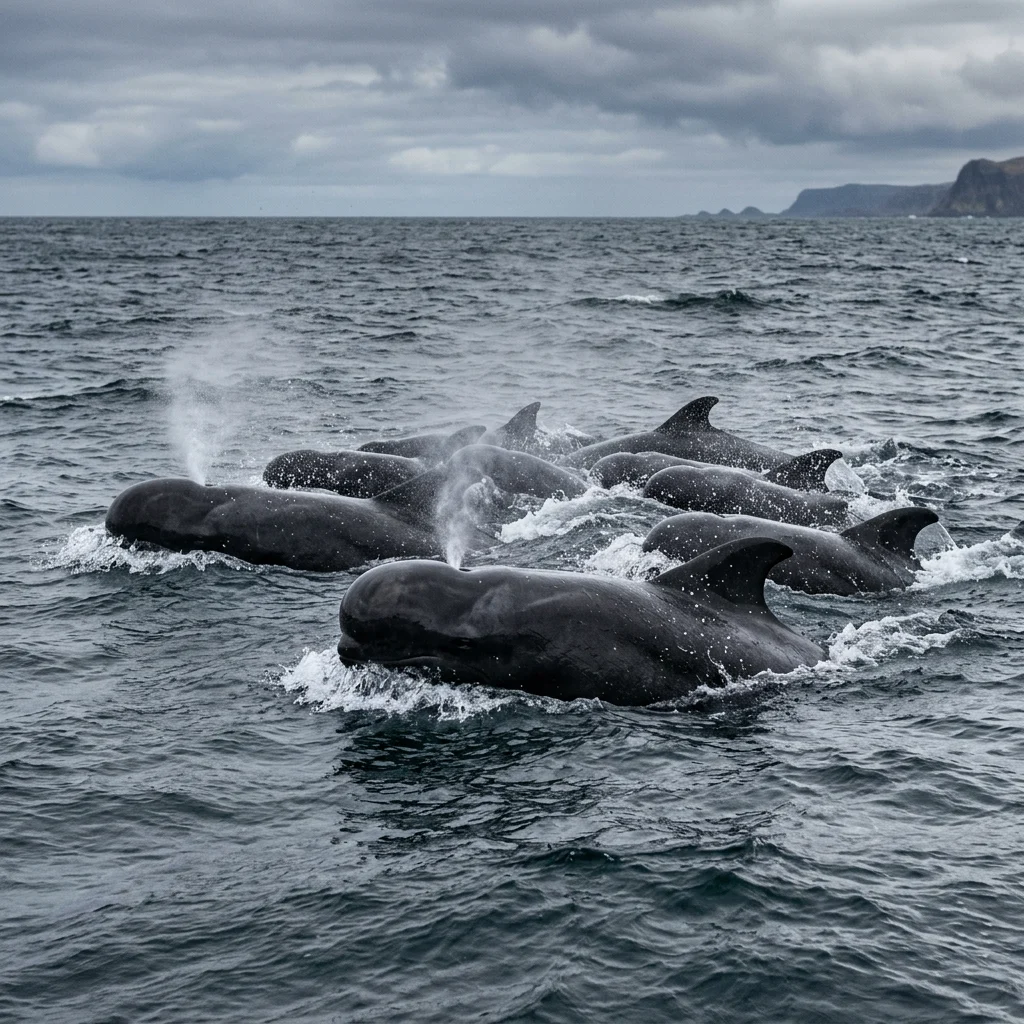
They seem to avoid them. Off Iceland, orcas usually move away when long-finned pilot whales arrive.
A 2022 study led by Anna Selbmann analysed 24 encounters in Icelandic waters between 2007 and 2020. In 68% of them the orcas left before the pilot whales even reached them, and in 28% the two species raced off at high speed, porpoising at up to about 25 km/h. No physical attacks have been recorded, and the reason is still debated: mobbing, competition or protection of pilot whale calves are all possibilities. For the narrower question of predators, see what eats orcas?
A follow-up experiment by the same research group, published in Scientific Reports in 2026, tested whether sound alone was enough. Researchers attached suction-cup tags to eight killer whales off Iceland and played them 15-minute recordings of pilot whale calls, control noise or synthetic tones. When they heard pilot whales, the orcas abandoned feeding and travelled directly away at nearly double their normal speed, bunched into tighter groups and, in five of the eight groups, fell completely silent after the playback ended. That is exactly the response one would expect from animals that regard pilot whales as a threat, even if no actual fight has ever been filmed.
What are the biggest threats to killer whales?
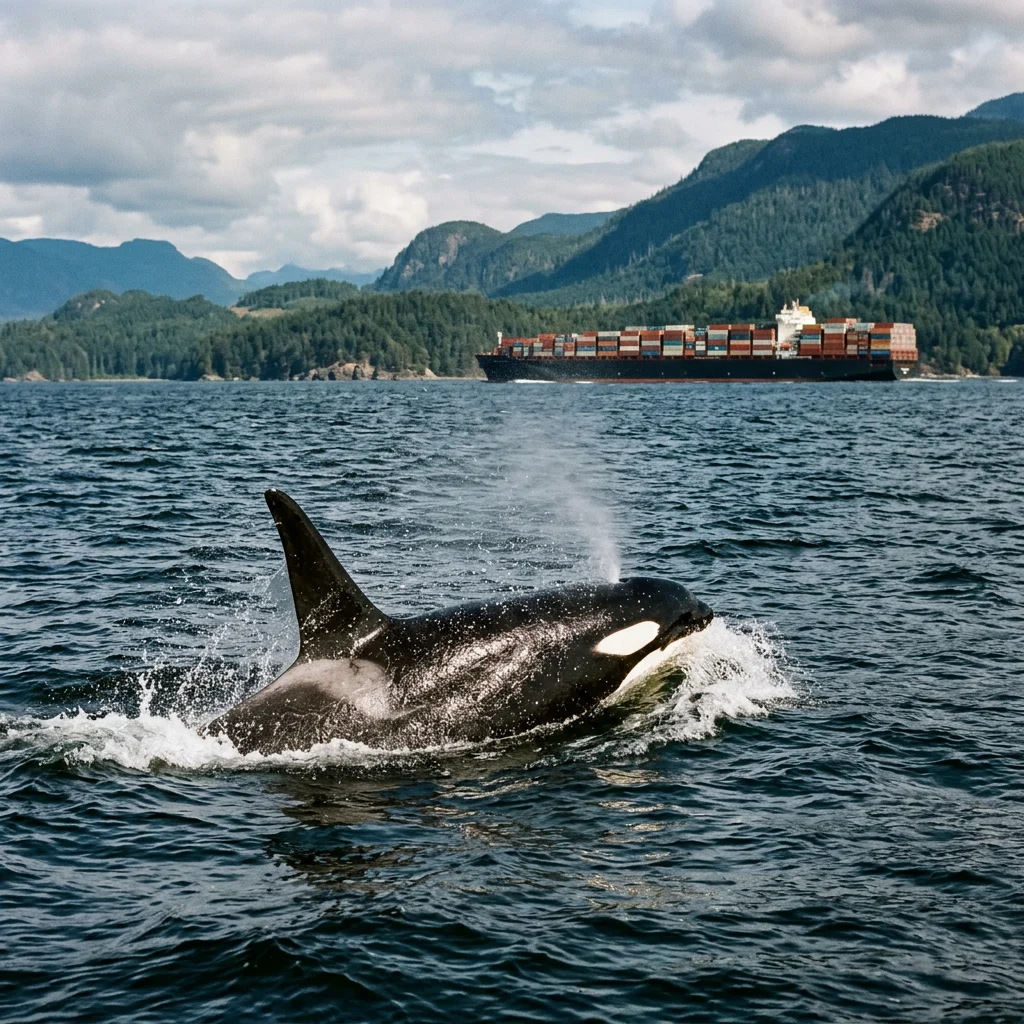
People.
Every serious review of killer whale conservation reaches the same conclusion: the animals that limit orca numbers today are humans. NOAA Fisheries lists the main threats as bycatch and entanglement in fishing gear, lack of prey caused by overfishing and habitat loss, chemical contaminants, oil spills, and disturbance from vessel traffic and underwater noise. The sections below look at each in turn, using populations where the evidence is strongest.
How does pollution harm killer whales?
Because they feed at the top of long food chains, orcas accumulate persistent pollutants such as PCBs (polychlorinated biphenyls) in their blubber. More than a million tonnes of PCBs were produced from the 1930s onward, and although they were banned decades ago, they are still leaking into the sea. In 2018 a study in Science led by Jean-Pierre Desforges of Aarhus University modelled the effects of PCBs on 19 killer whale populations, using data from more than 350 whales. It found that over half of the populations studied were severely affected, and that in the most contaminated regions, including waters off Brazil, the Strait of Gibraltar, the UK, Japan and the northeast Pacific, populations faced a high risk of collapse within 30 to 50 years. Effects on fertility and immunity can begin at around 50 mg/kg in tissue, while some killer whales have carried levels as high as 1,300 mg/kg.
The clearest single example is Lulu, a member of the tiny West Coast Community of orcas in Scotland, which numbers about eight animals. She was found dead on the Isle of Tiree in January 2016, killed by entanglement in creel rope. Tests by the UK’s Cefas laboratory found PCB levels in her blubber above 950 mg/kg lipid, more than 80 times the accepted toxicity threshold for marine mammals. She was at least 20 years old, yet her ovaries showed she had never reproduced, and no calf has been recorded in her group in more than two decades of monitoring. That group is expected to disappear.
Why are the Southern Resident orcas endangered?
The Southern Resident killer whales of Washington State and British Columbia are the most closely studied orcas in the world, and they illustrate how human pressures add up. The Center for Whale Research counted 74 whales on 1 July 2025: 27 in J pod, 14 in K pod and 33 in L pod. The population peaked at about 98 animals between the late 1970s and mid-1990s and had fallen to 78 by 2001. NOAA listed the Southern Residents as endangered under the US Endangered Species Act in November 2005.
These orcas eat fish, mainly Chinook salmon, and declining salmon runs mean many whales are short of food. Hungry whales burn their blubber, which releases stored contaminants into the bloodstream, and vessel noise makes it harder to find fish by echolocation. Calf survival has been poor. In 2018 the female known as J35, or Tahlequah, carried her dead newborn for about 17 days and roughly 1,000 miles (1,600 km), an event that drew worldwide attention. In late December 2024 she lost another calf, J61, and again carried its body for more than 11 days into January 2025.
How did oil spills and captures affect killer whales?
When the Exxon Valdez ran aground in Prince William Sound, Alaska, in March 1989, two groups of orcas swam through the oil. A long-term study by Craig Matkin and colleagues, published in Marine Ecology Progress Series in 2008, found that the resident AB pod lost 33% of its members in the year after the spill and the mammal-eating AT1 group lost 41%, including nine whales. AB pod had still not recovered 16 years later, and the AT1 group has continued to decline and is listed as depleted under the Marine Mammal Protection Act.
Live captures for marine parks removed whole generations from some populations. The Southern Residents lost 48 members to captivity in the 1960s and early 1970s; in the best-known roundup, at Penn Cove, Washington, in August 1970, seven young orcas were taken and five others died, including an adult female that drowned in a net trying to reach her calf. One of the captured calves, known as Lolita or Tokitae, spent more than five decades at the Miami Seaquarium and died there in August 2023. Iceland supplied another 48 orcas to marine parks between 1976 and 1988. The Southern Residents, reduced to about 71 whales by 1974, have never fully recovered.
Are people still harming the Iberian orcas?
The orcas of the Strait of Gibraltar and the Iberian coast are a small, isolated population that follows Atlantic bluefin tuna. A complete census in 2011 counted 39 animals in five pods, and a more recent estimate puts the population at about 37. The IUCN listed the subpopulation as Critically Endangered in 2019. Since May 2020 some of these orcas have been ramming and biting the rudders of sailing boats, and several yachts have sunk, which has made the whales unpopular with some sailors.
In August 2026 the conservation group WeWhale reported that Toñi, an orca of about 60 and the oldest known member of the population, had at least ten fresh marks on her dorsal fin and back consistent with shotgun pellets. Spain’s environment ministry opened an investigation, and the minister said the marks were “compatible with pellet shots”, although gunfire had not been officially confirmed. For a population this small, the loss of a single experienced matriarch could matter a great deal.
Common misconceptions about what attacks orcas
Several popular claims do not stand up. Great white sharks do not hunt orcas; the documented evidence runs entirely the other way. Humpbacks are not “enemies” of orcas in a general sense; they interfere mainly when mammal-eating orcas are already attacking something. Killer whales are not a single uniform species in their habits, either. Fish-eating populations rarely interact with humpbacks or pilot whales at all, while mammal-eating Bigg’s orcas are the ones that provoke mobbing. Finally, the idea that orcas face no threats because they have no predators confuses predation with mortality. Calves still die young, adults still starve, and whole populations have declined within a human lifetime, almost entirely because of what people have put into, or taken out of, the sea.
What eats orcas?
Nothing preys on adult orcas. Humans have hunted them, and calves could in theory be taken by large sharks, but no case has been confirmed. Full answer: what eats orcas.
Are great white sharks afraid of orcas?
They behave as if they are. Tagged white sharks at the Farallon Islands left within hours of orcas passing and mostly stayed away for the rest of the season; in South Africa they abandon bays after orca visits.
Do killer whales have any predators?
No regular predators as adults; they are apex predators.
What animal can kill a killer whale?
Mainly other orcas; humpbacks and sperm whales may injure them in defence.
Are killer whales afraid of anything?
They avoid conflict with groups of pilot whales and are sensitive to disturbance by boats.
Do sharks eat killer whales?
No confirmed cases of predation. Small cookiecutter sharks bite plugs of flesh from offshore orcas, but orcas are far more likely to eat sharks.
Why do humpbacks attack orcas?
Probably to protect calves, a behaviour that seems to extend to other species.
Are killer whales endangered?
The species is Data Deficient, but some populations, like the Southern Residents, are endangered.
- Pitman, R. L. et al. (2017). Humpback whales interfering when mammal-eating killer whales attack other species: mobbing behavior and interspecific altruism? Marine Mammal Science 33: 7–58.
- Towers, J. R. et al. (2018). Infanticide in a mammal-eating killer whale population. Scientific Reports 8: 4366.
- Jepson, P. D. et al. (2016). PCB pollution continues to impact populations of orcas and other dolphins in European waters. Scientific Reports 6: 18573.
- NOAA Fisheries. Species directory: whales, dolphins and porpoises. fisheries.noaa.gov.
Blane Perun has been exploring Earth’s oceans and marine life for over 25 years. Founder of TheSea.Org in 1999, underwater photographer, coral aquaculture pioneer, and explorer of 80+ countries.
About Blane Perun → More on Whales →