Do Gray Whales Have Baleen? — Yes: Short, Creamy Plates Built for Sieving Mud
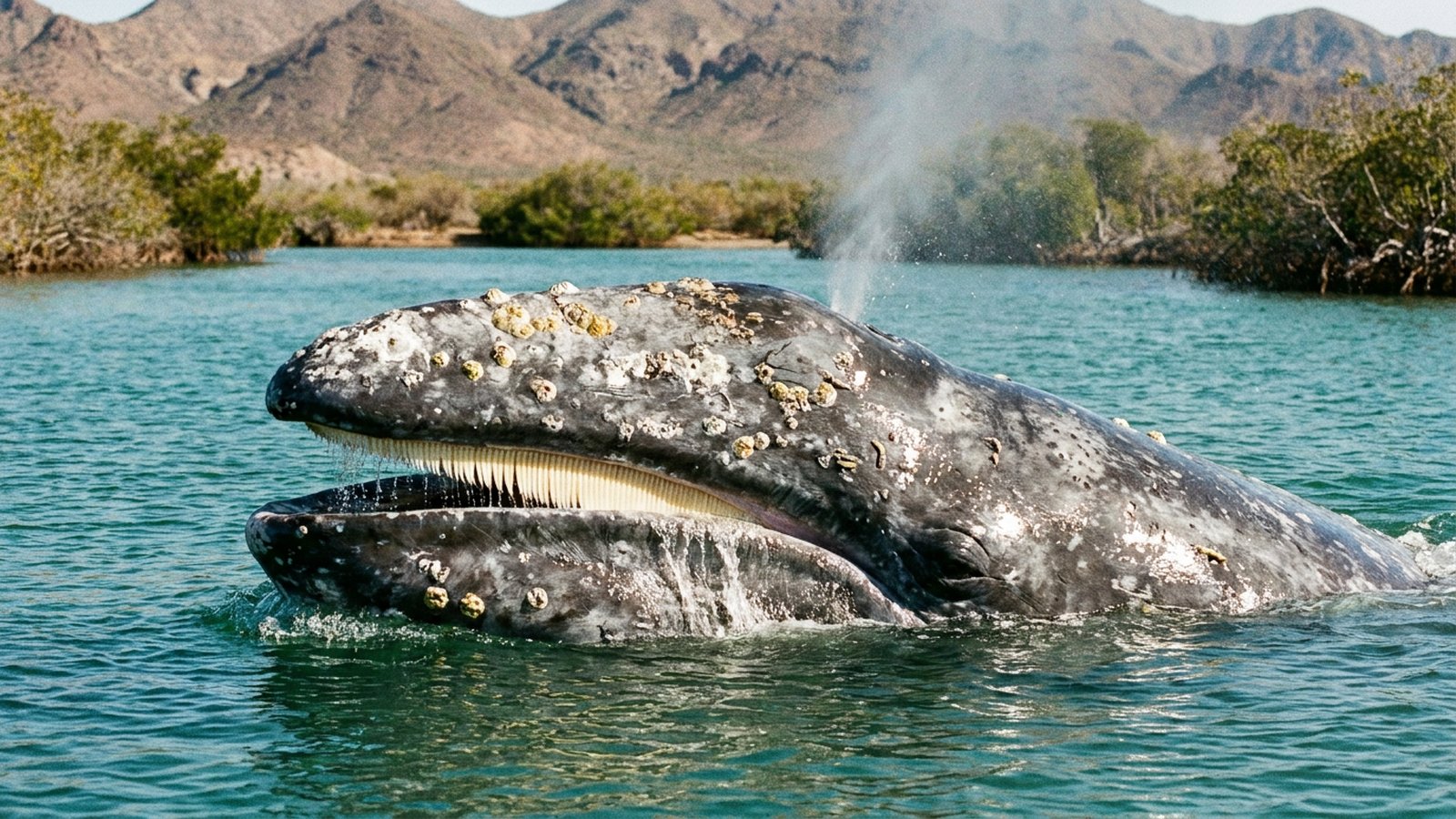
Yes, gray whales have baleen. Each side of the upper jaw carries about 130–180 short, thick, cream to pale-yellow plates, usually only 5–25 cm long, with coarse bristles. That stubby, tough baleen suits their unique feeding style: gray whales are the only baleen whales that feed mainly on the sea floor, rolling on their side, sucking up mud and straining out amphipods and other invertebrates.
Plates of keratin, the same protein as hair and fingernails, hanging from the upper jaw of baleen whales in place of teeth. Their inner edges fray into bristles that form a sieve to trap food while water and sediment are pushed out. See baleen whales.
How does gray whale baleen compare with other whales?
It is the shortest and coarsest among the large baleen whales.
| Whale | Baleen length | Plates per side | Diet |
|---|---|---|---|
| Gray whale | ~5–25 cm | ~130–180 | Amphipods, sediment-dwellers |
| Blue whale | ~up to 1 m | ~270–395 | Krill |
| Humpback | ~up to 80 cm | ~270–400 | Krill, small fish |
| Right whale | ~2–2.8 m | ~200–270 | Copepods |
| Bowhead | Up to ~4 m | ~230–360 | Copepods, krill |
How do gray whales use their baleen to feed?
By vacuuming the sea floor.
A feeding gray whale rolls onto its side (most are “right-sided,” with more worn baleen on that side), retracts its tongue to create suction, and draws in a mouthful of sediment. It then pushes the water and mud out through its baleen, trapping amphipods, worms and shrimp-like animals. The feeding leaves pits on the sea floor and visible mud plumes at the surface. Gray whales also skim-feed and take plankton or herring eggs when bottom prey is scarce.
Why does gray whale baleen wear down?
Because it constantly scrapes sand and mud.
Abrasive sediment wears gray whale baleen faster than that of open-water feeders, and plates on the favoured feeding side are often noticeably shorter. Baleen grows continuously from the gum, like fingernails, so it is replaced over time. Gray whales also carry heavy loads of barnacles and whale lice, especially on the head. See what barnacles do for whales.
Are gray whales doing well?
The eastern Pacific population is down from recent highs.
After commercial whaling, eastern North Pacific gray whales recovered to roughly 27,000 by 2016, one of the great conservation successes. Since then, an unusual mortality event and changes in Arctic prey have driven numbers down to about 13,000 in NOAA’s winter 2025 count, the lowest since the 1970s. The western North Pacific population is much smaller, a few hundred whales. Gray whales vanished from the Atlantic by the 1700s, though a few wanderers have appeared since 2010. See gray whales’ two blowholes.
What is baleen made of, and why does it not break?
Baleen is made of alpha-keratin, the same family of proteins found in hair, nails, hooves and horn. Each plate grows from a gum-like tissue in the roof of the mouth and is built from hollow tubules wrapped in sheets of keratin. As the inner edge of the plate wears against the tongue, the sheets break down and the tubules are freed as the bristly fringe that does the actual filtering. In gray whales those fringes are coarse and thick, more like a stiff broom than the fine hair of a right whale.
Most hard keratins, such as fingernails and horn, become stiff partly because they dry out. Baleen never dries, because it lives permanently in water. A 2010 study in Proceedings of the Royal Society B by Szewciw and colleagues showed that whales solve this problem by adding mineral. Baleen is reinforced with calcium salts, and in some species it is the most heavily calcified hard keratin known in any mammal. The researchers also found striking differences in the calcification patterns between whale species, suggesting that each species’ baleen is tuned to how it feeds. For a bottom feeder whose baleen constantly scrapes against sand and shells, toughness and resistance to wear matter more than fineness.
How does gray whale baleen differ from that of rorquals?
Rorquals, the group that includes blue, fin and humpback whales, are lunge feeders. They swallow enormous volumes of water and prey in a single gulp, expanding their throats with dozens of pleats, then push the water out through baleen with fine fringes. Their baleen needs to be long and fine enough to trap small krill and fish quickly from a huge mouthful of water.
Gray whales do something quite different. Their throat has only two to five short grooves, so they cannot expand their mouths in the same way, and they rely on suction instead. The tongue pulls back sharply, drawing in water, sediment and prey, and then pushes forward to force the mixture out through the baleen. That action puts heavy, abrasive loads on the plates. Short, thick, stiff baleen is far better suited to this than the long, flexible plates of right whales or rorquals. In effect, the gray whale’s baleen is built more like a sieve for gravel than a net for plankton.
Did whale ancestors have baleen or teeth?
Ancestors of today’s baleen whales had teeth. The earliest members of the mysticete lineage, which lived more than 30 million years ago, were toothed predators, and gray whale fetuses still develop tooth buds that are reabsorbed before birth. How these toothed animals gave rise to baleen is one of the key questions in whale evolution.
A study published in Current Biology in 2018 by Carlos Peredo and colleagues described a fossil whale named Maiabalaena from Oregon, about 33 million years old, that had lost its teeth but showed no signs of baleen. The authors argued that early mysticetes went through a toothless stage in which they relied on suction feeding before baleen evolved. That idea is interesting for gray whales, which are the living baleen whales that depend most on suction. Their feeding style may echo a very ancient stage in the evolution of the whole group, even though modern gray whales are not direct descendants of those suction feeders.
Where do gray whales feed in summer?
Most eastern North Pacific gray whales spend the summer and autumn in the northern Bering Sea and the Chukchi Sea, where shallow, nutrient-rich continental shelves support dense communities of bottom-dwelling animals. Much of their food consists of small tube-dwelling amphipods that live in great densities in the sediment, along with other crustaceans, worms and molluscs. A gray whale can feed almost continuously during the long Arctic days, building up the fat reserves that will carry it through migration and the winter breeding season.
The whales are not limited to Arctic waters. A small group of a few hundred animals, known as the Pacific Coast Feeding Group, spends the summer off northern California, Oregon, Washington and British Columbia instead of travelling to the Arctic. These whales feed in kelp forests and nearshore waters on mysid shrimp, crab larvae and ghost shrimp, and sometimes skim swarms of prey from the water column. Their baleen and feeding methods are the same, but the prey and habitat are different, showing that gray whales are more flexible feeders than their bottom-feeding reputation suggests.
How do gray whales change the sea floor?
When a gray whale feeds on the bottom, it leaves a shallow pit in the sediment where it has sucked up a mouthful of mud. In areas with many feeding whales, the sea floor can be covered with these feeding pits, and the plumes of mud released at the surface can be seen from aircraft. Studies in the Bering and Chukchi seas in the 1980s, including work by Hans Nelson and Kirk Johnson, described gray whales and walruses as tillers of the sea floor because of the amount of sediment they disturb.
That disturbance has ecological effects. It releases nutrients from the sediment into the water, brings buried invertebrates to the surface where seabirds and fish can eat them, and creates patches of disturbed seabed that are colonised by new animals. In this sense gray whales act as ecosystem engineers, much like animals that churn up soil on land. Seabirds often gather around feeding whales to pick off prey stirred up by the plumes.
Can baleen record a whale’s life history?
Yes. Because baleen grows continuously from the gum and is not replaced all at once, each plate is like a strip of recording tape. The keratin laid down at the base today records the chemistry of the whale’s body today, while the tip of the plate holds a record from months or years ago. Scientists can cut a plate into small sections along its length and measure stable isotopes of carbon and nitrogen, which reflect where the whale was feeding and what it was eating.
Researchers working on bowhead and right whales have taken this further, measuring hormones such as cortisol and progesterone in baleen to reconstruct periods of stress and pregnancy. In gray whales, isotopic patterns in baleen can show the alternation between rich summer feeding in the Arctic and the long winter fast of migration. Because the stubby gray whale baleen wears away quickly at the tip, its record covers a shorter span than the long plates of bowheads, but it still gives researchers a window into how individual whales cope with changing food supplies.
Why did so many gray whales die after 2019?
Between 2019 and 2023 gray whales stranded in unusually high numbers along the west coast of North America, and NOAA declared an unusual mortality event. Many of the dead whales were thin or emaciated, and researchers linked the deaths to changes in the whales’ food supply. Some whales had arrived in Mexican lagoons in poor condition, and others were seen feeding far outside their usual range, apparently searching for food.
A study published in Science in 2023 by Joshua Stewart and colleagues compared decades of gray whale population data with conditions in the Arctic feeding areas. It found that the gray whale population is closely tied to the amount of prey on the sea floor and the whales’ access to feeding grounds. When low prey biomass coincided with heavy ice cover, gray whales suffered major die-offs, each reducing the population by 15 to 25 percent. The authors suggested that even a long-lived, mobile species is sensitive to rapid change in the Arctic. For a bottom feeder with specialised baleen, a decline in the amphipods and other animals of the sea floor is especially serious.
Does baleen ever stop working?
Baleen keeps growing throughout life, so normal wear is replaced. In gray whales the plates on the side a whale prefers to feed on are often worn shorter than those on the other side, and some whales have uneven or broken baleen. As long as the plates continue to grow and the fringes stay intact, the whale can still feed. Damage from entanglement in fishing gear, injuries to the mouth or disease can interfere with feeding, but such cases are rare compared with starvation caused by a lack of prey.
For people who see gray whale baleen in a museum or on a beach, its appearance can be surprising. Compared with the long black baleen of a bowhead or the glossy plates of a humpback, gray whale baleen looks short, pale and worn, sometimes with flecks of sand still caught in the fringes. That modest appearance hides one of the most specialised feeding structures among whales, built to handle mud, shells and gravel that would quickly destroy finer baleen.
How does gray whale baleen compare with a bowhead’s?
The contrast between the two Arctic baleen whales could hardly be greater. A bowhead whale, which feeds on tiny copepods and krill skimmed from the water, carries the longest baleen of any whale, with plates reaching about 4 m. Gray whales share the same Arctic summer waters, yet their plates rarely exceed about 25 cm. The difference reflects their prey: fine, long baleen is needed to catch drifting plankton, while short, coarse baleen survives the grit of the sea floor. Two whales living side by side have evolved opposite solutions to the same problem of filtering food from seawater, which is why baleen shape is such a reliable clue to how a whale feeds.
How do scientists study gray whale feeding today?
Researchers combine several tools. Drones are now widely used to measure the body condition of gray whales from above, photographing their width and length to estimate how fat or thin they are. Suction-cup tags with cameras and motion sensors show how whales roll, dive and suck up prey on the sea floor. Grab samples of sediment from feeding areas reveal how much prey is available and how it has changed over time.
Together these methods show how closely the health of the whales depends on the health of the sea floor. In Oregon, studies of the Pacific Coast Feeding Group have followed individual whales across years and linked their body condition to the abundance of prey in kelp forests and reefs. In the Arctic, long-term benthic surveys have tracked shifts in amphipod communities as the water warms and sea ice retreats. For gray whales, baleen is only part of the story; the real question is whether the animals it filters will remain plentiful.
Are gray whales baleen whales?
Yes, they are baleen whales in the family Eschrichtiidae.
How many baleen plates does a gray whale have?
About 130–180 on each side of the upper jaw.
What colour is gray whale baleen?
Cream to pale yellow.
Do gray whales have teeth?
No; baleen whales have teeth only briefly as foetuses.
What do gray whales eat?
Mainly amphipods and other invertebrates from sea-floor sediments.
How many gray whales are left?
About 13,000 in the eastern North Pacific (2025) and a few hundred in the west.
Where can you see gray whales feeding?
Off Alaska and the Chukchi Sea in summer, and some summer residents off Oregon, Washington and British Columbia.
How long is gray whale migration?
Roughly 16,000–22,000 km round trip between Arctic feeding grounds and Baja California lagoons, among the longest of any mammal.
- NOAA Fisheries (2025). Eastern North Pacific gray whales continue decline after downturn during unusual mortality event: ~13,000 (range 11,700–14,500).
- Nerini, M. (1984). A review of gray whale feeding ecology. In Jones, M. L. et al. (eds.) The Gray Whale. Academic Press.
- Jefferson, T. A., Webber, M. A. & Pitman, R. L. (2015). Marine Mammals of the World: A Comprehensive Guide to Their Identification, 2nd ed. Academic Press.
Blane Perun has been exploring Earth’s oceans and marine life for over 25 years. Founder of TheSea.Org in 1999, underwater photographer, coral aquaculture pioneer, and explorer of 80+ countries.
