Snorkel Gear — What a Diver Actually Uses
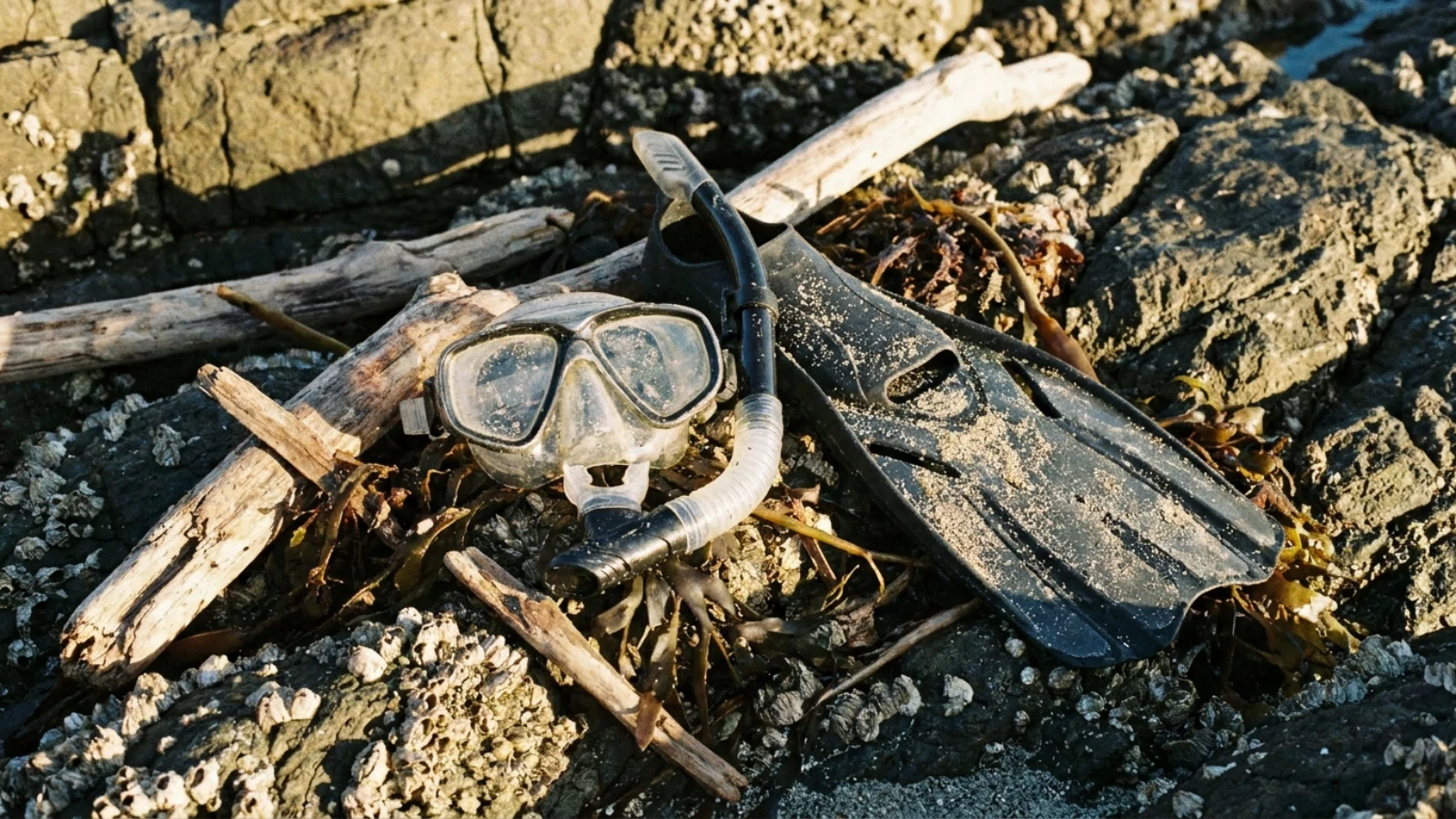
You need four things: a mask that seals on your face, a simple snorkel, fins, and sun protection you wear rather than rub on. Spend your money on the mask, because fit is everything; a basic snorkel and full-foot fins are fine for most warm-water trips. Add a snorkel vest for children and weak swimmers. Divers often use the same low-volume, tempered-glass mask for snorkeling and scuba, and a mask that fits is worth more than any other item you pack.
Snorkel kit — the checklist
- Mask: Tempered glass, soft silicone skirt, low internal volume
- Snorkel: J-tube or semi-dry with a purge valve; comfortable silicone mouthpiece
- Fins: Full-foot for warm beaches; open-heel with booties for rocky entries and boats
- Flotation: Inflatable snorkel vest for kids, older or nervous swimmers
- Sun: Rash guard or 1–3 mm wetsuit top; mineral sunscreen on exposed skin
- Extras: Anti-fog gel, mesh bag, dry bag for phone and keys
- Tempered glass: Look for “tempered” on the lens; it is safety glass that crumbles rather than shards if broken
- Hawaii sunscreen law: Oxybenzone and octinoxate sunscreens banned statewide since January 1, 2021
- Maui County: Only mineral sunscreens (zinc oxide, titanium dioxide) may be sold or used since October 1, 2022
- Full face masks: A 2022 Duke-led lab study found two of three design types did not work as advertised
What snorkel gear do you really need?
A mask, a snorkel and fins, plus sun protection. A flotation vest is essential for children and anyone not comfortable in deep water. Everything else is optional.
Rental gear works, but a poorly fitting rental mask is a common reason first-timers give up: a leaking, fogging mask turns a great reef into a miserable hour. If you buy one piece, buy the mask. Snorkels and fins matter less, and fins are bulky to travel with, so many experienced snorkelers carry a mask and snorkel and rent fins at the destination. For technique once you have the kit, see snorkeling for beginners and our older snorkeling basics page.
How do you choose a snorkel mask?
Choose a mask that seals on your face without the strap. Place it on your face, breathe in gently through your nose and let go: if it stays put, it fits.
Do that test with the strap hanging loose and your hair pushed back. A good mask has a soft silicone skirt (clear or black; black reduces glare), a tempered-glass lens, and a nose pocket you can pinch to equalise if you free-dive a few feet. Low-volume masks, where the lens sits close to your eyes, are easier to clear and have a wider field of view than they look. If you have a moustache, a little petroleum-free balm on the hair helps the seal. Prescription lenses are available for many popular masks.
Which snorkel is best: dry, semi-dry or classic?
A semi-dry snorkel with a splash guard and a purge valve is the best all-round choice for beginners. Experienced snorkelers and free-divers often prefer a simple J-tube.
| Type | How it works | Good for | Watch out for |
|---|---|---|---|
| — | — | — | — |
| Classic J-tube | Open tube; you blast water out | Free-diving, experienced snorkelers | Takes on splash in chop |
| Semi-dry | Splash guard on top, purge valve at the bottom | Most beginners and families | Slightly more breathing resistance |
| Dry | Float valve seals the top when submerged | Very nervous snorkelers | Valve can stick; a trapped air volume makes diving down awkward |
| Full face mask | Mask and snorkel in one | See our safety review | Lab tests showed problems with several designs |
Breathing resistance matters more than marketing. Hawaii’s state snorkel safety research identified breathing effort as one factor in rapid-onset pulmonary edema, a cause linked to many visitor snorkel deaths, so a wide-bore tube that is easy to breathe through is a good thing. We look at that question in detail in are full face snorkel masks safe?
Full-foot or open-heel fins?
Full-foot fins (shoe-style) suit warm water and sandy beaches. Open-heel fins worn with neoprene booties are better where you walk over rock, lava or broken shell, or jump off a boat.
Short, flexible fins are easier on the legs and kinder to the reef because you kick less sand and coral. Long free-diving fins are powerful but awkward in shallow water. In Hawaii and many Caribbean islands the entries are rocky, which is why booties and open-heel fins are the usual choice there.
Do you need a snorkel vest?
Children, older swimmers and anyone nervous in deep water should wear one. Many tour boats require them, and they let you rest at the surface without standing on the reef.
An inflatable vest is orally inflated, so you can add or let out air. Keep it partly inflated: enough to float you comfortably, not so much that it pushes your face out of the water. If you plan to duck-dive to look at something, deflate it first.
What should you wear when snorkeling?
A rash guard or thin wetsuit top. You will spend an hour face down in tropical sun, and the backs of your legs and neck burn first.
Covering up means using less sunscreen, which is better for you and for the reef. Hawaii has banned sunscreens containing oxybenzone and octinoxate since January 1, 2021, and Maui County allows only mineral sunscreens (zinc oxide or titanium dioxide) since October 1, 2022. Florida’s Key West passed a similar ban, but a 2020 state law blocked local sunscreen bans, so in Florida it is a matter of choice.
A low-volume mask with a soft skirt, a semi-dry snorkel, short open-heel fins with booties, a long-sleeve rash guard, a dry bag and a small tube of anti-fog gel will fit in carry-on luggage, leaving bulky items such as flotation vests to rent at the destination.
One weird gear fact
New masks fog because of a thin film left on the glass at the factory. Scrubbing the inside of a tempered-glass lens with non-gel toothpaste removes it; do not do this to plastic lenses, which scratch.Where did the mask, snorkel and fins come from?
The basic snorkeling kit is younger than most people assume, and most of it was invented in France. The modern swimfin is credited to Louis de Corlieu, a French naval officer who demonstrated his first prototype to a group of fellow officers in 1914. He left the navy in 1924 to develop the idea, began mass production in France in 1939, and in the same year licensed the design to Owen Churchill in the United States, who sold it under the name “swimfins”, the term still used in English.
Breathing tubes and masks followed the spearfishers of the Mediterranean. A 1957 account by Gilbert Doukan describes a swimmer on the beach at La Croix-Valmer using a face mask and a breathing tube every summer from 1927 to 1930. In December 1938, the French spearfisher Maxime Forjot and his partner Albert Mejean filed a patent for a breathing tube worn over the front of a single-lens mask, and in the same year the naval officer Yves Le Prieur introduced his “Nautilus” full-face mask with tubes and a ball valve that closed when submerged. A year later, the Russian-born spearfisher Alexandre Kramarenko filed a French patent for a tube worn at the side of the head, the layout that most snorkels still follow. The word itself is borrowed from the German Schnorchel, the air mast that let submarines run their diesel engines while submerged; in November 1950, the Honolulu Sporting Goods Company advertised a side-mounted “swim-pipe” by inviting buyers to “try the human version of the submarine snorkel”.
Thermal protection came last. The physicist Hugh Bradner, then at the University of California, Berkeley, worked out in 1952 that a suit did not have to be watertight to keep a swimmer warm, provided a thin layer of water trapped against the skin was held there by an insulating fabric. Foamed neoprene suits based on that insight reached the market in the mid-1950s. The first national standard for snorkels and masks, British Standard BS 4532, was published in December 1969.
How long and wide should a snorkel be?
The most important technical fact about a snorkel is that it adds dead space: when you exhale, the last part of each breath stays in the tube, and you inhale that stale air again before any fresh air reaches you. The larger the tube’s volume, and the smaller the user’s breath, the more stale air is rebreathed and the greater the risk of carbon dioxide building up. That is why the snorkel standards have shrunk over time. The British standard of 1969 allowed tubes of 500 to 600 mm. The current European standard, EN 1972 in its 2015 edition, sets a maximum length of 380 mm and an internal volume of no more than 230 cubic centimetres for Class A snorkels, intended for users with larger lung capacity, and 350 mm and 150 cubic centimetres for Class B, intended for children and others with smaller lungs.
Two other points follow from the same physics. A longer tube does not let you breathe deeper underwater: even a short distance below the surface, the water pressure on your chest makes it very hard to draw air down a tube, which is why snorkels are kept short. And the bore matters as well as the length. Standards have allowed wider bores over the years, because a narrow tube increases the effort of each breath, but a very wide tube on a small child adds too much dead space. In practice, an adult should choose a snorkel sized for adults and a child a snorkel labelled for children, rather than sharing one design across the family. Hawaii’s snorkel research has made breathing resistance a safety issue as well as a comfort one, which is another reason to avoid long, narrow or heavily valved tubes.
Why do fish look bigger through a mask?
A mask works by putting a pocket of air in front of your eyes. Without it, water touches the cornea, and because the cornea bends light far less in water than in air, the eye cannot focus and everything looks blurred. With a flat lens in place, the image is sharp again, but it is distorted: light bends as it passes from water through the glass into air, so objects underwater appear about 34% bigger and 25% nearer than they really are. That is why a fish that looks close enough to touch is usually further away, and why first-time snorkelers often misjudge the depth over a reef.
Colour changes too. Water absorbs the red end of the spectrum first, so even in shallow tropical water a reef looks bluer and less red than it does in a flash photograph. Snorkelers who need glasses have good options. Prescription lenses can be ground flat on one side and bonded to the inside of the mask’s faceplate, giving the same correction above and below the surface, and some masks are made with removable lenses that can be swapped for corrective ones. Contact lenses can be worn under a mask, but they can wash out if the mask floods, so keep your eyes closed when clearing water.
What separates a good mask from a cheap one?
Most masks share the same components: a faceplate, a soft skirt that seals against the face and encloses the nose, a frame and a strap. Higher-quality masks use a tempered glass faceplate and a skirt of soft, durable silicone, and they come in different shapes and internal volumes so that more face shapes can find a good seal. Single-window masks give an uninterrupted view. Twin-lens masks sit closer to the eyes, so they hold less air, are easier to clear and are less buoyant; that is the design most freedivers use. Frameless masks bond the glass directly to the skirt, which makes them flatter and easier to fold into a pocket.
Masks have been the subject of several national standards since the 1960s, including British, German, Austrian and American ones, which set requirements for materials, strength and fit. Few retail snorkel sets mention them, and the most useful checks remain the practical ones: the word “tempered” on the glass, a skirt that is soft rather than stiff, a nose pocket that you can pinch, and a strap that adjusts easily and can be replaced, because the strap is usually the first part to fail.
What makes fins efficient?
Fins multiply the surface area that pushes against the water, which means a snorkeler can cover the same distance with far fewer, slower kicks. That has a safety benefit as well as a comfort one: steady, relaxed kicks use less oxygen and keep breathing calm, and a snorkeler who can swim against a light current without effort is less likely to tire. Fins have been used to build swimming confidence for a long time; in the United States they were used experimentally with reluctant beginners as early as 1947.
For snorkeling, a fin that is short and moderately flexible is usually best. Long, stiff blades are designed for divers and freedivers who need power at depth, and in shallow water they make it easy to kick sand, hit coral or bump other swimmers. Kicking from the hips with straight but relaxed legs, rather than cycling from the knees, keeps the blades near the surface and away from the reef. Fins should fit snugly without pinching; a fin that is too loose rubs blisters on the heel and can slip off in surf.
How much exposure protection do you need?
Even warm water draws heat away from the body far faster than air. Still water conducts heat about 20 to 25 times more efficiently than still air, so a snorkeler floating motionless for an hour in water that feels pleasant at first can become chilled. Foamed neoprene slows that loss, which is why wetsuits are graded by thickness, from thin suits of 2 mm or less that cover only the torso to full 8 mm suits used in cold water with boots, gloves and a hood. For tropical snorkeling, a rash guard of spandex and nylon or polyester, or a thin neoprene top, usually gives enough warmth and protects against sunburn and scrapes.
Neoprene has a side effect that snorkelers notice: it floats. A thicker suit makes it easier to stay at the surface, which many beginners appreciate, but harder to duck-dive to look at something below. In places where stinging jellyfish are a seasonal hazard, such as northern Australia, full-body suits of thin lycra are commonly worn because they cover the skin without adding warmth or buoyancy. Wherever you snorkel, covering skin with fabric is more reliable than sunscreen, which washes off and has to be reapplied.
How do you look after snorkel gear?
The standard advice for masks applies to all of it: rinse inside and out with fresh water after each day’s use and let it dry out of direct sunlight before you store it, because ultraviolet light breaks down silicone and plastic. Salt crystals left in a purge valve or a snorkel’s splash guard can stop it sealing properly, so give the moving parts an extra rinse. Store a mask in its hard box so the skirt is not squashed out of shape, and keep fins flat rather than bent. Before each trip, check straps and buckles for cracks, look for splits in the mask skirt and the snorkel mouthpiece, and replace anything brittle. A mask cared for in this way should last for several years.
Rental gear is a convenience, but it has had many previous users. Give a rented mask and mouthpiece a thorough rinse before use, check the strap and the valves, and do the fit test in the shop rather than on the beach.
How do you stop a snorkel mask fogging?
Clean the lens, then spit or use anti-fog gel on the inside of the glass just before you get in, and rinse lightly. Keep the mask on your face rather than your forehead once wet.
A brand-new mask needs its factory film removed first. Breathing out through your nose also fogs the lens, so practise breathing only through your mouth.
- Hawaii Act 104 (SB2571), oxybenzone and octinoxate sunscreen ban effective January 1, 2021; County of Maui, Mineral-Only Sunscreen ordinance (effective October 1, 2022); Florida SB 172 (2020) preemption of local sunscreen bans; Farrell et al., “Testing of full face snorkel masks to examine recreational snorkeler deaths,” Undersea & Hyperbaric Medicine 49(1), 2022; Foti PR, Wilcox CM, Goto RS, Factors contributing to snorkel drowning in Hawaiʻi, Hawaiʻi Journal of Health & Social Welfare, 2022
- European standard EN 1972:2015 (snorkels) and British Standard BS 4532:1969, as summarised in reference works on swimming snorkels and diving masks
- Histories of the swimfin (Louis de Corlieu, Owen Churchill), the snorkel (Forjot, Le Prieur, Kramarenko) and the wetsuit (Hugh Bradner, 1952)
- Reference data on diving-mask optics (image size and distance underwater) and wetsuit thermal properties
What snorkel gear do I need?
A mask, snorkel and fins, plus a rash guard or wetsuit top for sun. Add a snorkel vest for children or weak swimmers.
What is the best type of snorkel for beginners?
A semi-dry snorkel with a splash guard and a purge valve. It keeps most splash out while staying easy to breathe through.
How should a snorkel mask fit?
It should seal when you hold it to your face and inhale gently through your nose, without using the strap.
Are dry snorkels better?
They keep water out at the surface, but the float valve can stick and they are awkward if you dive down. Many experienced snorkelers prefer semi-dry or classic snorkels.
Should I buy or rent snorkel gear?
Buy at least the mask for fit and hygiene. Fins can be rented at most destinations.
Is reef-safe sunscreen required in Hawaii?
Yes. Sunscreens with oxybenzone or octinoxate are banned statewide, and Maui County allows only mineral sunscreens.
Why does my snorkel mask leak?
Usually hair under the skirt, a strap pulled too tight, or a mask that does not match your face shape. Smiling can also break the seal.
Do I need fins to snorkel?
You can snorkel without them in calm water, but fins let you move with less effort and stay in control in current.
Blane Perun has been exploring Earth’s oceans and marine life for over 25 years. Founder of TheSea.Org in 1999, underwater photographer, coral aquaculture pioneer, and explorer of 80+ countries.
About Blane Perun → All snorkeling destinations →