Full Face Snorkel Masks — Are They Safe?
A full face snorkel mask combines mask and snorkel in one shell that covers your eyes, nose and mouth. They are easy to breathe in at first, which is why beginners like them, but the evidence is not reassuring. A 2022 Duke-led study in Undersea & Hyperbaric Medicine found two of three design types did not work as advertised, and breathing resistance rose when water got in. In March 2026 the U.S. Consumer Product Safety Commission told consumers to stop using about 84,000 OUSPT full face masks sold on Amazon, citing labored breathing and carbon dioxide build-up. Some Hawaii tour operators and shops refuse them. The safer choice is a traditional mask and snorkel, and if you do use a full face mask, buy one with separate breathing channels from a recognised brand, and never snorkel alone in it.
Full face masks — the evidence
- 2022 lab study: 10 volunteers, three design types tested; two did not function as advertised
- Gas supply: No mask gave a dangerous gas supply in dry testing, but water intrusion raised breathing resistance
- CPSC warning: March 5, 2026; ~84,000 OUSPT masks sold on Amazon, March 2019–February 2026
- Reported incidents: Five consumers reported breathing trouble, light-headedness or loss of consciousness
- Hawaii context: About 45 visitor ocean drownings a year (2019–2023); snorkeling the most common activity
- Safer alternative: Low-volume mask plus a semi-dry snorkel
- Why the concern: Your exhaled air can mix back into the space you breathe from if the mask’s air channels or valves fail
- Can’t equalise: You cannot pinch your nose, so you cannot dive down more than a few feet
- Hard to remove fast: One-piece design means you cannot just spit out a snorkel to breathe fresh air
- Bans: Many Hawaii snorkel boats and some rental shops will not allow them
Are full face snorkel masks safe?
Some are worse than others, and none has been proven safer than a regular mask and snorkel. The best lab study to date found most designs tested did not work as advertised, and in 2026 U.S. regulators warned against one widely sold model.
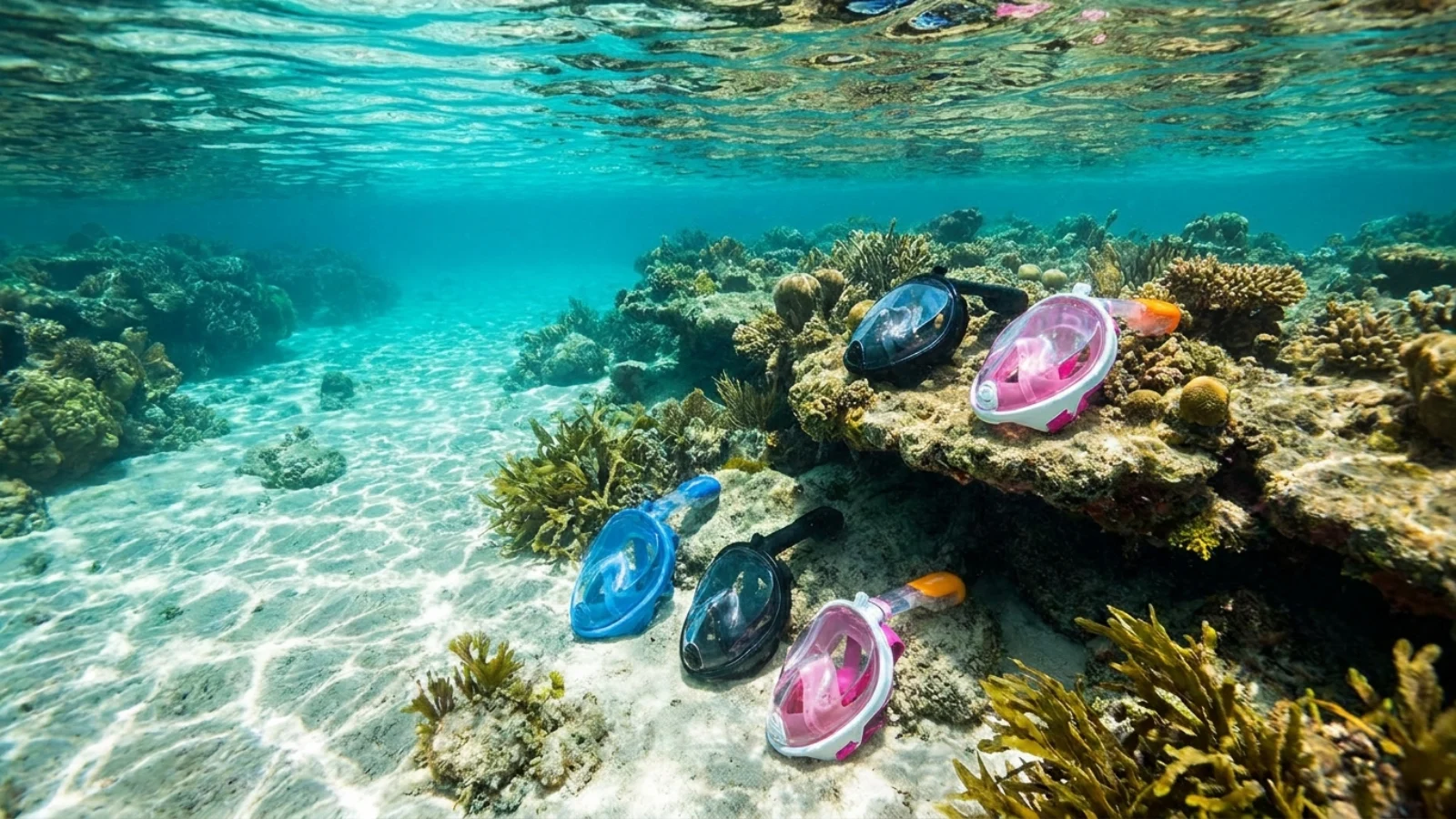
The idea of a full face mask is simple: a one-piece shell with a built-in snorkel on top, so you can breathe naturally through your nose and mouth. Fresh air should come down one channel and your exhaled air should leave by another, so you are not re-breathing your own carbon dioxide. When the valves and channels work, that is fine. When they leak, stick or let water in, you work harder to breathe and may inhale air with more CO2 than normal.
What did the Duke study find?
In 2022, a team including Duke researchers tested commercial full face masks on 10 volunteers. Two of the three design types did not function as advertised, and some designs got harder to breathe through when water entered the mask.
The paper, “Testing of full face snorkel masks to examine recreational snorkeler deaths” (Farrell, Natoli, Brown, Yook and Lance), was published in Undersea & Hyperbaric Medicine. The researchers monitored inspired and expired CO2 and oxygen, blood oxygen and airway pressure. They did not find that the masks delivered a dangerous gas supply in their tests, and they could not explain the Hawaii deaths conclusively. But the rise in breathing resistance with water intrusion, caused by a shared design feature, could raise respiratory distress in real-world use.
Why did the CPSC warn about full face snorkel masks?
On March 5, 2026, the CPSC told consumers to immediately stop using OUSPT full face snorkel masks, about 84,000 units sold on Amazon from March 2019 to February 2026, because they can cause labored breathing and raise carbon dioxide levels.
The agency said the masks could lead to loss of consciousness, fluid in the lungs and drowning. It had five consumer reports of breathing difficulty, light-headedness or loss of consciousness, and noted a lawsuit alleging a drowning death that it had not confirmed. If you own a full face mask, check it against the CPSC notice.
How is a full face snorkel mask supposed to work?
A conventional snorkel is a simple tube: you breathe in and out through the same passage, and the air left in the tube at the end of each breath is breathed back in at the start of the next. That volume is called dead space, and a well-designed snorkel keeps it small. A full face mask tries to solve the dead-space problem with plumbing. Fresh air is meant to come down the top tube, flow across the inside of the visor, which also keeps it from fogging, and enter an inner pocket around the nose and mouth through one-way valves. Exhaled air is supposed to leave that pocket by a separate route, usually channels running up the sides of the mask, and exit at the top of the snorkel without mixing with the incoming air.
The design works only if every part does its job. The inner pocket has to seal around the nose and mouth, the small valves have to open and close on every breath, and the channels have to stay clear of water. If the inner pocket fits badly, exhaled air spills into the large space behind the visor and is breathed again, so the volume of stale air the wearer has to clear can become many times that of an ordinary snorkel. If a valve sticks or water collects in a channel, the wearer has to suck harder on each breath. The breathing feels easy when everything is working, which is exactly why a problem can go unnoticed until the wearer is already short of breath.
Why are young children especially at risk?
A small child takes much smaller breaths than an adult, so the same amount of dead space is a much bigger share of each breath. A 2025 case series from a children’s hospital in Trieste, Italy, published in the journal Children, described three children under six who were brought to the emergency department after incidents while wearing full face masks. Two had non-fatal drownings, and one had a cardiac arrest caused by drowning; all three incidents happened during short submersions. The authors argued that when used by young children, these masks may have a mechanical dead space larger than the child’s tidal volume, the amount of air moved in a normal breath. In that situation the child would rebreathe much of their own carbon dioxide, and the resulting rise in carbon dioxide and fall in oxygen could cause dizziness, confusion and loss of consciousness.
Three cases cannot show how common the problem is, and the paper does not prove that every child-size mask is unsafe. It does show a plausible mechanism and a real pattern of harm, and it adds to the case for keeping small children in a properly fitted traditional mask, a short snorkel and a flotation vest, with an adult within arm’s reach.
What did Hawaii’s snorkel safety research find?
Hawaii has the most detailed public discussion of snorkel deaths because it has so many of them. The state Department of Health launched a Snorkel Safety Study in 2019 after an unexplained rise in snorkeling deaths: according to figures reported by the diving newsletter Undercurrent, snorkel-related drownings among visitors rose from 82 in 2010–2014 to 114 in 2015–2019. One strand of that work was a voluntary survey of people who had got into trouble while snorkeling and survived. Of 131 respondents, 37% were wearing full-face gear at the time, a share that is striking but cannot be turned into a risk estimate, because nobody knows what proportion of all snorkelers wear these masks.
The clinical side of the research was published in 2022 in the Hawaii Journal of Health and Social Welfare by Philip Foti, Christie Wilcox and Ronald Goto, using snorkel airway-resistance measurements, medical examiner case reports and survivor surveys. It identified two mechanisms that needed further study: accidentally inhaling water, and hypoxia from acute negative-pressure pulmonary edema, in which straining to breathe against resistance draws fluid into the lungs. That second mechanism explains why breathing resistance from any snorkel, including a full face mask with a faulty valve, is taken seriously. The research also changed practice at drowning scenes. After Nancy Peacock died in Hawaii in 2016 while wearing a full face mask bought online, her husband campaigned for investigators to collect and examine snorkel equipment, and in her case the mask went missing before it could be tested.
What did the CPSC warning actually do?
The March 2026 notice from the U.S. Consumer Product Safety Commission was a product safety warning, not a recall. A recall is normally agreed with the company that sells a product, and it usually comes with a refund or replacement. In this case, CPSC said the seller had not responded to its requests for information or to its request to recall the masks, so the agency used its power to warn the public directly. It urged owners to stop using the OUSPT masks and dispose of them immediately, and told them not to sell or give them away.
The warning applies only to the OUSPT product, about 84,000 units sold on Amazon.com from March 2019 to February 2026. It does not say that other brands are safe, and it does not say that they are unsafe. Many full face masks sold online look almost identical, sometimes under several brand names, so a mask without clear branding, model information or a traceable manufacturer is hard to check against any warning. Owners who cannot identify who made their mask have good reason to replace it.
What else drives snorkeling deaths?
Masks are only one factor, and research from Australia, where snorkeling deaths have been studied for decades, shows how much the snorkeler’s own health matters. A review by John Lippmann of the Australasian Diving Safety Foundation, published in 2025, analysed 317 snorkeling and breath-hold diving deaths in Australia from 2000 to 2021. The median age of victims was 48, about two-thirds were overweight or obese, and almost half had health conditions, including ischaemic heart disease and thickening of the heart muscle, that made them prone to an abnormal heart rhythm in the water. About a third were likely disabled by cardiac arrhythmias, and at least 137 died from primary drowning. An earlier analysis of the 2014–2018 deaths found that about two-thirds of victims were inexperienced snorkelers and that 64 of 91 were alone.
Those findings point to the same precautions in Hawaii, Australia or anywhere else. Older snorkelers and anyone with heart or lung disease face the greatest risk, and should be cautious about exertion, currents and long swims. Snorkeling with a partner who is watching, rather than merely nearby, matters more than any choice of equipment. A mask that adds breathing resistance, hides the face from a buddy, or takes time to remove simply stacks one more risk on top of these.
Why were snorkel masks turned into medical equipment in 2020?
Early in the COVID-19 pandemic, hospitals short of protective equipment began adapting full face snorkel masks into improvised respirators, fitting 3D-printed adapters that let medical filters replace the snorkel tube. Several teams tested the idea. One study, published in A&A Practice in 2020, fitted a full face snorkel mask with a breathing-circuit filter and found it passed the U.S. Occupational Safety and Health Administration fit test for N95 respirators, with a fit factor of 142. The team also measured heart rate, oxygen saturation and exhaled and inspired carbon dioxide at rest and during moderate exercise, and found neither a dangerous build-up of carbon dioxide nor low blood oxygen.
That might seem to contradict the safety concerns, but the conditions were very different. The modified masks were used on dry land, with a filter in place of the snorkel, by adults who were not swimming. The results suggest that the basic face-seal design can deliver adequate gas exchange when it seals well and stays dry. They say nothing about what happens when water enters a channel, a valve sticks, a child wears an adult design or a tired swimmer starts to breathe hard in the open sea.
How can you check a full face mask before using it in open water?
Anyone who decides to use one can reduce the risk with a few checks in a pool or calm shallow water. Put the mask on and look for the inner nose-and-mouth pocket: if there is none, or it does not touch your face all around, exhaled air will mix with the air you breathe next. Breathe slowly with your face in the water for several minutes while standing in water shallow enough to stand in, and notice whether each breath becomes harder, whether the visor fogs, or whether you start to feel light-headed or develop a headache, which can be early signs of carbon dioxide build-up. Then practise taking the mask off quickly with one hand, as you would have to in an emergency.
If any of those checks fails, the mask is not suitable for open water. If it passes, use it only on the surface in calm water, never for diving down, and swim with a partner who knows how it comes off. Replace masks whose valves are cracked or whose silicone has hardened, because a valve that no longer seats properly will let exhaled air back into the breathing space.
What should you use instead?
For most people the answer is an ordinary low-volume mask with a soft silicone skirt and a separate snorkel, ideally a semi-dry design with a splash guard on top and a purge valve near the mouthpiece. That combination keeps dead space low, lets you breathe in fresh air simply by lifting your face or spitting out the mouthpiece, and allows you to pinch your nose to equalise if you want to look at something a few feet down. Many people who choose a full face mask do so because they find a mouthpiece uncomfortable or feel anxious with their face in the water. Both problems usually improve with a short practice session in a pool or a calm, waist-deep lagoon, which is also the best place to learn to clear water from a snorkel without panic.
Are full face masks to blame for Hawaii’s snorkel deaths?
Not on current evidence. Hawaii’s research points to rapid-onset pulmonary edema as a likely factor in many snorkel deaths, and breathing resistance from any snorkel is one suspected trigger, along with exertion and existing heart problems.
The Hawaii Department of Health’s review of non-resident ocean drownings for 2019 to 2023 counted about 45 visitor deaths a year, and snorkeling was the activity in 87 of the 202 cases analysed, more than any other. The review does not attribute those deaths to any one type of equipment, and health officials say more research is needed. The lesson for any snorkeler is the same: choose gear that is easy to breathe through, do not over-exert, and if you feel breathless, lift your head and remove the mask.
| Traditional mask + snorkel | Full face mask | |
|---|---|---|
| — | — | — |
| Breathing | Mouth only; low resistance with a wide tube | Nose and mouth; resistance rises if valves fail or water enters |
| Clearing water | Blow out the snorkel | Must lift or remove the mask |
| Diving down | Pinch nose to equalise | Not possible beyond a few feet |
| Getting fresh air | Spit out the snorkel | Pull the whole mask off |
| Tour boats in Hawaii | Accepted everywhere | Often banned |
No full face mask has been shown to be safer than a well-fitted low-volume mask and a semi-dry snorkel, and the traditional set takes only a short practice session to get used to. Our snorkel gear guide shows how to fit them, and snorkeling for beginners covers breathing through a snorkel calmly.
One weird mask fact
In a full face mask your nose sits inside the breathing space, so you cannot pinch it to equalise. That alone limits you to the top few feet of water.- Farrell J, Natoli MJ, Brown GJ, Yook A, Lance RM, “Testing of full face snorkel masks to examine recreational snorkeler deaths,” Undersea & Hyperbaric Medicine 49(1):29–42, 2022; U.S. Consumer Product Safety Commission warning on OUSPT full face snorkel masks, March 5, 2026; Suncoast Searchlight fact brief on full face masks
- Hawaii Department of Health, EMSIPSB: non-resident ocean drownings 2019–2023; Foti PR, Wilcox CM, Goto RS. Factors contributing to snorkel drowning in Hawaiʻi. Hawaiʻi Journal of Health & Social Welfare, 2022
- Undercurrent: OUSPT full face snorkel mask warning and Hawaii Snorkel Safety Study (April 2026)
- Trapani L et al. Full-face snorkeling masks carry a risk of hypercapnia and drowning in younger children: a case series. Children (Basel), 2025
- Lippmann J. Snorkelling and breath-hold diving fatalities in Australia: a review of 317 deaths. IJERPH, 2025; Lippmann J. Diving and Hyperbaric Medicine, 2023
- Kechli MK, Lerman J, Ross MM. Modifying a full-face snorkel mask to meet N95 respirator standards. A&A Practice, 2020
Are full face snorkel masks safe?
Not proven to be. A 2022 lab study found two of three design types did not work as advertised, and the CPSC warned against one popular model in 2026. A traditional mask and snorkel is the safer choice.
Why are full face snorkel masks banned in Hawaii?
They are not banned by law, but many tour operators and rental shops refuse them because of concerns about breathing resistance and difficulty removing them in an emergency.
Can you get CO2 poisoning from a full face snorkel mask?
If the mask’s valves or air channels fail, exhaled CO2 can build up in the space you breathe from. The CPSC cited higher carbon dioxide levels in its 2026 warning.
Have any full face snorkel masks been recalled?
The March 2026 CPSC notice on about 84,000 OUSPT masks sold on Amazon between March 2019 and February 2026 was a safety warning, not a recall: the seller did not respond to CPSC, so the agency told owners to stop using and dispose of them.
Can you dive underwater with a full face snorkel mask?
Only a few feet. You cannot pinch your nose to equalise, so pressure on your ears limits how deep you can go.
Are full face masks good for kids?
They are often sold for children, but a child in difficulty cannot quickly spit out a snorkel. A properly fitted kids’ mask, snorkel and vest is safer.
Are full face snorkel masks better for beginners?
They feel easier at first, but beginners are the group most likely to panic if breathing becomes hard. Learn on a traditional mask in shallow water.
Blane Perun has been exploring Earth’s oceans and marine life for over 25 years. Founder of TheSea.Org in 1999, underwater photographer, coral aquaculture pioneer, and explorer of 80+ countries.
About Blane Perun → All snorkeling destinations →