Sleeper Shark — The Slow Giants of the Cold Deep
Sleeper sharks are large, slow-moving dogfish sharks of the family Somniosidae that live in cold, deep water. The best known after the Greenland shark is the Pacific sleeper shark (Somniosus pacificus), confirmed at 4.65 m and up to 888 kg, with individuals of about 7 m filmed in deep water. It lives from the intertidal zone to below 2,000 m in the North Pacific, eats octopus, squid and fish, scavenges whale carcasses, and is listed as Near Threatened.
Pacific Sleeper Shark
What are sleeper sharks?
“Sleeper shark” is the common name for the family Somniosidae, and especially the genus Somniosus: big, heavy, slow sharks with small fins, small eyes and no anal fin, adapted to cold water and a low-energy life.
There are five Somniosus species: the Greenland shark of the Arctic and North Atlantic, the Pacific sleeper shark of the North Pacific, the southern sleeper shark of the Southern Hemisphere, and the smaller little sleeper shark and Taiwan sleeper shark. The wider family also includes smaller deep-water species such as the velvet dogfish and the Portuguese dogfish. The name comes from their sluggish appearance and slow, deliberate swimming. They are not actually asleep: they conserve energy in cold, food-poor water and rely on short bursts of acceleration to catch prey.
In January 2025, researchers filming in the Southern Ocean recorded a sleeper shark, likely the southern sleeper shark, off the South Shetland Islands, the first shark ever recorded in Antarctic waters, which shows how little is known about where these sharks go.
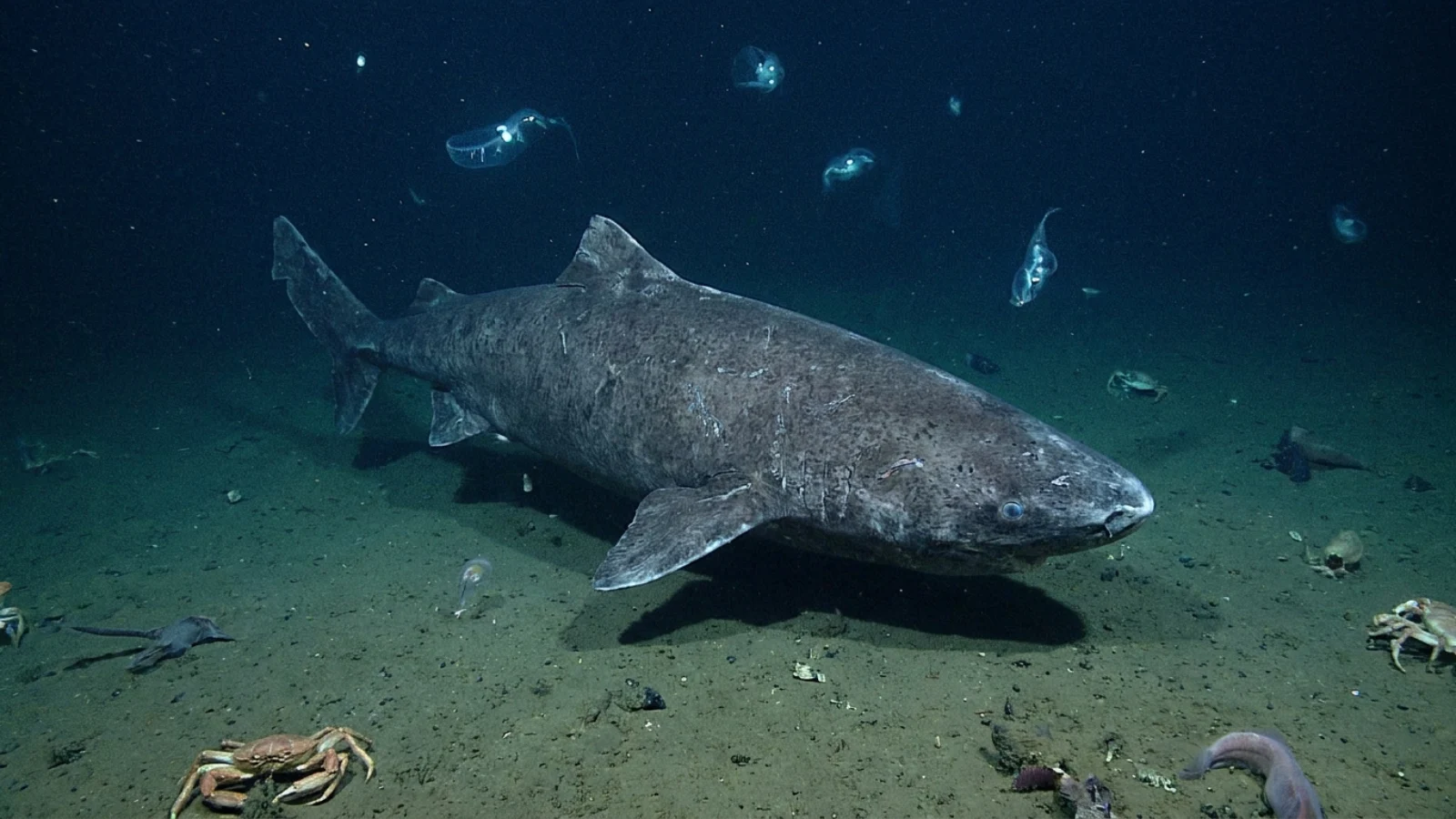
How big do Pacific sleeper sharks get?
The largest confirmed Pacific sleeper shark measured 4.65 m, and a 4.4 m individual weighed 888 kg. Sharks estimated at about 7 m have been filmed in deep water, and there are unconfirmed reports of 9 m.
Adult females mature at about 3.7 m, which makes the Pacific sleeper shark one of the largest sharks in the world, comparable to the great white. A large individual filmed in deep water off Tokyo Bay in 1989 was estimated at about 7 m. The body is thick and cylindrical, dark grey to brown, with two small dorsal fins of similar size, no fin spines, a short rounded snout and small eyes. The upper teeth are narrow spikes and the lower teeth broad, interlocking blades, a cutting arrangement for slicing chunks from large prey or carcasses, the same as in the Greenland shark.
Where do sleeper sharks live?
The Pacific sleeper shark ranges across the North Pacific from Japan and Russia through the Bering Sea and Alaska to Mexico, on continental shelves and slopes from the shallows to at least 2,000 m.
Tracked sharks have ranged from about 106 m to 1,323 m but spent more than 99% of their time at 200–600 m. In the far north, where surface water is cold, they come right into the shallows, and one was found trapped in a tide pool. Farther south they stay deep: submersibles have filmed them at about 1,220 m off Japan and 1,920 m off O‘ahu, Hawaii, in water around 4°C. A 2024 review led by NOAA’s Beth Matta also compiled records from as far afield as Palau and the Solomon Islands, though those deep tropical records may involve related species.
What do sleeper sharks eat?
Pacific sleeper sharks eat octopus, squid, bottom fish, crabs and snails, and larger sharks also eat seals, dolphins and whale meat, much of it scavenged from carcasses on the seafloor.
In the Gulf of Alaska, 73% of stomachs examined held remains of the giant Pacific octopus. Off California a sleeper shark was found full of large squid, and off Patagonia a 4.2 m shark had eaten Patagonian toothfish. One 3.7 m female from California had 136 kg of food in its stomach, which shows how much these sharks can eat when they find food. Pacific sleeper sharks have an excellent sense of smell and gather at whale falls: in 1998 a shark of about 5 m was filmed feeding on a whale carcass at around 1,740 m. Researchers once suspected they hunted Steller sea lions in Alaska, but a later diet study found little evidence of it; most marine-mammal tissue in their stomachs appears to have been scavenged.
How do sleeper sharks reproduce?
Very little is known. Sleeper sharks are thought to be ovoviviparous, with eggs hatching inside the mother. Females can carry around 300 large eggs, but how many pups are born is unknown.
Newborn Pacific sleeper sharks have been estimated at about 38–42 cm long. Gestation may last two years or more. Growth is slow: a 4.3 m female caught in the Aleutian Islands was estimated by eye-lens radiocarbon dating to be about 35 years old and was still not mature. That points to late maturity and a long life, though nothing like the centuries estimated for the Greenland shark has been confirmed.
Are sleeper sharks dangerous?
No. Sleeper sharks live in deep, cold water that people rarely enter, and there are no recorded bites on humans.
Almost all encounters with sleeper sharks happen through deep-sea cameras, research submersibles and fishing gear. They are commonly caught as bycatch on bottom longlines and in trawls for halibut, sablefish and pollock in Alaska.
Are sleeper sharks endangered?
The IUCN moved the Pacific sleeper shark from Data Deficient to Near Threatened in 2021, citing fishing pressure and regional declines. The southern and little sleeper sharks are also poorly known.
Because they mature late and probably live a long time, sleeper sharks cannot replace losses quickly. Bycatch in North Pacific groundfish fisheries is the main threat, and catch rates in some Alaskan surveys have fallen. Like the Greenland shark, they are a reminder that even huge deep-sea animals can be vulnerable to fisheries that rarely target them directly.
How does the sleeper shark compare with other sharks?
The Pacific sleeper shark is the Pacific counterpart of the Greenland shark and one of the largest sharks of any kind, similar in length to a great white.
It belongs to the dogfish order, Squaliformes, with the spiny dogfish, the cookiecutter and the lantern sharks. For another ancient deep-sea giant, see the sixgill shark; for the biggest sharks overall, see our ranking of the biggest sharks in the world.
| Species | Max length | Max weight | Unprov. bites (ISAF) | Lifespan | IUCN |
|---|---|---|---|---|---|
| Pacific sleeper shark | 4.65 m confirmed (~7 m filmed) | 888 kg | 0 | Long; 35 yrs at 4.3 m | NT |
| Greenland shark | 6.4–7.3 m | ~1,000+ kg | 0 | 272–512 yrs (est.) | VU |
| Great white shark | 6.0 m | 2,300 kg | 351 | 70 yrs | VU |
| Basking shark | 10–12 m | ~5,000 kg | 0 | ~50 yrs | EN |
| Spiny dogfish | 1.6 m | 9 kg | 0 | 70–100 yrs | VU |
| Tiger shark | 5.5 m | 900 kg | 142 | 27–50 yrs | NT |
Bite counts: Florida Museum International Shark Attack File, species-implicated table (1580–2022). * Genus-level total. IUCN: LC Least Concern, NT Near Threatened, VU Vulnerable, EN Endangered, CR Critically Endangered, DD Data Deficient.
What is a sleeper shark?
A large, slow-moving dogfish shark of the family Somniosidae, adapted to cold, deep water. The five Somniosus species include the Greenland shark and the Pacific sleeper shark.
How big do Pacific sleeper sharks get?
The largest confirmed was 4.65 m, and a 4.4 m shark weighed 888 kg. Individuals of about 7 m have been filmed in deep water.
Are sleeper sharks dangerous?
No. They live in deep, cold water and there are no recorded bites on people.
What do sleeper sharks eat?
Octopus, squid, bottom fish, crabs and snails, plus whale and seal meat that is mostly scavenged from carcasses.
How deep do sleeper sharks live?
From the intertidal zone in the far north to below 2,000 m, but tracked sharks spent over 99% of their time at 200–600 m.
Is the Pacific sleeper shark related to the Greenland shark?
Yes. Both are in the genus Somniosus and look very similar; the Pacific sleeper shark replaces the Greenland shark in the North Pacific.
How long do sleeper sharks live?
Unknown, but a 4.3 m female was aged at about 35 years and was still immature, suggesting a long lifespan.
Are sleeper sharks endangered?
The Pacific sleeper shark is Near Threatened (IUCN 2021) because of bycatch in North Pacific fisheries.
Blane Perun has been exploring Earth’s oceans and marine life for over 25 years. Founder of TheSea.Org in 1999, underwater photographer, coral aquaculture pioneer, and explorer of 80+ countries.
About Blane Perun → All Shark Species A–Z →