Cookiecutter Shark — The Glowing Shark That Takes Bites Out of Whales
The cookiecutter shark (Isistius brasiliensis) is a small, cigar-shaped dogfish shark, no longer than 56 cm (22 in), that feeds by latching onto much larger animals and twisting out a round plug of flesh about 5 cm across. It lives in tropical and warm oceans worldwide, spends the day as deep as 3.7 km, rises to the surface at night, and glows green from thousands of tiny light organs on its belly.
Cookiecutter Shark
How does a cookiecutter shark bite?
A cookiecutter shark seals its lips onto the skin of its victim like a suction cup, drives in its saw-like lower teeth, then spins its body to carve out a neat, round plug of flesh. The wound left behind looks as if someone used a cookie cutter.
The jaws are built for this one job. The upper jaw carries 30–37 small, narrow teeth that act as anchors. The lower jaw carries 25–31 large, triangular, interlocking teeth that form a single continuous cutting edge, proportionally among the largest teeth of any shark. Once the lips are sealed and the upper teeth hooked in, the shark rotates around its own axis and the lower teeth slice a cone of tissue free. The crater wounds average about 5 cm across and 7 cm deep.
The lower teeth are shed and replaced as a complete row rather than one at a time. A young shark growing from 14 cm to 50 cm goes through about 15 sets, or 435–465 teeth, and it swallows the old rows, probably to recycle the calcium. Its large, oily liver, up to about 35% of body weight, keeps it close to neutrally buoyant, so it can hover in the water column while it waits for a target.
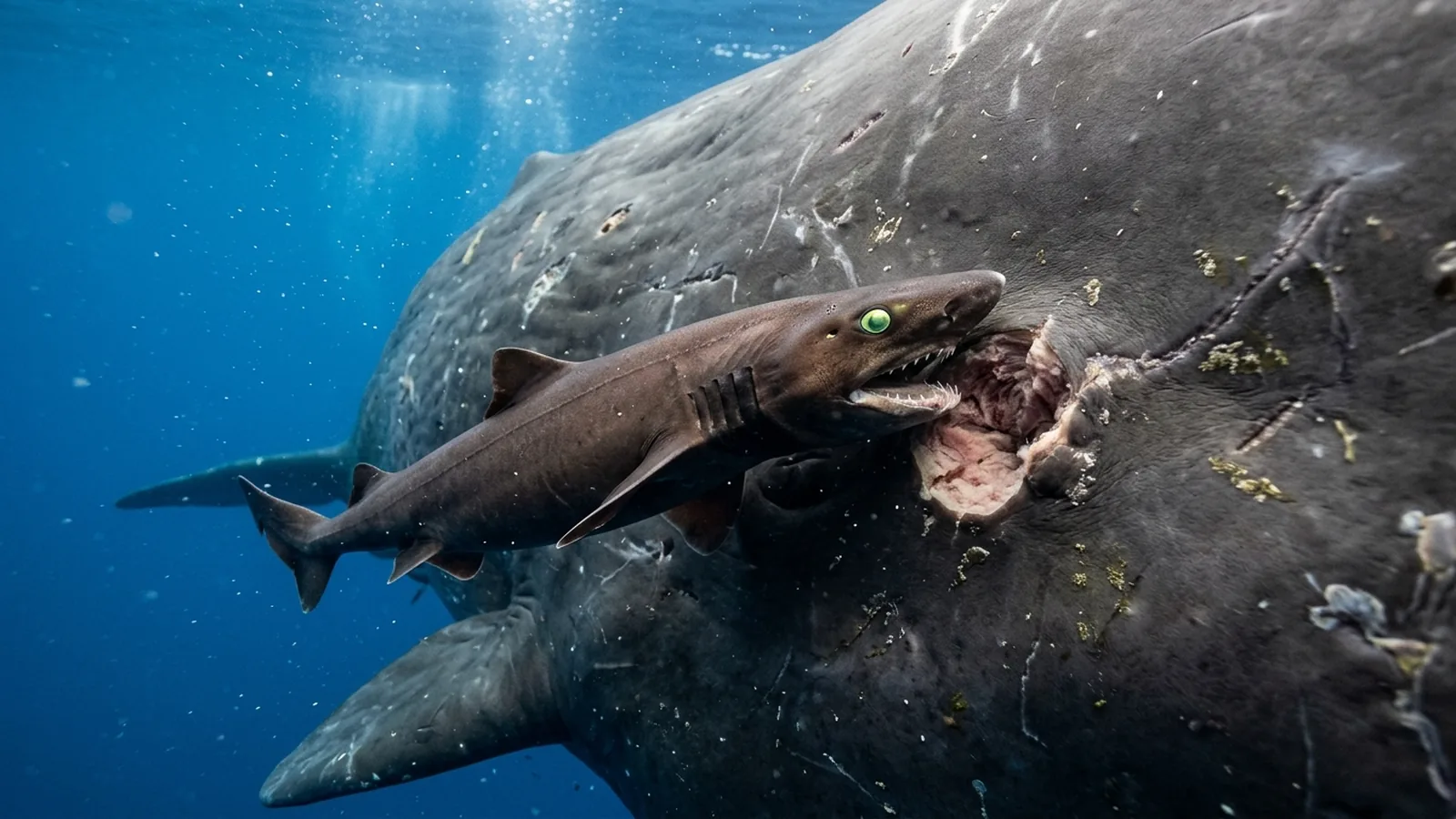
What animals do cookiecutter sharks bite?
Almost anything big and warm-water: whales, dolphins, seals, tuna, swordfish, marlin, wahoo, stingrays and other sharks, including great whites. It also eats whole squid.
Cookiecutter scars are so common that marine mammal researchers use them as a natural marker. Off Hawaii nearly every adult spinner dolphin carries the oval white scars of old cookiecutter bites, and the round pits show up on sperm whales, beaked whales, blue whales, elephant seals and great white sharks. Tuna and swordfish landed in the tropics often have fresh crater wounds, which reduces their market value. Not all of its food is stolen in plugs, though: cookiecutters also eat squid with mantles of 15–30 cm whole, along with crustaceans and small fish.
Why does the cookiecutter shark glow?
The cookiecutter’s belly is covered in tiny photophores that give off a greenish light, a camouflage trick called counter-illumination. A dark band around the throat stays unlit, and that collar may be the lure.
Seen from below in the open ocean, any animal is a dark silhouette against the faint light from the surface. By glowing on its underside, the cookiecutter matches that background light and erases its own outline. The exception is a dark collar around the throat and gill region. Bioluminescence researcher Edith Widder proposed that this collar, seen from below, looks like the silhouette of a small fish. A tuna or dolphin moving in to catch it gets close enough for the shark to strike. If that is right, the cookiecutter is one of the very few predators that uses a lure made of shadow rather than light. The photophores are too small to see with the naked eye, and the glow has been reported to last about three hours after the shark is taken from the water. For more on how deep-sea animals make light, see our guide to bioluminescent drifters.
Where do cookiecutter sharks live?
Cookiecutters live in tropical and warm-temperate oceans around the world, mostly between 20°N and 20°S in water of 18–26°C, and are often found near oceanic islands.
By day the species lives at depths of 1–3.7 km, and at night it rises to within about 85 m of the surface, a daily vertical migration of up to 3 km each way, one of the longest of any animal. That nightly rise follows the mass of squid, lanternfish and other deep-sea animals that move toward the surface after dark, and it brings the shark into the zone where tuna and dolphins hunt. Fresh wounds on marine mammals suggest it may reach as far north as California in warm years.
Do cookiecutter sharks bite humans?
Rarely, but yes. Almost every confirmed human bite has involved long-distance swimmers crossing deep channels at night, mostly in Hawaii. The ISAF lists 5 unprovoked bites and no deaths.
The first well-documented live bite was on swimmer Mike Spalding during a night crossing off Maui in March 2009. In 2019 three swimmers attempting the Kaiwi (Molokai) Channel between Oahu and Molokai were bitten in separate crossings, two of them while wearing electrical shark deterrents, and further bites followed off Kona in 2022 and in the Molokai Channel in 2023. In 2017 a seven-year-old boy was bitten while swimming at dusk in Alma Bay, Queensland. Bodies recovered from the sea have also shown post-mortem cookiecutter bites. For channel swimmers, the practical advice is to avoid swimming in deep water at night without protection.
How did cookiecutter sharks damage submarines?
In the 1970s several US Navy submarines came back to port with round holes bitten in the rubber boots of their sonar domes. The culprit turned out to be the cookiecutter shark.
The damage was serious enough to let oil leak from the sonar domes and compromise sound transmission. In the 1980s about 30 US Navy submarines had electrical cable sheaths bitten, and the fix was to cover vulnerable parts in fibreglass. Cookiecutters have also bitten undersea telecommunications cables and oceanographic instruments. Stewart Springer, who helped popularise the name “cookiecutter,” originally called them “demon whale-biters.”
How do cookiecutter sharks reproduce?
Cookiecutter sharks are aplacental viviparous: the embryos develop on yolk inside the mother’s two uteri and are born live in litters of 6 to 12.
Pups are born at about 14–15 cm. Males mature at about 36 cm and females at roughly 39–41 cm, and females grow larger, to 56 cm against 42 cm for males. Little is known about growth rates, lifespan or where pupping takes place. Because the species has no commercial value, is widespread and is rarely caught, the IUCN lists it as Least Concern.
How does the cookiecutter compare with other sharks?
The cookiecutter is one of the smallest sharks covered on TheSea.Org and the only one that routinely feeds on animals hundreds of times its size.
It belongs to the dogfish order, Squaliformes, alongside the spiny dogfish, the glowing lantern sharks and the giant Greenland shark. A close relative, the largetooth cookiecutter (Isistius plutodus), has even larger lower teeth relative to its size.
| Species | Max length | Max weight | Unprov. bites (ISAF) | Lifespan | IUCN |
|---|---|---|---|---|---|
| Cookiecutter shark | 0.56 m | n/a (small) | 5 | n/a | LC |
| Spiny dogfish | 1.6 m | 9 kg | 0 | 70–100 yrs | VU |
| Blue shark | 3.8 m | 206 kg | 13 | 20 yrs | NT |
| Great white shark | 6.0 m | 2,300 kg | 351 | 70 yrs | VU |
| Whale shark | 18.8 m | 19,000 kg | 0 | 80–130 yrs | EN |
Bite counts: Florida Museum International Shark Attack File, species-implicated table (1580–2022). * Genus-level total. IUCN: LC Least Concern, NT Near Threatened, VU Vulnerable, EN Endangered, CR Critically Endangered, DD Data Deficient.
The cookiecutter is one of more than 50 sharks that make their own light; see bioluminescent sharks for how and why they glow.
How big is a cookiecutter shark?
Very small: females reach about 56 cm (22 in) and males about 42 cm (16.5 in). Pups are born at 14–15 cm.
Do cookiecutter sharks attack humans?
Rarely. The ISAF lists 5 unprovoked bites, most of them on long-distance swimmers crossing deep Hawaiian channels at night. None were fatal.
How does a cookiecutter shark eat?
It seals its lips onto a larger animal, hooks in with its upper teeth, then spins so its large lower teeth cut out a round plug of flesh about 5 cm wide. It also eats squid whole.
Why do cookiecutter sharks glow?
Tiny photophores on the belly produce a greenish light that hides the shark’s silhouette from below. An unlit dark collar may act as a lure that looks like a small fish to predators.
Did cookiecutter sharks really bite submarines?
Yes. US Navy submarines in the 1970s had round bites in the rubber covers of their sonar domes, and about 30 submarines had cable sheaths bitten in the 1980s.
Where do cookiecutter sharks live?
In tropical and warm-temperate oceans worldwide, mostly between 20°N and 20°S, often near oceanic islands such as Hawaii. They live up to 3.7 km deep by day and rise to the surface at night.
Are cookiecutter sharks endangered?
No. The IUCN lists the species as Least Concern because it is widespread and has no commercial fishery.
Can a cookiecutter shark kill a whale?
No. The bites are painful and leave permanent scars, but they are far too small to kill a whale, dolphin or large fish.
Blane Perun has been exploring Earth’s oceans and marine life for over 25 years. Founder of TheSea.Org in 1999, underwater photographer, coral aquaculture pioneer, and explorer of 80+ countries.
About Blane Perun → All Shark Species A–Z →