Porbeagle Shark — The Warm-Bodied Mackerel Shark of Cold Seas
The porbeagle (Lamna nasus) is a stocky, warm-bodied mackerel shark of the cold North Atlantic and the Southern Hemisphere, a close relative of the salmon shark and great white. Adults typically measure 1.5–2.5 m, reaching about 3 m and 230 kg. It keeps its body 7–10°C warmer than the sea, hunts mackerel, herring and squid, and is famous for playful behaviour at the surface. Decades of overfishing have made it Vulnerable globally.
Porbeagle Shark
How do you identify a porbeagle shark?
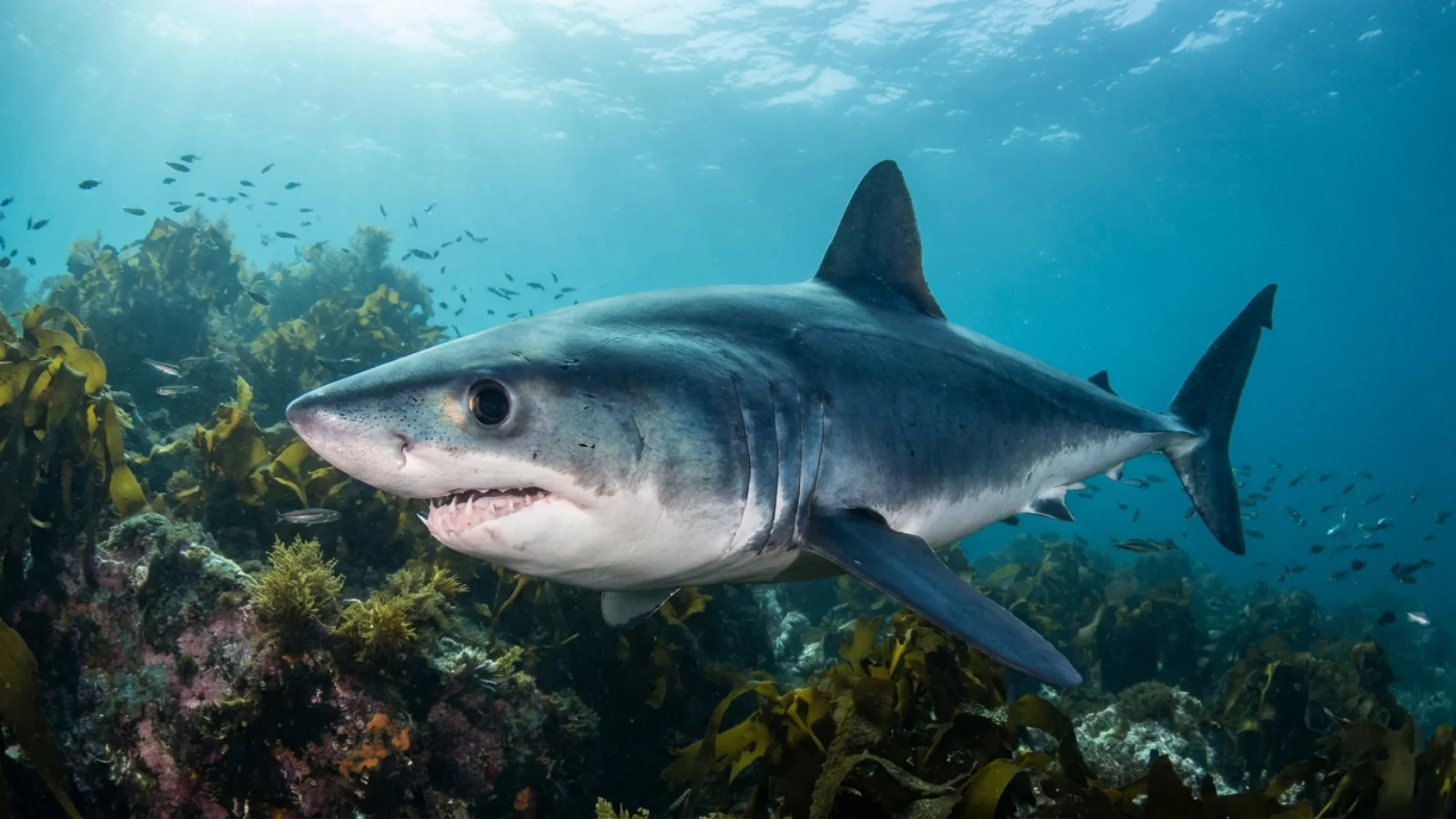
A porbeagle is a heavy, spindle-shaped shark with a pointed conical snout, large black eyes, a crescent tail with two keels on each side of the base, and a distinctive white patch at the rear of the first dorsal fin.
At a glance a porbeagle looks like a small great white or a stocky mako. The best field marks are the free rear tip of the first dorsal fin, which is white or pale grey, and the small secondary keel below the main keel on the tail base; makos and whites have only one keel. The back is dark blue-grey and the belly white, without the dark blotches of its Pacific twin, the salmon shark. The teeth are smooth-edged blades with small side cusps, built for gripping fish. Adults usually measure 1.5–2.5 m, with confirmed maximums around 3 m and reports of up to 3.7 m and 230 kg.
How does a porbeagle stay warm?
The porbeagle is one of the few “warm-bodied” sharks. Heat-exchanging blood vessels in its muscles, eyes and brain keep its body about 7–10°C warmer than the surrounding water.
Like the great white, makos and salmon shark, the porbeagle has retia mirabilia, counter-current networks of arteries and veins that keep the heat produced by its swimming muscles inside the body. Warm muscles give it speed and stamina, and a warm brain and eyes help it hunt in cold, dim water. Porbeagles have been caught in water as cold as about 1–2°C and generally avoid water warmer than 18°C, which is why they are found at high latitudes and why they are absent from the tropics.
Where do porbeagle sharks live?
Porbeagles live in two separate bands of cool water: the North Atlantic and Mediterranean in the north, and a circumpolar band of the Southern Hemisphere around South America, southern Africa, Australia and New Zealand. They are absent from the North Pacific, where the salmon shark takes their place.
In the North Atlantic, porbeagles range from Newfoundland, the Gulf of Maine and Nova Scotia to Iceland, Norway, the British Isles, the Bay of Biscay and the Mediterranean. They are found over continental shelves and in the open ocean, mostly in the upper 200 m, but tagged sharks have dived to about 715 m. Porbeagles are strong migrants, moving 1,000–2,000 km between seasonal feeding grounds, and populations segregate by size and sex.
Do porbeagles really play?
Porbeagles are one of the few sharks reported to play. Off Cornwall, they have been seen rolling at the surface, wrapping themselves in kelp, and repeatedly nudging and biting floats.
Anglers and naturalists in the southwest of England have described porbeagles rolling and twisting in floating kelp fronds, sometimes while being chased by other porbeagles, and repeatedly prodding and biting balloon floats on fishing lines, shaking their heads when the float pops. Whether this is true play, curiosity, or some kind of feeding or social behaviour is hard to prove, but it is one of the most frequently cited examples of possible play in fish. For a broader look at shark behaviour, see all about sharks.
What do porbeagles eat?
Porbeagles eat mostly fish and squid: mackerel, herring, pilchards, cod, hake and other schooling and bottom fish, plus small sharks such as spiny dogfish.
They hunt both in midwater and near the bottom, and stomach contents have included flounder, John Dory, whelks, sea urchins and even stones. Their diet shifts with the seasons as they follow schools of mackerel and herring along the continental shelf. The name “mackerel shark” reflects how closely they track those fish. In the North Atlantic, porbeagles often hunt the same prey as Atlantic bluefin tuna, and they are caught in the same fisheries.
How do porbeagles reproduce?
Porbeagles are ovoviviparous with oophagy: embryos hatch inside the mother and feed on a supply of unfertilised eggs. Litters are very small, usually 4 pups.
Gestation lasts about 8–9 months, and pups are born at about 60–80 cm. Females mature late, at roughly 12–16 years and 2.0–2.5 m, and males at about 6–10 years. Estimates of maximum lifespan range from about 30 years to around 65 years in the northwest Atlantic. With only about four pups per litter and late maturity, a porbeagle population can increase by only a few percent a year at best.
Are porbeagle sharks dangerous?
Porbeagles are not considered dangerous to people. The ISAF lists 2 unprovoked bites and no fatalities, and they rarely come close to swimmers.
Most porbeagle interactions involve anglers. They are a strong-fighting game fish in the UK and Ireland, where catch-and-release is now required, and they often investigate baits and floats near boats. Porbeagles are rarely seen by divers.
Why are porbeagles Vulnerable?
Porbeagles were fished to collapse. Directed fisheries, especially Norwegian and later Canadian and Faroese longline fleets, removed most of the North Atlantic population in the 20th century. The species is listed as Vulnerable globally.
In the 1960s, Norwegian fishers took about 4,100 tonnes a year off Newfoundland and Nova Scotia, mostly for the Italian market, and the fishery collapsed within a few years. Northeast Atlantic stocks were reduced to a small fraction of their former size. The EU banned targeted fishing for porbeagles in 2010, and the species was listed on CITES Appendix II in 2013. Since then, there are signs of recovery in the northeast Atlantic, and anglers have reported more porbeagles off the UK. Because of the porbeagle’s slow reproduction, though, recovery will take decades.
How does the porbeagle compare with other mackerel sharks?
The porbeagle is the cold-water Atlantic member of the family Lamnidae, alongside the great white, makos and salmon shark.
It is the Atlantic counterpart of the salmon shark, smaller and less powerful than the great white, and more cold-adapted than the shortfin mako or longfin mako.
| Species | Max length | Max weight | Unprov. bites (ISAF) | Lifespan | IUCN |
|---|---|---|---|---|---|
| Porbeagle shark | ~3 m+ (3.7 m reported) | 230 kg | 2 | 30–65 yrs (est.) | VU |
| Salmon shark | 3.0 m | 220 kg | 0 | ~20–25 yrs | LC |
| Great white shark | 6.0 m | 2,300 kg | 351 | 70 yrs | VU |
| Shortfin mako | 4.0 m | 570 kg | 10 | 30 yrs | EN |
| Common thresher | 5.7 m (confirmed) | 510 kg | 0 | 45–50 yrs (est.) | VU |
| Blue shark | 3.8 m | 206 kg | 13 | 20 yrs | NT |
Bite counts: Florida Museum International Shark Attack File, species-implicated table (1580–2022). * Genus-level total. IUCN: LC Least Concern, NT Near Threatened, VU Vulnerable, EN Endangered, CR Critically Endangered, DD Data Deficient.
Is a porbeagle a great white?
No, but they are close relatives. Both are mackerel sharks (family Lamnidae). Porbeagles are smaller, with a white patch on the rear of the dorsal fin and a second keel on the tail base.
Are porbeagle sharks dangerous?
They are not considered dangerous. The ISAF lists 2 unprovoked bites and no deaths.
How big do porbeagle sharks get?
Adults are usually 1.5–2.5 m. The largest reach about 3 m and 230 kg, with reports of up to 3.7 m.
Are porbeagles warm-blooded?
Partly. They keep their muscles, eyes and brain about 7–10°C warmer than the water using heat-exchanging blood vessels.
Where do porbeagle sharks live?
In the cool North Atlantic and Mediterranean, and in a band around the Southern Hemisphere. They are not found in the tropics or the North Pacific.
Are there porbeagle sharks in the UK?
Yes. Porbeagles are found around the British Isles, particularly off Cornwall, Wales, Scotland and Ireland, and UK anglers have reported more of them in recent years.
Are porbeagles endangered?
They are Vulnerable globally on the IUCN Red List after heavy overfishing, and listed on CITES Appendix II. The EU has banned targeted fishing since 2010.
Why is it called a porbeagle?
The name probably comes from the Cornish porbugel, combining “porpoise” and “beagle.”
Blane Perun has been exploring Earth’s oceans and marine life for over 25 years. Founder of TheSea.Org in 1999, underwater photographer, coral aquaculture pioneer, and explorer of 80+ countries.
About Blane Perun → All Shark Species A–Z →