Horn Shark — The Spiny Little Shark That Lays Screw-Shaped Eggs
The horn shark (Heterodontus francisci) is a small, harmless bullhead shark of California and Mexico, usually about 1 m long and no more than 1.2 m, with a blunt pig-like snout, ridges over the eyes, and a sharp spine in front of each dorsal fin. It hunts sea urchins, crabs and snails at night, crushing them with molar-like back teeth, and lays remarkable spiral, screw-shaped egg cases that the mother wedges into rock crevices.
Horn Shark
How do you identify a horn shark?
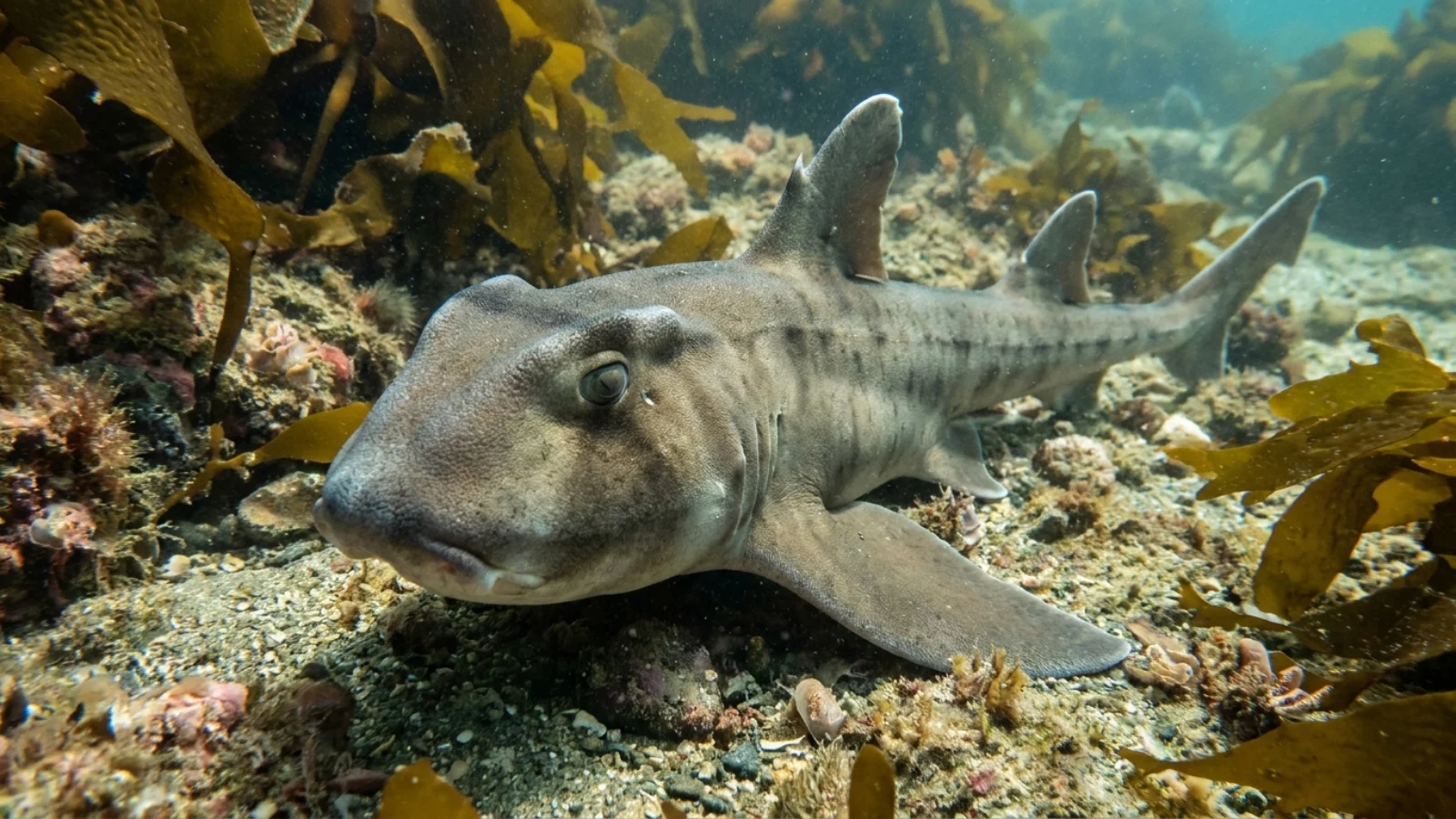
A horn shark has a short, blunt, pig-like head with high ridges above the eyes, a stout spine at the front of each of its two tall dorsal fins, and a grey-brown body sprinkled with small dark spots.
The “horns” are the two dorsal fin spines, which are thick and sharp. On reef-dwelling horn sharks they are often worn short by rubbing against rocks. The ridges over the eyes give the face a heavy-browed look, and the mouth sits under a short, rounded snout. Adults are usually about 1 m long, with a maximum of about 1.2 m. Horn sharks are bullhead sharks (order Heterodontiformes), a small, ancient group of nine species found in the Pacific and Indian Oceans that includes the Port Jackson shark of Australia. Bullhead sharks are often called living fossils because their body plan has changed little in tens of millions of years.
Heterodontus means “different teeth.” Horn sharks have small, pointed front teeth for gripping and broad, flat, molar-like back teeth for crushing shells. In the wild their average bite force has been measured at about 95 newtons, with a maximum of 135 N, and lost teeth are replaced in about four weeks.
Why do some horn sharks have purple teeth?
Horn sharks that eat a lot of purple sea urchins end up with purple-stained teeth and fin spines, coloured by pigments in the urchins.
About 95% of the adult diet consists of hard-shelled prey: sea urchins, crabs, snails, clams and other molluscs and crustaceans. Horn sharks also take small fish, squid and worms. They hunt at night, mainly by smell, and have unusually few electroreceptors for a shark, only about 148 ampullae of Lorenzini. On kelp-forest reefs in southern California where purple urchins are abundant, horn sharks can play a small part in keeping urchin numbers in check, alongside sea otters and California sheephead. For how otters fit into that story, see why sea otters are a keystone species.
What do horn shark eggs look like?
Horn shark eggs are dark brown, cone-shaped cases with two broad flanges that spiral around them like the thread of a screw. The mother picks each egg up in her mouth and screws it into a rock crevice.
Mating takes place in December or January. From February to April, a female lays up to 24 eggs, two at a time every 11–14 days, in water 2–13 m deep. Each case is about 10–12 cm long. In the wild she wedges the eggs into crevices, where the spiral shape locks them in place and protects them from being eaten or swept away; in aquariums, females often just drop them. The eggs take 6–10 months to hatch, producing pups of 15–17 cm that already have their dorsal spines. Snails sometimes drill into the cases to eat the yolk, and northern elephant seals eat both eggs and sharks. Beachcombers and divers in California sometimes find empty cases, which look a little like seaweed holdfasts or a broken drill bit.
Where do horn sharks live?
Horn sharks live along the Pacific coast of North America from Monterey Bay, California, to the Gulf of California, mostly on rocky reefs, kelp forests and sandy flats between 2 and 11 m.
By day horn sharks hide in caves, crevices and kelp holdfasts, often in the same spot day after day; at night they come out to hunt. They are strong homebodies: home ranges are only about 1,000 m², and individuals have been recorded in the same area for over a decade, with the longest documented movement just 16 km. In winter they move to water deeper than about 30 m, and juveniles favour sandy flats at 40–150 m. Divers at Catalina Island, the Channel Islands, La Jolla and the Monterey Peninsula regularly find them tucked under ledges. Our guide to scuba diving in San Diego covers the kelp forests where they are common.
Are horn sharks dangerous?
No. Horn sharks are slow, small and docile, with crushing teeth. The only risk is from their sharp dorsal spines if they are grabbed.
The spines are an effective defence against predators: a Pacific angel shark was once seen spitting out a young horn shark that had jammed its spines in its mouth. For people, the lesson is the same as with any wildlife: look, don’t grab.
Are horn sharks endangered?
No. The horn shark is listed as Least Concern by the IUCN. It is not targeted commercially in the United States, though it is caught as bycatch and used for food and fishmeal in Mexico.
Bycatch off California averages about 1,800 kg a year. In the past, some divers killed horn sharks to make jewellery from their fin spines. Its small home range means local populations can be affected by habitat damage, but much of its California range lies within marine protected areas.
How does the horn shark compare with other sharks?
The horn shark is one of the smallest and most harmless sharks on the California coast, sharing kelp forests with the leopard shark and the swell shark.
It shares rocky reefs and kelp beds with the leopard shark, and its crushing diet resembles that of the bonnethead. For other small egg-laying sharks, see the bamboo shark and epaulette shark.
| Species | Max length | Max weight | Unprov. bites (ISAF) | Lifespan | IUCN |
|---|---|---|---|---|---|
| Horn shark | 1.2 m | n/a | 0 | 12+ yrs (captive) | LC |
| Leopard shark | 1.9 m | ~18 kg avg | 1 | 20–30 yrs | LC |
| Brownbanded bamboo shark | 1.04 m | n/a (small) | 0 | 25 yrs (aquaria) | NT |
| Epaulette shark | 1.07 m | n/a (small) | 0 | n/a | LC |
| Angel shark | ~2.4 m | ~80 kg | 1* | n/a | CR |
Bite counts: Florida Museum International Shark Attack File, species-implicated table (1580–2022). * Genus-level total. IUCN: LC Least Concern, NT Near Threatened, VU Vulnerable, EN Endangered, CR Critically Endangered, DD Data Deficient.
Are horn sharks dangerous?
No. They are small and docile with crushing teeth. Their dorsal fin spines can cause painful wounds if the shark is grabbed.
How big do horn sharks get?
Usually about 1 m (3.3 ft), with a maximum of 1.2 m (3.9 ft).
Why are they called horn sharks?
For the sharp, horn-like spine at the front of each dorsal fin.
What do horn shark eggs look like?
Dark brown, cone-shaped cases about 10–12 cm long, with two flanges that spiral around them like a screw thread. Mothers wedge them into rock crevices.
Where do horn sharks live?
On rocky reefs, kelp forests and sand flats from Monterey Bay, California, to the Gulf of California, Mexico.
What do horn sharks eat?
Mostly sea urchins, crabs, snails and clams, which they crush with flat back teeth. Purple urchins can stain their teeth purple.
How long do horn sharks live?
More than 12 years in captivity, with an unconfirmed report of about 25 years.
Can you keep a horn shark in an aquarium?
They are kept in public aquariums and sometimes by advanced hobbyists, but they need large, cool-water systems. In California, collection is regulated.
Blane Perun has been exploring Earth’s oceans and marine life for over 25 years. Founder of TheSea.Org in 1999, underwater photographer, coral aquaculture pioneer, and explorer of 80+ countries.
About Blane Perun → All Shark Species A–Z →